

Copper-clad aluminum wire (CCA wire) is a bimetallic composite conductor with an electrical-grade aluminum core and an outer layer of oxygen-free copper. In industrial procurement scenarios, it is no longer synonymous with a “low-cost alternative”—especially in high-frequency applications above 5 MHz, photovoltaic busbars, lightweight transformers, high-frequency inductors, and 5G communication components, where CCA’s performance curve and cost structure are actually superior to pure copper. However, industrial grade CCA wire cannot be reliably supplied by just any trading company. The ASTM B566 standard has rigid indicators for appearance, copper content, metallurgical bonding strength, tensile strength, resistivity, and density; four technical routes—cladding welding, continuous extrusion, hydrostatic extrusion, and electroplating—determine the upper limit of the product’s application; and the quality control and price elasticity behind the four supply models—source manufacturers, trading companies, OEM manufacturers, and regional agents—differ greatly. This article doesn’t discuss “what is CCA,” nor does it repeat definitions from Baidu Encyclopedia. Instead, we present a practical methodology for evaluating the supply of industrial-grade CCA wires from the perspective of a procurement engineer: a comprehensive overview of standards, process route comparison, product classification, global supply channels, 8-dimensional source factory evaluation, procurement contract quality control, and application-driven supplier capability matching. After reading this, you will learn: how to determine if a supplier can provide a stable supply; how to write a procurement technical document that won’t be misled; and how to identify quotes that “look cheap but are actually extremely risky.”
Industrial Positioning and Technical Basics of CCA Wires
The Fundamental Difference Between Industrial and Consumer-Grade CCA Wires CCA wires seem simple—aluminum core, copper foil, interface—but the difference between industrial-grade and consumer-grade (used for electronic cables, decorative items, low-end power cords) is orders of magnitude. Industrial-grade CCA must meet three stringent requirements: metallurgical bonding, not mechanical bonding; a nominal copper layer volume percentage of 10% or 15%, with strictly controlled deviations; and resistivity, tensile strength, elongation, and density must be traceable to ASTM B566 standards. Consumer-grade CCA (commonly found in electronic wires, decorative copper-clad aluminum wires, and low-end power adapter jumpers) extensively uses electroplating processes, has a copper content of less than 10%, weak copper-aluminum bonding, and is prone to delamination at high temperatures. When this type of wire enters the industrial supply chain, it represents a typical source of “inferior quality” risk. A detail in the ASTM B566 standard is often overlooked by buyers: finished wires must not contain any joints or splices. This means that industrial-grade CCA must be produced continuously, from the aluminum rod entering the warehouse to the finished product leaving the warehouse. The length of the continuous extruder, the aluminum rod splicing process, and the continuous welding capability of the copper strip at the source factory directly determine whether this standard can be met.
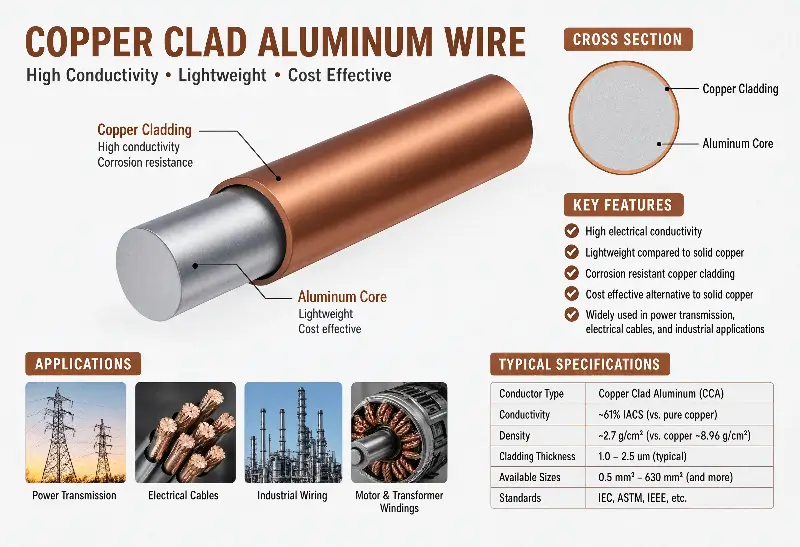
Engineering Significance of Performance Advantages: Why is CCA Wire Equivalent to Pure Copper Above 5 MHz? The engineering value of CCA wire lies in its non-linear advantage in “weight vs. conductivity.” Aluminum has a density one-third that of copper (2.7 g/cm³ vs. 8.96 g/cm³), and its conductivity is approximately 61% of copper’s (IACS standard). Simply in terms of weight, CCA can be about 50% lighter than pure copper while maintaining the same DC resistance (depending on the copper content and aluminum purity). This is the fundamental reason why CCA is chosen for high-frequency transformer windings, photovoltaic busbars, new energy vehicle wiring harnesses, and lightweight aerospace conductors. However, an even more crucial engineering characteristic is AC conductivity. Above 5 MHz, due to the skin effect—current concentrates on the conductor surface—the copper layer of the CCA bears almost all the current conduction, while the aluminum core only contributes mechanical support and lower cost. Therefore, above 5 MHz, the AC conductivity of CCA is equal to that of pure copper, but its weight is only half that of pure copper. This characteristic is crucial in high-frequency applications such as wireless charging transmitter coils, induction heating, RFID antennas, and 5G communication components.
Core Application Areas of Industrial-Grade CCA The mainstream application scenarios for industrial-grade CCA wires can be categorized by industry: Energy & Power: Photovoltaic busbars, internal jumpers for solar panels, neutral grounding for transformers, busbar extensions in lightweight distribution cabinets, battery connections in energy storage systems. High-Frequency Electronics: Wireless charging transmitter/receiver coils, windings for induction heating equipment, RFID tag antennas, 5G base station filter inductors, high-frequency switching power supplies. Automotive & Rail Transportation: Lightweight high-voltage wiring harnesses for new energy vehicles, internal windings for on-board chargers (OBCs), lightweight conductors for rail transit signaling systems. Specialty Cables & Inductors: Inner conductors of RF coaxial cables, deflection coils, chokes, solenoid valve windings. Different application scenarios result in significant differences in the requirements for the copper content, enamel coating grade, mechanical strength, and solderability of CCAs. This is why “general-purpose CCA suppliers” have almost no room to survive in the industrial market—a specialized product line is the moat that protects industrial-grade CCA suppliers.
ASTM B566 and the International Standards System Overview
ASTM B566: The Parent Standard for CCA Wire ASTM B566, “Standard Specification for Copper-Clad Aluminum Wire,” is the parent standard for CCA wire, and almost all clauses in industrial-grade CCA procurement technical specifications are referenced from this standard.
Note that ASTM B566 uses inch-pound units by default, with only resistivity and density standardized in SI units. This means that if the technical specifications use pure metric units (e.g., mm² cross-sectional area, Ω·mm²/m resistivity), it must be explicitly stated that “ASTM B566 is referenced and converted to SI units”. Key requirements for finished products according to the standard include: Tensile Strength and Elongation: ASTM B566 §10 specifies the minimum tensile strength and elongation for different grades. Class 10A typically ≥ 105 MPa / ≥ 15%, and Class 15H typically ≥ 175 MPa / ≥ 3%. The purchaser should clearly specify the reference clause number in the specifications. Resistivity: The nominal value for Class 10A is approximately 27.4 nΩ·m (equivalent to 65% of pure copper), and for Class 15A, approximately 26.5 nΩ·m. The standard also requires a maximum upper limit on resistivity at 20°C. Density: ASTM B566 tables provide the nominal density for each grade (approximately 3.32 g/cm³ for 10% copper and approximately 3.63 g/cm³ for 15% copper) for mass/length conversion and copper-aluminum volume ratio verification. Metallurgical Bonding: When the cross-section of the finished wire is inspected under a 100× microscope, the copper layer must be continuous, uniform, and without delamination. The mandrel bend test in ASTM B566 §11 is crucial for verifying the metallurgical bond—the copper and aluminum must not peel off after repeated bending. Joints and Splices: The finished wire must not contain any joints or splices. This rule directly eliminates the possibility of splicing short pieces.
IEC, NEMA, JIS, and GB Standards Compared to ASTM B566 are not the only international standards. Standard requirements vary significantly across different markets and customers: IEC 60317 Series: International Electrotechnical Commission standards for enameled wire (including CCA enameled wire/ECCAW). IEC 60317-0-1 is a general rule, while sub-standards such as IEC 60317-13/14/15 target specific enameled coating types. The European market mandates IEC standards. NEMA MW 1000: A standard from the National Electrical Manufacturers Association (NEMA) for round wire. NEMA rating is commonly required by OEMs in the North American market. JIS C 3202: A Japanese Industrial Standard for enameled wire. Commonly used by Japanese and some Southeast Asian customers. GB/T 6109: A Chinese National Standard for enameled wire. Commonly used in domestic trade and export to the Chinese market. ASTM B566: For bare CCA wire, excluding enamel coating. Enameled CCA wire (ECCAW) requires compliance with ASTM B566 + IEC/NEMA/JIS/GB enamel coating standards. Purchasing engineers typically specify in the specifications that “bare wire conforms to ASTM B566 Class 10A, enamel coating conforms to IEC 60317-13 grade 2.” This approach satisfies both European/American and Asian customers, avoiding rejection due to differences in standards.
Key Certifications Required for Industrial-Grade CCA Wire to Enter the Mainstream Market: – UL Certification (US/Canada Market): UL 1446 (Electrical Insulation Systems), UL 758 (Electronic Wire), UL 1063 (Machine Tool Wire). The UL File Number must be searchable on the UL website. – RoHS 2.0 (EU Market): Restricts four phthalates: lead, mercury, cadmium, hexavalent chromium, PBB, PBDE, DEHP, BBP, and DBP. – REACH SVHC (EU Market): List of Substances of Very High Concern, currently exceeding 230 items. CCA wire is generally not involved, but enamel coatings and additives require item-by-item verification. – CCC Mandatory Certification (China Market): Products with enameled wire listed in the CCC catalog require mandatory certification. – EN 50575 CPR (EU Building Product Regulation): Fire rating (Aca to Fca) for fixed installation cables. Note that CCA Wire must not be used for fixed wiring within buildings (NEC 2020, Clause 310.106(B)), this rule will be discussed in detail later. Certification is costly and time-consuming (UL typically takes 3-6 months, with a single certification costing 50,000-150,000 RMB). Whether the source manufacturer already possesses these certifications is one of the key indicators for assessing its industrial-grade supply capabilities.
Comparison of CCA Wire Manufacturing Processes
Clad Welding Process Clad welding is the mainstream process for industrial-grade CCA, also known as “continuous cladding welding”. Process route: The aluminum rod (diameter 8-12 mm) is stretched to the target diameter (usually 0.1-7.0 mm) through multiple passes, while the copper strip (thickness 0.05-0.5 mm, width calculated according to wire diameter) forms a continuous weld layer on the outside of the aluminum core through a welding mold. The quality of the metallurgical bond is determined by three parameters: welding temperature, welding pressure, and welding speed. Key quality control points: – Welding temperature: Typically 400-550°C. Too low a temperature results in insufficient bonding strength, while too high a temperature leads to the formation of brittle intermetallic compounds (CuAl₂, Cu₉Al₄) at the copper-aluminum interface. – Copper strip pretreatment: The copper strip must undergo cleaning, annealing, and surface activation treatment; otherwise, porosity and inclusions will appear at the weld interface. – Continuous production length: The continuous production length for a single strip is typically 5-50 km, limited by the length of the aluminum rod (standard aluminum rod 6 m) and the length of the copper strip coil. The cladding welding process has a relatively high production capacity (200-500 tons per month), suitable for Class 10A, Class 15A, Class 10H, and Class 15H specifications. However, the investment in equipment is large (imported continuous cladding welding machines cost 5-15 million RMB), and only large-scale source plants possess this capability.
Continuous Extrusion Process Continuous extrusion (conform extrusion) is an upgraded route of cladding welding, commonly used for large cross-section CCAs. Process route: The aluminum rod is heated to a semi-solid state through friction in the grooves of a continuous extruder, while the copper strip is welded to the aluminum core through a die during extrusion. The advantage of this process is high interfacial bonding strength (aluminum is semi-solid, and interfacial atomic diffusion is sufficient), suitable for large cross-section wires of 10 mm² and above. Continuous extrusion has lower production capacity (50-200 tons per month), but the mechanical strength of the product is superior to cladding welding. It is commonly used for transformer windings, busbar extensions, and high-power inductors.
Electroplating Process Electroplating is the main process route for low-end CCAs. Process route: The aluminum core is first pretreated (alkali washing, acid washing, zinc replacement), and then a copper layer is deposited in the electroplating solution. Electroplating has high throughput and low cost, but the copper-aluminum bonding is weak (the interface is mechanically interlocked, not metallurgically bonded), and it is prone to delamination at high temperatures. Electroplated CCAs are only suitable for ≤0.5 mm ultra-fine wire, low-frequency, low-current applications (such as internal jumpers in electronic wires, decorative items). Electroplated CCAs must not be used in industrial-grade high-frequency, power, or busbar applications—this is an industry-recognized “red line.” Practical experience of purchasing engineers: If a supplier cannot pass the ASTM B566 §11 mandrel bend test, it should be directly judged as electroplated or the process is substandard.
Industrial Grade CCA Wire Product Classification and Enamel Coating System
Bare CCA Wire and Enameled Wire (ECCAW) CCA Wire circulates in the industrial supply chain in two forms: Bare CCA Wire: Used directly for electrical connections (such as grounding, busbar extensions), without an insulation layer. Complies with any of ASTM B566 Class 10A/15A/10H/15H. Surface finish is typically bright annealed or lightly anodized (suitable for subsequent soldering). Enameled Wire (ECCAW, Enameled Copper Clad Aluminum Wire): CCA cores are coated with an enamel coating for use in electromagnetic windings (motors, transformers, inductors). Must comply with both ASTM B566 (bare wire) and IEC/NEMA/JIS/GB (enamel coating) standards. Purchasers need to clearly distinguish between scenarios: – Photovoltaic busbars, automotive high-voltage wiring harnesses, transformer neutral grounding → bare wire – Motor windings, transformer windings, inductor coils → enameled wire Mixing can lead to serious accidents – A new energy vehicle manufacturer once recalled the entire vehicle because it used bare CCA wire to replace enameled wire, which caused a short circuit in the drive motor stator.
Enamel coating thickness (grade 1/2/3) also affects selection: – Grade 1 (thin enamel coating): High fill factor, but weak voltage withstand capability, suitable for low-stress windings. – Grade 2 (medium enamel coating): General purpose, balancing voltage withstand capability and fill factor. – Grade 3 (thick enamel coating): Strong voltage withstand capability, suitable for high-frequency, high-voltage windings. For high-frequency transformer windings (switching power supplies, induction heating), Grade 2 is the industry standard. For high-power-density motors, Grade 3 is more reliable but costs 15-25% more.
Global CCA Wire Supply Channel Map
Supply Model Classification Industrial-grade CCA Wire supply models are divided into four categories, each with its applicable scenarios: Source Manufacturer: Owns the complete process of aluminum rod drawing, copper strip cladding welding, and enamel coating; monthly production capacity: 100-1000 tons. Direct export trade. OEM Manufacturer: Contract manufacturing; produces according to customer-provided specifications; quality control is handled by the client. Suitable for medium-volume, special specifications. Regional Distributor: Purchases products from source manufacturers or OEM manufacturers, adds a markup, and distributes to regional customers. Lacks technical capabilities; only provides logistics and local services. Trading Company/Importer/Exporter: Purchases products from source manufacturers or OEM manufacturers, adds a markup, and exports. Lacks technical capabilities; mainly profits from information asymmetry. Practical experience of procurement engineers: – Large batches (>10 tons/month) and standard specifications → Direct sourcing from the source factory is optimal. – Medium batches (1-10 tons/month) and standard specifications → Regional agents are the most economical. – Small batches (<1 ton/month) or special specifications → Trading companies are the most flexible but risky. – Long-term strategic cooperation → Direct supply from the source factory is essential, and a quality agreement must be established.
China: The main supplier of global CCA Wire. China is the region with the most concentrated global CCA Wire production capacity, accounting for 60-70% of global capacity. It is mainly distributed in: Zhengzhou/Gongyi Industrial Cluster, Henan Province: A CCA Wire cluster radiating from aluminum plants such as Zhengzhou Coal Group and Henan Yulian, characterized by proximity to aluminum raw materials (northern Henan is one of China’s main electrolytic aluminum producing areas), low labor costs, and abundant export experience. Representative companies include Zhengzhou LP Industry, a source manufacturer with 30 years of experience in exporting magnetic wire and covering the full range of copper conductors, aluminum conductors, and CCA wires. The Zhejiang Ningbo/Wenzhou Industrial Cluster, represented by companies like Ningbo Xingye and Wenzhou Hongfeng, boasts mature enameled wire technology and primarily targets the home appliance and small motor markets. The Jiangsu Suzhou/Wuxi Industrial Cluster, represented by companies like Wuxi Yuandong and Suzhou Keda, focuses on high-end technology with leading enameled coating processes, primarily targeting new energy vehicles and rail transportation. The Guangdong Foshan/Dongguan Industrial Cluster is centered on export trade, connecting Hong Kong traders with markets in Southeast Asia, the Middle East, and Africa. The advantages of Chinese CCA wire are its flexible production capacity, strong price competitiveness, and mature export processes; its disadvantages include overcapacity in low-to-mid-end products, a gap in high-end enameled coating technology, and lower brand recognition compared to source manufacturers in Europe, America, Japan, and South Korea.
Secondary Supply Belts in India, Turkey, and North America India: Represented by companies like Stellite and Polycab, driven by domestic market demand. Rapid capacity expansion but inconsistent technological maturity; primarily serving South Asia and the Middle East. Turkey: Represented by Turkish Copper and Turkish Cable, geographically connecting Eurasia and close to the EU market. Primarily supplying industrial users in Eastern Europe. North America: Represented by companies like MWS Wire Industries and Southwire, smaller in scale but technologically advanced, dominating specialized applications (such as aerospace and military). One of the core drafting units of the ASTM B566 standard is located in North America. Europe: Represented by comprehensive cable groups like Leoni and Nexans; CCA Wire is just a sub-product line, dominating high-end enamel coating and specialized applications. Purchasing Strategies: Choosing a primary supplier from Chinese manufacturers + backup suppliers from India/Turkey is currently a robust combination for B2B industrial procurement.
Key Risks: OEM by Trading Companies and “Seemingly Cheap” Quotes The most common pitfall in B2B industrial procurement is OEM by trading companies—trading companies purchase from a small factory, repackage and brand it, and then sell it to end users. Typical characteristics of this type of supply: – Prices are 15-30% lower than the market average. – They cannot provide the original ASTM B566 test report (they provide their own “factory inspection report”). – Factory visits cannot be arranged or the factory is located in the suburbs, making visits inconvenient. – The packaging lacks the source factory name or only has a vague address. Procurement engineers’ self-inspection methods: 1. Request an ASTM B566 test report and verify that the testing unit on the report matches the actual production unit. 2. Request a video conference with the factory workshop to verify the existence of the three main processes: aluminum rod drawing, copper strip welding, and enamel coating. 3. Engage a third party (such as SGS, BV, TÜV) to conduct a pre-shipment inspection (PSI) to verify that the goods are consistent with the specifications.
8 Core Dimensions of Source Plant Evaluation
Process Route and Equipment Capability The first evaluation dimension directly examines the process route and equipment capability. Core equipment list for source plants: – Aluminum Rod Continuous Casting and Rolling Mill: Determines the quality of the aluminum core. High-quality source plants use 9.5 mm aluminum rods (electrical grade 1350 aluminum alloy) with impurity content ≤ 0.5%. – Multi-Die Stretching Machine: Determines wire diameter accuracy. High-quality source plants use 12-18 passes of continuous stretching with a single-die stretching rate ≤ 25%. – Copper Strip Cladding Welding Machine: Determines the quality of the metallurgical bond. High-quality source plants use imported brands (such as Niehoff from Germany, Mailefer from Austria) continuous cladding welding machines with closed-loop control of welding temperature. – Enamel Coating Machine: Determines the quality of the enamel coating. High-quality source factories use vertical enameling machines (cataphoretic or die coating), with an enamel coating thickness tolerance of ±0.005 mm. – Annealing furnace: Determines the mechanical properties of the finished product. High-quality source factories use bell furnaces or in-line continuous annealing, ensuring precise atmosphere control. Evaluation method: Require suppliers to provide an equipment list (models, brand, origin, installation time) + workshop video link to verify the actual operating status of the equipment.
Capacity Matching and Order Flexibility The second evaluation dimension is capacity matching and order flexibility. Characteristics of high-quality source manufacturers’ production capacity: – Basic monthly production capacity: 100-1000 tons, covering all categories of aluminum core/copper core/CCA – Order flexibility: Monthly delivery can be adjusted within ±20% – Urgent order response: Standard delivery in 7-15 days, special delivery in 30-45 days – Minimum order quantity (MOQ): Standard from 500 kg, special from 1-2 tons Risk signals: – Basic monthly production capacity < 50 tons: Be cautious when ordering large quantities – Urgent order response > 30 days: Insufficient flexibility – Minimum order quantity > 5 tons: Cost pressure may be passed on
Quality Documentation and Traceability The third evaluation dimension is quality documentation and traceability, which is the most easily overlooked and problematic aspect of industrial-grade procurement. Required Quality Documents List: – ASTM B566 Test Report: Issued by a third-party laboratory (e.g., SGS, CTI, Pony), covering five indicators: tensile strength, elongation, resistivity, density, and metallurgical bonding. – Enamel Coating Test Report: Issued by a third-party laboratory, covering four indicators: pressure resistance, pinholes, adhesion, and thermal shock. – RoHS Test Report: Covers ten controlled substances. – REACH SVHC Declaration: Declares that the current batch does not contain SVHC substances. – UL Certification Certificate (if applicable): UL File Number can be found on ul.com. – PPAP (Production Part Approval Program): Required for automotive industry customers, containing 18 standard documents. – COC (Certificate of Conformity): Certificate of Conformity for each batch. – COA (Certificate of Analysis): Chemical composition analysis report for each batch. – Batch Traceability Code: Each spool has a unique batch code, traceable to the aluminum rod batch number, copper strip batch number, and enamel coating batch number, production time, and operator. risk signals: – Missing ASTM B566 report or only an in-house inspection report (not a third-party report) – Missing or non-standard batch traceability code – Incomplete PPAP documentation but claims to “be able to serve automotive customers”
Export Experience and Customer Cases The fourth evaluation dimension is export experience and customer cases. Characteristics of export experience of high-quality source factories: – Export history: ≥ 5 years – Number of export countries: ≥ 30 countries – Mainstream customer groups: Large and medium-sized OEMs in Europe and America (such as Schneider Electric, ABB, Siemens’ supplier system), Southeast Asian home appliance manufacturers, Indian transformer factories – Long-term cooperative customers: Customers with a cooperation period of ≥ 3 years account for more than 30% Reverse verification method: Require suppliers to provide ≥ 3 contactable international customers as reference checks, and directly confirm the cooperation history with these customers. Risk Signals: – Export history < 3 years – Inability to provide verifiable international customer references – “Customer confidentiality” used as an excuse to refuse to provide case studies (compliant references should be available after anonymization).
Copper Layer Uniformity and Geometric Accuracy The fifth evaluation dimension is copper layer uniformity and geometric accuracy. Verification Method: – Sampling 5% Metallographic cross-section analysis of the spool – inspection of the continuity, uniformity, and interfacial metallurgical bonding of the copper layer under a 100× microscope – the thickness of the enamel coating is measured at multiple points (at least 10 points) using a micrometer or laser thickness gauge.
The sixth evaluation dimension is the solderability and thermal shock performance of the enamel coating, specifically for enameled CCA wire (ECCAW). Solderability test: – Immersion temperature: 380 ± 5°C (for UEW enameled wire) or 420 ± 5°C (for PEW enameled wire) – Immersion time: ≥ 2 seconds (UEW), ≥ 3 seconds (PEW) – Criterion: 90% or more of the immersed area is covered by solder for passing. Heat shock test: – After winding the sample at 155-200°C (according to the enamel coating grade), immediately place it in a -20°C environment for 30 minutes. – The enamel coating must not crack, blister, or delaminate. – This is a key test simulating the thermal stress of windings during motor/transformer manufacturing. Continuity test (for enameled wire): – Scan the enamel coating surface with a pinhole detector at 1000V DC voltage. – ≤ 1 pinhole per 30 meters of wire length is passing. Excessive pinholes can cause short circuits in the windings, which is a fatal flaw of enameled wire.
Anti-stratification and long-term reliability The seventh evaluation dimension is anti-stratification and long-term reliability. ASTM B566 §11 Mandrel Bend Test: – The specimen is repeatedly bent 180° on a mandrel with a diameter 2-4 times the wire diameter, repeated 5-10 times. – After bending, the copper-aluminum interface is inspected with a 10× magnifying glass. – Judgment: Copper and aluminum must not peel, blister, or crack. Long-term reliability testing: – Heat aging test: 1000-3000 hours at 130-200°C, testing for changes in resistivity, tensile strength, and elongation. – Damp heat cycling test: 1000 hours at 85°C / 85% RH, testing for insulation performance. – Salt spray test: For special applications (such as marine engineering), spray with 5% NaCl solution for 96-500 hours, testing for copper-aluminum interface corrosion. Purchasing engineer’s practice: Anti-delamination test requires the supplier to provide a sampling test report before shipment, and third-party witnessed testing at least once a year.
Price Structure and Business Terms The eighth evaluation dimension is the price structure and business terms.
Price Risk Signals: – Price more than 15% below the market average: Likely to be electroplated or have substandard processes. – Frequent price fluctuations (>10%/month): Insufficient hedging mechanisms against LME copper and aluminum prices. – LME copper and aluminum benchmark, exchange rate, and processing fees not clearly stated in the quotation: Risk of future disputes. Key Business Terms: – Payment Method: 30% TT prepayment + 70% upon presentation of a copy of the bill of lading (standard); new customers may request 100% TT or L/C. – Trade Terms: FOB (ex-works price + sea freight), CIF (including marine insurance), DDP (including customs duties, door-to-door). FOB is most common for B2B industrial procurement. – Warranty Period: Usually 12 months from the date of delivery. – Dispute Resolution: Third-party arbitration (e.g., SGS International Arbitration).
Procurement Contracts, Quality Control, and Traceability
Key Clauses of the Procurement Specification The Procurement Specification is the “constitution” of industrial-grade CCA Wire procurement, determining the basis for handling subsequent disputes. A complete specification sheet should include: 1. Product Definition – Product Name: CCA Wire / ECCAW (Enamelled Copper-Clad Aluminum Wire) – Applicable Standards: ASTM B566 Class ___ A/H, IEC 60317- Grade ___ – Specification Range: Wire Diameter ___ mm to ___ mm 2. Material Specifications – Aluminum Core Material: Electrical Grade 1350 Aluminum Alloy, Aluminum Purity ≥ 99.5% – Copper Coating Material: Oxygen-Free Copper (OFC, C10100) or Electrical Grade Copper (C11000), Copper Purity ≥ 99.9% – Copper Percentage: ___ vol% (e.g., 10% or 15%) – Enamelled Coating Type: ___ (e.g., polyester-imide) – Enamelled Coating Thermal Class: °C (e.g., 180°C) 3. Mechanical Properties – Tensile Strength: ≥ ___ MPa – Elongation: ≥ ___ % – Hardness: HV ___ (if applicable) 4. Electrical Properties – 20°C DC Resistivity: ≤ ___ nΩ·m – 20°C Density: ___ ± 0.05 g/cm³ 5. Geometric Accuracy – Roundness Tolerance: ± ___ mm – Ovality: ≤ ___ mm – enamel coating Thickness: ___ ± ___ mm – Copper Layer Circumferential Deviation: ≤ ± % 6. Test Methods – Refer to ASTM B566 §, § – Refer to IEC 60317- – Third-Party Laboratory: ___ (e.g., SGS, BV, TÜV, CTI) 7. Acceptance Rules – Sampling Plan: According to ___ standard (e.g., ISO 2859-1 AQL 1.0) – Batch Definition: Every ___ kg constitutes a batch – Non-conformity handling: Return/Downgrade/Accept with concessions 8. Documentation requirements – ASTM B566 test report (per batch) – Certificate of Conformity (per batch) – Chemical Analysis and Analysis (COA) report (per quarter) – Batch traceability code (per spool)
Incoming Inspection and Third-Party Verification Even if the source factory has good quality control, incoming inspection is still a necessary last line of defense. Incoming Inspection Process: 1. Document Check – Verify that the ASTM B566 test report, COA, and COC are complete. – Verify that the batch number on the report matches the batch code on the actual spool. – Check that the report date is within 6 months (ASTM B566 test reports are typically valid for 6 months). 2. Sampling Inspection – Sampling according to ISO 2859-1 AQL 1.0 standard inspection procedures. – The sampling quantity is usually 5-10 spools per batch. – The sampling length for each spool is 1-2 meters. 3. Test Items – Visual inspection (copper layer continuity, enamel coating uniformity) – Geometric dimensions (wire diameter, ellipticity, enamel coating thickness) – Electrical properties (resistivity, continuity test) – Mechanical properties (tensile strength, elongation, sampled at least quarterly) 4. Third-Party Witnessing – For first-time cooperation or large orders: commission a third party (SGS, BV, TÜV) to witness the testing. Witnessing the test report as one of the payment vouchers
Quality Traceability and Batch Management Industrial-grade CCA Wire’s quality traceability is a full-chain management “from aluminum ore to winding”. The traceability code for each spool should be able to trace back to: – Aluminum rod supplier, aluminum rod batch number, aluminum rod chemical composition – Copper strip supplier, copper strip batch number, copper strip chemical composition – enamel coating supplier, enamel coating batch number, enamel coating viscosity, solid content – Production date, production shift, operator, equipment parameters – Inspector, inspection date, inspection results Batch Management Practices: – Establish an independent quality file for each batch (electronic + paper dual backup) – File retention period ≥ 7 years (consistent with product lifecycle) – In case of customer complaints, specific production parameters can be traced back within 24 hours Risk Case: A new energy vehicle manufacturer experienced batch short circuits when using CCA Wire to manufacture drive motor stators. Traceability revealed that the aluminum rod supplier was changed but the incoming inspection process was not updated, and the iron content of the new batch of aluminum rods exceeded the standard, causing resistivity fluctuations. The key lesson from this case is that the core of quality traceability is not finding problems, but preventing them from spreading.
Application-Driven Supplier Capability Matching
High-Frequency Electronics Applications (Wireless Charging, Induction Heating, 5G) High-frequency electronic applications (above 5 MHz) have the most stringent requirements for CCA Wire. Core Requirements: – 15% copper content (Class 15A) for optimal high-frequency conductivity – enamel coating Grade 2 or Grade 3 (withstand voltage > 6 kV) – ultra-fine wire (0.05-0.5 mm) using hydrostatic extrusion process – enamel coating continuity pinholes < 0.5 per 30 meters (above general standards) Supplier Capability Matching: – Process route: overcoating or hydrostatic extrusion – enamel coating grade: polyester (EIW) or polyamide-imide (AIW) – Key Tests: Conductivity testing in the 1 MHz-100 MHz band, 100% online testing for enamel coating – Recommended: Source manufacturers with high-frequency application cases (wireless charging transmitter coils, 5G filter inductors)
Photovoltaic and New Energy Applications (Busbar, Energy Storage Connections) The requirements for CCA Wire in photovoltaic and new energy applications focus on lightweighting and cost. Core Requirements: – 10% copper content (Class 10A) to maximize lightweight advantages – Bare wire or thin enamel coating (polyurethane UEW) – UV aging resistance (enamel coating weather resistance) – 25-year lifespan guarantee (photovoltaic applications) Supplier Capability Matching: – Process route: overcoating welding (mainstream) or continuous extrusion (large cross-section) – Enamel coating: polyurethane (UEW) or modified polyester – Key tests: salt spray test, damp heat cycling test, thermal aging test (200°C × 3000 hours) – Recommendation: Source manufacturers with photovoltaic customer cases (TUV Rheinland, TUV SÜD certification)
Automotive and Rail Applications (High Voltage Harnesses, OBC, Traction) Automotive and rail applications are the most demanding application scenarios for CCA Wire. Core Requirements: – Compliant with IATF 16949 Automotive Quality Management System – Complete PPAP documentation – Vibration and temperature cycling resistance (-40°C to +150°C) – Flame retardant rating (EN 45545-2 HL3 Rail Transport) – 5-15 year lifespan guarantee Supplier Capability Matching: – Process route: Continuous extrusion (high-end) or overcoating welding (mainstream) – enamel coating: polyester imide (EIW) or polyamide imide (AIW) – Key tests: PPAP 18 standards, vibration test, temperature cycling test, flame retardant test – Recommended: Source manufacturers with automotive OEM customer cases (such as Tesla, BYD, CATL’s supplier system)
General Industrial Motors and transformer Applications General industrial motors and {transformers} are the most widespread applications of CCA Wire. Core Requirements: – ASTM B566 Class 10A or Class 15A – IEC 60317 enamel coating Grade 2 – Temperature resistance 155-180°C – Standardized specifications, large purchase volume Supplier capability matching: – Process route: cladding welding (standard specifications) – enamel coating: polyester (PEW) or polyester imide (EIW) – Key tests: routine ASTM B566 testing – Recommended: Source manufacturers with IEC/NEMA/UL multi-standard certification and monthly production capacity > 200 tons
NEC Regulatory Warning: CCA is prohibited for fixed wiring in buildings The National Electrical Code (NEC) 2020, Section 310.106(B), clearly states: Copper-clad aluminum wire must not be used for branch circuit wiring in buildings.
The background to this regulation is the North American residential fire investigation in the 1970s, which found that a large number of fires were related to aluminum core wire (pure aluminum or CCA). NEC’s solution is: fixed cabling must use pure copper wire, and CCA is only allowed for use in non-building fixed scenarios such as internal patch cords, grounding connections, and busbars. Practical impact on Chinese suppliers: – CCA wire exported to the North American market must be clearly labeled “for internal equipment only, non-building fixed cabling” – Labels and packaging must include NEC warnings – End customers must provide an End-Use Statement Reverse requirements for supplier capability matching: – Source manufacturers with NEC compliance label design capabilities – Source manufacturers familiar with US/Canadian market export regulations – Source manufacturers that can provide an End-Use Statement template
Final Recommendations for Purchasing Industrial-Grade CCA Wire CCA wire is not a product that can be used simply because it is cheap. The core of industrial-grade procurement is establishing a repeatable quality control chain—from matching the source factory’s process route, adapting to the application scenario, complying with ASTM B566 standards, third-party verification, and batch traceability, every link is indispensable. A sound practical approach is: choose a large-scale source factory in China as the primary supplier (e.g., a manufacturer with IEC/NEMA/UL multi-standard certifications, a monthly production capacity of 200 tons or more, and over 10 years of export experience); choose second-tier source factories in India or Turkey as backup suppliers; and choose a local trading company in your home country as a third supplier to handle urgent small-batch orders. This three-supplier system balances cost, risk, and response speed. Finally, a word of advice: Don’t trust the “lowest price.” The CCA Wire industry has high price transparency; any quote more than 15% below the market average must have a reason—electroplated materials, rework materials with substandard processes, or recycled materials after secondary annealing—any of these will expose problems in subsequent production. The cost of quality issues far outweighs price savings. Finding a source manufacturer willing to assist you with interpreting ASTM B566 test reports, preparing PPAP documentation, and optimizing application adaptation is far more important than finding a supplier that is 10% cheaper. This is the true value of purchasing industrial-grade CCA wire.