


IEC 60317 is the series of standards for specifications of particular types of winding wires issued by the International Electrotechnical Commission (IEC), and is the fundamental standard for the global winding wire industry. This series of standards covers round and rectangular wires, enameled wires with different insulation layers and temperature classes. The regulations on aluminum winding wires in IEC 60317 are the key basis for the design, production, procurement, and testing of aluminum enameled wires. This article systematically explains the classification, technical requirements, test methods, application scenarios, and selection guide of aluminum winding wires in the IEC 60317 standard system.
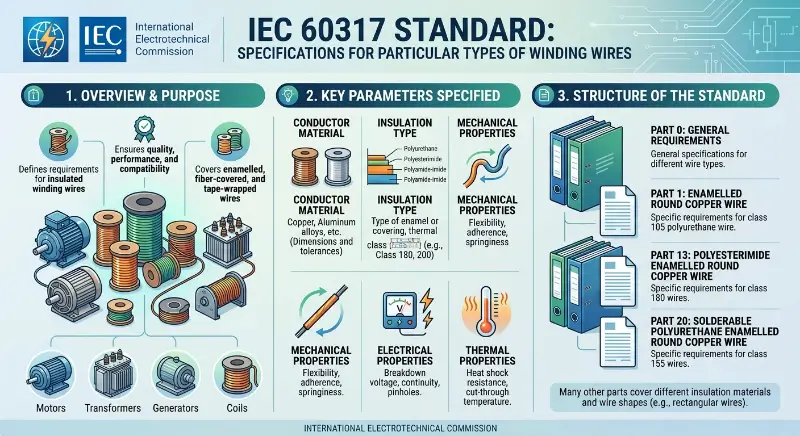
Overview of IEC 60317 Standard System
IEC 60317 Standard Structure
IEC 60317 is a collection of a series of standards, consisting of several independent parts: IEC 60317-0-1: General requirements for round copper wires, IEC 60317-0-2: General requirements for rectangular copper wires, IEC 60317-0-3: General requirements for round aluminum wires, IEC 60317-0-4: General requirements for rectangular aluminum wires, IEC 60317-0-5: General requirements for round copper wires (revised), IEC 60317-0-6: General requirements for round copper wires (revised), IEC 60317-0-7: General requirements for fully insulated enameled round copper wires, IEC 60317-0-8: General requirements for polyester fiberglass covered enameled rectangular copper wires, IEC 60317-0-9: General requirements for solderable polyurethane enameled round copper wires, IEC 60317-0-11: General requirements for polyurethane enameled stranded copper wires, IEC 60317-1 to IEC 60317-78: specific specifications for various types of enameled wires.
IEC 60317-0-3 Standard
IEC 60317-0-3 is the general requirements for round aluminum wires, specifying the basic specifications for round aluminum enameled wires. This standard specifies the nominal diameter range of aluminum conductors, conductor resistance, enamel thickness, electrical performance, mechanical performance, and other technical requirements. The latest version is IEC 60317-0-3:2008 and its amendment AMD1:2013.
IEC 60317-0-4 Standard
IEC 60317-0-4 is the general requirements for rectangular aluminum wires, specifying the basic specifications for rectangular (flat) aluminum enameled wires. Rectangular aluminum wires are widely used in transformers, high-power motors, generator sets, and other equipment.
Classification of IEC 60317 Aluminum Winding Wires
Classification by Insulation Enamel
Polyester enameled aluminum wire (PEW), Polyester-imide enameled aluminum wire (EIW), Polyamide-imide enameled aluminum wire (AIW), Polyurethane enameled aluminum wire (UEW), Polyester-imide/Polyamide-imide composite enameled aluminum wire (EIW/AIW), Polyvinyl formal enameled aluminum wire (PVF), Modified polyester enameled aluminum wire, Solderable polyurethane enameled aluminum wire.
Classification by Temperature Class
Temperature Class Table
| IEC Class | Temperature (°C) | Temperature (°F) | Notes |
|---|---|---|---|
| E | 120 | 248 | Early class, rarely used |
| B | 130 | 266 | Early class, rarely used |
| F | 155 | 311 | Medium temperature |
| H | 180 | 356 | High temperature |
| C | 200 | 392 | Relatively high temperature |
| C+ | 220 | 428 | High temperature class |
| 250 | 250 | 482 | Ultra-high temperature |
Classification by Shape
Round aluminum wire (Round Aluminum Wire), Rectangular aluminum wire/Flat aluminum wire (Rectangular Aluminum Wire), Profiled aluminum wire (Profiled Aluminum Wire), Stranded aluminum wire (Stranded Aluminum Wire).
Classification by Insulation Layer
Single-coat aluminum wire (Grade 1), Double-coat aluminum wire (Grade 2), Triple-coat aluminum wire (Grade 3), Composite coat aluminum wire.
IEC 60317-0-3 General Requirements for Round Aluminum Wires
Conductor Diameter Range
IEC 60317-0-3 specifies the nominal conductor diameter range of round aluminum enameled wires. According to the standard, the nominal diameter of round aluminum enameled wires is usually 0.250mm – 8.000mm. Common specifications in actual production include 0.30mm, 0.40mm, 0.50mm, 0.60mm, 0.80mm, 1.00mm, 1.20mm, 1.50mm, 1.80mm, 2.00mm, 2.50mm, 3.00mm, 4.00mm, 5.00mm, 6.00mm, etc.
Conductor Resistance Requirements
The resistivity of aluminum conductor is higher than that of copper, about 1.6 times that of copper. IEC 60317-0-3 specifies the maximum resistance value of aluminum conductor at 20°C. Resistance calculation formula: R = ρ × L / A, where ρ is the resistivity, and the resistivity of aluminum is about 2.82×10^-8 Ω·m.
Enamel Thickness Requirements
IEC 60317-0-3 specifies the minimum enamel thickness for different grades of aluminum enameled wires. Grade 1 enamel is thinner, Grade 2 enamel is thicker. Increasing enamel thickness can improve insulation performance, but it will reduce the fill factor and flexibility.
Elongation Requirements
Aluminum wire is more prone to fracture than copper wire, and the elongation requirements are stricter. IEC 60317-0-3 specifies the minimum elongation of aluminum enameled wires. Reference values for different diameter ranges are shown in the table.
Elongation Reference
| Diameter Range | Minimum Elongation |
|---|---|
| 0.250-0.500mm | ≥ 10% |
| 0.500-1.000mm | ≥ 12% |
| 1.000-2.500mm | ≥ 15% |
| 2.500-5.000mm | ≥ 18% |
| 5.000-8.000mm | ≥ 20% |
Flexibility and Adhesion
IEC 60317-0-3 specifies the flexibility and adhesion test requirements of the enamel. The mandrel winding test requires that the enameled aluminum wire is wound on a mandrel of specified diameter, and the enamel should have no cracking, peeling, or flaking. The snap test requires that the enamel has no damage when the aluminum wire is stretched at 20%.
IEC 60317 Specific Standards for Aluminum Winding Wires
Round Aluminum Wire Standards
IEC 60317-12
Class 130 polyester enameled round aluminum wire. Conductor diameter range: 0.250mm – 8.000mm. Applications: general motors, transformers, household appliances.
IEC 60317-13
Class 155 polyester enameled round aluminum wire. Conductor diameter range: 0.250mm – 8.000mm. Applications: F-class motors, small and medium transformers.
IEC 60317-15
Class 180 polyester-imide enameled round aluminum wire. Conductor diameter range: 0.250mm – 8.000mm. Applications: H-class motors, high-temperature transformers.
IEC 60317-25
Class 200 polyester-imide/polyamide-imide composite enameled round aluminum wire. Conductor diameter range: 0.250mm – 8.000mm. Applications: C-class motors, high-temperature motors.
IEC 60317-26
Class 220 polyamide-imide enameled round aluminum wire. Conductor diameter range: 0.250mm – 8.000mm. Applications: C+ class motors, ultra-high temperature environments.
IEC 60317-27
Solderable polyurethane enameled round aluminum wire. Conductor diameter range: 0.250mm – 5.000mm. Applications: electronic components, coils, transformers.
Rectangular Aluminum Wire Standards
IEC 60317-0-4
General requirements for rectangular aluminum enameled wires. Width range: 2.000mm – 16.000mm. Thickness range: 0.800mm – 5.600mm.
IEC 60317-72
Class 130 polyester enameled rectangular aluminum wire. Applications: transformers, low-voltage motors.
IEC 60317-73
Class 200 polyester-imide/polyamide-imide composite enameled rectangular aluminum wire. Applications: dry-type transformers, H-class motors.
IEC 60317-74
Class 200 polyester-imide/polyamide-imide composite enameled rectangular aluminum wire. Applications: wind power, new energy vehicle drive motors.
IEC 60317-75
Class 200 polyamide-imide enameled rectangular aluminum wire. Applications: ultra-high temperature motors.
IEC 60317-78
Class 220 polyamide-imide enameled rectangular aluminum wire. Applications: aerospace, high-end motors.
Advantages of Aluminum Wire over Copper Wire
Light Weight
The density of aluminum is 2.70 g/cm³, about 30% of copper (8.96 g/cm³). At the same current carrying capacity, the weight of aluminum wire is about 1/3 of copper wire. In applications where weight is sensitive, such as new energy vehicles, wind power, and rail transit, the advantages of aluminum wire are significant.
Low Cost
The raw material cost of aluminum is about 1/4-1/3 of copper. In large-scale applications, the cost advantage of aluminum wire is obvious. In the transformer industry, the cost of aluminum wire transformers is 30-50% lower than that of copper wire transformers.
Abundant Resources
Aluminum content in the earth’s crust is about 8.1%, the most abundant metal element in the earth’s crust. Copper content is about 0.006%, and the reserves of aluminum far exceed copper. Stable resource supply.
Good Processability
Aluminum has good plasticity and is easy to be drawn into fine wire. Aluminum has excellent ductility and can be processed into various specifications. Aluminum has a high recycling rate and meets environmental protection requirements.
Disadvantages of Aluminum Wire compared to Copper Wire
High Resistivity
The resistivity of aluminum is about 2.82×10^-8 Ω·m, and copper is about 1.72×10^-8 Ω·m. At the same cross-sectional area, the resistance of aluminum wire is 1.6 times that of copper wire. To achieve the same resistance, the cross-sectional area of aluminum wire needs to be increased (about 1.6 times).
Low Mechanical Strength
The tensile strength of aluminum is about 100-200 MPa, and copper is about 200-300 MPa. Aluminum wire is more prone to fracture, requiring more careful winding processes. Aluminum wire is easy to be damaged when bent.
Welding Difficulty
The welding performance of aluminum is worse than that of copper. The surface of aluminum is easy to form an oxide film (Al₂O₃), which affects the welding quality. The connection between aluminum and copper requires special processes (copper-aluminum transition joints).
High Contact Resistance
The contact resistance of aluminum is large, and overheating is easy to occur at the connection. Aluminum wire connection requires reliable connection techniques (copper-aluminum transition, special terminals, pressure connection, etc.).
Creep Tendency
Aluminum is prone to creep deformation under long-term stress, affecting the reliability of the connection. Issues such as pressure relaxation and stress release need to be considered.
Corrosion Tendency
Aluminum has high chemical activity and is easy to corrode in humid or corrosive environments. Anti-corrosion treatment is required.
Key Properties of IEC 60317 Aluminum Winding Wires
Electrical Properties
Conductor resistance: The aluminum conductor resistance at 20°C should be within the range specified by IEC 60317-0-3. Breakdown voltage: Depending on the enamel thickness and temperature class, the minimum breakdown voltage ranges from hundreds of volts to several thousand volts. Insulation resistance: The insulation resistance measured under DC voltage should meet the standard requirements.
Mechanical Properties
Elongation: ensures that the aluminum wire does not break during winding. Springback angle: the angle at which the aluminum wire springs back after bending, affecting the winding quality. Flexibility: mandrel winding test, enamel does not crack or peel. Adhesion: snap test, peel test, enamel is firmly bonded to the aluminum conductor.
Thermal Properties
Heat shock: after treatment at a specified temperature, the enamel does not crack. Softening breakdown: the enamel is not broken down at high temperature. Temperature index: the working temperature determined based on the thermal aging test.
Chemical Properties
Solvent resistance: resistant to alcohols, ketones, hydrocarbons, etc. Refrigerant resistance: resistant to R134a, R410A, etc. Transformer oil resistance: resistant to mineral oil, synthetic ester oil.
IEC 60317 Aluminum Winding Wire Test Methods
Appearance Inspection
Inspect the enamel surface with the naked eye or a low-power magnifying glass. Inspection content: enamel continuity, color uniformity, surface defects, enamel bubbles, enamel impurities, etc.
Dimension Inspection
Conductor diameter: measured with an outside micrometer. Enamel thickness: measured with an enamel thickness gauge or microscope. Overall outer diameter: measured with an outside micrometer.
Resistance Test
Use a resistance bridge or micro-ohmmeter to measure the resistance of the aluminum wire. The measurement temperature should be controlled at 20°C ± 0.5°C, or temperature conversion should be performed.
Elongation Test
Perform a tensile test on a tensile testing machine. Tensile speed: ≤ 5mm/min. Calculate the elongation: Elongation = (L₁ – L₀) / L₀ × 100%.
Enamel Flexibility Test
Wind the enameled aluminum wire around a mandrel of specified diameter for a specified number of turns. Check whether the enamel is cracked, peeled, or flaked. Common mandrel diameters: 1× wire diameter, 2× wire diameter, 3× wire diameter, 5× wire diameter.
Breakdown Voltage Test
Use a high-voltage tester to apply increasing voltage to the enameled wire. Record the breakdown voltage value. The test should be carried out under the conditions specified in the standard.
Pinhole Test
Use the mercury method or water immersion method to detect enamel pinholes. Standard requirement: the number of pinholes allowed per 30m of enameled wire does not exceed the specified value.
Temperature Index Test
Determine the temperature index of the enameled wire through accelerated aging test. Perform aging tests at multiple temperature points, draw the thermal aging curve, and extrapolate to obtain the temperature index.
Application Fields of IEC 60317 Aluminum Winding Wires
Distribution Transformers
Distribution transformers are the largest application field of aluminum winding wires. Class 130 and Class 155 polyester enameled round and rectangular aluminum wires specified by IEC 60317-12 and IEC 60317-13 are widely used in: oil-immersed distribution transformers, dry-type distribution transformers, combined transformers, pre-assembled substations. Advantages: low cost, light weight, meeting the insulation class and temperature resistance requirements of distribution transformers.
Small and Medium Motors
Small and medium motors are an important application field of aluminum winding wires. Applications: fan motors, air conditioner motors, washing machine motors, range hood motors, water pump motors. Standards used: IEC 60317-12, IEC 60317-13, etc. Aluminum wire in small motors can significantly reduce cost and weight.
New Energy Vehicles
New energy vehicle drive motors are an emerging application of aluminum winding wires. Hairpin windings use rectangular aluminum wires, complying with IEC 60317-73 and IEC 60317-74 standards. Advantages: light weight, increased range, low cost, good heat dissipation.
Wind Power Generators
Wind power generators (especially direct-drive permanent magnet wind generators) use a large number of aluminum winding wires. Rectangular aluminum wires comply with IEC 60317-73 standard. Requirements: high temperature resistance, high strength, high reliability.
Solar Photovoltaic
Aluminum winding wires are used in solar photovoltaic inverters and combiner boxes. Round aluminum wires comply with IEC 60317-12 standard. Requirements: strong weather resistance, long life.
Household Appliances
Household appliances (air conditioners, refrigerators, washing machines, water heaters, etc.) motors use a large number of aluminum winding wires. Requirements: low cost, high reliability, good safety.
Rail Transit
Rail transit traction motors and transformers use aluminum winding wires. Requirements: high temperature resistance, high strength, vibration environment adaptation.
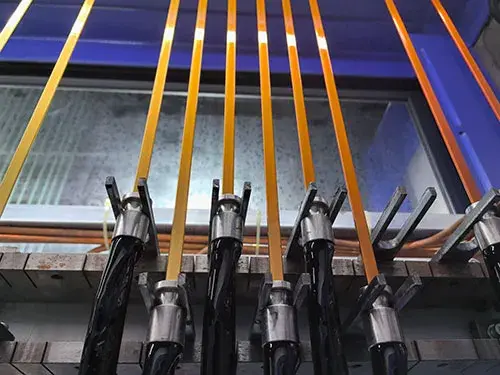
IEC 60317 Aluminum Winding Wire Selection Guide
Selection Steps
Step 1: Determine Application Scenario
Determine the application scenario based on equipment type, working environment, and load characteristics.
Step 2: Determine Temperature Class
Choose the temperature class based on the equipment working temperature. Common choices: Class 130 (Class B), Class 155 (Class F), Class 180 (Class H), Class 200 (Class C).
Step 3: Select Insulation Enamel Type
Choose the insulation enamel type based on the requirements of temperature resistance, chemical resistance, and electrical performance. Common choices: polyester, polyester-imide, polyamide-imide.
Step 4: Determine Conductor Specification
Choose the conductor specification based on current carrying capacity, voltage class, and mechanical strength. Considerations: resistance, cross-sectional area, weight.
Step 5: Select Conductor Shape
Choose round or rectangular wire based on the equipment structure. Transformers often use rectangular wires, and motors often use round or rectangular wires.
Step 6: Verify Standard Compliance
Confirm that the selected aluminum wire complies with the relevant IEC 60317 standard requirements.
Selection Considerations
Electrical Factors
Current carrying capacity, voltage class, working frequency, skin effect, eddy current loss.
Thermal Factors
Working temperature, temperature rise limit, heat dissipation conditions, short-term overload capacity.
Mechanical Factors
Tensile strength, elongation, bending radius, vibration environment.
Economic Factors
Initial cost, operating efficiency, maintenance cost, full life cycle cost.
Environmental Factors
Working environment temperature, humidity, corrosive gases, altitude.
Future Development Trends of IEC 60317 Aluminum Winding Wires
High-Temperature Class Aluminum Wire
With the increasing demand for high-temperature applications such as new energy, rail transit, and aerospace, the demand for Class 220 and Class 250 aluminum enameled wires is growing. The application of new materials (polyimide, polybenzimidazole, etc.) will promote the development of high-temperature aluminum wires.
High-Strength Aluminum Wire
The application of high-strength aluminum alloy wires (Al-Mg-Si, Al-Zr, etc.) will improve the mechanical properties of aluminum wires and expand the application of aluminum wires in high-performance motors and transformers.
Large-Size Rectangular Aluminum Wire
With the rapid development of new energy vehicles, the demand for large-size rectangular aluminum wires (width 10-20mm, thickness 2-6mm) is increasing.
High-Frequency Application Aluminum Wire
With the development of wireless charging and high-frequency power supplies, the demand for high-frequency aluminum winding wires is increasing. Problems such as skin effect and eddy current loss need to be solved.
Intelligent Manufacturing
Intelligent manufacturing of aluminum enameled wires will become a trend. Automated production lines, online inspection, and intelligent logistics will improve production efficiency and product quality.
Standardization Unification
With the process of globalization, aluminum wire standards will become more unified. The revision and update of IEC 60317 standards will become more frequent, and the correspondence with regional standards (GB/T, NEMA, JIS) will become clearer.
Summary
IEC 60317 is the core standard of the winding wire industry, covering round and rectangular aluminum wires, multiple temperature classes, and multiple enamel types of aluminum winding wires. IEC 60317-0-3 and IEC 60317-0-4 are the general requirements standards for aluminum wires, and IEC 60317-12 to IEC 60317-78 specify the requirements for specific types of aluminum wires. Aluminum wire has the advantages of light weight, low cost, and abundant resources compared with copper wire, but also has the disadvantages of high resistivity, low mechanical strength, and welding difficulty. Aluminum wire is widely used in distribution transformers, small and medium motors, new energy vehicles, wind power, household appliances, and other fields. Selection requires comprehensive consideration of electrical, thermal, mechanical, economic, environmental, and other factors. The application of IEC 60317 standards ensures the quality of aluminum winding wires and promotes the healthy development of the industry. High temperature class, high strength, large size, and high-frequency application are the future development directions of aluminum winding wires.