


Introduction
Magnet wire, also known as enameled wire or winding wire, is a crucial basic material used for electromagnetic energy conversion in the electrical equipment manufacturing industry. Its quality directly determines the insulation reliability, operating efficiency, service life, and safety performance of electromagnetic components such as motors, transformers, relays, sensors, household appliances, rail transit traction systems, and new energy vehicle drive systems. In international and domestic standard systems such as ANSI/NEMA MW 1000-2018, IEC 60317 series, GB/T 23312 series, and ASTM D1676, magnet wire quality testing is clearly defined as “a systematic verification activity of conductor geometric accuracy, enameled coating integrity, electrical performance, mechanical performance, thermal performance, and chemical durability,” an indispensable technical link in the entire process of enameled wire industry from raw material verification to finished product delivery.
From an industrial practice perspective, quality testing is not an isolated inspection action, but a systematic project that spans the entire product lifecycle. Within the product manufacturer, quality testing is a core technical means for process control (IPQC) and outgoing quality control (OQC). On the purchasing side, quality testing is a key basis for supplier qualification, incoming quality control (IQC), and continuous quality monitoring. In failure analysis scenarios, quality testing is the engineering foundation for root cause identification and improvement verification.
The engineering answers to “How to Test Magnet Wire Quality” can be systematically explained from seven dimensions: testing standards, test item classification, testing methods and operating procedures, judgment criteria and acceptance criteria, testing equipment and calibration system, quality management system, and the evolution of testing trends. This article provides a systematic guide to testing methods and system construction solutions for enameled wire manufacturers, application engineers, quality engineers, and procurement engineers.
Testing Standards Framework
The international and domestic standards system for magnet wire quality testing is the fundamental basis for testing methods, judgment rules, and acceptance criteria. The standards system not only specifies the details of the test items, but also defines the entire process of technical specifications, including testing principles, equipment requirements, sample preparation, operating procedures, data processing, and conformity determination.
International Standards
The IEC 60317 series of standards are specialized standards for winding wires developed by the International Electrotechnical Commission (IEC), and are among the most influential technical specifications in the global magnet wire industry. This series is divided into dozens of parts based on enamel coating type, conductor material, and thermal rating: IEC 60317-0-1 specifies general requirements for enameled round copper wire; IEC 60317-0-2 specifies general requirements for enameled round aluminum wire; IEC 60317-0-3 specifies general requirements for enameled flat copper wire; IEC 60317-0-4 specifies general requirements for glass fiber wrapped wire; and IEC 60317-0-5 specifies general requirements for fiber-coated enameled copper round wire. The various specific standards of IEC 60317-X specify the specific technical requirements, test methods and judgment limits for specific enamel coating systems such as polyester-enameled wire, polyurethane-enameled wire, polyester-imide, polyamide-imide, polyimide, and composite coating.
ANSI/NEMA MW 1000-2018 is a North American standard for magnetic wire developed by the National Electrical Manufacturers Association (NEMA), covering nearly one hundred specifications (MW 1-C to MW 80-C range), each corresponding to a specific enamel coating system, thermal rating, and conductor material. ASTM D1676 is a test method standard for enamel-coated magnetic wire insulation developed by the American Society for Testing and Materials (ASTM), detailing the operational procedures, equipment requirements, and judgment criteria for dozens of test methods. JIS C 3202 is a Japanese Industrial Standard for enameled wire, primarily used in the Japanese and Southeast Asian markets.
Chinese National Standards
The GB/T 23312 series is a Chinese national standard (Guojiā Biāozhǔn, recommended national standard), which is equivalent to the technical content of the IEC 60317 series. GB/T 23312.1 specifies the general requirements for enameled round copper wire, GB/T 23312.2 specifies the general requirements for enameled round aluminum wire, and GB/T 23312.3 specifies the general requirements for enameled flat copper wire. The GB/T 6109 series is a standard for test methods for enameled wire, specifying the operating procedures and judgment rules for key test items such as breakdown voltage, enameled coating continuity, enameled coating thickness, and elongation.
Standard Hierarchy
The magnet wire standards system is structurally divided into three levels. General Requirements, at the top level, specify the basic requirements, test methods, judgment rules, and quality assurance system requirements for magnet wire. Particular Specifications, in the middle level, specify detailed test items and judgment limits for specific magnet wire systems, conductor materials, and thermal grades. Test Methods, at the foundation level, specify detailed operating procedures, equipment requirements, sample preparation, and data processing methods for specific test items.
When performing quality testing on magnet wire, test engineers should first determine the applicable standard system (IEC, NEMA, GB, JIS, ASTM), and then determine the test items, judgment limits, and operational details based on the specific specification number. In cross-border procurement scenarios, special attention should be paid to the differences between different standard systems to avoid deviations between test results and judgment conclusions due to misuse of standards.
Testing Categories and Engineering Indicators
Quality testing items for magnetic wires can be categorized into five main types based on their testing objectives: conductor testing, electrical testing, mechanical testing, thermal testing, and chemical testing. Each type of testing item corresponds to specific physical quantities, testing methods, judgment criteria, and engineering judgment standards.
Conductor Testing
The conductor is the main current-carrying component of the magnetic wire, and its quality directly determines the wire’s conductivity, mechanical strength, and processing performance. Conductor testing includes: conductor diameter testing (measuring the bare conductor diameter using a micrometer or optical diameter gauge, with the standard tolerance grade as the judgment standard); conductor resistance testing (measuring the resistance of a sample of specified length using a DC bridge or four-terminal resistance tester, calculating the resistivity based on the conductor material and cross-sectional area, with the deviation between the measured value and the standard value within the range specified in the standard); elongation testing (breaking a conductor of specified length using a universal testing machine, measuring the percentage elongation after breakage, with standard grade copper conductors exhibiting a high level of elongation); and conductor surface quality testing (visual inspection or microscopic examination of the conductor surface to check for defects such as cracks, peeling, inclusions, oxidation, and contamination).
Film Electrical Testing
The enamel coating is the core insulation of the magnetic wire, and its quality directly determines the electrical insulation performance of the magnetic wire. Electrical testing items for the enamel coating include: breakdown voltage test (applying an increasing AC voltage under standard electrode conditions until the enamel coating breaks down; the breakdown voltage of Class 200 enamel coatings should reach a considerably high level), continuity of insulation test (applying a specified DC voltage in a standard aqueous solution using the aqueous solution voltage method, with the enameled wire continuously passing through the solution tank; leakage paths are formed at pinholes or thin spots in the enamel coating; the defect density of Class 200 enamel coatings should be extremely low), dielectric loss tangent tanδ test (measuring the dielectric loss tangent of the enamel coating at a specific frequency, reflecting the energy loss characteristics of the enamel coating under an AC electric field), and DC withstand voltage test (applying a specified DC voltage to the surface of the enameled wire and maintaining it for a specified time, detecting whether the leakage current exceeds the standard limit).
Film Mechanical Testing
During use, the enamel coating is subjected to various mechanical stresses such as tension, bending, abrasion, and impact. Mechanical testing verifies the mechanical durability of the enamel coating, including: flexibility (the enamel coating should not crack when the enameled wire is pulled or wound rapidly on a mandrel of a specified diameter), adhesion (the enamel coating should not peel off from the conductor surface under tension, bending, or winding conditions), abrasion resistance (the enamel coating’s abrasion resistance is measured using an abrasion tester under standard load), cut-through temperature (the enamel coating is subjected to a specified pressure and heated to breakdown on a standard hot plate), and coefficient of friction (the static and dynamic coefficients of friction of the enamel coating are measured using the tension method).
Film Thermal Testing
The thermal stability of the enamel coating under operating temperature and short-term overheating conditions is a core indicator of the reliability of the magnet wire. This includes: thermal shock (the enamel coating should not crack after being placed in an oven at standard temperature for a specified time and then immediately wound; Class 200 enamel coatings can withstand relatively severe thermal shock conditions), softening temperature (the enamel coating should not break down after applying a specified pressure and holding it for a specified time on a hot plate at standard temperature), temperature index (long-term thermal aging test performed according to IEC 60216 standard, extrapolating the highest operating temperature of the enamel coating under standard life using the Arrhenius curve; the temperature index of Class 200 enamel coatings should reach above 200°C), and thermal endurance (predicting the long-term service life of the enamel coating at a specific operating temperature based on the Arrhenius kinetic model).
Film Chemical Testing
In special application environments, enamel coatings must possess the following chemical durability properties: solderability (enameled wire products should be able to be directly wetted by molten solder after immersion in a solder bath at standard temperature for a specified time, and the wetting area should meet standard requirements), solvent resistance (enamel coatings should not exhibit significant swelling, blistering, peeling, or performance degradation after immersion in standard solvents for a specified time), chemical resistance (specific tolerance tests for transformer oil, ATF oil, refrigerants R1234yf and R32, battery electrolytes, acid and alkali solutions, etc.), oil resistance (enameled wire products should be evaluated for swelling, blistering, and breakdown voltage changes after immersion in standard test oil for a specified time), and hydrolysis resistance (enameled wire products should undergo hydrolysis stability tests under high temperature and high humidity conditions).
Testing Methods and Procedures
The standard operating procedures and judgment criteria for major test items form the engineering foundation of quality testing. This section describes the operating steps and judgment criteria for key test items.
Breakdown Voltage Test Method
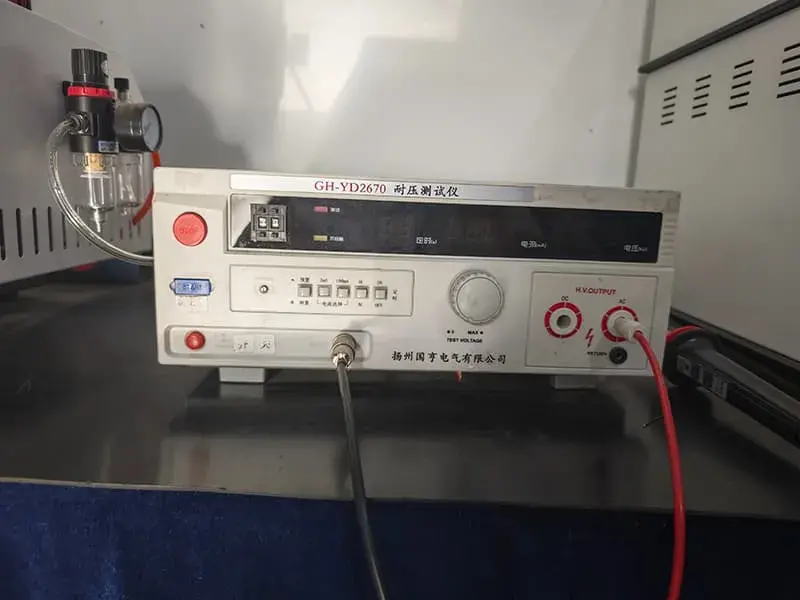
The breakdown voltage testing equipment is a breakdown voltage tester (including a high-voltage transformer, standard electrodes, a voltage controller, a breakdown detection circuit, and a safety interlock device). Test procedure: Cut a sample to a specified length, remove the enamel coating from both ends to expose the conductor; install the standard electrode (cylindrical), ground the conductor, and apply high voltage to the electrode; increase the AC voltage at a standard specified rate until the enamel coating breaks down, and the breakdown detection circuit records the breakdown voltage value; take the median value from multiple measurements and calculate the breakdown field strength (breakdown voltage divided by the enamel coating thickness). Judgment criteria: Determine the breakdown voltage according to the lower limit of the corresponding specification number in the standard; Class 200 enamel coating round wires are considered to have a high breakdown strength level.
Continuity of Insulation Test Method
The enamel coating continuity test equipment is an enamel coating continuity tester (including a low-voltage power supply, a standard aqueous solution tank, a defect counter, and a wire routing mechanism). Test procedure: Cut a sample to a specified length; prepare a standard aqueous solution (containing a fixed amount of sodium chloride, surfactant, and deionized water); continuously pass the enameled wire through the aqueous solution tank, grounding the conductor, and apply a specified DC voltage to the aqueous solution; when pinholes or thin spots are present in the enamel coating, the current loop closes, and the defect counter records the defect. Judgment criteria: Determination is based on the upper limit of the number of defects within the specified length in the standard; the defect density of Class 200 enamel coatings should be extremely low.
Film Thickness Test Method
Method 1 for testing enamel coating thickness is the micrometer method: Measure the outer diameter D of the enameled wire (including the enamel coating), remove the enamel coating, and then measure the diameter d of the bare conductor. The enamel coating thickness is half the difference between the two. Method 2 is the microscopic cross-section method: Mount the enameled wire sample, polish it, and observe the cross-section under a microscope. Measure the enamel coating thickness at multiple different locations and take the average value. The microscopic cross-section method is more accurate and allows direct observation of the enamel coating’s uniformity, defect distribution, and interface condition. Judgment criteria: According to NEMA MW 1000-2018 enamel coating thickness grade standard, Class 200 enamel coating belongs to the standard thickness grade.
Flexibility and Thermal Shock Test
enamel coating flexibility test: Take a sample of specified length and rapidly pull the enameled wire on a mandrel of specified diameter. The enameled coating should not crack. Thermal shock test: Take a sample of specified length and place the enameled wire in a standard temperature oven for a specified time. Immediately remove it and wind it on a mandrel of specified diameter. The enameled coating should not crack. Criterion: Under magnification, no visible cracks should be found in the enameled coating.
Solderability and Elongation Test
Solderability Test (for direct solderability products): Heat the solder pot to the standard temperature; determine the immersion time according to the wire diameter; immerse the sample in the solder pot for the specified time; remove and cool, then observe the wetting condition. Judgment Criteria: The wetting area should meet the standard requirements, with no cold solder joints or unsoldered areas.
Conductor elongation test: Cut a specimen of a specified length (remove enamel coating); clamp both ends in a universal testing machine; stretch at a constant speed according to the standard specification until fracture; calculate the elongation using the standard formula. Judgment criteria: judged according to conductor class; Class 2 copper conductors are considered high elongation class.
Testing Equipment and Quality System
The configuration and calibration of quality testing equipment, as well as the establishment of a testing quality management system, are the fundamental guarantees for the reliability of test results.
Essential Testing Equipment
The manufacturer’s testing center should be equipped with a complete testing equipment system. Core equipment includes: a breakdown voltage tester (AC high voltage continuously adjustable, electrode system conforming to IEC 60851 standard), a continuity tester (with standard test length and automatic defect counting), a micrometer (high precision level), a thickness microscope (with high magnification and high measurement accuracy), a universal testing machine (high precision elongation measurement), a thermal shock test chamber (temperature coverage of the enameled wire thermal grade range), a softening breakdown tester (standard temperature hot plate + voltage testing system), a soldering furnace (standard temperature range controllable), a DC bridge (high precision level), an eddy current flaw detector, and a laser diameter gauge.
Auxiliary equipment includes specialized equipment such as constant temperature and humidity test chambers, oil resistance test devices, refrigerant test devices, salt spray test chambers, and ultraviolet aging test chambers.
Calibration and Quality Management
Test equipment should be calibrated regularly and traceable to national or international metrological standards. Calibration cycles are as follows: voltage equipment annually, length equipment semi-annually, temperature equipment semi-annually, mechanical equipment annually, and electrical equipment annually. Calibration organizations should possess national metrological certification (CMA) or China National Accreditation Service for Conformity Assessment (CNAS) accreditation. Test laboratories should establish complete equipment files and calibration plans, and obtain ISO/IEC 17025 laboratory accreditation.
Manufacturers should establish a complete quality management system: ISO 9001 (Quality Management System Certification), ISO 14001 (Environmental Management System Certification), ISO 45001 (Occupational Health and Safety Management System Certification), and IATF 16949 (Automotive Industry Quality Management System Certification).
Incoming quality control (IQC) by the purchaser should be conducted according to the AQL (Acceptable Quality Level) sampling plan. Core test items include conductor diameter and resistance, coating continuity, breakdown voltage, coating flexibility, coating thickness, and elongation. Judgment rules are applied according to different AQL levels, commonly including 0.65, 1.0, and 1.5.
Each batch of magnet wire should be accompanied by a complete Mill Test Certificate (MTC) upon leaving the factory. The report should include specifications/models and batch number, conductor material and diameter, enamel coating type and grade, thermal rating, measured values and judgment limits for each test item, test date and tester, quality inspection stamp, and manufacturer’s stamp. The test report should be kept permanently to establish a batch traceability system.
Testing Optimization and Emerging Technologies
Magnet wire quality testing is evolving from offline sampling to online full inspection, from destructive testing to non-destructive testing, and from manual interpretation to data-driven intelligent interpretation. Emerging technologies are reshaping the engineering paradigm of magnet wire quality testing.
Online Testing Systems
Modern enameled wire production lines are equipped with online quality monitoring systems. Online continuous testing of the enameled wire coating enables continuous monitoring of every roll of wire on the production line, with real-time display and recording of defects. Online breakdown voltage testing enables periodic sampling tests, automatically marking and rejecting defective products. Online conductor diameter monitoring uses a laser diameter gauge to display real-time trends in wire diameter fluctuations. Online enameled wire coating thickness monitoring uses X-ray fluorescence or laser thickness measurement technology to achieve real-time monitoring of the coating thickness. Online eddy current testing enables automatic detection of internal conductor defects. The advantages of the online monitoring system lie in its real-time performance, continuity, and comprehensive coverage, enabling timely detection of production anomalies, tracing the root cause of problems, adjusting process parameters, and reducing the defect rate.
Non-Destructive Testing
Non-destructive testing (NDT) reduces material loss caused by destructive testing, improving testing efficiency and economy. Dielectric spectroscopy analysis assesses chemical structure changes and aging levels of the enamel coating by measuring its dielectric constant and tanδ. Infrared thermography identifies enamel coating defects by analyzing surface temperature distribution. Ultrasonic testing evaluates the thickness and integrity of the enamel coating by analyzing the propagation characteristics of ultrasonic waves within it. Machine vision, using high-resolution cameras and AI algorithms, identifies defects such as pinholes, blistering, peeling, and contamination on the enamel coating surface.
Data-Driven Quality Management
Quality management methods based on big data and machine learning are reshaping the quality control paradigm in the magnet wire industry. Process parameter-quality mapping models establish predictive models for key quality indicators such as magnet coating thickness, breakdown voltage, and magnet coating continuity, enabling a quantitative assessment of the impact of process parameters on quality. Anomaly detection, based on Statistical Process Control (SPC) and AI algorithms, identifies quality anomalies in the production process in real time. Lifetime prediction, based on historical test data and accelerated aging models, predicts the long-term reliability of magnet wire in specific application environments.
Conclusion
The engineering answer to “How to Test Magnet Wire Quality” can be summarized as follows: Based on international and domestic standards such as IEC 60317, NEMA MW 1000-2018, and GB/T 23312, systematically verify the quality of the magnet wire according to five major categories of test items: conductor, electrical, mechanical, thermal, and chemical.
Test methods should strictly follow the operating procedures specified in the standards to ensure the comparability, repeatability, and traceability of test results. Test equipment should be calibrated regularly and traceable to national metrological standards to ensure the engineering accuracy of test data. The quality system should be certified by third parties such as ISO 9001 and IATF 16949 to ensure the systematization and continuous improvement of quality management.
With the digital transformation and high-end upgrading of the wire manufacturing industry, quality testing is evolving from offline sampling inspection to online full inspection, from destructive testing to non-destructive testing, and from manual interpretation to data-driven intelligent interpretation. Emerging technologies such as online monitoring systems, dielectric spectrum analysis, machine vision, and machine learning algorithms will become the core methodologies for the next generation of high-end wire quality management.
For manufacturers of electromagnetic wire, building comprehensive testing capabilities, cultivating a professional testing team, adopting advanced testing equipment, and implementing a data-driven quality management model are essential for enhancing product competitiveness and winning market share in the high-end market. For application engineers and procurement engineers, a deep understanding of the engineering implications of electromagnetic wire quality testing, precise selection based on application scenarios, and rigorous implementation of incoming material inspection and supplier evaluation are key measures to ensure the reliability of electromagnetic components and the competitiveness of end products.
About the Author
Zhengzhou LP Industry Co., Ltd. is a source manufacturer of enameled wire with 30 years of export experience. With a modern 60-acre production base, it specializes in manufacturing copper/aluminum/copper-clad aluminum enameled round wire, flat wire, and square wire, offering a full range of heat treatment grades. Certified by ISO 9001/14001/45001, UL, REACH, and RoHS, its products are exported to over 50 countries.
Contact Information: – 📧 Email:<office@cnlpzz.com> – 📱 WhatsApp: 0086-19337889070 – 🌐 Website:<https://lpenamelwire.com/>