

Introduction
The insulating enamel coating on magnet wire serves as the critical electrical isolation barrier for coil windings. The enamel film—comprising polyurethane, polyester, polyester-imide, polyamide-imide, or polyimide—applied over copper conductors typically measures only 18 to 100 µm in thickness, yet must withstand winding stresses, thermal aging, and prolonged exposure to chemical agents. When end applications require direct exposure of the copper conductor—for example, resistance spot welding, low-voltage terminal connections, scrap copper recycling, tinning of transformer lead wires, or laboratory sample preparation—the enamel coating must be completely removed without damaging the underlying copper substrate. This article systematically reviews five proven enamel removal methods validated across industrial and laboratory environments, covering fine wires (AWG 30–40) processed manually in field settings up to heavy round wires (diameter > 5 mm) handled in high-volume industrial production. A comparative engineering analysis is provided across five dimensions: compatibility with enamel type, stripping quality, copper conductor loss, equipment cost, and constraints related to safety and environmental compliance—enabling process engineers, maintenance technicians, educators, and recyclers to select the optimal method for their specific application.
Mechanical Scraping
Principle and Applicable Scenarios
The mechanical scraping method removes the insulation coating from copper conductors by physically disrupting the surface integrity of the enamel film via friction or cutting. This method relies on the hardness of the tool’s cutting edge or abrasive particles being higher than that of the enamel but lower than that of pure copper, thereby enabling enamel removal without significant damage to the copper substrate. Its defining characteristics are zero thermal input and no chemical involvement, making it the most fundamental and universally applicable technique. It is suitable for round magnet wire with diameters ranging from 0.5 mm to 5 mm and rectangular (flat) magnet wire with widths from 2 mm to 10 mm. It remains indispensable for small-batch applications such as field emergency repairs, instructional demonstrations, and laboratory sample preparation.
Tool Types and Process Key Points
Common mechanical scraping tools include utility knives or razor blades, fine-grit sandpaper (400–1000 mesh), half-round needle files, and dedicated magnet wire enamel scrapers. During operation, the wire is secured in a bench vise or auxiliary fixture; the tool is then moved radially or axially across the enamel surface for 3–5 reciprocating strokes until uniform copper metallic luster is exposed. In the sandpaper method, the wire is rubbed back and forth across folded sandpaper, relying on the micro-cutting action of abrasive particles to remove the enamel. Dedicated enamel scrapers integrate a handle and blade slot, optimizing them for repetitive field operations.
Critical Parameters and Quality Control
Uniformity of enamel removal primarily depends on scraping angle, applied force, and number of strokes. An excessively steep angle risks cutting into the copper substrate, causing visible scratches; an overly shallow angle fails to effectively disrupt enamel adhesion. Excessive force causes significant loss of copper cross-sectional area, impairing subsequent current-carrying capacity; insufficient force leaves residual enamel fragments, compromising solderability or electrical contact. Quality acceptance is based on visual inspection: uniformly bright copper color, absence of dark spots or residual enamel specks. When necessary, verification is performed using a 10× magnifier.
Advantages, Disadvantages, and Application Boundaries
The primary advantages of mechanical scraping are extremely low equipment cost, immediate operability, and absence of chemical or thermal hazards. Its disadvantages include low efficiency—rendering it unsuitable for high-volume processing—high dependence on operator skill for process consistency, susceptibility to copper wire breakage when applied to ultra-fine wire (diameter < 0.3 mm), and significantly increased difficulty in removing high-strength enamel systems such as polyamide-imide (PAI) and polyimide (PI).
Thermal Stripping
Principle and Thermal Decomposition Mechanism of the Enamel Coating
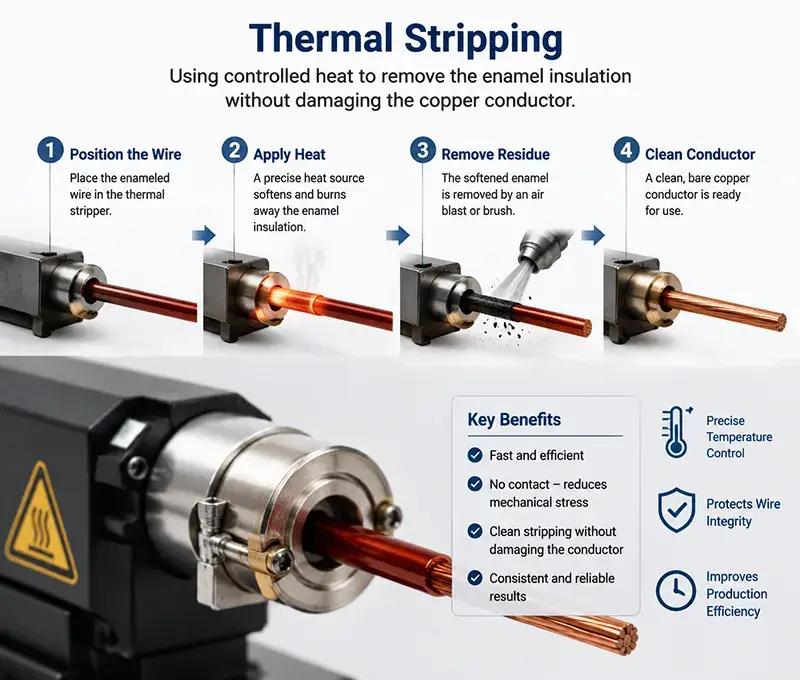
Thermal stripping exploits the thermal oxidative decomposition or pyrolysis reactions of polymeric materials in the enamel coating at elevated temperatures, converting the insulation layer into ash or carbonized residue that can be wiped or peeled off. The onset decomposition temperature of the main resin in the enamel varies with its chemical structure: polyurethane enamel begins decomposing at approximately 250–300 °C; polyester enamel at ~350 °C; polyester-imide enamel at ~380 °C; polyamide-imide enamel at ~400 °C; and polyimide enamel at >450 °C. During heating, the enamel undergoes three sequential stages—softening, blistering, and carbonization—after which it can be removed using a steel brush or cotton cloth.
Tool Types and Operating Procedures
Common heat sources include soldering irons (soldering temperature: 350–450 °C), hot-air guns (adjustable range: 200–500 °C), butane lighters, or gas torches (flame temperature: ~1000–1300 °C). In the soldering iron method, the preheated tip is applied directly to the end of the enameled wire for 5–15 seconds; once the enamel is charred and blackened, it is removed using sandpaper or a steel brush. The hot-air gun method employs uniform, non-contact heating and is suitable for larger surface areas or longer wire segments. In the lighter method, the wire is briefly passed through the outer flame zone for 2–4 seconds, relying on convective and radiative heat transfer to combust and decompose the enamel.
Critical Parameters and Copper Conductor Protection
The primary risk associated with thermal stripping is oxidation of the copper substrate. Copper begins significant oxidation to cuprous oxide (Cu₂O) above 200 °C; oxidation accelerates above 400 °C, forming cupric oxide (CuO). This black oxide layer not only impairs subsequent solderability but also reduces electrical conductivity. Mitigation strategies include: minimizing heating duration (recommended single-cycle heating time ≤15 seconds); selecting temperature-controlled heat sources (e.g., soldering irons or hot-air guns) over open flames; immediately wiping off the oxide layer post-heating using alcohol-soaked cotton swabs or fine-grit sandpaper; and prioritizing chemical stripping—rather than thermal stripping—for high-temperature enamels such as polyimide.
Advantages, Disadvantages, and Applicability Boundaries
Thermal stripping benefits from widespread equipment availability, rapid operation, and no special facility requirements, making it especially suitable for on-site emergency stripping and single-point terminal processing. Its disadvantages include poor temperature precision, significant copper oxidation risk, low efficiency on high-temperature-resistant enamels (e.g., polyimide), and emission of hazardous fumes containing aromatic amines and aldehydes—requiring operation inside a fume hood or outdoors. In high-volume production, thermal stripping exhibits inferior energy efficiency and process consistency compared to chemical or mechanical rotary stripping methods.
Chemical Solvent Method
Paint Film Dissolution Mechanism and Solvent Systems
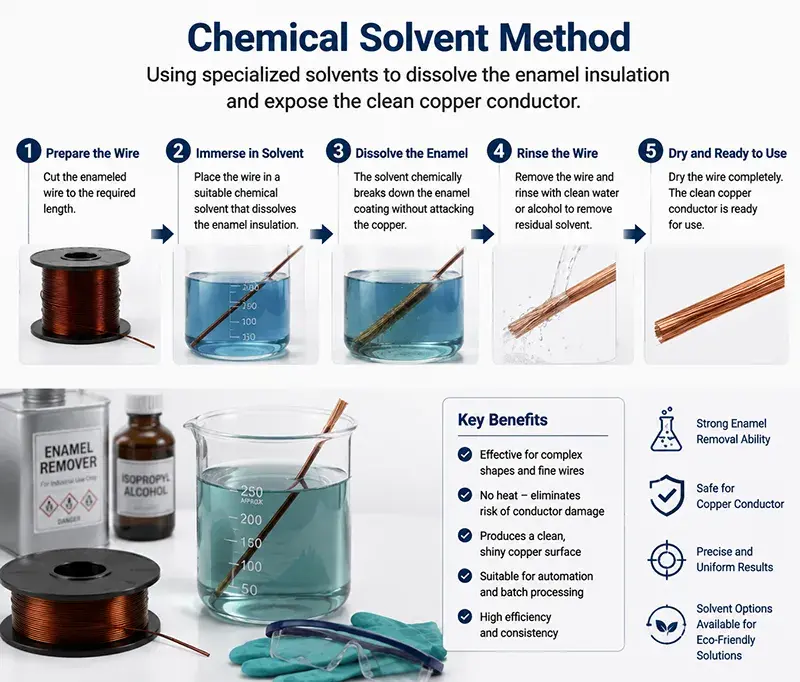
The chemical solvent method removes enamel coatings by swelling, penetrating, and chemically cleaving the polymeric resin matrix of the enamel film using organic solvents or alkaline aqueous solutions. Enamel resin undergoes four sequential stages—penetration, swelling, dissolution, and delamination—in a compatible solvent, ultimately detaching from the copper conductor as residue or an emulsion. Common solvent systems include: ketone solvents such as acetone, methyl ethyl ketone (MEK), and methyl isobutyl ketone (MIBK), which exhibit excellent solubility for polyurethane enamel; chlorinated hydrocarbons such as methylene chloride and 1,1-dichloroethylene, which demonstrate high efficacy against polyester and polyester-imide enamels; polar aprotic solvents such as N-methyl-2-pyrrolidone (NMP) and dimethylformamide (DMF), which possess the strongest dissolving power for polyamide-imide and polyimide enamels; and strong acids such as concentrated sulfuric acid and concentrated nitric acid, which degrade virtually all organic enamel films via oxidative bond scission.
Process Flow and Operating Parameters
The standard chemical stripping process comprises five steps: pre-cleaning, solvent immersion, enamel delamination, post-cleaning, and drying. Pre-cleaning employs isopropyl alcohol to remove surface oils and particulate contaminants from wire surfaces. Solvent immersion is conducted at temperatures ranging from 20 °C to 80 °C for durations of 5 to 120 minutes; higher temperatures accelerate dissolution kinetics but concurrently increase solvent volatility and safety hazards. During the enamel delamination stage, ultrasonic agitation or mechanical stirring may be applied to expedite detachment of the swollen enamel layer from the copper surface. Post-cleaning involves rinsing with deionized water or alcohol to remove residual solvent. Final drying proceeds either by ambient air-drying or low-temperature oven drying. Polyurethane enamel typically softens and detaches after 10–30 minutes of room-temperature acetone immersion; polyimide enamel requires immersion in NMP at 80 °C for ≥60 minutes.
Critical Parameters and Copper Corrosion Mitigation
A primary risk associated with chemical stripping is corrosion of the copper substrate. Strong acid systems (e.g., concentrated sulfuric acid, concentrated nitric acid) cause significant copper corrosion; immersion time must therefore be strictly limited (typically ≤30 seconds) and conducted predominantly at ambient temperature, followed immediately by thorough water rinsing and neutralization. Ammonia–hydrogen peroxide mixtures also corrode copper and are employed only transiently under specific conditions. Strong alkalis (e.g., sodium hydroxide) exhibit comparatively low copper corrosion potential and constitute the principal active ingredient in industrially prevalent alkaline strippers; however, their efficacy against polyimide enamel is limited.
Advantages, Disadvantages, and Applicability Boundaries
The principal advantage of the chemical solvent method lies in its high batch-processing capacity and superior adaptability to complex wire geometries—including stranded wires and coil terminations. Key disadvantages include solvent toxicity (e.g., NMP exhibits reproductive toxicity; methylene chloride is carcinogenic), volatile organic compound (VOC) emissions, and safety hazards (chlorinated hydrocarbons are non-flammable but their vapors are hazardous); high-cost waste-liquid treatment is mandatory, requiring classification and recovery as hazardous waste per applicable regulatory frameworks; stringent personnel protection requirements mandate full personal protective equipment (PPE), including fume hoods, respirators, and chemical-resistant gloves.
Hot Alkaline Solution Method
Principle and Lacquer Film Hydrolysis Mechanism
The hot alkaline solution method employs a sodium hydroxide (NaOH) aqueous solution at elevated temperatures to saponify ester bonds or hydrolyze amide bonds within the polymer lacquer film, thereby cleaving the resin macromolecular chains into water-soluble oligomers or monomers, which are ultimately stripped from the copper surface. This method exhibits high efficacy for lacquer films containing ester bonds—such as polyester, polyester-imide, and polyurethane—but limited effectiveness against polyimide (which lacks both ester and amide bonds). Typical NaOH concentration ranges from 5% to 20% (mass fraction), operating temperature from 80 °C to 100 °C, and treatment duration from 10 to 60 minutes.
Process Equipment and Operational Procedure
Typical equipment for the hot alkaline solution method consists of a stainless-steel or polytetrafluoroethylene (PTFE)-lined tank equipped with heating and temperature control; scale ranges from laboratory beakers (500 mL) to industrial stripping tanks (hundreds of liters). The process sequence includes: preparation and heating of the alkaline solution (gradually ramping temperature from 70 °C to the target operating temperature to prevent localized boiling and splashing); immersion of wire specimens for the prescribed duration; immediate thorough rinsing with warm deionized water post-treatment to remove residual alkali; neutralization via immersion in a dilute hydrochloric acid (HCl) bath (1%–5%) for 30–60 seconds; and final rinse with deionized water followed by drying.
Critical Parameters and Copper Substrate Protection
Hot alkaline solutions induce only mild corrosion of copper, with oxidation representing the primary risk. Under high-temperature alkaline conditions, copper surfaces readily form copper oxide (CuO) or copper hydroxide [Cu(OH)₂] layers, adversely affecting subsequent solderability. Mitigation strategies include: addition of 0.5%–2% sodium nitrite (NaNO₂) or potassium dichromate (K₂Cr₂O₇) to the alkaline solution as copper corrosion inhibitors; strict adherence to treatment time—no longer than required for complete lacquer removal (maximum 60 minutes); and immediate soldering or application of anti-oxidation coatings following neutralization. Sodium nitrite is widely adopted due to its ability to form a dense passivation layer on copper surfaces under strongly alkaline, high-temperature conditions; however, its inherent toxicity necessitates segregated treatment of spent alkaline waste solutions.
Advantages, Disadvantages, and Applicability Boundaries
The hot alkaline solution method is one of the most mature, large-scale industrial processes for magnet wire insulation removal. It offers excellent process stability, low operational cost, and simple equipment requirements—making it especially suitable for batch stripping applications in transformer manufacturing, motor repair workshops, and recycled copper recovery facilities. Key disadvantages include ineffectiveness against polyimide insulation; stringent requirements for precise control of temperature and time—over-treatment leads to copper oxidation and excessive alkali consumption; and the need for periodic replenishment and replacement of the alkaline solution, with spent solutions containing high concentrations of sodium salts requiring neutralization and dilution prior to discharge.
Mechanical Rotary Stripping
Principle and Tool Geometry
Mechanical rotary stripping employs dedicated electric or pneumatic wire strippers as actuators. High-speed rotating annular or semi-circular blades apply precise radial cutting force to the wire, removing the outer enamel coating without severing the copper conductor. Blade geometric parameters—including cutting edge angle, rake angle, and clearance angle—are optimized; typical cutting depth is controlled within the enamel thickness range (10–100 µm), leveraging the hardness differential between the blade and the copper substrate to achieve selective material removal.
Equipment Types and Applicable Wire Gauges
Equipment is categorized by automation level into handheld wire strippers, semi-automatic wire strippers, and fully automatic wire strippers. Handheld wire strippers integrate jaws and blades, suitable for on-site processing of round enameled wire from AWG 10 to AWG 30. Semi-automatic wire strippers are triggered via foot pedal or push-button operation, ideal for repetitive enamel removal on fine wires from AWG 18 to AWG 40. Fully automatic wire strippers integrate wire feeding, length setting, stripping, and cutting functions, capable of processing wires from AWG 14 to AWG 42 at speeds up to several tens of meters per minute. By wire geometry, equipment is further classified as round-wire-specific or rectangular-wire-specific: round-wire blades feature V-shaped or semi-circular profiles, whereas rectangular-wire blades employ rectangular slot geometries.
Process Parameters and Quality Control
Key process parameters include blade rotational speed (typically 600–3000 rpm), feed rate (10–100 mm/s), stripping length (adjustable, typically 3–25 mm), and blade wear compensation. Quality control relies on visual inspection of stripped sections for uniform copper color, absence of scratches, and no residual enamel. Where required, peel adhesion testing (measuring interfacial bond strength between enamel coating and copper substrate) is performed to verify complete enamel removal. Blade service life is influenced by enamel type and wire gauge; polyimide enamel causes the most rapid blade wear, while carbide or diamond-coated blades extend service life by a factor of 3–5.
Advantages, Disadvantages, and Application Boundaries
The principal advantages of mechanical rotary stripping are high throughput, excellent process consistency, and operational simplicity—making it ideal for high-volume industrial applications such as motor manufacturing, transformer winding, and electronic component lead processing. Equipment investment ranges from several hundred RMB (handheld tools) to several hundred thousand RMB (fully automated lines). Key limitations include extremely stringent blade precision requirements for ultra-fine wires (AWG 40 and finer), resulting in sharply escalating equipment costs; poor adaptability to rectangular wires, shaped wires, and stranded wires—necessitating specialized fixtures and blades; and increased maintenance costs and downtime due to periodic blade replacement and calibration.
Engineering Comparison and Selection Matrix of Five Methods
Compatibility Comparison by Enamel Type
Significant differences exist in the response of various enamel resin systems to the five methods. Polyurethane enamel (UEW) exhibits the highest chemical reactivity, showing high sensitivity to acetone, hot alkaline solution, and soldering iron methods; polyester enamel (PEW) demonstrates enhanced chemical resistance, requiring methyl ethyl ketone (MEK) or hot alkaline solution at elevated temperatures; polyester-imide enamel (EIW) necessitates highly polar solvents such as N-methyl-2-pyrrolidone (NMP) or dimethylformamide (DMF); polyamide-imide enamel (AIW) possesses excellent chemical resistance, responding effectively only to strong polar solvents like NMP under heated conditions; polyimide enamel (PIW) exhibits near-complete resistance to all ambient-temperature chemical methods and requires either prolonged high-temperature treatment with hot alkaline solution or mechanical removal.
Efficiency and Cost Comparison
Ranked by desizing time per 1-meter length of magnet wire: chemical solvent immersion (batch processing) is fastest, enabling simultaneous treatment of dozens of wires in a single tank; mechanical rotary method ranks second, achieving throughput of tens of meters per minute on automated lines; hot alkaline solution method is moderate, permitting batch processing but requiring 30–60 minutes of immersion; thermal stripping is point-specific, taking 5–15 seconds per spot but unsuitable for batch processing; mechanical scraping is slowest, requiring 1–5 minutes per wire. Regarding equipment and operational costs: mechanical scraping incurs the lowest cost (tooling only); thermal stripping follows (heating equipment); hot alkaline solution method is mid-range (tank setup and heating required); chemical solvent method carries higher costs due to solvent consumption and wastewater treatment; mechanical rotary method entails the highest capital investment.
Safety and Environmental Comparison
Mechanical scraping presents virtually no safety or environmental hazards; thermal stripping poses risks of fume inhalation and copper oxidation, mandating adequate ventilation; chemical solvent method involves the highest solvent toxicity, requiring full personal protective equipment (PPE) and solvent recovery systems; hot alkaline solution method primarily entails risks of thermal alkali burns and caustic mist irritation, with high-pH effluent requiring neutralization prior to disposal; mechanical rotary method presents moderate mechanical injury risk, necessitating noise and dust control measures. Overall, mechanical scraping and mechanical rotary methods deliver the best safety and environmental performance, whereas chemical solvent method carries the highest risk profile.
Selection Decision Matrix
Selection by wire gauge: ultra-fine wire (AWG 30 and finer) is best suited for mechanical scraping or dedicated fine-wire strippers; medium-fine wire (AWG 18–30) is compatible with mechanical rotary, thermal stripping, and hot alkaline solution methods; coarse wire (diameter > 1 mm) is preferably processed via mechanical scraping or batch chemical solvent treatment. Selection by enamel type: polyurethane and polyester enamels respond effectively to all five methods; polyimide enamel is removable only via prolonged hot alkaline treatment, mechanical scraping, or specialized strong solvents. Selection by production volume: single-piece or low-volume batches (< 10 pieces) are best handled by mechanical scraping or thermal stripping; medium-volume batches (10–1,000 pieces) suit mechanical rotary or hot alkaline solution methods; high-volume batches (> 1,000 pieces) are optimally processed using hot alkaline solution or chemical solvent methods.
Process Safety and Environmental Compliance
Personal Protective Equipment (PPE) Requirements
All wire stripping operations require operators to wear safety goggles and chemical-resistant gloves. Thermal stripping additionally mandates heat-resistant gloves and respiratory protection; chemical solvent stripping requires an organic vapor-filtering half-mask or supplied-air respirator; hot caustic solution stripping necessitates heat- and alkali-resistant gloves, face shield, and apron; mechanical rotary stripping requires noise-dampening earplugs and impact-resistant safety goggles. PPE integrity must be verified prior to operation, and gloves must not contact high-temperature surfaces or strong acids/alkalis during operation.
Ventilation and Waste Liquid Management
Thermal stripping must be conducted inside a fume hood or in a well-ventilated open area; open flames are strictly prohibited in the work zone. Chemical solvent stripping likewise requires forced ventilation, with vapor concentrations maintained below occupational exposure limits. Hot caustic solution stripping requires edge-extraction ventilation at the tank to minimize alkali mist dispersion. Waste liquids shall be segregated and collected: organic solvent waste classified as HW06 hazardous waste shall be disposed of by qualified licensed entities; copper-containing alkaline waste classified as HW22 copper-bearing waste shall be processed accordingly; acidic waste shall first undergo neutralization before discharge as inorganic wastewater. All waste liquid containers must be clearly labeled with composition, concentration, date, and operator name.
Process Documentation and Quality Traceability
Industrial-grade wire stripping operations shall maintain batch records including enamel type, wire diameter specification, stripping method, critical parameters (temperature, time, concentration), operator identification, and inspection results. Quality traceability records shall be retained for a minimum of 5 years to facilitate root-cause analysis in case of process deviations. Quality inspection items include visual assessment of uniform copper color, peel strength testing (adhesion strength between polyimide enamel and copper substrate), solderability verification (solder wetting time), and conductivity testing (to ensure copper substrate integrity is preserved during stripping).
Conclusion
The enamel removal process for magnet wire—though seemingly a final-stage operation—plays a critical role across multiple domains, including transformer manufacturing, motor repair, recycled copper recovery, and education/research. The five mainstream methods—mechanical scraping, thermal stripping, chemical solvent immersion, hot alkaline solution treatment, and mechanical rotational stripping—each rely on distinct physical and chemical principles and are selected based on enamel type, wire gauge, batch size, and safety/environmental constraints. For polyurethane- and polyester-based enamels, method selection offers the broadest flexibility; in contrast, polyimide enamels—owing to their exceptional chemical and thermal resistance—require aggressive solvents, high-temperature alkaline solutions, or specialized mechanical cutting tools. In industrial practice, methods are frequently combined according to enamel specification standards (IEC 60851, NEMA MW 1000 series), on-site equipment capabilities, batch volume, and environmental regulatory requirements—for instance, coarse removal via hot alkaline solution followed by precision finishing via mechanical rotational stripping—to balance efficiency, quality, and copper substrate protection. With tightening environmental regulations, greener alternatives—including aqueous-based strippers, low-temperature plasma stripping, and supercritical carbon dioxide extraction—are expected to gain traction, offering reduced environmental impact while preserving the process maturity of conventional methods—representing a key direction in the evolution of magnet wire enamel removal technology.