


Enameled Copper Wire (ECW), a critical winding material for core electrical equipment—including motors, transformers, inductors, relays, and sensors—requires accurate identification of product specifications and precise interpretation of technical datasheets. This is essential for procurement engineers, motor repair technicians, winding technicians, quality control personnel, and design engineers. ECW labels and technical datasheets contain numerous technical parameters: product identification, conductor specifications, enamel type, thermal class, dielectric breakdown voltage, mechanical properties, chemical resistance, packaging specifications, and certification markings. Furthermore, discrepancies exist among international standard systems—including NEMA MW 1000, IEC 60317, GB/T 6109, and JIS C 3202—in naming conventions, parameter definitions, and test methods. This article systematically addresses the fundamental structure of ECW labels; interpretation of key product codes and model designations; differences among international standard systems; conductor specifications; enamel class and enamel type; thermal class and insulation class; electrical properties; mechanical properties; color coding; packaging information; certification markings; practical application of technical datasheets; selection decision workflow; real-world case studies; and common misconceptions—aiming to equip readers with comprehensive competence in interpreting ECW labels and technical datasheets.
Basic Structure of Enameled Copper Wire Labels
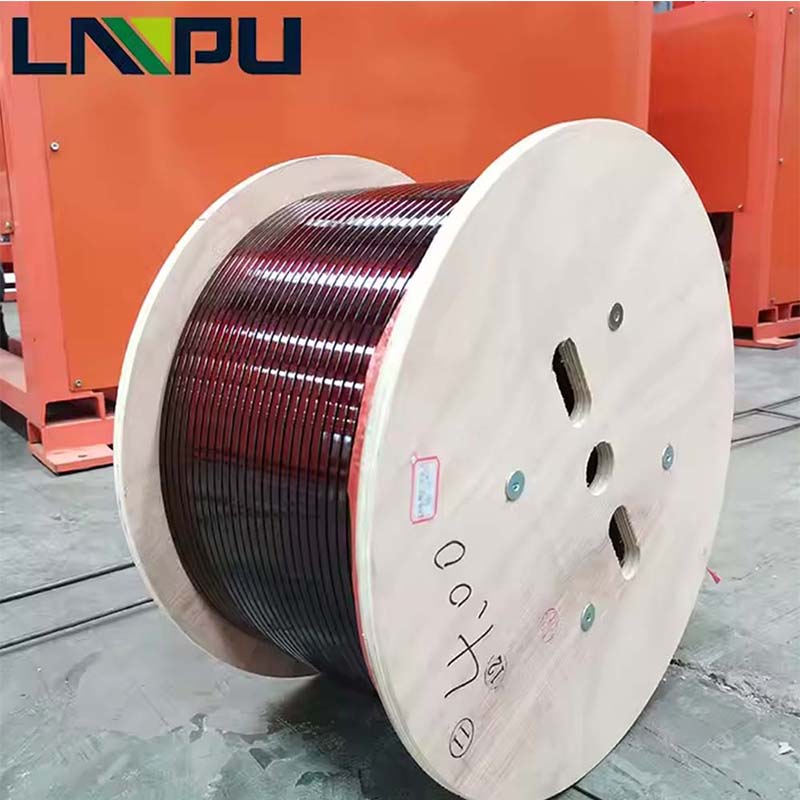
The enameled copper wire label serves as a critical medium for product identification and technical information transmission. Label content typically comprises multiple modules, including manufacturer information, product identification, technical parameters, compliance markings, production traceability, and usage precautions.
Manufacturer Information:
- Manufacturer logo/brand: MWS Wire Industries, Elektrisola, Superior Essex, Rea Magnet Wire, Synflex Elektro, Lacq, LWW Lichanghe, Lisheng, Guangyu, Fuzhou Weida, Dongguan Hongda, Changcheng Electric, etc.
- Manufacturer address
- Manufacturer contact information
- Manufacturer website
- Brand slogan
Product Identity:
- Product Name
- Part Number
- Product Series
- Commercial Designation
- Category
Technical Specifications:
- Conductor Material: Cu (Copper), CCA (Copper Clad Aluminum)
- Conductor Size: Diameter in mm / AWG
- Coating Type: PEW, UEW, EIW, AIW, PI, etc.
- Film Grade: Grade 1 (Thin), Grade 2 (Medium), Grade 3 (Thick)
- Thermal Class: 130°C / 155°C / 180°C / 220°C, etc.
- Breakdown Voltage: kV or V
- Color
Compliance and Certification:
- International standards (NEMA MW XXX-C, IEC 60317 XX, GB/T XXX)
- Certification marks (UL, RoHS, REACH, CE, CCC, IATF 16949)
- Safety data (SDS/MSDS)
- Environmental compliance (RoHS, REACH)
Production traceability:
- Lot Number/Batch Number
- Manufacturing Date
- Shelf Life / Expiry Date
- Inspector Code
- Serial Number
Packaging Information:
- Reel Type: PT4–PT200, VR, VRS
- Net Weight: 500 g, 1 kg, 5 kg, 15 kg, 25 kg, 50 kg, 100 kg
- Gross Weight
- Length: m or km
- Reel Recyclability
Handling & Safety:
- Storage Condition: Temperature, Humidity
- Handling Instructions
- Safety Warning
- QR Code / Barcode
Interpretation of Key Product Codes and Model Designations
The product code and model designation of enameled copper wire comply with international standard naming conventions, and the nomenclature system conveys complete information on enamel type, temperature class, conductor specification, and enamel grade.
NEMA MW 1000-2018 Nomenclature Rules
NEMA MW 1000 is the general specification for magnet wire issued by the National Electrical Manufacturers Association (NEMA), with NEMA MW 1000-2018 and NEMA MW 1000-2023 being the current mainstream versions. Each specific grade begins with “MW” (Magnetics Wire), followed by a series number, and ends with the suffix “-C” (Class).
Interpretation of the NEMA MW 1000 Standard Number:
- MW = Magnet Wire
- Numerals = Series number (denoting different coatings and thermal classes)
- -C = Class (revision identifier)
Typical NEMA MW 1000 enameled round copper wire / enameled flat copper wire grades:
- MW 24-C (240°C Polyimide Round Wire) / MW 25-C (240°C Polyimide Rectangular Wire)
- MW 28-C (200°C Polyetherimide Round Wire) / MW 29-C (200°C Polyetherimide Rectangular Wire)
- MW 35-C (130°C Polyester Enamel Round Wire) / MW 36-C (130°C Polyester Enamel Rectangular Wire)
- MW 64-C (240°C Aromatic Polyimide Round Wire) / MW 65-C (240°C Aromatic Polyimide Rectangular Wire)
- MW 76-C (180°C Enameled Copper Wire with Polyester-imide Basecoat and Polyamide-imide Topcoat Round Wire) / MW 77-C (180°C Enameled Copper Wire with Polyester-imide Basecoat and Polyamide-imide Topcoat Rectangular Wire)
- MW 79-C (155°C Polyurethane Enamel Round Wire) / MW 80-C (155°C Polyurethane Enamel Rectangular Wire)
- MW 82-C (200°C Polyetherimide Round Wire) / MW 83-C (200°C Polyetherimide Rectangular Wire)
- MW 84-C (220°C Amide-imide Round Wire) / MW 85-C (220°C Amide-imide Rectangular Wire)
- MW 86-C (200°C Polyester Enamel / Polyetherimide Composite-coated Round Wire) / MW 87-C (200°C Polyester Enamel / Polyetherimide Composite-coated Rectangular Wire)
NEMA MW 1000-2018 Nomenclature Example:
- MW 35-C AWG 24 Grade 2: Round copper wire with 130°C polyester enamel (PEW), AWG 24 nominal diameter approximately 0.511 mm, enamel coating Grade 2 (medium build)
- MW 79-C AWG 30 Grade 1: Round copper wire with 155°C polyurethane enamel (UEW), AWG 30 nominal diameter approximately 0.255 mm, enamel coating Grade 1 (thin build)
- MW 84-C 2.0 mm Grade 2: Round copper wire with 220°C polyamide-imide enamel (AIW), nominal diameter 2.0 mm, enamel coating Grade 2
IEC 60317 Nomenclature Rules
IEC 60317 is the enameled wire specification issued by the International Electrotechnical Commission (IEC), with each specific grade designated as IEC 60317-X, where X denotes the series number, accompanied by the general requirements standard IEC 60317-0-X.
IEC 60317 General Requirements Series:
- IEC 60317-0-1: General requirements for enamelled round copper winding wire
- IEC 60317-0-2: General requirements for enamelled rectangular copper winding wire
- IEC 60317-0-3: General requirements for glass-fibre covered enamelled round copper winding wire
- IEC 60317-0-4: General requirements for glass-fibre covered enamelled rectangular copper winding wire
- IEC 60317-0-5: General requirements for enamelled round aluminium winding wire
- IEC 60317-0-6: General requirements for enamelled rectangular aluminium winding wire
- IEC 60317-0-7: General requirements for fully insulated enamelled round copper winding wire
Typical models of the IEC 60317 series:
- IEC 60317-1: 120°C PVF round wire
- IEC 60317-2: 130°C PEW round wire
- IEC 60317-3: 155°C PEW round wire
- IEC 60317-4: 130°C PEW rectangular wire
- IEC 60317-7: 130°C PEW round wire
- IEC 60317-8: 155°C PEW rectangular wire
- IEC 60317-11: Solderable UEW round wire
- IEC 60317-12: 180°C PEW round wire
- IEC 60317-13: 180°C PEW rectangular wire
- IEC 60317-15: 180°C EIW round wire
- IEC 60317-16: 180°C EIW rectangular wire
- IEC 60317-19: 200°C PEI round wire
- IEC 60317-20: 200°C PEI rectangular wire
- IEC 60317-22: 180°C polyamide-composite PEW/PEI round wire
- IEC 60317-23: Solderable UEW round wire
- IEC 60317-25: PEW round wire
- IEC 60317-26: AIW round wire
- IEC 60317-30: 200°C PEI rectangular wire
- IEC 60317-35: Solderable UEW round wire
- IEC 60317-36: UEW round wire
- IEC 60317-37: 200°C PEI round wire
- IEC 60317-38: 200°C PEI round wire
- IEC 60317-39: 200°C PEI round wire
- IEC 60317-40: 200°C PEI round wire
- IEC 60317-41: 200°C PEI round wire
- IEC 60317-42: 200°C PEI round wire
- IEC 60317-43: 200°C PEI round wire
- IEC 60317-44: 200°C PEI round wire
- IEC 60317-45: 200°C PEI round wire
- IEC 60317-46: 200°C PEI round wire
- IEC 60317-47: 200°C PEI round wire
- IEC 60317-48: 200°C PEI round wire
- IEC 60317-49: 240°C PI round wire
- IEC 60317-50: 240°C PI rectangular wire
- IEC 60317-53: 220°C AIW rectangular wire
- IEC 60317-54: 200°C PEI round wire
- IEC 60317-55: Solderable UEW round wire
- IEC 60317-57: 220°C AIW round wire
- IEC 60317-58: Solderable UEW round wire
- IEC 60317-59: 200°C PEI round wire
- IEC 60317-60: 200°C PEI round wire
- IEC 60317-61: 200°C PEI round wire
- IEC 60317-62: 200°C PEI round wire
- IEC 60317-63: 200°C PEI round wire
- IEC 60317-64: 240°C PI round wire
- IEC 60317-65: 240°C PI rectangular wire
- IEC 60317-66: 240°C PI rectangular wire
- IEC 60317-67: 105°C PVF rectangular aluminum wire
- IEC 60317-68: 240°C PI round wire
- IEC 60317-69: 240°C PI rectangular wire
IEC 60317 Nomenclature Example:
- IEC 60317-13 4.00 × 1.00 mm, Grade 2: Rectangular copper wire with 180 °C PEW enamel coating, dimensions 4.00 mm width × 1.00 mm thickness, enamel coating grade 2 (medium build)
- IEC 60317-57 AWG 22, Grade 2: Round copper wire with 220 °C AIW enamel coating, AWG 22 nominal diameter approximately 0.644 mm, enamel coating grade 2
- IEC 60317-49 AWG 30, Grade 1: Round copper wire with 240 °C PI enamel coating, AWG 30 nominal diameter approximately 0.255 mm, enamel coating grade 1
GB/T 6109 / GB/T 7095 Nomenclature Rules
The GB/T 6109 series are Chinese national standards (identical adoption of the IEC 60317 series), and the GB/T 7095 series are national standards for rectangular enameled wire.
GB/T 6109 Main Types (Enameled Round Winding Wire):
- GB/T 6109.1 = IEC 60317-1 (120°C PVF)
- GB/T 6109.2 = IEC 60317-2 (130°C PEW)
- GB/T 6109.3 = IEC 60317-3 (155°C PEW)
- GB/T 6109.4 = IEC 60317-4 (130°C PEW rectangular wire)
- GB/T 6109.7 = IEC 60317-7
- GB/T 6109.8 = IEC 60317-8 (155°C PEW rectangular wire)
- GB/T 6109.11 = IEC 60317-11 (solderable UEW)
- GB/T 6109.12 = IEC 60317-12 (180°C PEW)
- GB/T 6109.13 = IEC 60317-13 (180°C PEW rectangular wire)
- GB/T 6109.15 = IEC 60317-15 (180°C EIW)
- GB/T 6109.16 = IEC 60317-16 (180°C EIW rectangular wire)
- GB/T 6109.19 = IEC 60317-19 (200°C PEI)
- GB/T 6109.20 = IEC 60317-20 (200°C PEI rectangular wire)
- GB/T 6109.22 = IEC 60317-22 (180°C composite PEW/PEI)
- GB/T 6109.23 = IEC 60317-23 (solderable UEW)
GB/T 7095 Main Types (Enameled Rectangular Winding Wire):
- GB/T 7095.1 = IEC 60317-0-2 General Requirements
- GB/T 7095.2 = IEC 60317-2 Enamelled Rectangular Wire
- GB/T 7095.3 = IEC 60317-16 (180 °C EIW Rectangular Wire)
- GB/T 7095.4 = IEC 60317-15 (180 °C EIW)
- GB/T 7095.5 = IEC 60317-29 (130 °C PEW Rectangular Wire)
- GB/T 7095.6 = IEC 60317-30 (200 °C PEI Rectangular Wire)
Traditional Chinese National Standard naming (based on product code):
- Q (Oil-based enameled round copper wire, Class 105)
- QQ (Formvar enameled round copper wire, Class 120)
- QQL (Formvar enameled round aluminum wire, Class 120)
- QQS (Colored Formvar enameled round copper wire)
- QQB (Formvar enameled rectangular copper wire)
- QA (Polyurethane enameled round copper wire, Classes 130/155)
- QH (Epoxy enameled round copper wire, Class 120)
- QZ (Polyester enameled round copper wire, Classes 130/155/180)
- QZY (Polyester-imide enameled round copper wire, Classes 155/180)
- QZYL (Polyester-imide enameled round aluminum wire)
- QY (Polyamide-imide enameled round copper wire, Class 220)
- QYJ (Modified polyamide-imide enameled round copper wire)
- QXY (Polyamide-polyester-imide composite enameled round copper wire, Class 180)
- QFB/QZFB (Refrigerant-resistant enameled wire)
China enamel thickness designation:
- QA-1/130: Polyurethane enameled round copper wire, thin coating (Grade 1), Class 130
- QA-2/130: Polyurethane enameled round copper wire, medium coating (Grade 2), Class 130
- QA-1/155: Polyurethane enameled round copper wire, thin coating (Grade 1), Class 155
- QA-2/155: Polyurethane enameled round copper wire, medium coating (Grade 2), Class 155
- International designation 1UEW/130: Grade 1 UEW enameled wire, Class 130 (equivalent to QA-1/130)
- International designation 2UEW/130: Grade 2 UEW enameled wire, Class 130 (equivalent to QA-2/130)
JIS C 3202 Nomenclature Rules
JIS C 3202 is the Japanese Industrial Standard (JIS) for enameled round copper wire, corresponding to the IEC 60317 series. Japanese enameled wire nomenclature is relatively simple, primarily using coating abbreviations to denote insulation types.
- PVF (JIS C 3202 Class 1, 120 °C Formaldehyde Enamelled Round Copper Wire)
- PEW (JIS C 3202 Class 2, 130–155 °C Polyester Enamelled Round Copper Wire)
- UEW (JIS C 3202 Class 3, 130–180 °C Polyurethane Enamelled Round Copper Wire)
- EIW (JIS C 3202 Class 4, 180 °C Polyester-imide Enamelled Round Copper Wire)
- AIW (JIS C 3202 Class 5, 220 °C Polyamide-imide Enamelled Round Copper Wire)
- PIW (JIS C 3202 Class 6, 240 °C Polyimide Enamelled Round Copper Wire)
- PEIW (JIS C 3202 Class 7, 200 °C Polyester-imide Enamelled Round Copper Wire)
JIS enamel coating class designation:
- 0 (Thin coating, corresponding to IEC Grade 1)
- 1 (Medium coating, corresponding to IEC Grade 2)
- 2 (Heavy coating, corresponding to IEC Grade 3)
JIS designation example:
- UEW 0.5 1: Polyurethane enameled round copper wire, diameter 0.5 mm, medium coating (Class 1, corresponding to Grade 2)
- PEW 1.0 0: Polyester enameled round copper wire, diameter 1.0 mm, thin coating (Class 0, corresponding to Grade 1)
Interpretation of Conductor Specification Parameters
The conductor specifications of enameled copper wire are core information on labels and data sheets, including parameters such as conductor material, conductor diameter, conductor tolerance, conductor resistance, and cross-sectional area.
Conductor material type:
- C11000 / Cu-ETP (Electrolytic Tough Pitch Copper, 99.95% Cu): General-purpose magnet wire
- C10100 / Cu-OFEC (Oxygen-Free Electronic Copper, 99.99% Cu): High-frequency motors, vacuum equipment
- C10200 / Cu-OFC (Oxygen-Free Copper, 99.95% Cu)
- CCA (Copper Clad Aluminum): Weight-sensitive applications
- Cu-Ag alloy (Copper-Silver): High-strength applications
- Cu-Cd alloy (Copper-Cadmium): High-strength applications
- Cu-Cr-Zr alloy (Copper-Chromium-Zirconium): High-strength, heat-resistant applications
- Cu-Be alloy (Copper-Beryllium): High-strength spring applications
Conductor Diameter and Gauge System:
Enamelled copper wire commonly uses three gauge systems: metric diameter (mm), AWG (American Wire Gauge), and SWG (British Standard Wire Gauge).
Metric diameter range:
- Round wire: 0.020–6.000 mm
- Commonly used: 0.040–2.500 mm
- Rectangular (flat) wire: width 1.000–16.000 mm × thickness 0.100–5.600 mm
- Width-to-thickness ratio: 2:1 to 8:1
AWG gauge range:
- Enameled round wire: AWG 8–44 (diameter 3.264–0.0508 mm)
- Commonly used: AWG 18–40
- Smaller AWG numbers correspond to larger diameters; AWG 8 has a diameter of 3.264 mm, and AWG 44 has a diameter of 0.0508 mm
AWG to Metric Conversion (Selected Typical Values):
- AWG 8: 3.264 mm / Cross-sectional area 8.37 mm²
- AWG 12: 2.053 mm / Cross-sectional area 3.31 mm²
- AWG 16: 1.291 mm / Cross-sectional area 1.31 mm²
- AWG 18: 1.024 mm / Cross-sectional area 0.823 mm²
- AWG 20: 0.813 mm / Cross-sectional area 0.519 mm²
- AWG 22: 0.643 mm / Cross-sectional area 0.324 mm²
- AWG 24: 0.511 mm / Cross-sectional area 0.205 mm²
- AWG 26: 0.404 mm / Cross-sectional area 0.128 mm²
- AWG 28: 0.320 mm / Cross-sectional area 0.0804 mm²
- AWG 30: 0.255 mm / Cross-sectional area 0.0509 mm²
- AWG 32: 0.202 mm / Cross-sectional area 0.0320 mm²
- AWG 34: 0.160 mm / Cross-sectional area 0.0201 mm²
- AWG 36: 0.127 mm / Cross-sectional area 0.0126 mm²
- AWG 38: 0.101 mm / Cross-sectional area 0.0080 mm²
- AWG 40: 0.080 mm / Cross-sectional area 0.0050 mm²
Conductor Tolerance:
- Grade 1 tolerance (precision): ±0.013 mm (diameter ≤ 1.0 mm) / ±0.025 mm (diameter > 1.0 mm)
- Grade 2 tolerance (standard): ±0.025 mm (diameter ≤ 1.0 mm) / ±0.05 mm (diameter > 1.0 mm)
Conductor Resistivity:
– Standard: ≤0.01724 Ω·mm²/m (20 °C, C11000)
– Oxygen-free copper: ≤0.017241 Ω·mm²/m (20 °C, C10100)
– High-purity copper: ≤0.01707 Ω·mm²/m
Conductor DC Resistance:
- Unit: Ω/m, Ω/km, Ω/1000 ft
- Standard: Measured at 20 °C
- AWG 20 (diameter 0.813 mm): ≤ 0.0333 Ω/m
- AWG 24 (diameter 0.511 mm): ≤ 0.0842 Ω/m
- AWG 30 (diameter 0.255 mm): ≤ 0.354 Ω/m
Temperature Coefficient:
- Copper resistivity temperature coefficient: 0.00393 /°C (at 20 °C)
- Resistance at 60 °C: R(60) = R(20) × [1 + 0.00393 × (60 − 20)]
- Resistance at 75 °C: R(75) = R(20) × [1 + 0.00393 × (75 − 20)]
Interpretation of Film Grade and Film Type
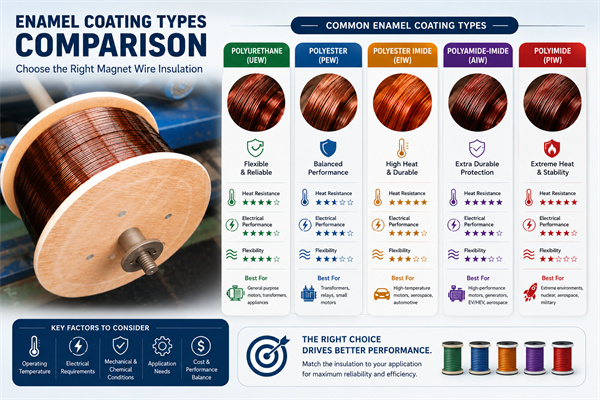
Film Grade and Film Type are core parameters of enameled copper wire, determining its electrical, mechanical, and thermal performance.
Enamel coating class definition:
The enamel coating grade defines the thickness of the insulation layer of magnet wire and is a critical technical classification for magnet wire.
- Grade 1 (Thin Film / Grade 1):
- Thinnest enamel coating thickness
- Minimum overall diameter
- Lower breakdown voltage
- Applications: Small-size windings, high slot fill factor requirements, micro-motors, small transformers, space-constrained windings
- Grade 2 (Medium Coating / Grade 2):
- Standard coating thickness
- Standard overall diameter
- Medium breakdown voltage
- Applications: General-purpose motors, transformers, inductors, and relays (standard applications)
- Grade 3 (Heavy Coating / Grade 3):
- Thickest coating thickness
- Largest overall diameter
- Highest breakdown voltage
- Applications: Heavy-duty motors, high-voltage transformers, high-reliability windings, oil-immersed windings, short-circuit surge-resistant windings
Lacquer Coating Thickness Grade Comparison (Typical Values for AWG 22 / 0.644 mm Round Copper Wire):
| Parameter | Grade 1 | Grade 2 | Grade 3 |
|---|---|---|---|
| Minimum enamel coating thickness increase | 0.030 mm | 0.057 mm | 0.084 mm |
| Maximum enamel coating thickness increase | 0.060 mm | 0.094 mm | 0.124 mm |
| Minimum overall diameter | 0.674 mm | 0.701 mm | 0.728 mm |
| Maximum overall diameter | 0.704 mm | 0.738 mm | 0.768 mm |
| Minimum dielectric breakdown voltage (kV) | 1.7 | 2.7 | 3.4 |
Enameled coating thickness grade comparison (typical values for flat copper wire 4.00 × 1.00 mm):
| Parameter | Grade 1 | Grade 2 | Grade 3 |
|---|---|---|---|
| Minimum enamel coating thickness increase | 0.060 mm | 0.100 mm | 0.140 mm |
| Maximum enamel coating thickness increase | 0.090 mm | 0.130 mm | 0.170 mm |
| Minimum breakdown voltage (kV) | 2.3 | 3.5 | 5.0 |
Film Type / Coating Type:
The enamel type determines the wire’s temperature resistance, mechanical, chemical, and electrical properties. Different enamel types feature distinct molecular structures and performance characteristics:
- PVF (Polyvinyl Formal):
- Also known as: Formvar, formaldehyde resin enamel
- Thermal class: 105–120 °C
- Characteristics: Uniform film, excellent abrasion resistance, good winding performance
- Disadvantages: Poor solvent resistance (dissolved by alcohols)
- Applications: Transformers, motors, household appliances
- Standards: IEC 60317-1, GB/T 6109.1, NEMA MW 15-C/MW 18-C
- PEW (Polyester Enamel Wire):
- Also known as: Polyester enamel coating
- Thermal class: 130°C / 155°C / 180°C
- Characteristics: Excellent electrical properties, good thermal shock resistance, moderate mechanical strength
- Disadvantage: Poor solderability (enamel decomposes at 380°C)
- Applications: Standard motors, transformers, household appliances
- Standards: IEC 60317-2/3/12, GB/T 6109.2/3/12, NEMA MW 35-C/MW 36-C
- UEW (Polyurethane):
- Also known as: polyurethane enamel, self-bonding enamel
- Thermal class: 130 °C / 155 °C / 180 °C
- Characteristics: Direct solderability (solderability at 380 °C for 3 seconds), excellent high-frequency performance (low tan δ)
- Disadvantages: Poor chemical resistance; mechanical strength inferior to PEW
- Applications: Small relays, winding wires, SMD inductors, high-frequency transformers
- Standards: IEC 60317-11/21/23/35, GB/T 6109.11/21/23, NEMA MW 79-C/MW 80-C
- EIW (Polyesterimide):
- Also known as: Polyester-imide enamel coating
- Thermal class: 180 °C
- Characteristics: Excellent thermal shock resistance, high mechanical strength
- Applications: Motors, transformers (standard high-temperature applications)
- Standards: IEC 60317-15/16, GB/T 6109.15/16, NEMA MW 76-C/MW 77-C
- PEI (Polyesterimide):
- Also known as: Modified PEI
- Thermal class: 200 °C
- Characteristics: Thermal shock resistance, high-temperature stability
- Applications: High-temperature motors, transformers
- Standards: IEC 60317-19/20, GB/T 6109.19/20, NEMA MW 82-C/MW 83-C
- AIW (Polyamide-imide):
- Also known as: Polyamide-imide enamel coating
- Temperature class: 220 °C
- Characteristics: Exceptional thermal resistance (softening breakdown temperature 330–350 °C), chemical resistance, and abrasion resistance
- Disadvantage: High cost
- Applications: Aerospace motors, railway traction motors, high-temperature transformers
- Standards: IEC 60317-26/57, GB/T 6109.26, NEMA MW 84-C/MW 85-C
- Polyimide (PI):
- Also known as: polyimide enamel coating
- Thermal class: 240°C
- Characteristics: exceptional high-temperature resistance (–200°C to +400°C), radiation resistance, chemical resistance
- Disadvantages: highest cost, solder resistance poor
- Applications: aerospace, aviation, nuclear industry, superconductivity
- Standards: IEC 60317-49/50/64/65, NEMA MW 24-C/MW 25-C
- Dual Coating / Composite:
- Base Layer: PEW or EIW (primary insulation layer)
- Top Layer: AIW or PI (reinforcement layer)
- Thermal Class: 180–240 °C
- Characteristics: Excellent comprehensive performance
- Standards: IEC 60317-22, NEMA MW 86-C/MW 87-C
Enamel Type Abbreviation Reference:
| International Designation | Chinese Designation | Full Name | Thermal Class | Solderability |
|---|---|---|---|---|
| PVF / PVAc | Polyvinyl Formal | 105–120 °C | Non-solderable | |
| PEW | QZ | Polyester | 130–180 °C | Non-solderable |
| UEW | QA | Polyurethane | 130–180 °C | Direct solderable |
| EIW | QZY | Polyester-imide | 180 °C | Non-solderable |
| PEI | QZY | Modified polyester-imide | 200 °C | Non-solderable |
| AIW | QY | Polyamide-imide | 220 °C | Non-solderable |
| PI | QYJ | Polyimide | 240 °C | Non-solderable |
| Dual Coating | QXY | Composite Enamel | 180–240 °C | Non-solderable |
Interpretation of Thermal Class and Insulation Class
Thermal Class is one of the most critical parameters of magnet wire, determining its maximum long-term operating temperature.
Thermal Class Standard Definition:
The thermal class standard definition is based on a comprehensive evaluation of the insulation system’s temperature index and heat shock temperature.
- Temperature Index (TI): The operating temperature at which the electrical and mechanical properties of magnet wire degrade to 50% of their initial values after continuous operation for 20,000 hours (25,000 hours per certain standards) at that temperature.
- Thermal Shock Temperature: The highest temperature at which the magnet wire, after winding, remains crack-free for one hour.
Thermal Class System:
| Thermal Class | Temperature | Temperature Index | Thermal Shock Temperature | Typical Enamel Types |
|---|---|---|---|---|
| Class A | 105°C | 105 | 125°C | PVF, PVAc, Oil-based |
| Class E | 120°C | 120 | 140°C | PVF |
| Class B | 130°C | 130 | 155°C | PEW, UEW, EIW (Standard) |
| Class F | 155°C | 155 | 175°C | PEW, UEW, EIW, AIW (Enhanced) |
| Class H | 180°C | 180 | 200°C | EIW, PEW (Enhanced) |
| Class N | 200°C | 200 | 220°C | PEI, AIW |
| Class R | 220°C | 220 | 240°C | AIW |
| Class 240°C | 240°C | 240 | 260°C | PI, Dual-coating |
Thermal Class Selection Principle:
- Safety margin: Select a thermal class 15–25 °C higher than the actual operating temperature.
- Lifetime consideration: Lifetime halves for every 10 °C increase in temperature (Montsinger’s rule).
- Operating temperature: Continuous operating temperature / short-term peak temperature / short-circuit temperature.
- Aging margin: Consider long-term aging over 20,000–40,000 hours.
- System compatibility: Compatible with impregnating resins, insulating varnishes, and insulating papers.
Thermal Class and Insulation System Relationship:
- Insulation system temperature: the maximum temperature of the overall insulation system of a motor or transformer
- The thermal class of enamelled wire is the core constraint of the insulation system
- Class B insulation system: 130°C enamelled wire + 130°C impregnating resin may be used
- Class F insulation system: 155°C enamelled wire + 155°C impregnating resin may be used
- Class H insulation system: 180°C enamelled wire + 180°C impregnating resin may be used
UL 1446 Certification:
UL 1446 (North American Insulation System Standard) is a critical reference for thermal class certification of magnet wire:
- UL 1446 rating table is consistent with NEMA MW 1000
- Enamelled wire certified to UL 1446 may be marked with temperature ratings
- UL 1446 ratings corresponding to enamel types are detailed in the UL standard
Interpretation of Electrical Performance Parameters
The electrical performance parameters of magnet wire determine its dielectric strength and electrical reliability.
Breakdown Voltage:
Dielectric breakdown voltage is the most critical electrical performance parameter of magnet wire, representing the maximum voltage the enamel coating can withstand.
- Unit: V (volts) or kV (kilovolts)
- Test method: IEC 60851-5
- Test voltage frequency: 50/60 Hz power frequency
- Voltage ramp rate: 100–500 V/s (standard: 100 V/s)
- Specimen: Uncoiled single wire, twisted pair, or wire wound on a core
Breakdown voltage classification (typical value for round copper wire AWG 22 / 0.644 mm):
| Film Grade | Grade 1 | Grade 2 | Grade 3 |
|---|---|---|---|
| Minimum Breakdown Voltage | 1700 V | 2700 V | 3400 V |
| Continuous Breakdown Voltage | 7500 V | 12000 V | 15000 V |
Breakdown Voltage Classification (Typical Value for Rectangular Copper Wire 4.00 × 1.00 mm):
| Insulation Grade | Grade 1 | Grade 2 | Grade 3 |
|---|---|---|---|
| Minimum Dielectric Breakdown Voltage | 2300 V | 3500 V | 5000 V |
Relationship between dielectric breakdown voltage and enamel type:
- PVF coating: 1700–3400 V (Grade 1–3)
- PEW coating: 1700–3400 V (Grade 1–3)
- UEW coating: 1500–3000 V (Grade 1–3)
- EIW coating: 2300–5000 V (Grade 1–3)
- PEI coating: 2700–5500 V (Grade 1–3)
- AIW coating: 3000–6000 V (Grade 1–3)
- PI coating: 3500–7000 V (Grade 1–3)
Dielectric Strength:
- Dielectric strength: ≥10–50 kV/mm
- Calculation formula: Dielectric strength = Breakdown voltage / Film thickness
- Test voltage: Power frequency 50/60 Hz
- Film thickness: Grade 1 (thin) to Grade 3 (thick)
Dielectric Constant:
- 1 kHz: 3.0–4.0 (PEW, EIW, AIW)
- 1 MHz: 2.8–3.8
- High-frequency motor magnet wire requirements: low loss, low dielectric constant
Dissipation Factor (tan δ):
- 1 kHz: ≤0.020
- 1 MHz: ≤0.025
- High-frequency applications: ≤0.010
Volume Resistivity:
- Volume resistivity of the enamel coating: ≥10¹²–10¹⁶ Ω·m
- Measuring voltage: 100–500 V DC
Surface Resistivity:
- Surface resistivity of the enamel coating: ≥10¹¹–10¹⁵ Ω
Pinhole Test:
- Test methods: Mercury method, indigo dye method
- Standard: IEC 60851-5
- Number of insulation pinholes: ≤5 per 15 m (Grade 1, diameter ≥0.5 mm)
- Number of insulation pinholes: ≤3 per 15 m (Grade 2, diameter ≥0.5 mm)
- Number of insulation pinholes: ≤2 per 15 m (Grade 3, diameter ≥0.5 mm)
Interpretation of Mechanical Performance Parameters
The mechanical properties of magnet wire determine its reliability and durability during winding, assembly, and operation.
Elongation:
Elongation is the core indicator of magnet wire flexibility, representing the maximum extension ratio of the magnet wire prior to tensile fracture.
- Test method: IEC 60851-3
- Unit: % (percent)
- Speed: 5 mm/min standard speed
- Specimen: Bare wire with enamel coating removed
Elongation Classification (Typical Values for Round Copper Wire):
| Conductor Diameter | Minimum Elongation |
|---|---|
| 0.020–0.063 mm | ≥5% |
| 0.063–0.250 mm | ≥10% |
| 0.250–0.500 mm | ≥15% |
| 0.500–1.000 mm | ≥20% |
| 1.000–1.500 mm | ≥25% |
| 1.500–2.500 mm | ≥25% |
| 2.500–5.000 mm | ≥30% |
| 5.000–6.000 mm | ≥30% |
Tensile Strength:
- Annealed copper: ≤220 MPa
- 1/2 Hard copper: 220–280 MPa
- Hard copper: 280–380 MPa
Yield Strength:
- Annealed copper: ≤120 MPa
- 1/2-hard copper: 120–200 MPa
- Hard-drawn copper: 200–350 MPa
Elastic Modulus (Young’s Modulus):
– Annealed copper: approx. 110 GPa
Winding Test (Mandrel Test / Wrapping Test):
- Test method: The enameled wire is wound around a round rod of specified diameter without cracking of the insulation.
- Round rod diameter = enameled wire diameter × N (N = 1, 2, 3)
- N = 1: Most stringent requirement—insulation must not crack.
- N = 2: Standard requirement.
- N = 3: Lenient requirement.
Repeated Bending:
- Test method: Repeated bending of enameled wire at a fixed angle
- Standard number of cycles: ≥10–50 cycles (depending on wire diameter and enamel type)
- Failure criterion: Enamel cracking or conductor breakage
Abrasion Resistance:
- Test methods: Pin abrasion test, scratch test
- Unit: N (newtons)
- Typical value: ≥1.5–5.0 N (force required to breach the insulation film)
- High-abrasion-resistance enamel: ≥5.0 N
- High-abrasion-resistance applications: High-speed winding, automated winding machines
Springback / Resilience:
- Test method: Springback angle after bending enameled wire
- Round copper wire ≤1.0 mm: ≤5°–10° (depending on diameter)
- Rectangular copper wire: ≤3°–5°
- Annealed copper: low springback
- Hard-drawn copper: high springback
Flexibility:
- Test method: Winding + repeated bending
- Standard: IEC 60851-3
Softening Breakdown (Cut-Through Temperature):
- Test method: Apply pressure to crossed enameled wires on a heated plate.
- Softening breakdown temperature of enamel coating: ≥200–400 °C (depending on enamel type)
- PVF enamel: ≥200 °C
- PEW enamel: ≥230 °C
- EIW enamel: ≥250 °C
- AIW enamel: ≥330–350 °C
- PI enamel: ≥400 °C
Heat Shock:
- Test method: Enamel-coated wire is wound for 1 hour at the specified temperature.
- Temperature at which enamel coating remains crack-free: According to thermal class.
Color Coding and Identification
Color coding of magnet wire complies with the international standard IEC 60304 and manufacturer-specific nomenclature.
IEC 60304 Color Standard:
IEC 60304 is the internationally recognized color-coding standard for magnet wire, defining 12 standard colors:
| Color Code | Color Name | Chinese Name | Application |
|---|---|---|---|
| 0 | Natural | Natural (Original) Color | General-purpose |
| 1 | Red | Red | Phase identification |
| 2 | Blue | Blue | Phase identification |
| 3 | Yellow | Yellow | Phase identification |
| 4 | Green | Green | Grounding or neutral conductor |
| 5 | Black | Black | Phase identification |
| 6 | Brown | Brown | Phase identification |
| 7 | Orange | Orange | Phase identification |
| 8 | White | White | Neutral conductor |
| 9 | Grey | Grey | Identification |
| 10 | Pink | Pink | Identification |
| 11 | Beige | Beige | Identification |
Color—Typical Applications:
- Natural: Most common and economical; undyed
- Red: Commonly used for main windings
- Blue: Commonly used for auxiliary windings
- Yellow: Commonly used for taps or split-phase windings
- Green: Commonly used for grounding identification
- Black: Commonly used for auxiliary windings
- Brown, Orange: Commonly used for phase differentiation
- White: Commonly used for neutral conductors
- Two-tone: For special identification
Marking method for colored enamelled wire:
- Color code + diameter
- Example: MW 35-C AWG 24 Red Grade 2 = Red enameled round copper wire, AWG 24, 130°C PEW, Grade 2
Interpretation of Packaging Information and Storage Conditions
Packaging information and storage conditions for magnet wire are critical components of quality assurance and inventory management.
Reel Type:
- PT Series: Plastic Reel
- VR Series: Recyclable Plastic Reel
- VRS Series: Shrink-Wrapped Plastic Reel
- Wooden Reel: Used in limited quantities
- Metal Reel: Used for large wire diameters
- Container Reel: Used for large wire diameters
Typical spool models:
- PT4 (Φ 100 mm, capacity: 0.5–1 kg)
- PT10 (Φ 160 mm, capacity: 1–3 kg)
- PT25 (Φ 200 mm, capacity: 5–10 kg)
- PT45 (Φ 250 mm, capacity: 10–25 kg)
- PT80 (Φ 315 mm, capacity: 25–50 kg)
- PT200 (Φ 500 mm, capacity: 50–200 kg)
Weight Specifications:
- Laboratory specifications: 100 g, 500 g, 1 kg
- Standard specifications: 5 kg, 10 kg, 15 kg, 25 kg
- Industrial specifications: 50 kg, 100 kg, 200 kg
- Container specifications: 500 kg, 1000 kg
Length specifications (typical reference: AWG 22 / 0.644 mm round copper wire):
- 5 kg spool: approx. 1300 m
- 10 kg spool: approx. 2600 m
- 25 kg spool: approx. 6500 m
Storage Conditions:
- Temperature: 10–30 °C (ideal: 20–25 °C)
- Humidity: 40–65 % RH
- Avoid direct sunlight: UV radiation damages the enamel coating
- Avoid chemical exposure: acids, alkalis, solvents
- Shelf life: typically 12–24 months (depending on enamel type)
- Periodic reel rotation during storage (to prevent enamel blocking)
- Storage location: dry, well-ventilated, and light-shielded
Precautions for Use:
- Surface coating protection
- Winding speed control (to prevent excessive stretching)
- Winding tension control (to prevent over-stretching)
- Avoid crushing of spools during storage
Interpretation of Certification Marks and Compliance
Certification markings and compliance of magnet wire are critical to ensuring product quality, safety, and environmental compliance.
UL certification (Underwriters Laboratories Inc.):
- UL 1446: Standard for Electrical Insulation Systems for Magnet Wire
- UL 746C: Evaluation of Polymeric Materials—Electrical Properties
- UL VW-1: Vertical Wire Flame Test
- UL 1581: Reference Standard for Electrical Wires and Cables
- UL Mark: UL Logo + Manufacturer’s Identification Code + File Number
- Mandatory requirement for the North American market
RoHS Certified (Restriction of Hazardous Substances Directive of the European Union):
- RoHS 2.0 (2011/65/EU): Restricts 10 hazardous substances
- Restricted substances: Lead (Pb), Mercury (Hg), Cadmium (Cd), Hexavalent chromium (Cr⁶⁺), Polybrominated biphenyls (PBB), Polybrominated diphenyl ethers (PBDE), Phthalates DEHP, BBP, DBP, DIBP
- Magnet wire relevance: Chemical constituents of the enamel coating
- Magnet wire RoHS requirements: Enamel coating, binders, and dyes must be free of restricted substances
- Mandatory requirement for the EU market
REACH Certification (Registration, Evaluation, Authorisation and Restriction of Chemicals)
- REACH (EC 1907/2006)
- Substance List: Over 200 Substances of Very High Concern (SVHC)
- Magnet Wire Relevance: Chemical substances in the enamel coating
- Mandatory requirement for the EU market
CE Mark (European Conformity Mark):
- CE marking is not mandatory for magnet wire (magnet wire is not classified as electrical equipment).
- However, motors or transformers incorporating magnet wire require CE certification for export to the European Union.
CCC Certification (China Compulsory Product Certification):
- CCC certification for magnet wire is non-mandatory
- However, certain electrical products incorporating magnet wire require CCC certification
- Required in certain scenarios in the Chinese market
IATF 16949 (Automotive Quality Management System):
- Automotive industry magnet wire supply chain requirements
- Magnet wire manufacturers must hold IATF 16949 certification
- Magnet wire requirements for automotive motors
ISO 9001 (Quality Management System):
- Fundamental certification for magnet wire manufacturers
- Globally recognized
ISO 14001 (Environmental Management System):
– Environmental certification for magnet wire manufacturers
– Globally applicable
UL/IEC 60317 dual certification:
- Compatible with both North American and European standards
- Held simultaneously by most major magnet wire manufacturers
Practical Application of Datasheets
The datasheet is a comprehensive document specifying the technical parameters of magnet wire; correct interpretation and application of the datasheet are critical to magnet wire selection.
Typical structure of the technical data sheet:
- Product Name and Code
- Application Description
- Physical Parameters (Conductor, Enamel Coating, Color, Shape)
- Mechanical Parameters (Elongation, Tensile Strength, Wrap Test, Bend Test, Softening Point, Springback)
- Electrical Parameters (Dielectric Breakdown Voltage, Dielectric Strength, Resistance, Resistivity)
- Thermal Performance Parameters (Thermal Class, Softening Point, Thermal Shock)
- Chemical Resistance Parameters (Oil Resistance, Solvent Resistance, Refrigerant Resistance)
- Test Standards (IEC 60851, ASTM D1676)
- Certification Marks (UL, RoHS, REACH)
- Storage and Handling Recommendations
- Safety Data (SDS)
How to Interpret the Technical Data Sheet:
- Step 1: Identify Product Identity
– Manufacturer Information
– Product Code
– Standard Cross-Reference
– Batch Number, Date - Step 2: Identify Conductor Specifications
– Conductor Material
– Diameter / AWG / SWG
– Cross-Sectional Area
– Tolerance
– Resistance - Step 3: Identify Enamel Coating Parameters
– Enamel Type
– Enamel Grade
– Enamel Thickness
– Color - Step 4: Identify Thermal Class
– Long-term Operating Temperature
– Thermal Shock Temperature
– Softening Breakdown - Step 5: Identify Electrical Properties
– Breakdown Voltage
– Dielectric Strength
– Dielectric Constant
– Dissipation Factor (tan δ)
– Volume Resistivity - Step 6: Identify Mechanical Properties
– Elongation
– Tensile Strength
– Winding Performance
– Repeated Bending
– Abrasion Resistance - Step 7: Identify Certifications and Compliance
– UL
– RoHS
– REACH
– CCC
– IATF 16949 - Step 8: Comprehensive Evaluation and Application
– Comparison against application requirements
– Compatibility with impregnating resins
– Compatibility with the insulation system
Comparison of Technical Specifications Table and Sample Test Results:
– Technical specification table data are typical values.
– Actual test data shall meet minimum values.
– Certificates of Conformance (CoC) shall be requested for critical parameters.
– Sampling retesting is required for large-volume procurement.
Selection Decision Process
A correct selection decision process is critical to ensuring that magnet wire meets application requirements.
Step 1: Determine the operating temperature
- Continuous operating temperature
- Short-term peak temperature
- Short-circuit temperature
- Select thermal class 15–25 °C higher than operating temperature
Step 2: Determine the voltage class
- Rated voltage
- Breakdown voltage requirement
- Select breakdown voltage 3–5 times higher than the actual operating voltage
Step 3: Determine Current and Conductor Gauge
- Rated current
- Current density (recommended 3–5 A/mm² for magnet wire)
- Temperature rise constraint
- Select AWG / mm diameter
Step 4: Determine the enamel coating grade
- Slot fill requirement: Select Grade 1 for high slot fill.
- General-purpose winding: Select Grade 2.
- High-reliability, high-voltage applications: Select Grade 3.
Step 5: Determine the enamel type
- General-purpose motors: PEW / EIW
- Small relays: UEW
- High-temperature resistance: AIW / PI
- Direct soldering requirement: UEW
Step 6: Determine color
- General-purpose: natural color (cost-effective)
- Multi-winding differentiation: colored
Step 7: Verify Certifications
- North American market: UL
- European Union market: RoHS, REACH
- Automotive applications: IATF 16949
- General: ISO 9001
Step 8: Determine Packaging
– Laboratory: Small packaging
– Mass production: Standard packaging
– Automatic winding: Large packaging
Step 9: Verify Parameters
- Compare with technical specification sheet
- Verify compatibility with impregnating resin
- Verify compatibility with insulation system
Step 10: Purchase Order Placement
- Request factory inspection report
- Agree on technical specifications
- Agree on shelf life
- Agree on storage conditions
Practical Case Analysis
Case 1: Selection of Motors for Household Electric Fans
Requirements:
- Operating temperature: 130 °C (Class B)
- Voltage: 220 V AC
- Current: 0.5 A
- Frequency: 50 Hz
- Service life: 10 years
- Cost-sensitive
- North American market (UL requirements)
Selection process:
- Step 1: Temperature → Class B (130 °C) enameled wire
- Step 2: Voltage → 220 V AC enameled wire dielectric breakdown ≥ 1000 V
- Step 3: Current → 0.5 A / 5 A/mm² = 0.1 mm² → AWG 26–28
- Step 4: Enamel coating → Grade 2 general-purpose
- Step 5: Enamel type → PEW (130 °C general-purpose)
- Step 6: Color → Natural
- Step 7: UL certification
Final selection:
- NEMA MW 35-C AWG 26 Grade 2 Natural
- or IEC 60317-2 AWG 26 Grade 2
- or GB/T 6109.2 AWG 26 Grade 2
Case 2: High-Temperature Traction Motor Selection
Requirements:
- Operating temperature: 220 °C (Class R)
- Voltage: 3000 V AC
- Current: 200 A
- Frequency: Variable frequency (50–1000 Hz)
- Service life: 30 years
- High reliability
- Railway applications
Selection process:
- Step 1: Temperature → Class R (220 °C) magnet wire
- Step 2: Voltage → 3,000 V AC breakdown voltage ≥ 10,000 V
- Step 3: Current → 200 A / 4 A/mm² = 50 mm² → Large diameter
- Step 4: Insulation coating → Grade 2–3 high-voltage
- Step 5: Insulation coating type → AIW (high-temperature resistant up to 220 °C)
- Step 6: Color → Natural color
- Step 7: ISO/TS 22163 IRIS certification
Final selection:
- NEMA MW 84-C Grade 2 Natural
- or IEC 60317-57 Grade 2
- or GB/T 6109.26 Grade 2
Case 3: Selection of High-Frequency Motors for Aerospace Applications
Requirement:
- Operating temperature: 200 °C (Class N)
- Voltage: 1000 V AC
- Current: 10 A
- Frequency: 10–50 kHz
- Service life: 20 years
- Aerospace applications
- AS9100D quality management system
Selection process:
- Step 1: Temperature → Class N (200 °C) magnet wire
- Step 2: Voltage → 1000 V AC breakdown ≥ 3500 V
- Step 3: Current → 10 A / 5 A/mm² = 2 mm² → AWG 14
- Step 4: Enamel coating → Grade 2, medium build
- Step 5: Enamel type → PEI / dual coating (200 °C)
- Step 6: Color → Natural
- Step 7: AS9100D, UL, RoHS certified
Final selection:
- NEMA MW 82-C AWG 14 Grade 2 Natural
- or IEC 60317-19 AWG 14 Grade 2
Case 4: Miniaturization-Oriented Selection for Transformers
Requirements:
- Operating temperature: 130 °C
- Voltage rating: 1000 V
- High-frequency (50 kHz)
- High slot fill factor
- Compact dimensions
- Cost-sensitive
Selection process:
- Step 1: Temperature → Class B (130 °C)
- Step 2: Voltage → 1000 V breakdown ≥ 3000 V
- Step 3: Current → 2 A
- Step 4: Enamel coating → Grade 1 thin film (high slot fill factor)
- Step 5: Enamel type → UEW (solderable, high-frequency)
- Step 6: Color → Natural
Final selection:
- NEMA MW 79-C AWG 22 Grade 1 Natural
- or IEC 60317-35 AWG 22 Grade 1
- or GB/T 6109.11 AWG 22 Grade 1
Common Misconceptions and Pitfalls
Misconception 1: Incorrect Thermal Class Selection
- Incorrect: Select enameled wire rated for the same temperature class as the system (e.g., 130°C enameled wire for a 130°C system).
- Correct: Select enameled wire rated for a higher temperature class than the system (e.g., 155°C enameled wire for a 130°C system).
- Reason: The system temperature is determined collectively by impregnating resins, insulating paper, and other insulating materials.
Misconception 2: Insufficient Dielectric Breakdown Voltage
- Incorrect: Breakdown voltage selected close to operating voltage
- Correct: Breakdown voltage is 3–5 times higher than operating voltage
- Reason: To accommodate voltage spikes, overvoltage conditions, and long-term aging
Misconception 3: Incorrect Selection of Enamel Film Class
- Incorrect: All windings selected Grade 2
- Correct: Select Grade based on slot fill ratio and voltage class
- Reason: Grade 1 is required for high slot fill ratio; Grade 3 is required for high voltage applications
Misconception 4: Ignoring manufacturer-specific differences
- Error: Considering only standard numbers without evaluating the manufacturer
- Correct: Refer to the manufacturer’s reputation, quality management system, and factory test reports
- Reason: Different manufacturers may implement the same standard with varying degrees of rigor
Misconception 5: Inadequate Certification
- Error: Failure to verify certification requirements for the target market
- Correct: First verify certification requirements for the target market (e.g., UL for North America, RoHS for the EU)
- Reason: Non-certified products may not be permitted for sale in the respective market
Misconception 6: Improper Storage
- Defect: Improper storage of magnet wire causing insulation film damage
- Correct practice: Store at temperature 10–30 °C, relative humidity 40–65 % RH, and in darkness
- Root cause: Improper storage leads to insulation film aging, blocking (blocking), and degradation of electrical and mechanical performance
Misconception 7: Ignoring impregnating resin compatibility
- Incorrect: Enamelled wire is incompatible with impregnating resin.
- Correct: Enamelled wire is synchronously matched with impregnating resin.
- Cause: Incompatibility between the enamel coating and the resin may lead to dissolution, blistering, or poor adhesion.
Misconception 8: Incorrect winding process
- Error: Excessive winding tension and excessive winding speed
- Correct: Rational winding process parameters
- Cause: Improper winding process leads to insulation film damage and elongation exceeding the limit
Misconception 9: Batch Mixing
- Error: Mixing different production batches
- Correct: Batch-wise management
- Reason: Performance may vary between batches, affecting motor consistency
Misconception 10: Price-Only Evaluation
- Mistake: Selecting the cheapest magnet wire
- Correct approach: Comprehensive evaluation of performance, cost, and reliability
- Reason: Low-quality magnet wire may lead to premature motor failure, resulting in higher total cost
Conclusion
The enameled copper wire label and technical specification sheet are critical carriers of product specifications and technical parameters; accurate interpretation and application are essential throughout the entire process—from enameled wire selection and procurement to inspection, winding, and motor/transformer manufacturing. The enameled copper wire label comprises multiple modules: manufacturer information, product identification, technical parameters, compliance markings, production traceability, packaging information, and usage & safety—each module conveying specific technical or regulatory information.
Interpretation of enameled copper wire labels and technical data sheets shall follow the following core principles:
- Accurately identify product identity: including manufacturer, product code, and international standard numbers (NEMA MW 1000, IEC 60317, GB/T 6109, JIS C 3202) to prevent model confusion.
- Accurately interpret conductor specifications: including conductor material (Cu, CCA), diameter (mm), AWG number, tolerance, cross-sectional area, and DC resistance.
- Accurately interpret enamel coating grade: Grade 1 (thin film), Grade 2 (medium film), Grade 3 (thick film), selected based on slot fill factor and voltage requirements.
- Accurately interpret enamel coating type: PVF (120°C), PEW (130–180°C), UEW (130–180°C, solderable), EIW (180°C), PEI (200°C), AIW (220°C), PI (240°C), selected based on thermal class and performance requirements.
- Accurately interpret thermal class: Class A (105°C), Class E (120°C), Class B (130°C), Class F (155°C), Class H (180°C), Class N (200°C), Class R (220°C), and 240°C class; select a thermal class rated at least 15–25°C above the actual operating temperature.
- Accurately interpret electrical properties: breakdown voltage (3–5 times the operating voltage), dielectric strength, dielectric constant, loss tangent (tan δ), and volume resistivity.
- Accurately interpret mechanical properties: elongation (≥15–30% depending on diameter), tensile strength, winding capability, repeated bending resistance, abrasion resistance, softening breakdown, and thermal shock resistance.
- Accurately interpret color coding: IEC 60304 standard color system for multi-winding identification.
- Accurately interpret packaging information: reel type, weight, length, and storage conditions (temperature 10–30°C, humidity 40–65% RH).
- Accurately interpret certification markings: UL (North America), RoHS/REACH (EU), CCC (China), IATF 16949 (automotive).
Magnet wire engineers and technicians should systematically enhance their ability to interpret magnet wire labels and technical data sheets—through structured learning (manufacturer technical manuals, international standards such as IEC 60317 and NEMA MW 1000, parameter tables), case-based analysis (magnet wire selection examples for different motor types), and experimental verification (dielectric breakdown voltage, elongation, thermal shock, pinhole testing, and winding tests)—to avoid common misinterpretations and ensure correct magnet wire selection, compliant procurement, reliable winding performance, and insulation system compatibility, thereby providing a core guarantee for the high-quality manufacturing of electrical equipment such as motors, transformers, and inductors.