


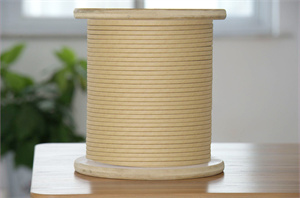
Paper covered wire is a composite insulated wire made by tightly wrapping bare or enameled copper wire with insulating paper tape (mostly kraft paper), followed by vacuum impregnation and curing with insulating varnish. Under the IEC 60554-3-1 / IEC 60554-3-5 / ASTM D1305 / NEMA MW 1000 (MW 60-A paper-covered aluminum) standards, it belongs to a special magnet wire branch spanning thermal classes 105–220, serving as the core winding material for oil-immersed transformers, instrument transformers, and reactors.
However, prices for paper covered wire can vary by 30%–50%. Inferior paper covered wire may pass factory inspection without issue but begin partial discharge, breakdown, and fire after 3–5 years of operation. How can inferior products be kept out at the procurement stage? Check the following 8 dimensions thoroughly.
I. Conductor Material and Purity
The conductor is the “bone” of paper covered wire. Quality wire uses oxygen-free copper rod (OFC, oxygen content ≤ 50 ppm) or electrical round aluminum rod (purity ≥ 99.7%), with conductivity of ≥ 101% IACS and ≥ 61% IACS respectively.
Identification method: Request the supplier provide a Mill Test Certificate (MTC), which should include three hard indicators: Cu content, O₂ content, and resistivity. If the supplier merely says “pure copper” but cannot provide an MTC, it is most likely recycled copper.
II. Type and Grade of Insulating Paper
The “flesh” of paper covered wire is the insulating paper. The three most common types are:
Ordinary Kraft Paper — IEC 60554-3-1 standard, Class 105 heat resistance, lowest price, used for ordinary oil-immersed transformers.
Thermally Upgraded Paper (TUP) — IEC 60554-3-5 standard, chemically modified with dicyandiamide, melamine, or polyacrylamide, Class 120, extending transformer lifespan by 30%–50%.
Aramid Paper (Nomex 410/414) — NEMA MW 60-A standard, Class 220, specifically used for dry-type transformers, high-speed rail traction transformers, and wind power transformers.
For high-temperature or long-lifespan applications, inferior paper covered wire often uses standard kraft paper to impersonate TUP or Nomex, which is difficult to identify visually — the paper roll factory label and material certificate must be examined.
III. Tape Layer Count and Overlap Rate
NEMA MW 60-A specifies: paper-covered aluminum rectangular wire requires at least 2 layers of paper tape, with an overlap rate of ≥ 40%. IEC 60317-44 also requires continuous, uniform, gap-free overlap.
Paper covered wire with substandard overlap rate allows insulating varnish to seep through paper seams during winding impregnation, damaging inter-turn insulation. Identification method: Use calipers to measure the total thickness after wrapping, then subtract the conductor thickness plus the theoretical thickness of single-layer paper to back-calculate the actual layer count and overlap rate.
IV. Compatibility and Fill Rate of Impregnating Varnish
Paper covered wire is not a single-layer insulation, but a “conductor + paper + impregnating varnish” three-phase composite system. The impregnating varnish must be chemically compatible with the insulating paper — ordinary asphalt-based varnish cannot be used with aramid paper as it causes swelling.
For impregnated windings, the ideal state is varnish completely filling the paper fiber gaps without bubbles or voids. Inspection method: Cut open a sample section and observe the cross-section. Quality products should show no visible paper fiber texture, presenting a uniform “amber” or “light brown” appearance.
V. Breakdown Voltage (Dielectric Strength)
ASTM D1305 requires dielectric strength of paper tape laminates to be ≥ 30 kV/mm (oil-immersed state). NEMA MW 60-A specifies paper-covered aluminum wire at ≥ 300 V/mil (11800 V/mm).
Identification method: Request the supplier provide batch dielectric breakdown voltage reports, rather than simply stating “qualified.” It is recommended that buyers perform 5% re-inspection upon receipt, eliminating the lowest 10% of batches.
VI. Tensile Strength and Elongation
The tensile strength and elongation of the paper tape itself directly determine whether the paper covered wire will break during winding. ASTM D1305 specifies kraft paper tensile strength of ≥ 50 N/mm (MD direction) and elongation of ≥ 2%.
Identification method: Take a section of paper tape (without creases or damage) and pull it manually and slowly — quality paper tape will stretch gradually without sudden breaking; inferior paper tape will snap with a “pop” sound and have an uneven fracture.
VII. Appearance and Wrapping Consistency
Appearance is the most intuitive embodiment of quality. Quality paper covered wire should exhibit:
Tight tape wrapping, without looseness, wrinkles, or bulging.
Uniform color (kraft light yellow, Nomex white), without obvious color variation.
Neat edges, without exposed or torn paper edges.
Consistent color within the same batch.
Inferior products often feature loosely wrapped tape, uneven color depth, and visible exposed conductor. Such products tend to jam and jump on automatic winding machines, requiring workers to spend significant time on repairs.
VIII. Compliance and Certification System
The final dimension — and the most easily overlooked. Check whether the supplier simultaneously holds:
IEC 60317-44 (paper-covered round/flat copper/aluminum wire product standard).
IEC 60554-3-1 / -3-5 (kraft paper / TUP paper material standards).
ASTM D1305 (sulphate [kraft] layer-type electrical insulating paperboard).
NEMA MW 1000 (MW 60-A paper-covered aluminum).
UL 1446 (insulation system certification).
ISO 9001 / 14001 / 45001 (quality / environment / occupational health).
If only one certification can be selected as the baseline, it is recommended to prioritize IEC 60317-44 + ISO 9001 — the former ensures product qualification, while the latter ensures process controllability.
Final Thoughts
Ultimately, quality identification of paper covered wire does not depend on brand or price, but on hard indicators across 8 dimensions: conductor purity, paper type, tape overlap, impregnating varnish, breakdown voltage, tensile strength, appearance, and compliance. Convert these 8 items into an acceptance checklist, verify against each batch upon delivery, and inferior products will largely be kept out.
If you are evaluating suppliers of paper-covered copper wire, paper-covered aluminum wire, Nomex paper-covered flat wire, or TUP paper-covered wire, please contact Zhengzhou LP Industry Co., Ltd. Email: office@cnlpzz.com, WhatsApp: 0086-19337889070. We offer direct factory supply with 30 years of export experience and support UL / IEC / NEMA multi-system certifications.