


In manufacturing, suppliers are not cost centers—they are strategic assets. For industries that consume large volumes of enameled wire, such as motors, transformers, and home appliances, a stable enameled wire supplier is often far more valuable than a cheaper one. Unlike commodity parts, enameled wire comes in many specifications, its quality directly affects downstream product performance, supplier qualification cycles run 6-18 months, and customer production processes are usually tuned to specific enameled wire characteristics.
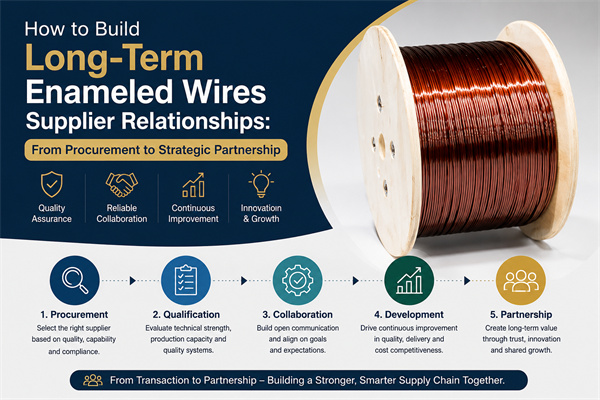
Once a stable cooperative relationship is established, buyers gain reliable supply assurance, priority access to new processes and products, better payment terms, and reduced quality variation. Suppliers, in turn, enjoy stable orders and cash flow, can plan products over the long term, reduce customer development costs, and ultimately grow together with their customers.
I. Five Stages of Building the Relationship
Building a long-term cooperative relationship with an enameled wire supplier typically goes through five progressive stages. Stage one is identification and shortlisting (1-3 months), where buyers find potential suppliers through industry research, trade shows, online search, and peer referrals. Stage two is evaluation and qualification (2-6 months), focused on credential review, production capacity assessment, sample testing, factory audits, and price negotiation. Stage three is trial and small-batch orders (3-6 months), during which buyers verify actual performance through small orders covering quality, delivery, service, and communication.
Stage four is volume cooperation (6-12 months), with formal orders, strict quality monitoring, disciplined delivery management, problem resolution, and deeper relationship development. Stage five is strategic partnership (over one year), featuring long-term agreements, joint product development, joint planning, mutual trust, and shared growth.
II. Key Criteria for Choosing the Right Supplier
Product quality is always the top priority when selecting an enameled wire supplier. Buyers need to confirm that the supplier complies with international standards such as IEC 60317 and NEMA MW 1000, holds third-party test reports, has passed ISO 9001 quality management system certification as well as industry certifications like UL, CQC, and IATF 16949, and has a proven track record of quality performance. Production capacity should be evaluated in terms of scale, equipment sophistication, process technology capability, R&D investment, and future expansion potential.
Price competitiveness is not only about unit price but also covers price stability, payment terms, volume discounts, and long-term price commitments. Delivery and service include standard lead times, expedited response capability, logistics network, inventory capacity, and after-sales support. Geography matters too: transportation distance, time zone differences, cultural differences, and political environment all influence the relationship. Finally, the supplier’s stability—company history, financial health, management team, employee retention, and customer reputation—is equally critical.
III. Factory Audits: An Essential Step
Factory audits are an essential step in building a long-term relationship. Their purpose is to verify the supplier’s actual capability, identify potential risks, establish a foundation of trust, and provide a basis for future cooperation. Audit content covers five areas: qualification documents (business license, quality system certificates, industry certifications, intellectual property certificates, financial statements); production capability (production line scale, equipment list, process level, capacity utilization, expansion plans); quality control (QC system, testing equipment, inspection processes, non-conforming product handling, continuous improvement mechanisms);
R&D capability (R&D team size, R&D investment, patents, new product development capability, technology reserves); and management systems (organizational structure, IT maturity, process standardization, emergency response, environmental and safety standards).
Audits can be conducted on-site, by video link, or by engaging third-party agencies such as SGS, TUV, or BV for professional audits, with on-site audits being the most effective.
IV. Negotiation and Contracts: Protecting Both Sides
The essence of contract negotiation lies in total value, not just price. On price, the focus should be on total cost rather than unit price alone, including hidden costs such as transportation, insurance, and tariffs. On quality, agreements must clearly define quality standards, non-conforming product handling procedures, and quality traceability requirements. On delivery, the contract should specify delivery times, delay handling clauses, and emergency order response mechanisms. On payment, it should determine payment methods, account periods, and credit limits.
In addition, the contract should cover technical confidentiality, price confidentiality, and trade secrets. Core contract terms should include product specifications, pricing mechanism, delivery, payment conditions, intellectual property protection, confidentiality clauses, and dispute resolution.
Recommended additional terms include long-term cooperation incentives, price adjustment mechanisms, force majeure clauses, and exit mechanisms. On contract duration, long-term contracts (1-3 years) offer price stability and supply security but lack flexibility, while short-term contracts (3-12 months) are flexible but expose buyers to price volatility and supply risk. The more ideal approach is a hybrid model combining a framework agreement with short-term orders, balancing stability and flexibility.
V. Communication, Collaboration, and Quality Management
Establishing multi-level communication mechanisms is critical. At the operational level, sales and purchasing contacts handle daily matters such as orders, payments, and deliveries. At the technical level, engineering and technical staff handle specification confirmation, technical problem resolution, and joint development. At the strategic level, senior managers address long-term planning, major decisions, and relationship maintenance.
Regular meeting mechanisms include monthly meetings (order execution, quality issues, delivery, service evaluation), quarterly meetings (business review, trend analysis, improvement plans, new requirements), and annual meetings (strategic cooperation, annual planning, long-term commitment, joint development). For information sharing, buyers should share demand forecasts, product plans, quality feedback, and market trends, while suppliers should share capacity information, technology updates, industry insights, and risk warnings. On quality management, buyers need to establish incoming inspection (IQC) systems, in-process quality control, supplier quality evaluation (quarterly/annually), quality improvement mechanisms (8D reports, FMEA analysis), and certification support.
VI. Cost Management and Risk Management
The key to cost management is cost transparency and joint cost reduction. Buyers should open up cost structures, analyze cost reduction opportunities with suppliers, conduct value engineering (VE/VA), and evaluate alternative materials. In joint cost reduction, buyers can lower costs by consolidating orders, optimizing specifications, reducing special requirements, and improving forecast accuracy, while suppliers can offer better prices through process optimization, scale effects, raw material procurement optimization, and production efficiency improvements. Price adjustment mechanisms include raw material price linkages, exchange rate risk sharing, long-term price protection, and phased price adjustments. Inventory management can adopt JIT (just-in-time), VMI (vendor-managed inventory), and safety stock models.
On risk management, buyers must identify supply risks (financial, natural disaster, political, transportation), quality risks (variation, process changes, raw material changes, personnel changes), price risks (raw materials, exchange rates, policies), and technical risks (obsolescence, intellectual property, leakage), and develop response strategies for each category.
VII. Performance Evaluation and Relationship Deepening
An objective KPI evaluation system is critical for supplier management. Quality metrics include incoming qualification rate, number of quality complaints, major quality incidents, and improvement projects. Delivery metrics include on-time delivery rate, average lead time, expedited response time, and number of delays. Price metrics include price level, stability, cost reduction contribution, and payment conditions. Service metrics include response speed, problem resolution, technical support, and communication efficiency.
Cooperation metrics include strategic alignment, information sharing, joint development, and long-term commitment. Evaluations can be conducted monthly, quarterly, annually, or as special assessments, with results used to classify suppliers: excellent suppliers receive more orders and long-term cooperation, qualified suppliers maintain the status quo, suppliers needing improvement are required to improve, and unqualified suppliers are phased out.
Relationship deepening strategies include joint development (new products, processes, patents, standards), information sharing (market, technology, competition, industry), joint investment (R&D, equipment, training, certification), senior-level interaction (regular visits, exhibitions, events), and cultural alignment (shared corporate culture, values, quality philosophy, and development vision).
VIII. Common Questions and Recommendations
Building a long-term cooperative relationship with an enameled wire supplier usually takes 1-3 years and requires continuous investment and maintenance. When dealing with quality issues, buyers should immediately isolate non-conforming products, ask the supplier to perform root cause analysis, develop an improvement plan, track improvement results, and replace the supplier if necessary. Long-term cooperation does not always yield lower prices than short-term purchasing, but it does provide more stable prices and superior total cost of ownership. When facing a supplier’s request for price increases, buyers should understand the reason, verify its reasonableness, share the burden with the supplier, and evaluate alternatives when necessary.
As a general principle, key materials should be sourced from 2-3 qualified suppliers with clear primary and secondary roles, while non-key materials can be sourced from 1-2 suppliers, avoiding excessive concentration or excessive fragmentation. Contract terms typically run 1-3 years, and the “framework agreement plus short-term orders” model is generally ideal. To conclude, here are ten core recommendations: mutual benefit, quality first, open communication, long-term thinking, shared growth, mutual respect, information sharing, continuous improvement, risk management, and strategic vision.