

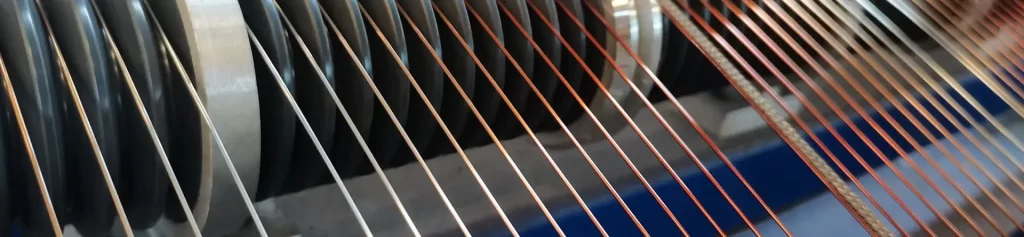
Introduction220°C high-temperature enameled copper wire is one of the highest-grade commercially available products in the enameled wire category, capable of long-term stable operation at 220°C.
In the industrial field, many applications operate at temperatures far exceeding the heat resistance limits of conventional insulation materials. 220°C high-temperature enameled copper wire provides a reliable insulation solution for these demanding conditions.
The core insulation material of 220°C high-temperature enameled wire is polyimide.
Polyimide is a high-performance organic polymer material with excellent heat resistance, superior electrical insulation properties, and outstanding chemical stability.
The successful development of this material has solved the insulation problems of many industrial equipment under extreme temperature conditions.
From petrochemicals to steel metallurgy, from aerospace to rail transportation, 220°C high-temperature enameled copper wire plays an irreplaceable role in various industrial fields.
With the continuous advancement of industrial technology and the increasing demands for equipment reliability, the market demand for 220°C high-temperature enameled wire continues to grow.
Chapter 1Technical Characteristics of 220°C High-Temperature enameled wire Polyimide Insulation Material Polyimide is the core insulation material for 220°C high-temperature enameled wire: In terms of chemical structure, the polyimide main chain contains an imide ring structure.
This aromatic heterocyclic structure endows the material with excellent thermal and chemical stability.
In terms of heat resistance, pure polyimide can withstand a wide temperature range from -200°C to +400°C, making it one of the best-performing organic polymer materials known to date.
In terms of electrical properties, polyimide has excellent electrical insulation strength and low dielectric loss characteristics, maintaining stable electrical performance even under high-temperature conditions.
In terms of chemical stability, polyimide is resistant to most organic solvents and greases, and also has good resistance to corrosive media such as acids and alkalis.
Key Performance Parameters The key performance parameters of 220°C high-temperature enameled copper wire include: In terms of heat resistance, the product can operate stably for a long time at 220°C without significant degradation in insulation performance and mechanical properties.
Regarding breakdown voltage, the breakdown voltage of 220°C high-temperature enameled wire is more than twice that of ordinary enameled wire, exhibiting extremely high electrical strength margin.
In terms of mechanical strength, the polyimide insulation possesses excellent tensile strength and abrasion resistance, capable of withstanding severe working stresses.
Comparison with Other Thermal Class Products 220°C high-temperature enameled copper wire belongs to the highest thermal class in the enameled wire product system.
The differences between it and other grades mainly lie in the type of insulation material, the maximum continuous operating temperature, and applicable scenarios.
The following table clearly shows the key differences between various thermal classes of enameled wire:
| Thermal Class | Insulation Material Type | Max Operating Temp | Typical Applications |
|---|---|---|---|
| Class B | Polyester resin | 130°C | Household appliance motors, general fan motors, small water pump motors |
| Class F | Polyester imide resin | 155°C | Industrial sewing machine motors, general industrial motors, commercial air conditioning compressors |
| Class H | Polyester imide/Polyamide-imide composite | 180°C | Lifting and metallurgical motors, mining drainage motors, high-temperature fan motors |
| Class C | Polyimide | 220°C | Petroleum cracking motors, steel metallurgical induction heating, aerospace electric drive systems |
As can be seen from the table, the higher the thermal class, the more stringent the requirements for the insulation material.
The Class C insulation used in 220°C high-temperature enameled copper wire represents the highest level of hot water resistance currently available in commercially available wires, enabling stable operation in extreme temperature environments where other classes are inadequate.
This leap in thermal class is not merely a numerical increase, but a major breakthrough in the molecular structure design of insulation materials, making polyimide insulation the only feasible solution for extreme high-temperature conditions.
Chapter 2Typical Industrial Application Areas Petrochemical Industry The petrochemical industry is an important application area for 220°C high-temperature wires: In the petroleum refining process, many processes need to be carried out in high-temperature environments.
The operating temperature of the motors for core equipment such as cracking furnaces and catalytic converters often exceeds 200°C. 220°C high-temperature wires provide reliable insulation protection for these high-temperature motors, ensuring long-term stable operation of the equipment under extreme conditions.
The motor windings of high-temperature fans, compressors, and other equipment in ethylene cracking units also extensively use 220°C high-temperature wires.
Iron and Steel Metallurgy Industry: The working environment in the iron and steel metallurgy industry is extremely harsh: Looping motors and coiling motors in steel rolling production lines operate at very high temperatures with limited cooling conditions, and the temperature of the motor windings may exceed the limits of conventional insulation. 220°C high-temperature insulation is widely used in key equipment such as blast furnace blowers and converter tilting equipment in metallurgy.
Induction heating equipment operates at extremely high temperatures, and 220°C high-temperature insulation is the standard choice for induction heating coil windings.
Aerospace Industry: Aerospace equipment has extremely stringent performance requirements for electrical materials: Electrical equipment around aero engines needs to operate in harsh environments with high temperatures, high vibrations, and high altitudes, where temperature conditions may exceed the limits of conventional insulation.
Satellites and spacecraft experience extreme temperature changes during orbital operation, and 220°C high-temperature insulation provides reliable insulation protection for spacecraft electronic equipment.
The electrical systems of military equipment typically require stable operation within a wide temperature range of -55°C to +220°C. 220°C high-temperature wire is the optimal solution to meet this requirement.
Rail Transit The operating environment of rail transit equipment is complex and variable: The traction motors of heavy-haul railways operate under high intensity, and the heat generated by the current can cause the winding temperature to rise.
High-temperature electrical components in rail transit vehicles, such as brake resistor cabinets and transformers, also require the use of high-temperature resistance insulation materials. 220°C high-temperature wire provides a guarantee for the reliable operation of rail transit electrical equipment.
Chapter 3Selection Technical Guide Selection Based on Operating Temperature Operating temperature is the primary consideration in selection: For applications with operating temperatures between 180°C and 220°C, 220°C high-temperature wire is the best choice, providing ample safety margin.
For extreme applications with operating temperatures above 220°C, it may be necessary to select products with a temperature resistance of 220°C or higher.
Considering temperature measurement errors and localized hot spots, it is recommended to allow a temperature margin of at least 20°C when selecting a product.
Selection Based on Reliability Requirements Reliability requirements affect the selection of insulation class: For safety-critical equipment, it is recommended to prioritize 220°C high-temperature insulation, even if the operating temperature is slightly lower than the limit of conventional Class H products.
For high-temperature continuous operation equipment, the low aging rate of 220°C high-temperature insulation ensures a longer service life.
For equipment with frequent start-stop cycles or load changes, the thermal stability advantage of high-temperature insulation is more significant.
Selection Based on Environmental Conditions Environmental conditions impose additional requirements on insulation materials: In chemically corrosive environments, it is necessary to consider whether the chemical resistance of polyimide meets the requirements.
In high-humidity environments, it is necessary to consider additional moisture-proof treatment for the windings.
In strong radiation environments, it is recommended to communicate with the supplier about products with special specifications.
Chapter 4Usage Precautions Winding Process The winding process for 220°C high-temperature enameled wire differs from that of conventional enameled wire: Tension control requires greater precision, as polyimide insulation is sensitive to tension; excessive tension may damage the enamel coating.
The bending radius needs to be appropriately increased to avoid cracking of the insulation layer.
The winding equipment needs to be clean to prevent impurities such as metal shavings from affecting insulation performance.
Welding Process Removing polyimide insulation requires a special process: Chemical paint removal is a common method, requiring the use of a special paint remover.
Mechanical paint scraping can also be used, but care must be taken to avoid damaging the copper conductor.
Residues must be cleaned promptly after welding.
Quality Inspection The quality inspection of 220°C high-temperature enameled wire requires special attention: Visual inspection ensures the enamel coating is intact, free of bubbles and impurities.
Dimensional inspection ensures the outer diameter and enamel coating thickness meet the specifications.
Electrical testing includes items such as breakdown voltage and insulation resistance.
Chapter 5Technological Development Trends Material Innovation The research and development of new polyimide materials continues to advance: Through methods such as modified copolymerization, new polyimide materials with better heat resistance and processing performance are being developed.
The introduction of nanocomposite technology provides a new way to improve the comprehensive performance of polyimide.
Process Advancement Advances in manufacturing processes have improved product quality: The development of precision coating technology has made the thickness control of enamel coatings more accurate.
The application of online inspection technology has improved product consistency.
Application Expansion The application fields of 220°C high-temperature enameled wire are constantly expanding: The demand for high-temperature electrical components in new energy vehicles has driven related research and development.
The application of high-temperature motors in intelligent manufacturing equipment is also growing. —
ConclusionWith its excellent heat resistance, superior electrical insulation properties, and reliable mechanical strength, 220°C high-temperature enameled copper wire has become the best choice for industrial applications in extreme high-temperature conditions.
In fields such as petrochemicals, steel metallurgy, aerospace, and rail transportation, 220°C high-temperature wire provides robust insulation protection for the reliable operation of various industrial equipment.
When selecting a model, factors such as operating temperature, reliability requirements, and environmental conditions should be comprehensively considered to choose the most suitable product.
With continuous advancements in materials technology and manufacturing processes, 220°C high-temperature wire will play an increasingly important role in more industrial sectors.