

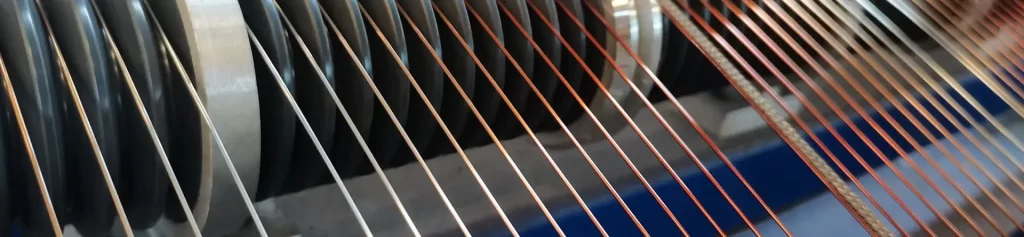
With the rapid development of manufacturing towards intelligence and automation, traditional manual winding methods can no longer meet the efficiency demands of large-scale production.
The application of high-speed winding machines is becoming increasingly widespread, placing entirely new requirements on the performance of enameled copper wire.
During high-speed winding, the enameled wire needs to withstand extremely high linear speeds, tensions, and friction.
Ordinary enameled wire is prone to problems such as coating damage and wire breakage under these conditions, seriously affecting production efficiency and product quality.
High-speed winding compatible enameled copper wire, through optimized material formulation and manufacturing processes, can maintain coating integrity and dimensional stability under high-speed, high-tension operating conditions.
This article will detail the technical characteristics, selection points, and application areas of high-speed winding compatible enameled copper wire, providing professional technical reference for winding process engineers and equipment procurement personnel.
Challenges of High-Speed Winding Technology Challenges Brought by High Linear Speed Modern high-speed winding machines can reach linear speeds of over 30 meters per second: Under high-speed operation, the frictional heat between the enameled wire and the guide rail and die increases significantly.
Prolonged friction can cause the enamel coating to soften or even burn, affecting insulation performance.
The wear resistance of ordinary enameled wire is insufficient to meet the requirements of high-speed friction.
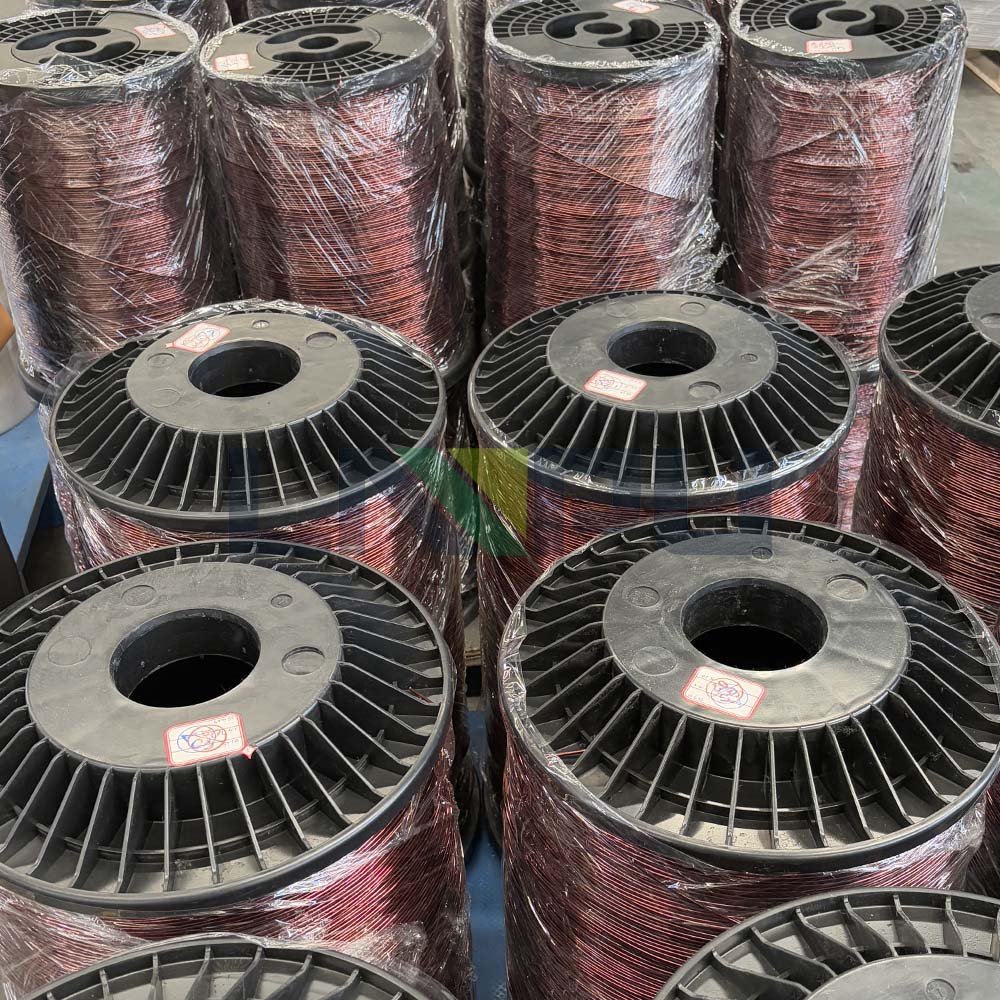
Challenges Under High Tension High-speed winding requires maintaining appropriate tension to ensure neat alignment: Excessive tension can cause conductor stretching deformation or even breakage.
Insufficient tension can lead to loose winding, affecting slot fill factor and electrical performance.
The enameled wire needs to maintain the integrity of the enamel coating under high tension, without cracking or peeling.
Challenges of High-Frequency Start-Stop Automated winding processes involve numerous sudden stops and starts: Frequent tension changes place higher demands on the adhesion of the enamel coating.
The impact at the moment of start-stop can easily cause localized damage to the enamel coating.
High-speed winding compatible products need to have better impact resistance.
Technical Characteristics of High-Speed Wound-Compatible Enameled Wire Excellent Flexibility High-speed wound-compatible enameled wire exhibits excellent flexibility: The conductor undergoes special annealing treatment, resulting in fine, uniform grains and moderate hardness.
It is less prone to permanent deformation when passing through guide rollers and dies at high speeds.
This flexibility also facilitates smaller bending radii and improves slot fill factor.
Excellent Abrasion Resistance Abrasion resistance is a key indicator for high-speed winding: High-solids content or modified insulating varnish formulations improve the density of the enameled coating.
This enhances the adhesion between the enameled coating and the conductor, reducing coating peeling caused by high-speed friction.
High-quality high-speed wound-compatible enameled wire can withstand linear speeds exceeding 30 meters per second.
Good Lubricity Some high-speed wound-compatible products have a lubricating layer on the enameled coating surface: Surface lubrication reduces the coefficient of friction and heat generation.
This extends the service life of dies and guide rollers.
It reduces wire breakage rates and improves production efficiency.
Excellent Thermal Stability Heat generated during high-speed winding needs to be dissipated promptly: The enamel coating has good heat resistance and will not soften under frictional heat.
The insulating varnish ages slowly, resulting in a long service life.
Its thermal stability temperature is typically higher than that of ordinary enameled wire. –
Key Performance Parameters Linear Speed Grade High-speed winding compatible enameled wire is classified into different grades according to linear speed: Standard grade is suitable for winding speeds below 15 meters per second.
High-speed grade is suitable for winding speeds from 15 to 25 meters per second.
Ultra-high-speed grade is suitable for winding speeds above 25 meters per second.
Tension Parameters The maximum applicable tension of the enameled wire is an important selection parameter: The maximum tension is determined based on the conductor cross-sectional area and material properties.
Tension overload can lead to conductor elongation or even breakage.
Sufficient safety margin must be considered during selection.
Enameled Coating Thickness The thickness of the enamel coating affects insulation performance and mechanical protection: A thinner enamel coating is beneficial for increasing slot fill factor, but the insulation strength is lower.
Thicker enamel coatings offer better insulation protection, but increase the outer diameter.
High-speed winding typically uses Grade 2 or heavy insulation specifications.
Surface Quality Surface smoothness affects frictional resistance: The surface should be smooth and flat, free of particles, bubbles, and impurities.
A rough surface will increase friction and affect winding speed.
High-quality products have a lower surface roughness Ra value.
Typical Application Areas Automotive Motors Automotive motors are a major application area for high-speed winding compatible enamel wires: Automotive air conditioning blower motors have high production volumes and require high production efficiency.
Starter motor winding needs to be completed quickly to reduce costs.
New energy vehicle drive motors also use automated high-speed winding.
Home Appliance Motors Home appliance motors have large production volumes and many types: Air conditioning compressor motors, washing machine motors, and refrigerator compressor motors all require high-speed winding.
High-speed winding compatible enamel wires are an economical choice for mass production.
Product quality is stable and consistent.
Power Tool Motors Power tools have requirements for both motor performance and cost: Electric drills, angle grinders, cutting machines, and other power tools have massive production volumes.
High-speed winding compatible with enameled wire meets the needs of efficient production.
Power tool motors have high speeds, placing more stringent requirements on enameled wire performance.
Industrial Automation Motors Industrial automation equipment has high requirements for motor reliability and consistency: Servo motors and stepper motors require precision winding.
High-speed winding compatible with enameled wire ensures product consistency and stability.
Automated production lines have extremely high requirements for the performance stability of enameled wire.
Selection Technical Guide Selection Based on Linear Speed Linear speed is the primary parameter for selection: Select the corresponding grade of product based on the maximum linear speed of the winding machine. A speed margin of at least 20% should be allowed when selecting. For ultra-high-speed winding machines, ultra-high-speed grade products are recommended. Selection Based on Enameled Coating Performance Enameled coating performance directly affects winding quality and efficiency: The wear resistance grade must meet the linear speed requirements. The thermal stability temperature needs to be higher than the actual operating temperature. Low-friction products with a lubricating layer can be selected as needed. Cost-Based Selection Optimize costs while meeting performance requirements: Ordinary high-speed products offer the best cost-performance ratio. Ultra-high-speed products are more expensive and should be selected according to need. Consider the overall cost of the enameled wire, including breakage rate and die wear. Conductor Specification Selection Conductor specifications affect the applicability of the enameled wire: Thin conductors cannot withstand the high tension of high-speed winding. Thick conductors require a thicker enamel coating to provide sufficient protection. Choose a suitable combination of conductor specifications and insulation class. — Chapter Six Usage Precautions Tension Setting Reasonable tension setting is key to high-speed winding: Calculate the recommended tension range based on the conductor cross-sectional area. Tension gauges need to be calibrated regularly to ensure accuracy. Excessive tension will cause breakage and damage to the enamel coating. Guide Roller and Die Maintenance The maintenance of guide rollers and dies directly affects winding quality: Regularly check the wear of guide rollers and replace them promptly. Keep the guide wheel surface smooth, free of burrs and impurities. The dimensional accuracy of the mold affects the winding quality. Storage and Pre-treatment The storage and pre-treatment of the enameled wire are also important: The storage environment should be dry and clean, avoiding moisture. Appropriate preheating should be performed before use in winter. Avoid kinking or dead bends in the enameled wire. — Chapter Seven: Technological Development Trends Ultra-High-Speed Winding Ultra-high-speed winding technology continues to develop: Linear speeds are developing towards 40 meters per second or even higher. Higher requirements are placed on the wear resistance and thermal stability of the enameled wire. The research and development of new insulating materials drives the advancement of ultra-high-speed winding technology. Intelligent Control The application of intelligent technology in the winding field: Tension closed-loop control systems achieve precise tension control. Real-time monitoring of winding parameters ensures stable quality. Fault early warning systems reduce unplanned downtime. Environmentally Friendly Materials Environmental requirements drive material innovation: The application of water-based insulating paint reduces VOC emissions. Research on biodegradable materials has made progress. Green manufacturing of high-speed winding compatible with enameled wire is becoming the trend. —
ConclusionHigh-speed winding compatible enameled copper wire is an ideal choice for modern automated winding processes.
Its excellent flexibility, outstanding wear resistance, good lubricity, and superior thermal stability enable it to maintain stable performance under high-speed, high-tension operating conditions.
In automotive motors, household appliance motors, power tool motors, and industrial automation motors, high-speed winding compatible enameled wire provides a reliable material guarantee for efficient production.
When selecting a model, factors such as line speed, enameled coating performance, cost, and conductor specifications should be considered comprehensively to choose the most suitable product.
With the development of ultra-high-speed winding technology and intelligent control technology, high-speed winding compatible enameled wire will face higher performance requirements and technical challenges, while also possessing broader development prospects.