

Wireless charging technology has developed rapidly in recent years, from smartphones and smartwatches to electric vehicles, wireless charging is becoming a mainstream power transmission method. The core of a wireless charging system is the electromagnetic induction or magnetic resonance coil, and the choice of coil conductor directly affects charging efficiency, heat generation, and overall performance.
Wireless Charging Technology Principles
Electromagnetic Induction Principles
Wireless charging mainly uses electromagnetic induction to transmit power. The transmitting coil carries high-frequency AC current to generate an alternating magnetic field; the receiving coil induces AC voltage in the magnetic field, which is rectified and filtered to charge the battery. Current mainstream wireless charging standards include the Qi standard, with operating frequencies in the 100-205kHz range; some fast charging solutions can reach 200-300kHz; magnetic resonance technology operates at even higher frequencies, typically in the MHz range.
Frequency Effects on Conductor Selection
As operating frequency increases, conductors exhibit special effects including skin effect and proximity effect. Skin depth is inversely proportional to the square root of frequency—at 100kHz, copper’s skin depth is approximately 0.21mm; at 1MHz, it is only 0.066mm.
Litz Wire Structure and Characteristics
Basic Litz Wire Structure
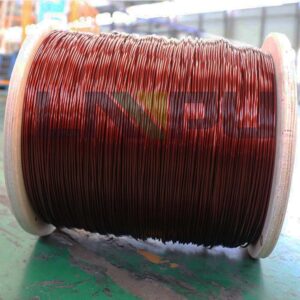
Litz wire consists of multiple fine enameled wires twisted together according to specific twisting pitch and direction. Each strand is individually insulated, ensuring every fine wire participates in conduction at high frequencies.
High-Frequency Advantages of Litz Wire
Litz wire design aims to reduce AC resistance and losses at high frequencies. Since each fine wire’s diameter is smaller than the skin depth, current distributes uniformly across the entire cross-section. The transposition design between strands ensures roughly equal current distribution across all wires.
Main Litz Wire Types
High-frequency Litz wire uses extremely fine individual strand diameters (such as 0.05-0.1mm) for frequencies above several MHz. Power Litz wire uses larger individual strand diameters (such as 0.2-0.5mm) for high-current transmission applications.
Enameled Copper Wire Technical Features
Basic Enameled Copper Wire Structure
Enameled copper wire has an insulating varnish coating on the copper conductor surface, baked and cured. Common types include polyurethane, polyester, polyester-imide, and polyamide-imide enameled wires.
Enameled Copper Wire in Wireless Charging
For wireless charging applications operating at 100-300kHz, enameled copper wire remains the choice for many designs. The cost of single enameled wire is significantly lower than equivalent Litz wire.
Limitations of Enameled Copper Wire
When operating frequency exceeds 500kHz or power increases significantly, AC losses from skin effect increase dramatically. Wire heating intensifies and system efficiency decreases.
Performance Comparison Analysis
AC Resistance Characteristics
| Comparison Item | Litz Wire | Enameled Copper Wire |
|---|---|---|
| AC Resistance | Low and stable | Increases significantly with frequency |
| High Frequency Performance | Excellent | Moderate |
| Cost | Higher | Lower |
| Mechanical Strength | Lower | Higher |
| Applicable Frequency | All frequencies | <300kHz |
Litz wire maintains low and stable AC resistance across a wide frequency range. Enameled copper wire’s AC resistance increases significantly with frequency. In high-frequency, high-power applications, Litz wire can reduce coil losses by 30%-50%.
Temperature Rise and Heat Dissipation
Litz wire generates less heat at the same power due to low AC losses. Enameled copper wire’s high-frequency losses generate more heat, often requiring additional heat dissipation structures.
Cost and Manufacturing
Litz wire prices are typically 2-5 times higher than equivalent cross-section enameled copper wire. Enameled copper wire manufacturing is mature with lower costs.
Application Scenarios Analysis
Consumer electronics wireless charging is currently the largest application market. For smartphones and wearables, enameled copper wire is typically adequate. For high-power EV wireless charging, Litz wire has clear advantages and is the mainstream technical solution.
Smartphones and Wearables
Smartphone wireless charging typically operates at 100-200kHz with 5-15W power. At these frequencies and power levels, enameled copper wire essentially meets requirements. Wearable device charging is even lower at 5W or below.
Tablets and Laptops
Tablet and laptop wireless charging typically operates at 10-30W, placing higher demands on charging efficiency and heat dissipation. For devices supporting 30W+ fast charging, Litz wire usage is increasing.
Electric Vehicle Wireless Charging
EV wireless charging power ranges from 3.3kW to 11kW or higher. High-power wireless charging demands stringent efficiency requirements. Litz wire has clear advantages in high-power wireless charging systems and is the current mainstream technical solution.
Industrial and Medical Equipment
Industrial sensors and power tool wireless charging typically operates at medium power levels. Medical implant wireless charging has extremely high requirements for reliability and long-term stability, typically using high-quality Litz wire.
Selection Recommendations
Selecting Based on Operating Frequency
Frequency is the primary factor affecting conductor selection. For conventional wireless charging below 200kHz such as Qi standard devices, enameled copper wire is typically the economical and practical choice. When frequency exceeds 300kHz, especially 500kHz and above, Litz wire advantages become apparent.
Selecting Based on Power Level
Low power (below 10W): Enameled copper wire is the first choice. Medium power (10-50W): Select based on efficiency requirements. High power (above 50W): Strongly recommend Litz wire.
Comprehensive Cost Considerations
Cost comparison should consider the entire system, not just individual conductors. Calculate total system cost including wire cost, heat dissipation system cost, reliability cost, and user experience cost.
Technology Development Trends
Litz Wire Technology Advances
New twisting processes achieve more uniform transposition distribution, further reducing AC resistance. Automated production lines improve product consistency while reducing manufacturing costs.
Wireless Charging Technology Evolution
Higher frequency wireless charging technology is under research, aiming to further reduce coil size and improve transmission efficiency. This will drive demand for Litz wire applications.
Material Innovation
Copper-clad aluminum wire combines aluminum’s lightweight properties with copper’s conductivity, potentially offering a balanced choice in certain applications.
High-frequency Litz wire and enameled copper wire each have their applicable scenarios in wireless charging. Litz wire has irreplaceable advantages in high-frequency, high-power, high-efficiency applications; enameled copper wire maintains mainstream status in conventional wireless charging applications with its mature process and cost advantages. Selection should comprehensively consider operating frequency, power level, space constraints, and budget.