

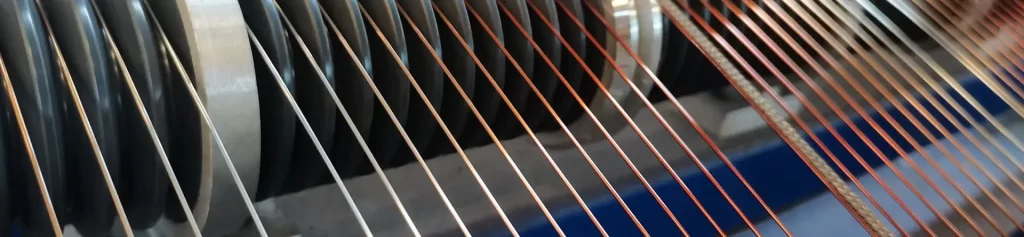
Heavy Build Enameled Aluminum Wire I. Overview of Heavy Build
1.1 Definition of Heavy Build
Heavy build is a term in NEMA MW 1000 standard — referring to enameled wire with enamel thickness at Grade 2 or above. In IEC standards, Grade 2 corresponds to thick enamel, Grade 3 corresponds to extra thick enamel.
In JIS standards, Grade 2 and Grade 3 are both high insulation grade choices — JIS C 3202 specifies Grade 3 breakdown voltage ≥ 6,000 V.

In NEMA standards, Heavy Build corresponds to NEMA MW 1000-C (round wire) and MW 1000-F (flat wire).
1.2 Engineering Significance of Heavy Build
The core value of heavy build enameled wire is high insulation reliability — it is irreplaceable in the following scenarios:
High voltage motors (≥ 6 kV): enamel breakdown voltage ≥ 6,000 V, preventing winding inter-turn short circuit.
High frequency transformers (≥ 1 kHz): large enamel thickness, high fault tolerance, withstanding high frequency voltage stress.
Wind power/photovoltaic inverters: durability guarantee under long-term high voltage stress.
EV drive motors: the ultimate challenge of 800V high voltage platform to enamel.
Nuclear power/railway and other critical applications: reliability guarantee under 30 to 40 year life requirements.
1.3 Heavy Build vs Single Build
Single Build (Grade 1) is the standard enamel thickness — small enamel increase, lower breakdown voltage, lower cost.
Heavy Build (Grade 2/3) is thick enamel — large enamel increase, high breakdown voltage, higher cost.
Core selection principles: voltage grade, reliability requirements, mechanical stress — these three factors determine whether heavy build is needed.
II. Enamel Thickness Classification
2.1 NEMA MW 1000
Standard
NEMA MW 1000 is a comprehensive standard for enameled wire developed by the National Electrical Manufacturers Association. NEMA MW 1000 specifies Single, Heavy, and Triple three-level enamel.
Single Build: standard enamel thickness, lower breakdown voltage.
Heavy Build: thick enamel thickness, high breakdown voltage.
Triple Build: extra thick enamel, highest breakdown voltage.
2.2 IEC 60317
Standard
IEC 60317 is the International Electrotechnical Commission enameled wire series standard. IEC 60317 specifies Grade 0, Grade 1, Grade 2, Grade 3 four-level enamel.
Grade 0: thin film enamel (IEC 60317-20).
Grade 1: standard enamel (IEC 60317-21).
Grade 2: thick enamel.
Grade 3: extra thick enamel.
2.3 JIS C 3202
Standard
JIS C 3202 is a Japanese industrial standard. JIS C 3202 specifies Grade 0, Grade 1, Grade 2, Grade 3 four-level enamel, consistent with IEC 60317.
2.4 Correspondence between Standards
The following table summarizes the correspondence between NEMA, IEC, and JIS enamel thickness standards:
| NEMA MW 1000 | IEC 60317 | JIS C 3202 | Chinese Name |
|---|---|---|---|
| Single Build | Grade 1 | Grade 1 | standard enamel |
| Heavy Build | Grade 2 | Grade 2 | thick enamel |
| Triple Build | Grade 3 | Grade 3 | extra thick enamel |
| — | Grade 0 | Grade 0 | thin film enamel |
III. Breakdown Voltage Comparison
3.1 Definition of Breakdown Voltage
Breakdown voltage is the core indicator for measuring enamel insulation strength — the unit is volt (V).
Breakdown voltage test methods: IEC 60851-5 (power frequency breakdown voltage), ASTM D3032 (enamel insulation strength).
3.2 Breakdown Voltage for Different Enamel Grades
The following table summarizes the breakdown voltage requirements for different enamel grades at different conductor diameters (IEC 60317 / JIS C 3202):
| Conductor Diameter (mm) | Grade 0 (V) | Grade 1 (V) | Grade 2 (V) | Grade 3 (V) |
|---|---|---|---|---|
| 0.25 | 600 | 1,200 | 1,800 | 2,400 |
| 0.50 | 1,200 | 2,400 | 3,500 | 4,800 |
| 1.00 | 1,500 | 2,800 | 4,200 | 6,000 |
| 1.50 | 1,900 | 3,200 | 4,800 | 7,000 |
| 2.00 | 2,200 | 3,500 | 5,200 | 7,800 |
| 3.00 | 2,800 | 4,200 | 6,000 | 9,000 |
The breakdown voltage of Grade 3 is 2 to 2.5 times that of Grade 1 — this is the direct quantitative basis for heavy build selection.
3.3 Safety Margin of Breakdown Voltage
In engineering design, the actual working voltage is far lower than the breakdown voltage — usually a safety margin of 5 to 10 times is taken.
Typical design:
Grade 1 enamel: working voltage ≤ 280 V (breakdown voltage 2,800 V ÷ 10).
Grade 2 enamel: working voltage ≤ 420 V (breakdown voltage 4,200 V ÷ 10).
Grade 3 enamel: working voltage ≤ 600 V (breakdown voltage 6,000 V ÷ 10).
But this is only continuous working voltage — transient voltage (such as lightning impulse, operating overvoltage) may be much higher than this. This is why high voltage motors and wind power transformers need Grade 3 enamel.
3.4 Statistical Characteristics of Breakdown Voltage
Enamel breakdown voltage is a statistical distribution — not a single determined value. The breakdown voltage of enameled wire in the same batch follows a Weibull distribution or normal distribution.
Engineering indicators: 5% percentile, 95% percentile, standard deviation of breakdown voltage — these statistical parameters determine enamel reliability.
Typical Heavy Build enamel: breakdown voltage standard deviation / average value ≤ 15%.
IV. Heavy Build Application Scenarios
4.1 High Voltage Motors
High voltage motors (≥ 6 kV) are the traditional main battlefield of heavy build enameled aluminum wire — typical applications include:
Mining/chemical high voltage motors: voltage 6 to 10 kV, windings withstand extremely high voltage stress.
Large air compressor/pump motors: voltage 3 to 6 kV, long-term continuous operation.
EV drive motors: 800V high voltage platform, insulation stress is 1 time higher than traditional 400V system.
Rail traction motors: voltage 1.5 to 3 kV, frequent start-stop, overload.
4.2 Wind Power/Photovoltaic
Wind power generators:
Onshore wind power: voltage 690 V, 3.3 kV, 6.6 kV, Heavy Build is standard.
Offshore wind power: voltage 10 to 66 kV, Triple Build (Grade 3) becomes mainstream.
Photovoltaic inverters:
Centralized inverter: voltage 1,500 V DC.
String inverter: voltage 1,000 to 1,500 V DC.
Heavy Build application requirements in wind/photovoltaic: 25 year life + extreme temperature cycle + marine salt spray environment.
4.3 High Voltage Transformers
Oil-immersed transformer: voltage 35 kV and above, requires Heavy Build enameled wire.
Dry-type transformer: voltage 10 to 35 kV, Heavy Build + vacuum pressure impregnation (VPI).
Rectifier transformer: voltage 6 to 35 kV, frequent overload.
4.4 Application Scenario Comparison
The following table summarizes the key parameters of heavy build enameled aluminum wire in different application scenarios:
| Application Scenario | Working Voltage | Enamel Grade | Life Requirement | Key Challenge |
|---|---|---|---|---|
| EV drive motor | 400 to 800 V | Grade 2/3 | 15 years | high power density, high frequency |
| Industrial HV motor | 3 to 10 kV | Grade 3 | 20 years | high voltage stress |
| Onshore wind power | 690 V to 3.3 kV | Grade 2/3 | 25 years | temperature cycle, vibration |
| Offshore wind power | 10 to 66 kV | Grade 3 | 25 to 30 years | salt spray, high humidity |
| Photovoltaic inverter | 1,000 to 1,500 V | Grade 2 | 25 years | outdoor environment |
| Oil-immersed transformer | 35 kV+ | Grade 3 | 30 to 40 years | long life, reliability |
| Rail transit | 1.5 to 3 kV | Grade 2/3 | 30 years | vibration, overload |
| Nuclear power | 6 to 24 kV | Grade 3 | 40 to 60 years | extreme reliability |
V. Conductor Selection
5.1 Application of
Aluminum vs Copper in Heavy Build
The application proportion of aluminum enameled wire in heavy build is growing rapidly — mainly driven by the following factors:
Cost: aluminum unit price is about 1/3 of copper.
Weight: aluminum density is 30% of copper, weight reduced by 50 to 66%.
Strategy: copper mine geopolitical risk, CBAM carbon tariff.
Carbon footprint: aluminum life cycle carbon emissions are lower than copper (after equal resistance conversion).
5.2 Technical Challenges of
Aluminum Heavy Build Enameled Wire
Challenge 1: Conductor diameter enlargement
Under equal resistance conditions, aluminum conductor diameter is 1.28 times that of copper — this increases winding space requirements.
Challenge 2: Enamel stress matching
The thermal expansion coefficient of aluminum (23.1 × 10⁻⁶ /°C) is 1.4 times that of copper (16.5 × 10⁻⁶ /°C) — the enamel stress during temperature cycle is greater.
Challenge 3: Connection process
The connection process of aluminum heavy build enameled wire is more complex — requires special welding (ultrasonic, resistance, laser).
5.3 Aluminum Heavy Build vs
Copper Heavy Build Comparison
| Comparison Dimension | Aluminum Heavy Build | Copper Heavy Build |
|---|---|---|
| Breakdown Voltage | Grade 3 ≥ 6,000 V | Grade 3 ≥ 6,000 V |
| Diameter (equal resistance) | 1.28 times copper | benchmark |
| Weight (equal resistance) | 35 to 50% of copper | benchmark |
| Cost (equal resistance) | 40 to 50% of copper | benchmark |
| Enamel Adhesion | good | excellent |
| Welding Process | ultrasonic/resistance/laser | tin/resistance |
| Life | 20 to 25 years | 30 to 40 years |
| Main Application | EV, wind power, energy storage | high-speed rail, nuclear power |
VI. Winding Advantages
6.1 Advantages of Thick Enamel for Winding
Design
Advantage 1: Higher Reliability
Thick enamel breakdown voltage is high, and the risk of inter-turn short circuit is significantly reduced. The failure probability of Grade 3 enamel is about 1/5 to 1/10 of Grade 1.
Advantage 2: Wider Voltage Design Margin
Grade 3 enamel can withstand higher transient voltage (lightning impulse, operating overvoltage). Typical design: 6 kV motor with Grade 3 enamel can withstand 30 kV lightning impulse.
Advantage 3: Better Process Fault Tolerance
Large enamel thickness, high mechanical strength — not easy to be damaged during winding. The first-pass qualification rate of winding increases by 5 to 10%.
6.2 Impact of Thick Enamel on
Design
Disadvantage 1: Increased Winding Space Occupancy
The enamel increase of Grade 3 is 30 to 50% more than that of Grade 1 — meaning the winding cross-sectional area increases by 5 to 10%.
Design trade-off: in some space-constrained applications (such as small size motors), Heavy Build may lead to insufficient slot fill factor.
Disadvantage 2: Degraded Heat Dissipation Performance
The thermal conductivity of thick enamel is poor — when the enamel thickness increases by 30%, the temperature rise may increase by 10 to 15°C.
Design trade-off: in high frequency applications, heat dissipation needs to be strengthened (oil immersion, forced air cooling).
Disadvantage 3: Increased Cost
The unit price of Heavy Build enameled wire is 1.3 to 1.8 times that of Single Build.
6.3 Summary of Winding Advantages
The following table summarizes the comprehensive impact of heavy build enameled aluminum wire on winding design:
| Indicator | Heavy Build Advantage | Heavy Build Disadvantage |
|---|---|---|
| Breakdown Voltage | increase 100 to 150% | — |
| Transient Voltage | increase 200 to 300% | — |
| Reliability | increase 5 to 10 times | — |
| Process Fault Tolerance | increase 5 to 10% | — |
| Winding Space | — | increase 5 to 10% |
| Heat Dissipation Performance | — | temperature rise +10 to 15°C |
| Unit Price | — | increase 30 to 80% |
| Weight | reduce 50% | — |
VII. Process and Quality Control
7.1 Enamel Coating Process
Coating methods:
Vertical coating: mainstream process, suitable for diameter 0.10 to 3.15 mm round wire.
Horizontal coating: suitable for large diameter (≥ 3.15 mm) and flat wire.
Mold coating: suitable for special specifications.
Number of coating passes:
Grade 1: usually 4 to 6 passes.
Grade 2: usually 6 to 8 passes.
Grade 3: usually 8 to 12 passes.
Curing process:
Furnace temperature: usually 350 to 450°C (depending on enamel material).
Furnace length: usually 4 to 12 m.
Wire speed: usually 50 to 200 m/min (depending on diameter and enamel thickness).
7.2 Enamel Uniformity Control
Enamel uniformity is the key quality indicator of heavy build enameled wire:
Conductor temperature uniformity: ±5°C.
Coating mold accuracy: ±5 μm.
Furnace temperature distribution: ±10°C.
Wire speed stability: ±2%.
7.3 Key Quality Control Points
Raw material control:
Aluminum rod purity: ≥ 99.5% (1350-O).
Enamel solid content: ±2%.
Enamel viscosity: ±5%.
Process control:
Enamel thickness online measurement: every 30 minutes.
Breakdown voltage online sampling: every 2 hours.
Conductor temperature monitoring: continuous recording.
Finished product control:
100% breakdown voltage test.
Conductor elongation test.
Scratch resistance test.
Solvent resistance test.
7.4 Common Quality Issues
Issue 1: Uneven Enamel Thickness
Cause: coating mold wear, enamel viscosity fluctuation, unstable wire speed.
Consequence: breakdown voltage fluctuation, local insulation weakness.
Issue 2: Enamel Eccentricity
Cause: coating mold eccentricity, conductor position deviation.
Consequence: enamel weak point, insulation failure risk.
Issue 3: Enamel Pinholes
Cause: enamel contamination, insufficient curing temperature, excessive environmental humidity.
Consequence: breakdown voltage drops seriously, insulation failure.
Issue 4: Enamel Blistering
Cause: insufficient solvent volatilization, excessive curing temperature.
Consequence: enamel structure loose, breakdown voltage unstable.
VIII. Testing and Certification
8.1 Key Testing Items
Required testing items for Grade 3 enameled aluminum wire:
Breakdown voltage: 5 tests per sample, minimum value ≥ 6,000 V.
Conductor elongation: ≥ 30% (diameter 1.0 mm).
Scratch resistance: ≥ 7.0 N load.
Heat shock: 200°C × 30 min + 20% stretch, enamel does not crack.
Chemical resistance: transformer oil, alcohol, acetone immersion for 24 hours, enamel does not swell.
Softening breakdown: 300°C hot plate, enamel does not crack.
8.2 Third-Party Certification
UL certification:
UL 1446 (electrical insulation system) + UL 2353 (enameled wire).
Applicable to North American market, especially home appliances and motors.
IEC certification:
IEC 60317-0-1, IEC 60317-1, IEC 60317-2 and other series standards.
Applicable to global market.
JIS certification:
JIS C 3202, JIS C 3210, JIS C 3211.
Applicable to Japanese market.
Other certifications:
CSA (Canada), VDE (Germany), CCC (China).
8.3 Certification Cost Comparison
| Certification System | Initial Certification | Annual Maintenance | Applicable Scope |
| Certification System | Initial Certification | Annual Maintenance | Applicable Scope |
|---|---|---|---|
| UL 1446 | 50,000 to 150,000 USD | 10,000 to 30,000 USD | North America |
| IEC 60317 | 10,000 to 30,000 EUR | 5,000 to 10,000 EUR | Global |
| JIS C 3202 | 500,000 to 3,000,000 JPY | 100,000 to 300,000 JPY | Japan |
| ISO 9001 | 50,000 to 100,000 RMB | 20,000 to 50,000 RMB | Global |
IX. Conclusion
Heavy build enameled aluminum wire is the key material for high insulation, high reliability electrical applications — it is irreplaceable in the fields of EV, wind power, high voltage motors, rail transit, oil-immersed transformers.
Core conclusions:
1. Heavy Build = Grade 2 / Grade 3 — breakdown voltage ≥ 4,200 V / ≥ 6,000 V.
2. Aluminum Heavy Build is growing rapidly in EV and wind power — driven by three advantages: cost, weight, carbon footprint.
3. Technical challenges of aluminum Heavy Build: conductor diameter enlarged by 1.28 times, enamel stress matching, connection process.
4. Winding advantages: reliability increased by 5 to 10 times, process fault tolerance increased by 5 to 10%, transient voltage tolerance increased by 200 to 300%.
5. Winding disadvantages: winding space increased by 5 to 10%, heat dissipation performance decreased, unit price increased by 30 to 80%.
For engineers: choosing Heavy Build must balance insulation reliability vs winding space vs heat dissipation performance vs cost — there is no one-size-fits-all solution.
For procurement: batch stability, enamel uniformity, third-party certification of Heavy Build enameled aluminum wire are the core evaluation dimensions.
For suppliers: investing in Heavy Build requires precision coating equipment, strict process control, complete quality system — this is a high threshold, high profit, high competitiveness track.
Future trends: 800V EV platform, offshore wind power 66 kV, long-life energy storage (25+ years), nuclear power (60 years) — will continue to drive the technical upgrade and market expansion of Heavy Build enameled aluminum wire.