

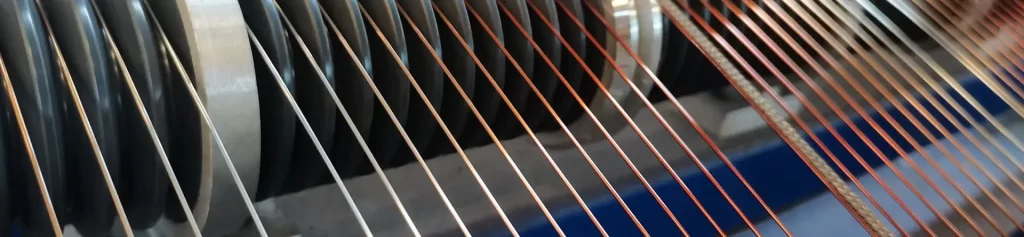
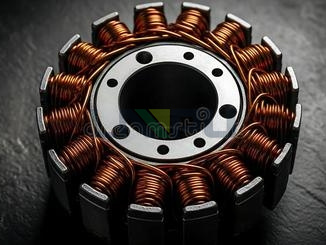
Industrial motors are the core power source for global industrial production. From pumps, fans, and compressors to conveyors and machine tools, industrial motors drive the operation of modern manufacturing. As the core conductive material of the motor stator and rotor, the performance of the winding wire directly affects the motor’s efficiency, reliability, lifespan, and operating costs.
With the popularization of variable frequency drive (VFD) technology and the continuous improvement of energy efficiency standards (such as IE3, IE4, and IE5), the requirements for winding wires in industrial motors are constantly increasing. This article provides a systematic technical guide for motor engineers and purchasing decision-makers from six dimensions: material selection, insulation system, technical requirements, challenges of variable frequency operation, application scenarios, and selection guidelines.
I. Material Selection for Industrial Motor Winding Wires
1.1 Copper Conductor
Copper conductor is the mainstream choice for industrial motor windings:
- Conductivity: Conductivity ≥97% IACS, low resistance loss, and high efficiency
- Mechanical Properties: Tensile strength 200-300 MPa, capable of withstanding mechanical stress during manufacturing processes such as winding, embedding, and shaping
- Welding Performance: Easy to weld and connect; mature end-connection technology
- Applicable Scenarios: High-efficiency motors (IE4/IE5), space-constrained compact motors, high-frequency applications
1.2 Aluminum Conductor
Aluminum conductor is gaining increasing attention in specific industrial motor applications:
- Lightweight: Density 2.70 g/cm³, approximately 30% of copper, significantly reducing motor weight
- Cost Advantage: Aluminum is far cheaper than copper, with a more pronounced cost advantage in large-section windings
- Conductivity: Conductivity ≥61% IACS; the difference in conductivity needs to be compensated by increasing the cross-sectional area (approximately 1.6 times)
- Applicable Scenarios: Industrial motors with relatively relaxed efficiency requirements, such as fans and pumps; cost-sensitive applications
1.3 Copper-Clad Aluminum Conductor
Copper-clad aluminum conductor combines the welding properties of copper with the lightweight advantages of aluminum:
- Structural Features: An aluminum core with an outer copper layer
- Applicable Scenarios: Medium-power motors, used in applications where cost and weight are both critical
II. Insulation System of Industrial Motor Windings
2.1 Insulation Class Requirements
Commonly used insulation classes for industrial motors:
| Insulation Class | Maximum Operating Temperature | Typical Applications |
|---|---|---|
| Class B | 130°C | Conventional industrial motors |
| Class F | 155°C | Mainstream industrial motors (IE3/IE4) |
| Class H | 180°C | High-temperature conditions, variable frequency motors |
2.2 Commonly Used Insulating Varnish Types
Polyesterimide (PEIW/EIW):
- Insulation Class: Class 155 (F grade)
- Characteristics: Good heat resistance, chemical resistance and mechanical strength
- Applications: IE3/IE4 energy efficiency grade industrial motors
Polyesterimide/Polyamide-imide (EI/AIW):
- Insulation Class: Class 180/200 (Class H and above)
- Features: Excellent high temperature resistance and withstands variable frequency pulse voltage
- Applications: Variable frequency motors, high-temperature motors
Polyurethane (UEW):
- Insulation Class: Class 130/155
- Features: Can be directly soldered, suitable for small industrial motors
2.3 Composite Insulation
Under harsh conditions, a composite insulation structure of enameled wire + film covering is often used:
- Enameled wire + polyester film (Class F)
- Enameled wire + polyimide film (Class H)
- Suitable for high voltage, variable frequency drives, and other special conditions
III. Technical Requirements for Industrial Motor Winding Wires
3.1 Electrical Performance
Breakdown Voltage: The winding wire enamel coating must be able to withstand the operating voltage and overvoltage. For variable frequency motors, the impact of high-frequency pulse voltage (dv/dt) on the enamel coating must be additionally considered.
Corona Resistant Performance: The high-frequency pulse voltage generated by the variable frequency drive can trigger corona discharge, accelerating the aging of the enamel coating. Variable frequency motor winding wires must use a corona-resistant insulation system (such as a polyamide-imide outer layer).
3.2 Thermal Performance
Thermal Aging: When winding wires operate at motor operating temperatures for extended periods, the insulating varnish will undergo thermal aging. High-quality winding wires maintain good mechanical strength and electrical properties even after thermal aging.
Thermal Shock: During motor start-up and shutdown, the winding temperature changes rapidly. The winding wires must possess good thermal shock stability to prevent enamel coating cracking.
3.3 Mechanical Performance
Flexibility: Winding wires must withstand bending and tension during winding, embedding, and shaping. Insufficient flexibility can lead to enamel coating damage.
Scratch Resistance: During embedding, the winding wires rub against the core slot walls. Winding wires with poor scratch resistance are easily scratched, leading to insulation failure.
Adhesion: The adhesion between the enamel coating and the conductor must be strong enough to prevent peeling during processing and operation.
3.4 Chemical Properties
Solvent Resistance: Winding wires, which come into contact with insulating varnish solvents during the VPI (Vacuum Pressure Impregnation) process, must have good solvent resistance to prevent swelling or dissolution of the enamel coating.
Refrigerant Resistance: In hermetic compressor motors, winding wires must withstand the chemical corrosion of refrigerants (such as R134a, R410A).
IV. Challenges of Variable Frequency Drive for Winding Wires
The widespread application of VFD technology in industrial motors places additional technical requirements on winding wires:
4.1 High-Frequency Pulse Voltage Stress
The VFD outputs high-frequency PWM pulse voltages, with peak voltages reaching more than twice the DC bus voltage. This high-frequency pulse voltage can cause partial discharge (corona) between the winding turns, accelerating the aging of the enamel coating.
Solutions:
- Use polyamide-imide (AIW) as the outer insulation layer
- Use a composite insulation structure (enameled + film)
- Improve the thickness and density of the enamel coating
4.2 Skin Effect and Proximity Effect
High-frequency current can cause skin effect and proximity effect, increasing the AC resistance and copper loss of the winding.
Solutions:
- Use multi-strand fine wires wound in parallel (Litz wire structure)
- Optimize winding design to reduce high-frequency losses
4.3 Thermal Cycling Stress
Variable frequency motors operate under varied conditions and undergo frequent thermal cycling. The winding wire enamel coating must withstand repeated thermal expansion and contraction.
Solutions:
- Select an insulation system with good thermal shock stability
- Optimize motor heat dissipation design to reduce temperature fluctuations
V. Application Scenarios of Industrial Motor Winding Wires
5.1 AC Motors
Three-Phase Asynchronous Motors: The most common type of motor in industry. Winding wires usually use Class F or Class H insulation.
Synchronous Motors: Used for high-power, high-precision applications, requiring higher electrical and mechanical performance of the winding wires.
5.2 DC Motors
Brushed DC Motors: The armature winding requires frequent commutation, and winding wires must possess good wear resistance and arc resistance.
Brushless DC Motors (BLDC): Electronic commutation; winding wire requirements are similar to AC motors.
5.3 Servo Motors
Servo motors require high precision and high response speed; winding wires typically use high-quality enameled copper wire with insulation class F/H.
5.4 Variable Frequency Motors
Motors specifically designed for VFD drives; winding wires must be corona resistant and able to withstand high-frequency pulse voltages, typically using Class H or higher insulation class.
5.5 Explosion-Proof Motors
Used in hazardous environments (such as petrochemical and coal mines); winding wires must meet explosion-proof certification requirements, and the insulation system must have a higher safety margin.
VI. Selection Guide
6.1 Conductor Material Selection
| Considerations | Copper Wire | Aluminum Wire |
|---|---|---|
| Efficiency Requirements | High (IE4/IE5) | Medium (IE3 and below) |
| Space Constraints | Compact | Spacious |
| Cost Budget | Sufficient | Sensitive |
| Weight Requirements | No special requirements | Lightweight |
6.2 Insulation Class Selection
- Class F (155°C): Mainstream industrial motors, IE3/IE4 energy efficiency rating
- Class H (180°C): Variable frequency motors, high-temperature conditions, heavy-duty applications
- Class B (130°C): Conventional applications, cost priority
6.3 Insulation Type Selection
- Conventional Conditions: PEIW/EIW (polyesterimide)
- Variable Frequency Conditions: EI/AIW (polyesterimide/polyamide-imide)
- Special Operating Conditions: Composite insulation (enameled + film)
6.4 Specifications Confirmation
- Wire diameter (or flat wire cross-section size)
- Minimum breakdown voltage
- Flexibility and scratch resistance requirements
- Certification requirements (UL, IEC, NEMA, etc.)
Conclusion
The selection of winding wire for industrial motors directly affects the efficiency, reliability, and service life of the motor. With the widespread adoption of variable frequency drives and increasingly stringent energy efficiency standards, industrial motors place higher demands on the thermal, electrical, and mechanical properties of their winding wires.
Selecting the appropriate winding wire requires comprehensive consideration of conductor material, insulation class, operating environment, and cost factors. For variable frequency motors, corona resistant performance is a crucial technical indicator. Collaborating with professional winding wire manufacturers ensures access to high-quality products that meet application requirements.