

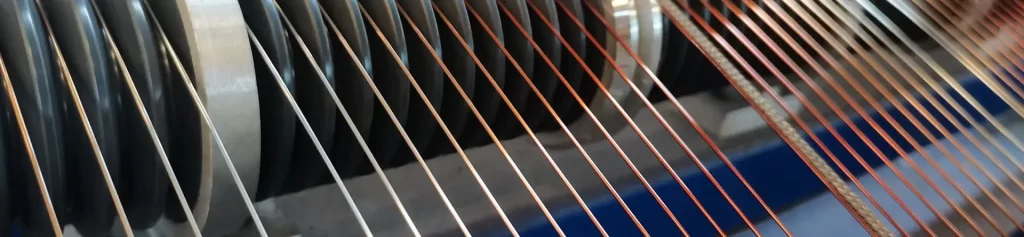
Fiberglass covered wire and polyimide wire are two representative products in the field of high-temperature winding wires. Fiberglass covered wire uses glass fiber as the main insulation and achieves multiple temperature resistance levels (Class 155/180/200) through insulating varnish treatment; polyimide wire uses polyimide (PI, Polyimide) or aramid tape as the main insulation and can achieve extremely high temperature resistance (Class 220/240). The two types of wires differ significantly in insulation class, mechanical properties, electrical properties, chemical properties, manufacturing process, application scenarios, and cost. This article systematically compares fiberglass covered wire and polyimide wire from multiple dimensions to provide technical basis for the selection decision of high-temperature winding wires.
Overview of Fiberglass Covered Wire and Polyimide Wire
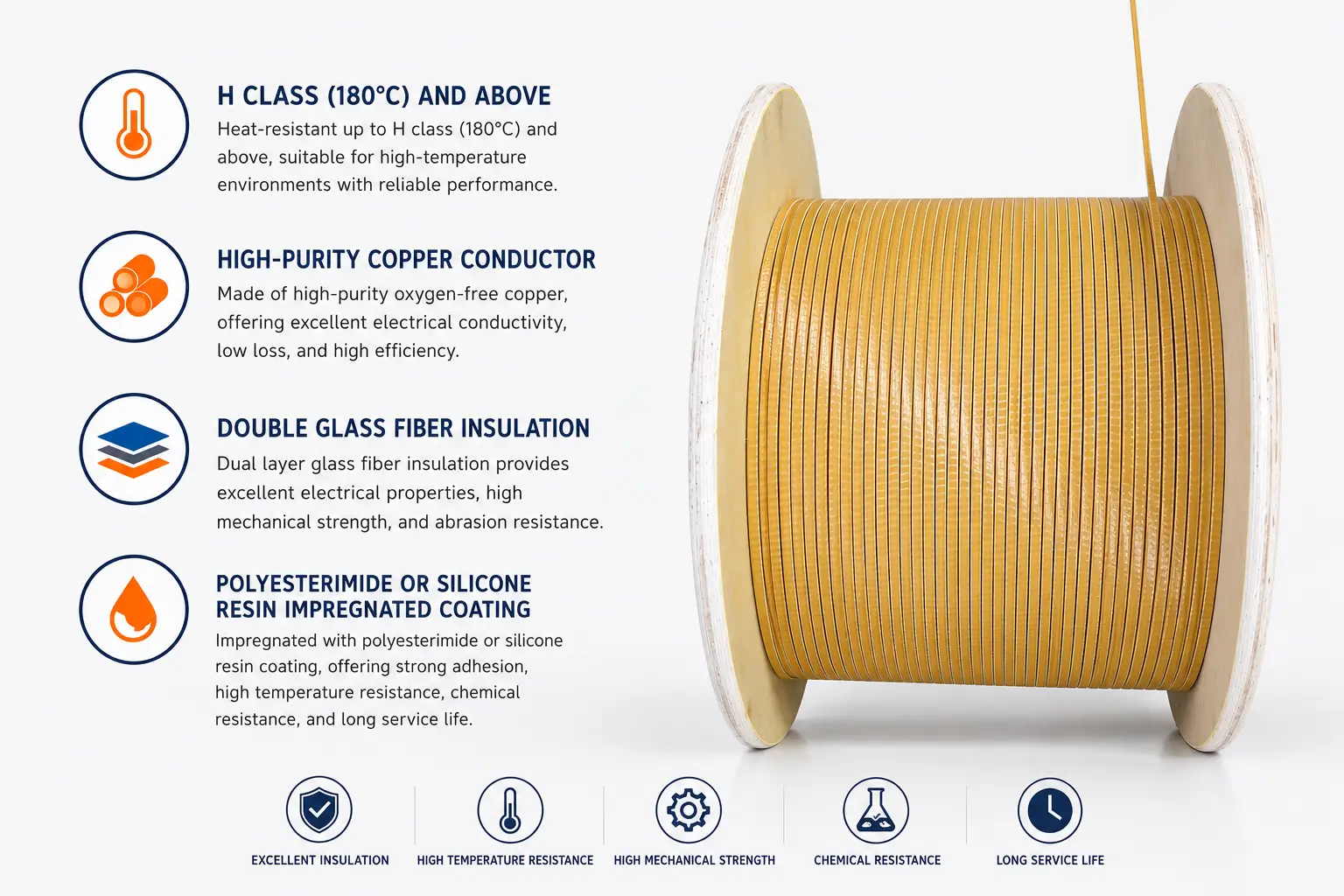
Fiberglass covered wire is a special type of winding wire with glass fiber filaments as the main insulation. A typical structure consists of a conductor (round copper/aluminum wire, rectangular copper/aluminum wire), an initial thin-film insulation (optional, Class 130 or Class 180 enamel coating), a glass fiber covering layer (single/double layer), and an insulating varnish layer (polyester, modified polyester, silicone resin, polyester imide). NEMA MW 1000-2018 specifies the following core specifications for glass-insulated round copper wire: MW 41-C (Class 155 glass-insulated, polyester insulating varnish), MW 45-C (Class 155 polyester fiberglass-insulated), MW 50-C (Class 180 glass-insulated, high-temperature organic varnish), MW 51-C (Class 180 polyester fiberglass-insulated, high-temperature organic varnish), MW 44-C (Class 200 glass-insulated, silicone-treated), and MW 47-C (Class 200 polyester fiberglass-insulated, silicone-treated). The core specifications for glass-insulated rectangular/square copper wire include: MW 42-C/46-C (Class 155), MW 52-C/53-C (Class 180), and MW 43-C/48-C (Class 200). IEC 60317-48 corresponds to MW 41-C standard.
Polyimide wire is a high-temperature winding wire with polyimide (PI) enamel coating as its insulation. Polyimide is currently the highest-class enamel coating material for thermal wires, with long-term operating temperatures reaching Class 220 (R class, 220°C) or Class 240 (240°C). NEMA MW 1000-2018 specifies the following polyimide-related specifications: MW 20-C (Class 240 polyimide film-insulated copper round/rectangular wire), MW 36-C (Class 220 polyester (amide)imide coated with PAIW), MW 38-C (Class 220 polyester (amide)imide coated with PAIW), and MW 84-C (Class 220 polyamide-imide, PAI). Aromatic polyimide sheathed rectangular/square wire is MW 64-C (Class 240), and aromatic polyamide paper-sheathed rectangular/square wire is MW 60-C (Class 220). IEC 60317-46 corresponds to polyimide enameled round copper wire, and IEC 60317-47 corresponds to aromatic polyimide sheathed rectangular/square copper wire.
The core difference between the two types of wire lies in their insulation structure: glass fiber-insulated wire has a composite structure of “glass fiber + insulating varnish”, with glass fiber as the main insulation material (temperature resistance above 550°C) and the overall temperature resistance determined by the insulating varnish (Class 155-200); polyimide enameled wire has a single or double layer structure of “polyimide enameled coating”, with polyimide enameled coating as the main insulation material (temperature resistance above 240°C) and the overall temperature resistance determined by the polyimide enameled coating (Class 220-240).
Insulation Class and Temperature Performance Comparison
Insulation class is a core indicator for evaluating the temperature resistance performance of winding wires. IEC 60085 standard specifies the thermal class system for electrical insulation: E (120°C)/B (130°C)/F (155°C)/H (180°C)/N (200°C)/R (220°C)/240°C. Enamelled round aluminum wire supplements this with C (200°C)/C+ (220°C) classes.
Regarding the insulation class of glass fiber insulated wire, it depends on the thermal class of the insulating varnish. Polyester insulating varnish treatment (MW 41-C) corresponds to Class 155 (F grade); modified polyester insulating varnish treatment corresponds to Class 180 (H grade); and silicone insulating varnish treatment (MW 44-C, MW 47-C) corresponds to Class 200 (N grade). Glass fiber insulated wire cannot reach Class 220/240 because the upper temperature limit of the insulating varnish restricts the overall temperature resistance.
Regarding the insulation class of polyimide enameled wire, polyamide-imide enamel coating (PAI, PAIW) can reach Class 220 (R grade), and polyimide enamel coating (PI) can reach Class 240 (240°C). Aromatic polyimide paper-wrapped wire can reach Class 220, and aromatic polyimide tape-wrapped wire (MW 64-C, MW 65-C) can reach Class 240. Polyimide enameled wire is currently the highest-class enameled wire type.
Regarding long-term operating temperature, the long-term operating temperature for glass fiber-insulated wire is 155°C for Class 155, 180°C for Class 180, and 200°C for Class 200. For polyimide enameled wire, the long-term operating temperature is 220°C for Class 220 and 240 for Class 240. Polyimide enameled wire has a 40°C higher operating temperature than Class 200 glass fiber-insulated wire and a 60°C higher operating temperature than Class 180 glass fiber-insulated wire.
Regarding thermal shock temperature, NEMA MW 1000-2018 specifies the following thermal shock temperatures: Class 155 175°C, Class 180 200°C, Class 200 220°C, Class 220 240°C, and Class 240 260°C. Polyamide-imide (PAI) has a softening breakdown temperature of 330-350°C. When subjected to instantaneous thermal shock exceeding 200°C, the internal stress of the enamel coating is extremely low, and it will not crack.
Regarding thermal aging life, the IEC 60172 standard specifies that the thermal aging life of winding wires is calculated based on the Arrhenius equation, with 20,000 hours corresponding to the rated temperature of the insulation class. Class 200 glass-insulated wire has a life of 20,000 hours when operating at 200°C, Class 220 polyimide enameled wire has a life of 20,000 hours when operating at 220°C, and Class 240 polyimide enameled wire has a life of 20,000 hours when operating at 240°C.
Mechanical Performance Comparison
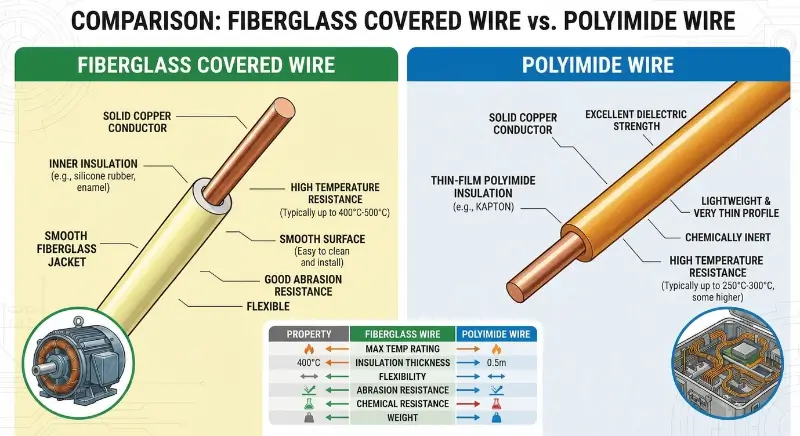
Glass fiber wrapped wire and polyimide wire differ significantly in mechanical properties, mainly in tensile strength, elongation, flexibility, scratch resistance, and vibration resistance.
In terms of tensile strength, glass fiber can reach 2000-3500 MPa, which is 50-100 times that of enamel coating (20-50 MPa). The mechanical strength of glass fiber-coated wire is mainly provided by glass fiber, and its overall tensile strength is significantly better than that of polyimide enameled wire. The tensile strength of polyimide enameled wire is about 100-200 MPa, but it is still much lower than that of glass fiber.
Regarding elongation, NEMA MW 41-C specifies the minimum elongation for glass fiber-covered round copper wire (with/without glass fiber): AWG 4/0-1/0 35%/35%, AWG 1-8 30%/30%, AWG 9-15 20%/30%, AWG 16-21 15%/25%, AWG 22-28 —/20%, AWG 29-30 —/15%. The elongation of polyimide enameled round copper wire is approximately 25-35% (nominal diameter 0.25-2.50mm), similar to that of glass fiber-covered wire (after glass fiber removal).
In terms of flexibility, polyimide enameled wire has a more brittle enamel coating and is less flexible than glass fiber-insulated wire. Polyimide enameled wire may experience enamel coating cracking when winding small-diameter coils (<10mm in diameter). Glass fiber-insulated wire, due to the flexibility of glass fibers, can be wound into coils with even smaller diameters. In bending tests, the pass criterion for polyimide enameled wire is that the enamel coating does not crack, while the pass criterion for glass fiber-insulated wire is that the overlay does not crack (not exposing the underlying bare wire or film insulation).
In terms of scratch resistance, polyimide enamel coatings outperform glass fiber-insulated wires. NEMA MW 1000-2018 Table 49 specifies the scratch resistance test for enamel coatings; the scratch resistance value for polyimide enamel coatings is typically ≥10N, significantly higher than that of the coating layer in glass fiber-insulated wires (where scratch resistance primarily depends on the insulating varnish layer). During automated winding and assembly processes, the enamel coating of polyimide enameled wire is more resistant to scratch damage.
In terms of vibration resistance, glass fiber coated wire exhibits superior vibration resistance compared to polyimide coated wire. The elastic modulus of glass fiber (approximately 70-80 GPa) is similar to that of copper conductor (approximately 110 GPa), resulting in uniform stress distribution and reduced stress concentration in vibrating environments. Polyimide coated wire, on the other hand, has a lower elastic modulus (approximately 3-5 GPa), significantly different from that of copper conductor. This difference can lead to relative displacement between the coated wire and the conductor in vibrating environments, potentially causing cracking of the coated wire.
Electrical Performance Comparison
Electrical performance is the core performance indicator of winding wire, mainly including breakdown voltage, dielectric strength, corona resistant, and insulation resistance.
Regarding breakdown voltage, glass fiber wrapped wire has a lower breakdown voltage because glass fiber has a porous structure, resulting in a lower breakdown voltage than solid enamel coating. NEMA MW 41-C (Class 155 glass fiber wrapped round copper wire) single-layer breakdown voltage: AWG 4/0-9.5≥170V, AWG 10-23.5≥360V, AWG 24-30≥225V; double-layer breakdown voltage: AWG 4/0-9.5≥315V, AWG 10-23.5≥540V, AWG 24-30≥400V. NEMA MW 47-C (Class 200 polyester fiberglass-coated round copper wire) single-layer breakdown voltage: AWG 4-9.5 ≥ 150V, AWG 10-23.5 ≥ 360V, AWG 24-30 ≥ 225V; double-layer breakdown voltage: AWG 4-9.5 ≥ 270V, AWG 10-23.5 ≥ 540V, AWG 24-30 ≥ 400V. IEC 60317-0-8 (polyester fiberglass-coated rectangular copper wire) has higher breakdown voltages: Class 1 single-layer ≥ 1350V, Class 1 double-layer ≥ 1560V, Class 2 single-layer ≥ 2350V, Class 2 double-layer ≥ 2560V. This is because it has a three-layer insulation structure consisting of an enamel coating, a fiberglass layer, and an insulating varnish.
Polyimide enameled wire has a high breakdown voltage because the enamel coating is solid and has high dielectric strength. The breakdown voltage of NEMA MW 20-C (Class 240 polyimide enameled round copper wire) is specified according to Grade 1/2/3: Grade 1 stranded wire has a breakdown voltage ≥3000V, Grade 2 ≥4500V, and Grade 3 ≥6000V (refer to typical values for polyimide enameled wire). The breakdown voltage of aramid-coated rectangular copper wire (MW 64-C) is typically ≥5000V.
In terms of dielectric strength, polyimide (enamel coating) has a significantly higher dielectric strength (approximately 200-300 kV/mm) than glass fiber-coated wire (glass fiber has a dielectric strength of approximately 10-20 kV/mm). Polyimide (enameled wire) exhibits a clear advantage in high-voltage applications.
In terms of corona resistance, polyimide enamel coatings exhibit significantly better performance than glass fiber-coated wires. Polyimide enamel coatings are less prone to partial discharge under high-voltage electric fields, with aramid PI enamel coatings showing particularly outstanding corona resistance. Glass fibers in glass fiber-coated wires may experience surface discharge under high-voltage electric fields, leading to insulation aging. Polyimide enameled wire is the preferred choice in high-voltage motors, high-voltage transformers, and high-voltage reactors.
In terms of insulation resistance, polyimide-coated wire has a better insulation resistance than glass fiber-coated wire. Polyimide has a dense structure, making it difficult for water molecules to penetrate, and its insulation resistance remains stable in humid environments. Glass fiber-coated wire, on the other hand, has a porous structure, allowing moisture to penetrate to the conductor surface, potentially causing a decrease in insulation resistance in humid environments.
Chemical Performance Comparison
Chemical properties are a key indicator for evaluating the environmental resistance of winding wires, mainly including resistance to acids/alkalis/salts/oils/solvents, moisture resistance, and UV resistance.
Regarding acid and alkali resistance, glass fiber exhibits excellent resistance to most acids and alkalis (except hydrofluoric acid), but it will slowly corrode after prolonged immersion in strong alkalis. Polyimide (enamel coating) also demonstrates excellent resistance to most acids and alkalis, but concentrated sulfuric acid and strong alkalis may corrode it. Both types of wires exhibit comparable chemical stability under normal acidic and alkaline conditions (pH 3-11).
In terms of salt spray resistance, glass fiber-coated wire exhibits excellent salt spray resistance and is widely used in offshore wind power, offshore platforms, and marine electrical equipment. Polyimide enameled wire also demonstrates excellent salt spray resistance, but the enameled coating may experience stress corrosion under prolonged salt spray conditions. Both types of wire pass the IEC 60068-2-52 salt spray test (≥56 days).
Regarding oil resistance, the oil resistance of glass fiber insulated wire depends on the oil resistance of the insulating varnish. Polyester insulating varnish (Class 155) has moderate oil resistance, while modified polyester and silicone resin (Class 200) have excellent oil resistance. Polyimide enamel coating has better oil resistance than glass fiber insulated wire; polyimide enamel coating does not swell or crack after long-term immersion in transformer oil, lubricating oil, and machine oil. In oil-containing environments such as transformers, reactors, and motors, polyimide enamel-coated wire is the preferred choice.
In terms of solvent resistance, polyimide enamel coating exhibits superior resistance compared to glass fiber wrapped wire. Polyimide enamel coating is resistant to organic solvents such as xylene, styrene, acetone, methanol, and ethanol. When glass fiber wrapped wire is immersed in organic solvents for extended periods, the insulating varnish layer may swell or peel off, leading to a decrease in insulation performance.
Regarding moisture resistance, glass-insulated wire may experience a decrease in insulation resistance due to moisture absorption by the glass fibers in long-term humid environments. Polyimide enameled wire, due to its dense enamel coating, exhibits superior moisture resistance compared to glass-insulated wire. In the IEC 60068-2-78 damp heat test (40°C/93% RH/56 days), the insulation resistance retention rate of polyimide enameled wire is significantly higher than that of glass-insulated wire.
In terms of UV resistance, both wires are comparable. Polyimide (enamel coating) is somewhat sensitive to UV radiation, and prolonged exposure may cause it to age. Glass fiber-insulated wire exhibits excellent UV resistance, but the insulating varnish layer may fail due to UV aging. For outdoor applications, both wires require additional UV protection (such as impregnation varnish or potting compound).
Manufacturing Process Comparison
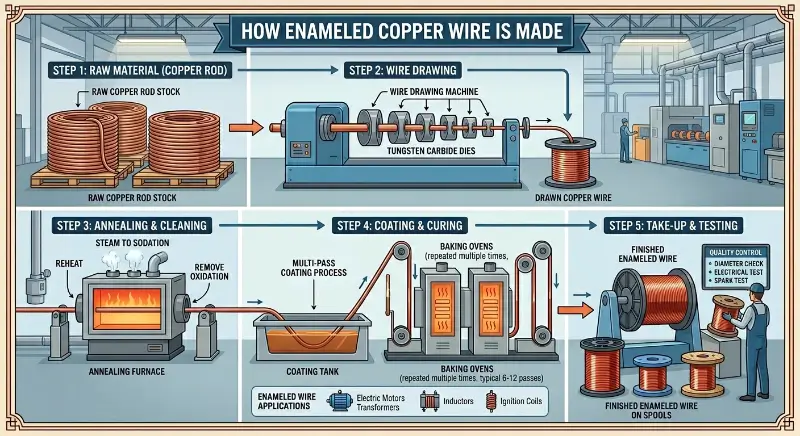
The manufacturing processes for glass fiber-insulated wire and polyimide-insulated wire are drastically different, which determines the production costs and quality control of the two types of wire.
The manufacturing process of glass fiber insulated wire includes: conductor pretreatment (annealing to improve elongation) → underlayer insulation coating (optional, enameling machine) → glass fiber braiding/winding (braiding machine/winding machine) → insulating varnish impregnation (immersion machine) → drying and curing (oven, 200-300°C polyester varnish or 250-350°C silicone varnish) → winding and packaging (PT4-PT200 spools). Key quality control points for glass fiber insulated wire include: the density, tension, and uniformity of the glass fiber coverage (“firmly, closely, evenly, and continuously”), and the viscosity, solids content, curing temperature, and time of the insulating varnish. NEMA MW 41-C explicitly requires that the glass fiber coverage be firm, tight, uniform, and continuous.
The manufacturing process of polyimide enameled wire includes: conductor pretreatment (annealing) → varnish preparation (polyamic acid precursor solution or polyimide solution) → enameling coating (enameling machine, multi-pass coating) → oven imidization (high-temperature oven, 300-400°C) → cooling → wire winding and packaging. Key quality control points for polyimide enameled wire include: varnish viscosity, solids content, number of coating passes, oven temperature gradient, degree of imidization (infrared spectroscopy detection), enameling coating thickness uniformity, and enameling coating continuity (pinhole test).
In terms of manufacturing costs, glass fiber insulated wire has a relatively moderate cost due to its lower raw material costs (glass fiber, polyester/silicone insulating varnish) and mature manufacturing process. Polyimide insulated wire has a higher cost because its raw material cost (polyimide resin) is approximately 3-5 times that of glass fiber, its manufacturing process is more complex (high-temperature imidization), and its yield rate is lower. The market price of polyimide insulated wire is typically 2-4 times that of glass fiber insulated wire.
In terms of yield, glass fiber wrapped wire has a high yield (≥95%) because the glass fiber weaving/winding process is mature and the defect rate is low. Polyimide enameled wire has a moderate yield (≥85%) because the enamel coating and high-temperature imidization processes are complex, and defects in the enamel coating (such as pinholes and uneven thickness) may lead to a decrease in yield.
Application Scenarios Comparison
The application scenarios of glass fiber wrapped wire and polyimide (enameled wire) are significantly different, mainly determined by three factors: insulation class, mechanical strength, and cost.
Typical applications of glass fiber wrapped wire:
- Large Transformers and Reactors: Rectangular glass fiber wrapped wire (Class 155/180/200) is the standard choice for high-current transformers and reactors, suitable for designs with currents ranging from 100-3000A. – Wind Turbines: Rectangular glass fiber wrapped wire (Class 180/200) is used in generators, transformers, and reactors for onshore and offshore wind power, especially for offshore wind power where Class 200 silicone-treated glass fiber wrapped wire is a core technology. – Industrial Motors: Rectangular glass fiber wrapped wire (Class 155/180) is used in high-voltage motors, traction motors, crane motors, and mining motors. – Photovoltaic Inverters and Energy Storage Converters: Rectangular or circular glass fiber wrapped wire (Class 155/180) is used in step-up inductors, filter inductors, and power frequency transformers. – New Energy Vehicles (Drive Motors): Round glass-insulated wire (Class 200) is used for stator windings in high-power-density drive motors. – Household and Commercial Appliances: Round glass-insulated wire (Class 155) is used for stator windings in household appliance motors. – Welding Machines and Induction Heating Equipment: Glass-insulated wire (Class 180/200) is used in welding machine transformers and induction heating coils.
Typical applications of polyimide enameled wire:
- Aerospace: Polyimide enameled wire (Class 220/240) is used in aircraft generators, aircraft transformers, flight control motors, and fuel pump motors, operating at temperatures up to 200-250°C in harsh environments. – Military Equipment: Polyimide enameled wire (Class 220/240) is used in military communication equipment, military motors, military transformers, military radar systems, and electrical systems for missiles and rockets. – Deep Sea and Nuclear Power: Polyimide enameled wire (Class 220/240) is used in deep-sea robots, nuclear power equipment, and deep-well drilling equipment, withstanding high temperatures, high pressures, and radiation environments. – Medical Devices: Polyimide enameled wire (Class 220/240) is used in MRI magnet coils, CT equipment, X-ray equipment, and medical robots. – Semiconductors and Precision Instruments: Polyimide enameled wire (Class 220/240) is used for coils inside vacuum chambers of semiconductor equipment and high-temperature components of precision instruments. – High-Temperature Motors and Special Motors: Polyimide enameled wire (Class 220/240) is used for deep well pump motors, flue gas motors, furnace motors, and high-temperature fan motors, with operating temperatures of 220-260°C.
Cost and Economic Comparison
Cost is one of the key factors in winding selection, especially in high-volume industrial applications.
In terms of raw material costs, glass fiber insulated wire has relatively low costs: glass fiber costs approximately 20-50 yuan/kg, polyester insulating varnish approximately 30-80 yuan/kg, silicone resin insulating varnish approximately 80-200 yuan/kg, and copper conductor costs are calculated based on market prices. Polyimide insulated wire has higher raw material costs: polyimide resin (approximately 200-500 yuan/kg) is 4-10 times more expensive than glass fiber, and the solvent cost of polyimide varnish is also higher.
In terms of manufacturing costs, glass fiber-insulated wire has a mature manufacturing process, relatively low equipment investment, and high production efficiency, with a manufacturing cost of approximately 50-150 yuan/kg. Polyimide (enameled wire) has a complex manufacturing process (high-temperature imidization), requires large equipment investment, has lower production efficiency, and a manufacturing cost of approximately 200-500 yuan/kg.
Regarding market prices, taking 0.5mm round copper wire as an example, the market price of glass-insulated wire (Class 155) is approximately 100-200 yuan/kg, and glass-insulated wire (Class 200) is approximately 200-350 yuan/kg. The market price of polyimide enameled wire (Class 220) is approximately 500-800 yuan/kg, and polyimide enameled wire (Class 240) is approximately 800-1500 yuan/kg. The price of polyimide enameled wire is approximately 2-5 times that of glass-insulated wire.
In terms of total lifecycle cost, the cost depends on the application environment. In typical industrial environments (-30°C to +60°C), glass-insulated wire can last 15-20 years. In harsh environments such as offshore wind power, deep sea, and military applications, glass-insulated wire (Class 200 silicone-treated) can last 10-15 years, requiring regular maintenance and inspection. Polyimide enameled wire has a higher total lifecycle cost but a longer lifespan, reaching 20-30 years in harsh environments such as aerospace, military, and nuclear power, with lower maintenance costs.
Selection Decision Recommendations
The selection of glass fiber-insulated wire and polyimide-insulated wire should be based on a comprehensive judgment of operating temperature, mechanical stress, electrical stress, chemical environment, and life cycle cost.
Scenarios where glass fiber wrapped wire is preferred:
- For transformers, reactors, and motors operating in typical industrial environments (-30°C to +60°C): Choose Class 155/180 glass fiber wrapped wire. It is suitable for normal temperatures, offers high mechanical strength, and is reasonably priced. – For high-current applications (100-3000A): Choose rectangular glass fiber wrapped wire. The large cross-section of the rectangular wire (2-6mm thickness, 5-15mm width) is suitable for high-current designs and offers high slot fill factor. – For applications with high mechanical stress (vibration, shock, bending): Choose glass fiber wrapped wire. The tensile strength of glass fiber (2000-3500 MPa) is significantly higher than that of enamel coating. – For offshore wind power, deep-sea platforms, and marine engineering: Choose Class 200 silicone-treated glass fiber wrapped wire (MW 44-C, MW 47-C). It is resistant to salt spray, temperature cycling, and vibration. – Cost-sensitive applications: Choose glass fiber wrapped wire, which has moderate manufacturing costs and a market price lower than polyimide enameled wire.
The preferred scenario for polyimide enameled wire:
- Ultra-high temperature applications (200-260°C): For motors, transformers, and reactors, choose Class 220/240 polyimide enameled wire, as polyimide enamel coating offers the highest thermal class. – Aerospace and military equipment: Choose Class 220/240 polyimide enameled wire to meet stringent weight, size, and reliability requirements. – High-voltage electrical applications (>10kV): For motors, transformers, and reactors, choose polyimide enameled wire for its high dielectric strength and excellent corona resistant properties. – Oil and organic solvent environments: Choose polyimide enameled wire for superior oil and solvent resistance compared to glass fiber-wrapped wire. – For applications in confined spaces and high power density: Choose polyimide enameled wire with a thin enamel coating (Grade 1 enamel coating thickness 0.02-0.04mm) to effectively utilize winding space.
Regarding hybrid solutions, in some applications, a hybrid approach combining glass fiber sheathing and polyimide impregnation can be used. The glass fiber sheathing provides mechanical strength and basic insulation, while the polyimide impregnation varnish (such as polyamide-imide varnish) fills the pores of the glass fibers, improving overall insulation performance and chemical resistance. This hybrid approach balances mechanical strength, thermal class, and cost.
Future Development Trends
Glass fiber wrapped wire and polyimide (enameled wire) continue to innovate and upgrade in multiple directions.
Technological upgrade directions for glass fiber wrapped wire:
- thermal class upgrade: Development of Class 220/240 glass fiber insulated wire (using aramid polyimide insulating varnish or nano-modified insulating varnish). – rectangular wire cross-section increase: Development of ultra-large cross-section rectangular glass fiber insulated wire with a thickness ≥10mm and a width ≥30mm, adaptable to ultra-high capacity transformers. – environmentally friendly insulating varnish: Development of water-based insulating varnish and low-VOC insulating varnish, compliant with environmental regulations. – intelligent manufacturing: Online inspection (CCD vision, AI defect recognition), automated production lines. – composite insulation technologies: Glass fiber + polyimide impregnation varnish, glass fiber + mica tape, glass fiber + ceramic coating.
Technological upgrade directions for polyimide enameled wire:
- Thermal Class Enhancement: Development of Class 260/300 polyimide enameled wire for future aerospace and nuclear fusion applications. – Thinner Enamel Coating: Development of Grade 0.5 (ultra-thin enameled coating) to further reduce coating thickness and improve fill factor. – Enameled Coating Modification: Modification of polyimide enameled coating with nanomaterials (nano SiO₂, nano Al₂O₃) to improve corona resistance and abrasion resistance. – Environmentally Friendly Solvents: Development of water-based polyimide paints and low-toxicity solvents. – Smart Manufacturing: Online enameled coating defect detection and automated imidization process control.
In terms of market competition, the glass fiber-covered wire market is mainly focused on mid-range applications, with major competitors including glass fiber-covered aluminum wire, polyimide film-wrapped wire, and aramid paper-wrapped wire. The polyimide wire market is primarily focused on high-end applications, with major competitors including aramid tape-wrapped wire, polyamide-imide wire, and mica tape-wrapped wire. The two types of wires complement each other in different application areas, rather than being complete substitutes.
Conclusion
Glass-insulated wire and polyimide-insulated wire are two representative products in the field of high-temperature winding wire, each with its own advantages and limitations in insulation class, mechanical properties, electrical properties, chemical properties, application scenarios, and cost. Glass-insulated wire, with its multi-level temperature resistance (Class 155/180/200), excellent mechanical strength, and moderate cost, dominates mid-range applications such as large transformers, wind turbines, and industrial motors. Polyimide-insulated wire, with its extremely high temperature resistance (Class 220/240), excellent electrical properties (dielectric strength, corona resistant), and chemical resistance, is irreplaceable in high-end applications such as aerospace, military equipment, medical devices, and semiconductors.
Selection decisions should be based on a comprehensive assessment of operating temperature, mechanical stress, electrical stress, chemical environment, and lifecycle cost. For conventional industrial environments, high-current applications, applications with high mechanical stress, and cost-sensitive applications, glass-insulated wire should be the first choice. For ultra-high temperature, high-voltage electrical, aerospace and military applications, oil-containing solvent environments, and high-power-density applications in confined spaces, polyimide-impregnated wire should be the first choice. In some scenarios, a hybrid solution of “glass-insulated wire + polyimide impregnation varnish” can balance multiple performance characteristics.
With the rapid development of high-end applications such as renewable energy, aerospace, military equipment, medical devices, and semiconductors, the market demand for glass-insulated wire and polyimide enameled wire will continue to grow, and technological upgrades will continue to advance. These two types of wire complement each other in different application areas, jointly supporting the innovative development of the global electrical industry.