

1 Introduction
Glass fiber insulated wire and paper insulated wire are two major categories of fiber-insulated conductors in the field of electromagnetic winding wires. They use inorganic glass fiber and organic insulating paper tape as the outer insulating medium, respectively, combined with impregnating varnish or mineral oil to form a complete insulation system. The two differ systematically in material composition, insulation performance, thermal class, manufacturing process characteristics, and application scenarios, while also exhibiting certain engineering substitution relationships. This article, based on standards such as NEMA MW 1000-2018, IEC 60317 series, and GB/T 7672, conducts a comparative analysis from five dimensions: material system, insulation performance, heat and mechanical properties, manufacturing process characteristics, and application selection, providing a systematic selection reference for winding wire engineers and purchasers.
It should be noted that paper-insulated wire is a broad concept. In this article, paper-insulated wire mainly refers to winding wires with cellulose insulating paper, aromatic polyamide paper, polyimide film paper, etc., as the base material, corresponding to the MW 31, MW 33, MW 60, MW 61, MW 64, and MW 65 series in NEMA MW 1000-2018. Fiberglass-insulated wire corresponds to the MW 41, MW 42, MW 44, MW 47, MW 50, MW 51, MW 52, and MW 53 series.
2 Comparison of Material Systems
2.1 Material Composition of Fiberglass Wire
The insulation system of fiberglass-coated wire consists of four layers: conductor, bottom enamel coating, fiberglass overlay, and impregnated varnish finish. The conductor is typically round copper or aluminum, with rectangular copper or aluminum used in a few applications. The bottom enamel coating is made of organic varnishes such as polyurethane, polyester, polyester imide, and polyamide-imide, with enamel coating grades ranging from 130 to 240. The fiberglass overlay uses electrical-grade E-Glass continuous filament glass yarn, with a dielectric constant of approximately 6.0 to 6.5, a volume resistivity of 10¹² to 10¹⁴ ohmmeters, and a softening point of approximately 846 degrees Celsius. The impregnating varnish is made of polyester, polyester imide, silicone, polyimide, etc.
The material system of fiberglass-coated wire is essentially a composite structure of inorganic glass fiber and organic enamel coating/impregnation varnish. The inorganic components provide mechanical strength, dielectric stability, and a heat-resistant framework, while the organic components provide processability, adhesion, and final cured strength.
2.2 Material Composition of Paper-Sheathed Thread
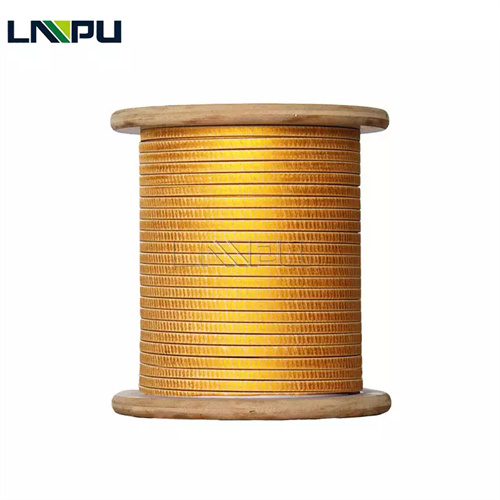
Paper-insulated wires consist of a three- or four-layer insulation system: a conductor, an enamel coating, a paper tape covering layer, and an adhesive or impregnation layer. The conductor is primarily made of round copper, round aluminum, rectangular copper, or rectangular aluminum. The enamel coating is similar to that of fiberglass-insulated wires. The paper tape covering layer is the core insulation medium of the paper-insulated wire; common substrates include:
- Cellulose insulating paper, i.e., traditional kraft paper, corresponds to MW 31 round wire and MW 33 rectangular wire in NEMA MW 1000-2018, Class 105 or 155; – Aromatic polyamide paper, trade name Nomex, corresponds to MW 60 aluminum wire and MW 61 copper wire, Class 220; – Polyimide film paper, corresponds to MW 64 aluminum wire and MW 65 copper wire, Class 240 and above; – polyester composite tape of film and paper, corresponding to some IEC 60317 sub-standards.
Paper-insulated wires are often used in conjunction with mineral oil in oil-immersed transformers. The mineral oil itself provides some insulation and heat dissipation, while the paper tape provides dielectric strength and mechanical barrier.
2.3 Fundamental Differences in Material Systems
The core medium of fiberglass-insulated wire is inorganic glass fiber, which has excellent chemical stability, high heat resistance, and is non-absorbent; the core medium of paper-insulated wire is organic cellulose or synthetic paper, which has relatively low chemical stability, high water absorption, and limited heat resistance. These material differences determine the fundamental divergence in insulation performance, heat resistance, and application scenarios.
3 insulation performance comparison
3.1 Dielectric Strength
According to NEMA MW 41-C Clause 3.8.4, the minimum dielectric breakdown voltage for fiberglass sheathing is: not less than 170 volts for single-layer sheathing and not less than 315 volts for double-layer sheathing. For sheathing with an enamel coating, the breakdown voltage corresponding to the enamel coating should be added. The dielectric loss tangent is approximately 0.005 to 0.015 at power frequency.
According to NEMA MW 60-A, the minimum dielectric breakdown voltage of paper-wrapped yarn is not less than 300 volts per mil, approximately 11,800 volts per millimeter of single-sided paper thickness, meaning a 40-micrometer paper tape can withstand approximately 470 volts. The dielectric loss tangent of cellulose paper is approximately 0.01 to 0.025 in the dry state, and increases significantly to over 0.05 after absorbing water.
In engineering applications, fiberglass-coated wire exhibits stable dielectric properties under dry conditions, while paper-coated wire shows significant differences in dielectric properties between dry and moist states. In oil-immersed transformer scenarios, the dielectric strength of paper-coated wire can be greatly improved after immersion in oil because the mineral oil fills the gaps between the paper tapes and suppresses the polarization effect of water molecules.
3.2 Heat Resistance and Thermal Life
Fiberglass-coated wires typically cover F class (155°C), H class (180°C), and C class (220°C and above). In NEMA MW 1000-2018, the most common fiberglass-coated wire series is MW 41-C (155 class, corresponding to IEC 60317-48); MW 44-C (200 class, silicone-treated fiberglass-coated wire); and MW 47-C (220 class, polyester-coated fiberglass-coated wire).
Paper-wrapped yarn is typically classified into three classes: traditional cellulose paper-wrapped yarn is Class 105 or 155, corresponding to NEMA MW 31 and MW 33; aromatic polyamide paper-wrapped yarn is Class 220, corresponding to NEMA MW 60 and MW 61; and polyimide film paper-wrapped yarn is Class 240 and above, corresponding to NEMA MW 64 and MW 65.
In terms of heat resistance, high-end paper-wrapped wire with polyimide film can reach a grade of 240 or higher, while glass fiber-wrapped wire reaches a maximum of about 220. The two have different focuses in terms of heat resistance limits. The advantage of glass fiber-wrapped wire lies in its excellent resistance to thermal shock and cracking resistance; the advantage of high-end paper-wrapped wire lies in its long-term thermal stability and stable dielectric strength.
3.3 Mechanical Strength and Vibration Resistance
The glass fiber braided layer of the fiberglass sheath imparts high radial stiffness and abrasion resistance to the conductor surface, significantly reducing the risk of insulation damage during manufacturing. According to NEMA MW 41-C Clauses 3.3.8 and 3.3.2, the sheath must not crack to the point of exposing the underlying bare wire or enamel coating after bending a mandrel diameter of 1d to 15d.
Paper-insulated wires have a spiral or overlapping wrapping structure, resulting in lower overall stiffness and relatively weaker abrasion resistance compared to fiberglass braided layers. However, in oil-immersed transformers, the composite system of paper-insulated wires, mineral oil, and insulating paperboard exhibits good overall stiffness and synergistic oil-paper insulation performance.
3.4 Chemical resistance and moisture protection
Fiberglass-coated wire is a chemically inert material, stable to weak acids, weak alkalis, mineral oils, synthetic ester oils, and silicone oils, and insensitive to moisture. When combined with an epoxy or polyester impregnation varnish curing layer, it can operate stably for extended periods in humid, polluted, and chemically corrosive environments.
Cellulose insulation paper for paper-insulated wires is extremely sensitive to moisture; after absorbing water, its dielectric strength decreases significantly, its mechanical strength deteriorates, and it is prone to mold growth. Aromatic polyamide paper and polyimide film paper have relatively good moisture resistance, but still require a dry environment and oil immersion protection. In oil-immersion transformer scenarios, the combination of paper-insulated wire and mineral oil can effectively isolate moisture.
3.5 Resistance to thermal cycling
Fiberglass-coated yarn disperses thermal stress through its glass fiber skeleton, resulting in a significantly lower coefficient of linear expansion compared to pure enamel coating systems, approximately 5 × 10⁻⁶ per K, compared to 60 to 100 × 10⁻⁶ per K for enamel coating—a difference of an order of magnitude. This characteristic gives fiberglass-coated yarn excellent crack resistance under frequent thermal cycling.
Under frequent thermal cycling, the difference in expansion coefficients between the paper tape and the impregnating varnish can lead to interfacial cracking or delamination in paper-covered yarn. In oil-immersed transformers, the buffering effect of mineral oil provides relatively better thermal cycling resistance.
4 Comparison of Process Features
4.1 Manufacturing Process
The manufacturing process of fiberglass-coated wire includes: conductor drawing or procurement, enamel coating and curing, fiberglass braiding or winding, and impregnation and curing of the enamel coating. The braiding equipment is a high-speed braiding machine, with a braiding pitch accurate to 0.1 mm, and the fiberglass coverage is typically no less than 95%. The impregnation process has evolved from early atmospheric pressure impregnation to vacuum pressure impregnation; the VPI process allows the enamel coating to fully penetrate the gaps between the fiberglass fibers.
The manufacturing process of paper-insulated wire includes: conductor drawing or procurement, enamel coating and curing, paper tape wrapping, and adhesive curing or impregnation. The wrapping equipment is a specialized paper tape wrapping machine; paper tape width, tension, and overlap rate are the core process parameters. Cellulose paper tape typically requires drying after wrapping, while aromatic polyamide paper tape can directly proceed to the impregnation or encapsulation process after wrapping.
4.2 Winding Manufacturing and Processing
Fiberglass-coated wire exhibits excellent machinability in winding manufacturing. Round wire is suitable for automatic winding machines, while rectangular flat wire is suitable for helical winding and continuous transposition winding of high-power windings. FGCW round wire can withstand repeated bending of mandrel diameters from 1d to 15d without cracking. Rectangular FGCW combined with Roebel transposition technology is the standard process for stator windings of large generators.
Paper-wrapped wire requires more precise process control in winding manufacturing. Cellulose paper tape is prone to creases or tears when bent, and rectangular paper-wrapped flat wire requires special processes to ensure proper Roebel transposition. High-end aromatic polyamide paper tape and polyimide film paper tape have significantly improved processability compared to cellulose paper tape, but still require specialized equipment and processes.
4.3 Impregnation and Curing
Vacuum pressure impregnation (VPI) is commonly used for fiberglass insulation. The VPI process allows the impregnating varnish to penetrate the gaps between the fiberglass fibers under vacuum, followed by further filling under a pressure of 0.3 to 0.6 MPa, resulting in a dense, gap-free insulator after curing. The VPI process can increase the overall dielectric strength of the winding by 30% to 50% compared to the unimpregnated state.
The impregnation process for paper-insulated wires varies depending on the application. In dry-type transformer applications, paper-insulated wires are often impregnated under normal pressure or by dripping, with the impregnating varnish filling the gaps between the paper tapes. In oil-impregnated transformer applications, paper-insulated wires do not require additional impregnating varnish; instead, they are used in conjunction with mineral oil. During the vacuum oiling process, the mineral oil penetrates the gaps between the paper tapes, forming an oil-paper insulation system.
4.4 Manufacturing Efficiency and Cost
Fiberglass-coated wire (FGCW) boasts high manufacturing efficiency, with weaving speeds reaching hundreds of meters per minute. Continuous production lines enable large-scale industrial production. However, the labor costs associated with fiberglass yarn and the weaving process constitute a significant portion of the material cost, making FGCW approximately 30% to 80% more expensive than conventional polyester-coated wire.
The manufacturing efficiency of paper-wrapped yarn is limited by the paper tape winding speed, and the single-machine capacity is usually lower than that of glass fiber braiding machines. Cellulose paper tape has a lower material cost, but the cost of high-end aromatic polyamide paper tape and polyimide film paper tape is significantly higher than that of glass fiber yarn. Overall, the cost range of paper-wrapped yarn is wide, from low-end cellulose paper wrapping to high-end polyimide film paper wrapping, covering both low-cost and high-cost extremes.
5 Comparison of Application Scenarios
5.1 Main Applications of Fiberglass Wire
Fiberglass-insulated yarns dominate in the following scenarios:
- High-voltage motor stator windings, rated voltage 6 kV and above, using VPI technology to achieve power frequency withstand voltage and partial discharge suppression; – Traction motors and rail transit motors, subjected to high vibration, high overload, and frequent start-stop conditions; – Wind turbine stator windings, for onshore and offshore wind power applications, using epoxy VPI to achieve salt spray resistance and long-term thermal stability; – Industrial induction heating coils, operating frequencies from 1 kHz to hundreds of kHz, subjected to high current and high temperature; – Automotive ignition coils, secondary windings subjected to 25 to 40 kV peak voltage; – High-reliability applications such as yaw and pitch motors, robot motors, and military special motors.
5.2 Main Applications of Paper-Wrapped Thread
Paper-wrapped thread dominates in the following scenarios:
- Oil-immersed power transformers: Cellulose paper-insulated wire combined with mineral oil forms a classic oil-paper insulation system, the traditional solution for large power transformers of 110 kV and above; – Dry-type transformers: Aromatic polyamide paper-insulated wire combined with epoxy or polyester impregnation varnish, suitable for fire-resistant and explosion-proof scenarios; – High-frequency transformers and inductors: Nomex paper and polyimide film paper are used for high-frequency insulation; – Special environment transformers: Moisture-resistant and oil-resistant transformers for marine, mining, and chemical applications; – Traction transformers: Vehicle-mounted or ground traction transformers in the rail transit field.
5.3 Oil-immersed transformer: A traditional area of advantage for paper-insulated wire
In the field of oil-immersed power transformers, the combination of paper-insulated wire and mineral oil is a classic insulation system proven over a century. Oil-paper insulation offers high dielectric strength, excellent heat dissipation, and relatively controllable cost. The oil absorption properties of cellulose paper tape allow it to form a homogeneous insulator with mineral oil. In large-scale power transformers with voltage levels of 110 kV and above, paper-insulated wire remains the mainstream winding insulation solution.
However, it should be noted that in scenarios such as offshore wind power booster transformers, compact dry transformers, and railway traction transformers, fiberglass-coated wires combined with VPI technology have gradually replaced some paper-coated wire applications, especially in scenarios with stringent requirements for fire prevention, explosion protection, and maintenance-free operation.
5.4 Engineering Replacement of Paper-Insulated Wire with Fiberglass Wire
In the following scenarios, fiberglass-insulated wires have become the engineering replacement for paper-insulated wires:
- Dry transformer: H-grade fiberglass-coated wire + vacuum pressure impregnated epoxy resin, which can replace traditional paper-coated wire and provide higher thermal class and mechanical strength; – Wind power boost transformer: H-grade fiberglass-coated wire + epoxy VPI process, which has better salt spray resistance and thermal cycling resistance than paper-coated wire in offshore wind power scenarios; – Traction motor: H-grade fiberglass-coated rectangular flat wire + VPI process, which can replace some of the paper-coated windings of traction transformers; – Special applications: In extreme environments such as islands, deserts, and high-altitude cold regions, fiberglass-coated wire has better resistance to moisture and temperature than cellulose paper-coated wire.
Conversely, paper-wrapped thread still maintains an irreplaceable advantage in the following scenarios:
- 110 kV and above ultra-high voltage oil-immersed power transformers, with the dielectric strength and cost advantages of paper-oil insulation systems; – Indoor dry-type transformers with stringent fire protection requirements, where the flame-retardant properties of high-end aromatic polyamide paper tape are superior to those of glass fiber impregnation varnish; – Power transformers with over 30 years of stable operation, where the long-term reliability data of the paper-oil system is more comprehensive.
6 Key Points for Selection and Evaluation
The selection of fiberglass-insulated wire and paper-insulated wire should be comprehensively evaluated from five dimensions: voltage level, thermal class, operating environment, mechanical requirements, and cost constraints.
Regarding voltage levels, fiberglass-insulated wire + VPI technology is recommended for stator windings of high-voltage motors of 10 kV and above; paper-insulated wire + mineral oil insulation system is recommended for large oil-immersed power transformers of 110 kV and above; dry-type transformers and distribution transformers below 10 kV can be flexibly selected.
In terms of thermal class, both fiberglass-coated and paper-coated wires are suitable for F-class and H-class applications; fiberglass-coated wires are more advantageous for high-temperature scenarios of C-class and above; and cellulose paper-coated wires have a significant cost advantage for low-pressure applications of B-class and below.
In terms of operating environment, fiberglass-coated wires have better tolerance in offshore wind power, humid environments, and vibration scenarios; paper-coated wires + mineral oil combination is irreplaceable in oil-immersed transformer scenarios; and high-end aromatic polyamide paper-coated wires are safer in fireproof and explosion-proof scenarios.
In terms of mechanical requirements, fiberglass-coated wire is recommended for scenarios involving vibration, shock, and frequent start-stop; paper-coated wire is sufficient for static winding and long-term stable operation scenarios.
In terms of cost constraints, cellulose paper-wrapped wire has obvious advantages in low-cost applications; for scenarios with high reliability, high heat resistance, and high mechanical requirements, glass fiber wrapped wire or high-end paper-wrapped wire is more valuable in engineering.
In terms of testing and verification, suppliers should be able to provide type test reports that comply with standards such as ANSI/NEMA MW 1000, IEC 60317 series, and GB/T 7672, and have specific test data for dielectric breakdown voltage, thermal level, mechanical flexibility, and accelerated thermal aging.
7 Engineering Evolution Trends
Fiberglass-insulated and paper-insulated wires have shown a trend of integration and complementarity in long-term engineering practice. In terms of integration, the composite insulation structure of fiberglass and paper has been applied to some high-end transformers and special motors; the composite structure of fiberglass and polyimide film is gradually being promoted in the fields of new energy and aerospace. In terms of complementarity, oil-immersed transformers still mainly use a paper-oil system, and fiberglass-insulated wires cannot completely replace them; the proportion of fiberglass-insulated wires in dry-type transformers, traction motors, wind power, and other scenarios continues to increase.
In future development, fiberglass-insulated wire will evolve towards higher heat resistance, higher dielectric constant, longer lifespan, and more intelligent operation and maintenance. Paper-insulated wire will be further developed towards higher voltage level oil-immersed (transformer), special application dry-type (transformer), and composite insulation structures. Both will coexist in different application scenarios for a long time, and engineers should select the most suitable insulation system based on specific operating conditions.
8 Conclusion
Fiberglass-insulated wire and paper-insulated wire are two major categories of fiber-insulated conductors in the field of electromagnetic winding wires, each with its own technological advantages and application scenarios. Fiberglass-insulated wire, with inorganic glass fiber as its core, boasts stable dielectric properties, high mechanical strength, thermal shock resistance, and moisture and corrosion resistance, making it suitable for high-voltage motors, wind power, traction, and special equipment. Paper-insulated wire, with organic insulating paper tape as its core, offers high dielectric strength, a mature oil-paper insulation system, and controllable costs, making it suitable for oil-immersed power transformers, dry-type transformers, and high-frequency inductors.
Selection decisions should be based on a comprehensive evaluation across multiple dimensions, including voltage level, thermal class, operating environment, mechanical requirements, and cost constraints. In the field of oil-immersed large-scale power transformers, paper-insulated wire remains irreplaceable; while in high-voltage motors, wind power, traction, and special equipment, fiberglass-insulated wire has become the mainstream solution. With the development of new materials and processes, fiberglass-insulated wire and paper-insulated wire will complement and integrate in more scenarios, jointly supporting the sustainable development of strategic industries such as power electronics, new energy, and rail transportation.
Contact Information:
- E-mail: office@cnlpzz.com
- WhatsApp: 0086-19337889070
- Zhengzhou LP Industry Co., Ltd.