


Technical Guide to Standards and Certification Processes for Fiberglass-Coated Wire
Fiberglass-coated wire, a special insulated conductor widely used in power equipment such as transformers, reactors, and motors, requires a comprehensive standards system for its production and quality evaluation. This article systematically elaborates on two core dimensions: the standards system architecture and the certification process for fiberglass-coated wire. First, the article outlines the differences in the structure and technical provisions between the IEC 60317 series of international standards and the ANSI/NEMA MW 1000 series of American national standards, and then analyzes the correspondence between the Chinese GB/T standards system and international standards. Regarding the certification process, the article details the application process and key points for UL certification, CE marking, RoHS declaration of conformity, REACH compliance, and ISO 9001 quality management system certification, providing practical guidance for manufacturers to obtain market access qualifications and for purchasers to assess supplier capabilities.
International Standards System Architecture
Structure of the IEC 60317 Series Standards
The IEC 60317 series standards, developed by Technical Committee 55 (TC55) of the International Electrotechnical Commission (IEC), is the most authoritative standards system in the field of insulated wires and insulated conductors worldwide. This series of standards uses a Part numbering system to distinguish different product types and technical requirements. The overall architecture of the IEC 60317 series standards is divided into two levels: general specifications and product specifications. Part 0 is the general specification, which stipulates common technical clauses such as conductor size series, insulation thickness classification, general test methods, and packaging and marking requirements. Each product specification (Part 1 to Part 77) builds upon the general specifications, specifying specific technical requirements for specific product types. IEC standards directly related to fiberglass-coated wire include: IEC 60317-48, which specifies the technical requirements for fiberglass-coated round copper wire; IEC 60317-51, which specifies the technical requirements for fiberglass-coated round aluminum wire; and IEC 60317-61, which specifies the technical requirements for polyester-coated rectangular and square copper wire. IEC 60317-0-1, as a general specification for round copper wire, specifies basic content such as dimensional ranges, permissible deviations, and test methods.
ANSI/NEMA MW 1000 Standard System
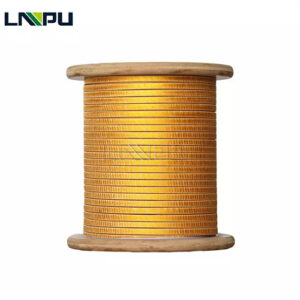
ANSI/NEMA MW 1000 is a standard for enameled wire and insulated conductors developed by the National Electrical Manufacturers Association (NEMA) and recognized as a US national standard by the American National Standards Institute (ANSI). This standard system is legally binding in the North American market and is the preferred basis for electrical equipment manufacturers in the region to select winding wires. The NEMA MW 1000 standard system is divided into several series based on product type: MW 1 to MW 15 are film-insulated wires; MW 41 to MW 65 are fiber-coated wires; and MW 71 to MW 80 are cable tie-insulated wires. Fiberglass-coated wire products are concentrated in the MW 41 to MW 55 range. MW 41-C specifies the technical requirements for 155-grade fiberglass-coated round copper wire, which is the core product specification for fiberglass-coated wire in the North American market. MW 50-C specifies the technical requirements for 180-grade high-temperature silicone-insulated fiberglass-coated wire. MW 53-C specifies the technical requirements for polyester-coated high-temperature rectangular copper wire. These standards use AWG (American Wire Gauge) and MCM (thousand-round mil) units in their dimensional systems, which are fundamentally different from the metric units of the IEC standard.
China GB/T Standard System
China’s national standard GB/T 7673 specifies the technical requirements for paper-insulated and fiberglass-coated winding wires, maintaining consistency with the IEC 60317 series standards in its technical framework. However, it uses an alphabetical system instead of a numerical system for thermal rating classification symbols. The thermal rating classifications specified in GB/T 7673 correspond to the following relationships with IEC 60085: Class A corresponds to 105 degrees C, Class E to 120 degrees C, Class B to 130 degrees C, Class F to 155 degrees C, Class H to 180 degrees C, and Class C to 200 degrees C. Fiberglass-coated wire products in the Chinese market are typically labeled as Class 180 (Class H) or Class 200 (Class C). Within China’s national standard system, standards related to winding wires also include the GB/T 4074 series of test method standards and the GB/T 6109 series of enameled wire product standards, collectively forming a complete technical standard system.
Comparison of Technical Clauses in Major Product Standards
IEC 60317-48 Technical Requirements
IEC 60317-48 applies to circular cross-section conductors made of electrical round copper wire, covered with continuous fiberglass yarn, and impregnated with insulating varnish. The products specified in this standard are conventional fiberglass-coated wires widely used by transformer and reactor manufacturers. Regarding dimensional specifications, IEC 60317-48 specifies conductor nominal diameters ranging from 0.050 mm to 5.00 mm, divided into several size grades. Insulation types are distinguished into two structures: bare fiberglass coating and primer-film composite fiberglass coating. The primer-film composite structure adds a polyester or polyester-imide film between the conductor and the fiberglass layer, providing higher electrical strength. Key performance indicators specified in the standard include: upper limit of conductor resistivity, minimum breakdown voltage of the insulation layer, mandrel diameter for bending tests, and lower limit of elongation. The thermal rating of this standard is determined by the heat resistance of the primer or impregnating varnish, typically Class 155, corresponding to a maximum operating temperature of 155 degrees C.
NEMA MW 41-C Technical Requirements
NEMA MW 41-C specifies the technical requirements for Class 155 fiberglass-coated round copper wire, widely referenced in the procurement specifications of North American transformer and reactor manufacturers. The technical clauses of this standard correspond to IEC 60317-48, but specific indicators differ. Regarding fiberglass material requirements, MW 41-C specifies that the fiberglass should be electrical grade continuous fiber yarn. If a primer film composite structure is used, the insulation class of the primer coating should be no less than Class 130. The fiberglass coating should be tightly, uniformly, and continuously wound onto the conductor surface and impregnated with insulating varnish to form a rigid outer sheath. The dielectric strength requirements specified in MW 41-C vary depending on the conductor specifications: AWG 4/0 to 9.5, minimum breakdown voltage 170V for single-layer insulation; AWG 10 to 23.5, minimum breakdown voltage 360V; AWG 24 to 30, minimum breakdown voltage 225V. For products with primer-coated composite insulation, the breakdown voltage requirements of the primer layer must be added.
Key Differences in Standard Clauses
There are systematic differences in the technical clauses between IEC and NEMA standards, which manufacturers and purchasers must pay close attention to in cross-market transactions. Regarding dimensional systems, IEC standards use metric units, with nominal diameter expressed in millimeters and dimensional tolerances expressed in absolute values; NEMA standards use imperial units, with nominal diameter expressed in AWG and dimensional tolerances specified in tabular form. Unit conversion is necessary when comparing the two standards, and the loss of conversion accuracy may affect the accuracy of selection. Regarding testing methods, the test voltage application time specified by NEMA standards is generally longer than that of IEC standards. For example, in dielectric strength testing, the standard voltage application time for routine IEC tests is 1 minute, while NEMA standards require even longer testing times for some products. This means that products that pass IEC standard testing may not necessarily meet all NEMA standard requirements. Regarding labeling requirements, IEC and NEMA standards have different mandatory regulations on the content and format of product labeling. Product labeling typically needs to include the manufacturer’s name or trademark, standard number, thermal rating, conductor specifications, etc., and the specific labeling method should comply with the requirements of the corresponding standard.
Certification Process and Market Access
UL Certification Process and Key Milestones
UL certification, provided by Underwriters Laboratories, is the most credible product safety certification in the North American market. For fiberglass-coated wire products, the main applicable standard is UL 1446, “Insulation System Standard”. The UL certification process consists of three stages: product testing, factory review, and annual follow-up inspection. During the product testing phase, manufacturers must submit representative samples to a UL-authorized laboratory and provide product technical documentation, including design drawings, a bill of materials, a description of the manufacturing process, and performance test data. The laboratory conducts comprehensive safety performance tests according to applicable standards, covering electrical strength, mechanical strength, thermal performance, and flammability characteristics. The testing cycle typically lasts 4 to 8 weeks. During the factory inspection phase, UL engineers conduct an initial factory inspection of the manufacturer’s production facilities to assess the effectiveness of the quality management system and confirm the consistency of the product with the tested samples. The initial factory inspection is usually arranged after the product testing is passed. During the annual follow-up inspection phase, UL regularly conducts surprise inspections of the factory production line, taking samples from the production line or warehouse for verification testing to ensure that product quality continues to meet certification requirements. Manufacturers must maintain complete production records and inspection data for UL engineers to review. The cost structure of UL certification includes an initial application fee, testing fees, factory inspection fees, and annual follow-up inspection fees. The certification is valid for one year and must be renewed upon expiration.
CE Marking and EU Market Access
The CE marking is a mandatory compliance mark for products entering the EU market, indicating that the product meets the basic safety requirements of relevant EU directives. For fiberglass-coated wire products, compliance with the Low Voltage Directive (LVD 2014/35/EU) and the Restriction of Hazardous Substances Directive (RoHS 2011/65/EU) is a prerequisite for obtaining the CE marking. The basic process for obtaining the CE marking includes: identifying the applicable EU directives and technical standards, conducting a product conformity assessment, preparing technical documentation, signing a declaration of conformity, and affixing the CE marking to the product. For insulating materials such as fiberglass-coated wire, product testing can be conducted by the manufacturer’s own laboratory or a third-party Notified Body. The test report, as part of the technical documentation, must prove that the product complies with all relevant clauses of the applicable standards. The technical documentation must be kept for at least 10 years for random checks by market regulators. The documentation includes: product description, design drawings, bill of materials, test reports, and declaration of conformity.
RoHS Declaration of Conformity Process
The RoHS Directive (2011/65/EU and (EU) 2015/863 as amended) is an EU directive restricting the use of hazardous substances in electrical and electronic equipment. Fiberglass-coated wire, as an electrical insulation material, falls under its control. The RoHS conformity assessment process includes: identifying restricted substances, obtaining material composition data, conducting testing and verification, and preparing a declaration of conformity. The list of restricted substances includes: lead, mercury, cadmium, hexavalent chromium, polybrominated biphenyls (PBBBs), polybrominated diphenyl ethers (PBDEs), di(2-ethylhexyl) phthalate, butyl benzyl phthalate, di-n-butyl phthalate, and diisobutyl phthalate. Fiberglass-coated wire products must ensure that the content of the above substances does not exceed the limits specified in the directive. Conformity verification is usually commissioned by the manufacturer to a qualified third-party testing organization. The test samples should be representative and are usually randomly selected from mass-produced products. The validity period of the test report depends on product changes and is usually 1 to 3 years. Manufacturers are required to prepare a RoHS Declaration of Conformity, declaring that their products comply with relevant directives, and retain test reports and technical documents for future reference.
REACH Regulation Response Strategies
The REACH Regulation (EC 1907/2006) is a comprehensive EU regulation governing the registration, evaluation, authorization, and restriction of chemicals, imposing information communication and content limits on products containing Substances of Very High Concern (SVHCs). The impact of the REACH Regulation on fiberglass-coated wire products is mainly reflected in the management of chemical raw materials such as insulating varnishes and impregnating agents. Manufacturers need to confirm whether their raw materials contain substances on the SVHC list. The SVHC list is continuously updated and currently includes more than 240 substances. Manufacturers should establish a raw material composition information system and regularly track updates to the SVHC list. For products containing SVHCs, when the content exceeds 0.1% wt, manufacturers must communicate safe usage information to downstream suppliers, including the substance name, intended use, and risk mitigation measures. When products containing SVHCs circulate in the EU market, compliance with authorization requirements and restrictions must also be considered.
ISO 9001 Quality Management System Certification
ISO 9001 is a quality management system standard developed by the International Organization for Standardization (ISO), providing an internationally recognized assessment framework for manufacturers’ quality management levels. The ISO 9001 certification process includes: system establishment, certification application, on-site audit, corrective actions, and certificate issuance. The certification audit is typically divided into two stages: the first stage assesses the establishment and implementation of the quality management system; the second stage assesses the effectiveness and conformity of the system’s operation. The audit is conducted by a third-party certification body, and the auditors must possess the corresponding professional qualifications. The certification certificate is valid for three years, during which annual surveillance audits are required to confirm the continued effectiveness of the quality management system. Recertification audits are required after the three-year period. ISO 9001 certification focuses on process management, risk control, and continuous improvement, emphasizing quality management principles such as customer focus, leadership, total participation, process approach, and improvement cycle.
Standard Selection and Certification Planning Guidelines
Target Market Standard Confirmation
The selection of standards for glass fiber coated wire products should primarily consider the regulatory requirements of the target market. For products exported to the North American market, priority should be given to meeting the requirements of the relevant clauses of ANSI/NEMA MW 1000 and obtaining UL certification. NEMA standards are widely adopted by electrical equipment manufacturers in North America and are a basic requirement for entering this market. For products exported to the European market, compliance with the IEC 60317 series standards and EU RoHS and REACH regulations is required. CE marking is mandatory for entry into the EU market. For products exported to other Asian countries, applicable standards should be selected based on the specific regulations of each country. The Japanese market typically requires compliance with JIS standards, while the Indian market typically requires compliance with IS standards.
Certification Combination Strategy
Manufacturers can develop cost-effective certification combination strategies based on the combination of target markets. For products entering both the North American and European markets, priority should be given to obtaining UL certification and ISO 9001 certification. UL certification testing standards are highly correlated with NEMA standards; products with UL certification generally meet NEMA requirements well. ISO 9001 certification can serve as a foundational quality management system, providing quality assurance support for other certifications. RoHS compliance is a basic requirement for the EU market; it is recommended that all products exported to the EU undergo a RoHS compliance assessment and obtain a declaration, regardless of whether the product ultimately uses restricted substances. REACH compliance needs to be assessed based on the actual chemical raw materials used. If raw materials such as insulating varnishes and impregnating agents have obtained SVHC compliance declarations from suppliers, the manufacturer’s REACH compliance risk is low.
Certification Timeline
The implementation of certification projects requires reasonable time planning to ensure products enter the target market on time. The complete cycle for UL certification is typically 3 to 6 months, including 4 to 8 weeks for testing, 2 to 4 weeks for factory inspection, and 2 to 4 weeks for report review and certificate issuance. For new applicants, it is recommended to allow at least 6 months. The CE marking acquisition cycle depends on the complexity of product testing and the completeness of technical documentation, typically taking 1 to 3 months. RoHS testing usually takes 2 to 4 weeks; if the product structure is simple and uses only one material, testing can be completed within one week. ISO 9001 certification typically takes 6 to 12 months, including 3 to 6 months for system establishment and 3 to 6 months for certification audit and certificate issuance. Manufacturers are advised to initiate certification planning during the product development stage, incorporating certification requirements into product design considerations to avoid delays in market launch plans due to certification cycles.
Conclusion
The standard system and certification process for fiberglass-coated wires are highly specialized and systematic. Manufacturers should thoroughly understand the differences between the IEC 60317 series standards, NEMA MW 1000 series standards, and the Chinese GB/T standard system, and develop reasonable product standard strategies based on the regulatory requirements of the target market and customer needs. Regarding certification acquisition, UL certification, CE marking, RoHS declaration of conformity, and ISO 9001 certification constitute the main qualification basis for fiberglass-coated wire products to enter the international market. Manufacturers should plan their certification portfolios and timelines appropriately, integrating certification requirements into the continuous improvement of their quality management systems. When evaluating suppliers, purchasers should consider the supplier’s standard conformity certificates and certifications as important assessment indicators, while also paying attention to the alignment between the certification’s validity period and scope of application.