

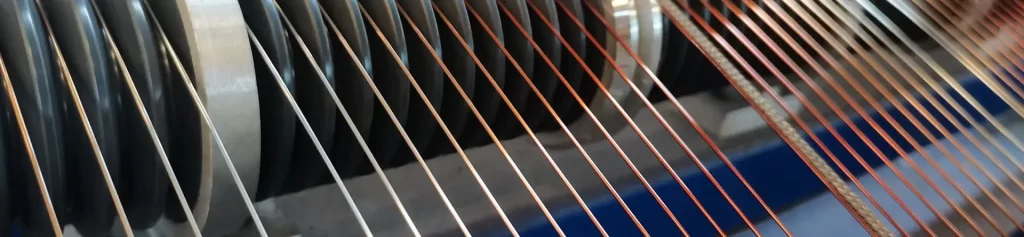
Railway systems constitute a critical national infrastructure and a mass-transit mode, encompassing high-speed rail, electric multiple units (EMUs), electric locomotives, metro and urban rail transit, maglev systems, freight railways, and monorails. Fiberglass covered wire (FGW) serves as the core winding insulation material for key electrical components in railway applications—including traction transformers, traction motors, traction reactors, on-board transformers, signaling transformers, and maglev linear motors—leveraging its distinctive advantages: exceptional high-temperature resistance (155–260 °C), high mechanical strength, outstanding fire-retardancy, low smoke and low toxicity, vibration resistance, impact resistance, oil resistance, aging resistance, and high reliability (30-year service life). Consequently, FGW plays an irreplaceable, critical role in railway systems. This document systematically addresses: the fundamental architecture and development trends of railway systems; the pivotal role of FGW in railway applications; comparative analysis of FGW versus other magnet wire insulation materials; FGW types and specifications; manufacturing processes and quality control; typical applications—including traction transformers, traction motors, EMUs and electric locomotives, maglev systems, railway signaling and control, and railway power supply systems; key performance requirements and test methods; selection guidelines; and future development trends.
Basic Architecture and Development Trends of Railway Systems
Railway systems serve as critical transportation infrastructure for passenger and freight transport and constitute a national strategic asset. Classified by speed class, traction method, and application scenario, railway systems comprise a diversified architecture—including high-speed railways, electric multiple units (EMUs), electric locomotives, subways and urban rail transit, maglev systems, freight railways, and monorails—each imposing distinct requirements on electrical system insulation materials.
Basic classification of railway systems:
- High-Speed Rail (HSR):
- China: CRH series, Fuxing (CR400AF/CR400BF), CR450 (China Standard EMU, >400 km/h)
- Japan: Tokaido Shinkansen, Sanyo Shinkansen, Tohoku Shinkansen, Hokkaido Shinkansen
- France: TGV, AGV (V150)
- Germany: ICE 1/2/3/4 (max. 350 km/h)
- South Korea: KTX, ITX
- Spain: AVE
- Italy: Frecciarossa
- Speed class: 250–400 km/h
- Traction power supply: 25 kV/50 Hz or 25 kV/60 Hz single-phase AC
- Electric Multiple Unit (EMU):
- Distributed power configuration: CRH1/CRH2/CRH3/CRH5/Fuxing Series
- Operating speed: 200–350 km/h
- Traction power supply: 25 kV AC via pantograph
- Electrical systems: Traction transformer, traction converter, traction motor, auxiliary power supply, signaling system
- Electric Locomotive:
- China: HXD Series, HXD1/2/3 (Harmony-type 8-axle), HXD2B/3B
- Overseas: Siemens Vectron, Alstom Prima, Traxx, Japanese EF510
- Speed: 120–200 km/h
- Traction Power Supply: 25 kV single-phase AC
- Power Output: 4000–14400 kW
- Diesel Locomotive:
- China: DF Series (DF4/DF8/DF11), HXN Series (Harmony-type diesel locomotive)
- Overseas: GE AC4400CW, EMD SD70
- Traction: Diesel engine–generator set + electric transmission
- Applied to non-electrified railways
- Metro and Urban Rail:
- Metro: Beijing, Shanghai, Guangzhou, Shenzhen, Hong Kong, Taipei
- Light Rail: Changchun, Dalian, Tianjin, Wuhan
- Tram: Shenyang, Suzhou, Nanjing, Qingdao
- Monorail: Chongqing Straddle-type Monorail, BYD Cloud Bus
- Unattended Train Operation (UTO) Metro: Beijing Yanfang Line, Shanghai Metro Lines 14/15/18
- Speed: 60–120 km/h
- Traction power supply: DC 1500 V / 750 V via pantograph or contact shoe
- Maglev (Magnetic Levitation):
- EMS (Electromagnetic Suspension): Shanghai Maglev TR08, Changsha Maglev, Fenghuang Maglev, Japan HSST
- EDS (Electrodynamic Suspension): Yamanashi Maglev L0 Series (Chuo Shinkansen, 600 km/h)
- China: Qingdao high-temperature superconducting maglev (600 km/h)
- Speed: 100–600 km/h
- Features: Long-stator linear motor or superconducting magnets
- Freight Railway:
- Heavy-haul freight: Daqin Line (China), Union Pacific, Norfolk Southern
- Freight EMU: CR450 Freight EMU (China)
- Traction power supply: 25 kV AC, DC 3000 V (heavy-haul railway)
- Power output: 10,000+ kW
- Monorail / Sky Rail:
- Straddle-beam monorail: Chongqing Metro Lines 2 and 3
- BYD Cloud Bus: Shenzhen, Brazil, Philippines
- Suspended monorail: Chengdu, Changsha
- High-Speed Freight EMU:
- China CR450 Freight EMU: 200–250 km/h freight EMU
- Operating speed: 200–250 km/h (dual-purpose for passenger and freight)
Regarding key technical requirements for railway systems, the railway electrical system—being a core subsystem of railway transportation equipment—performs critical functions including traction power supply, power conversion, auxiliary power supply, signal control, and passenger services, thus imposing extremely stringent requirements on electrical insulation reliability, lightweighting, fire resistance, flame retardancy, low smoke emission, and low toxicity (FST).
Electrical performance requirements:
- Traction power supply systems:
- 25 kV/50 Hz single-phase AC (China, most of Europe)
- 25 kV/60 Hz single-phase AC (Japan, North America, South Korea)
- DC 3000 V (parts of Europe, parts of North America)
- DC 1500 V (mainstream for China’s metro systems)
- DC 750 V (China’s light rail and early metro systems)
- Traction power rating: 480–14,400 kW (480–1,500 kW per EMU unit; 4,000–14,400 kW per electric locomotive)
- Traction frequency: 50/60 Hz utility frequency or variable-frequency speed control
- Traction converters: DC 1800 V / 3600 V IGBT/SiC converters
- Auxiliary power supplies: DC 110 V, AC 380 V / 220 V
Mechanical Environment:
- Vibration: Random vibration 5–2000 Hz (10–30 g peak)
- Shock: Shock loads during train startup, braking, passing through turnouts, and emergency braking
- Acceleration: Steady-state acceleration 0.1–0.3 g (normal operation), 5–10 g (emergency braking)
- Speed: 250–400 km/h (high-speed EMU), 350–600 km/h (maglev)
- Braking: Electric braking (regenerative braking, rheostatic braking) + pneumatic braking + eddy-current braking
Climatic conditions:
- Operating temperature: –40 °C to +55 °C (outdoor applications, overhead catenary systems, traction substations); –25 °C to +45 °C (on-board equipment)
- High-altitude operation: above 5,000 m elevation (Qinghai–Tibet Railway, Sichuan–Tibet Railway)
- Humidity: 5–100 % RH (including condensation)
- Rain and snow: outdoor operation
- Salt fog: coastal/marine salt fog environments (Guangdong–Hong Kong–Macao Greater Bay Area, Hainan, Qingdao)
- Sand and dust: wind-blown sand, airborne dust
- High altitude: low atmospheric pressure (≈54 kPa at 5,000 m elevation)
Fire-retardant requirements (railway-specific requirements):
- EN 45545-2 (European Railway Fire Protection Standard):
- Hazard Levels HL1–HL3 (HL1: general; HL2: long tunnels; HL3: very long tunnels/subway deep burial)
- R1: interior materials for rolling stock (seats, floor, walls, ceiling)
- R7: electrical insulation materials (wires, cables, insulating materials)
- TB/T 3237 (Chinese EMU Fire Protection Standard):
- Flame-retardant, low-smoke, low-toxicity
- Smoke density ≤200 (within 4 minutes)
- Toxicity Index (CIT) ≤10
- Heat Release Rate (HRR) ≤65 kW/m²
- DIN 5510-2 (German Railway Fire Protection Standard):
- Protection Classes 1–4
- Smoke Density (SR) ≤200
- Toxicity Index (Tox) ≤10
- NFPA 130 (North American Rail Transit Fire Protection Standard):
- Flame-retardant, low-smoke
- GB/T 2408 (Plastic Flammability Testing Standard):
- Flame Retardancy Ratings V-0, V-1, V-2
Reliability Requirements:
- Service life: 30 years (designed service life for EMUs/electric locomotives)
- MTBF: >100,000 hours
- Maintenance interval: 5–10 years (major overhaul)
- High availability: ≥99.9%
Lightweighting requirements:
- EMU weight reduction: 5–10% (1–3 tons per car)
- Traction transformer lightweighting: copper-to-aluminum substitution, aluminum foil windings
- Traction motor lightweighting: rare-earth permanent magnet (permanent magnet synchronous), direct drive (gearbox-less)
- High power density: 5–10 kW/kg (traction motor)
Airworthiness and Certification:
- China: CRCC, Ministry of Railways Certification
- Europe: ERA (European Union Agency for Railways) Certification, EN 50155
- North America: AAR (Association of American Railroads), FRA (Federal Railroad Administration)
- International: UIC (International Union of Railways), ISO 9001, ISO 14001, ISO/TS 22163 (IRIS)
Key Functions of Fiberglass Covered Wire in Railway Systems
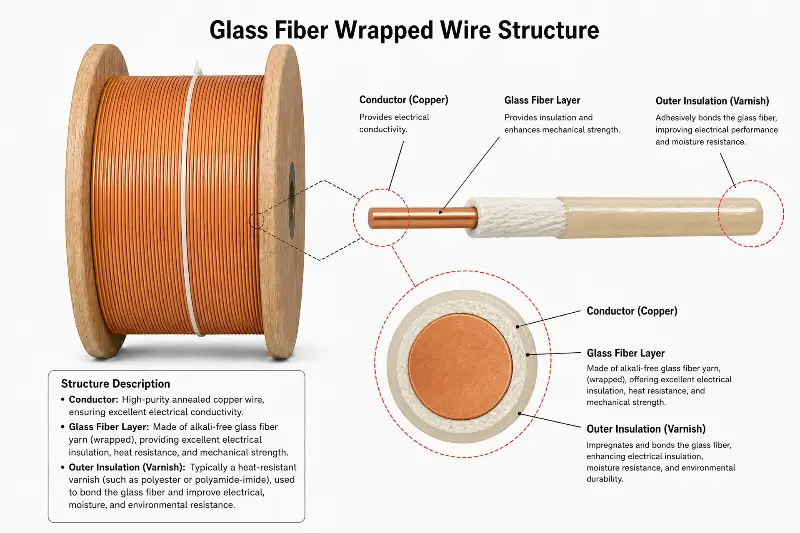
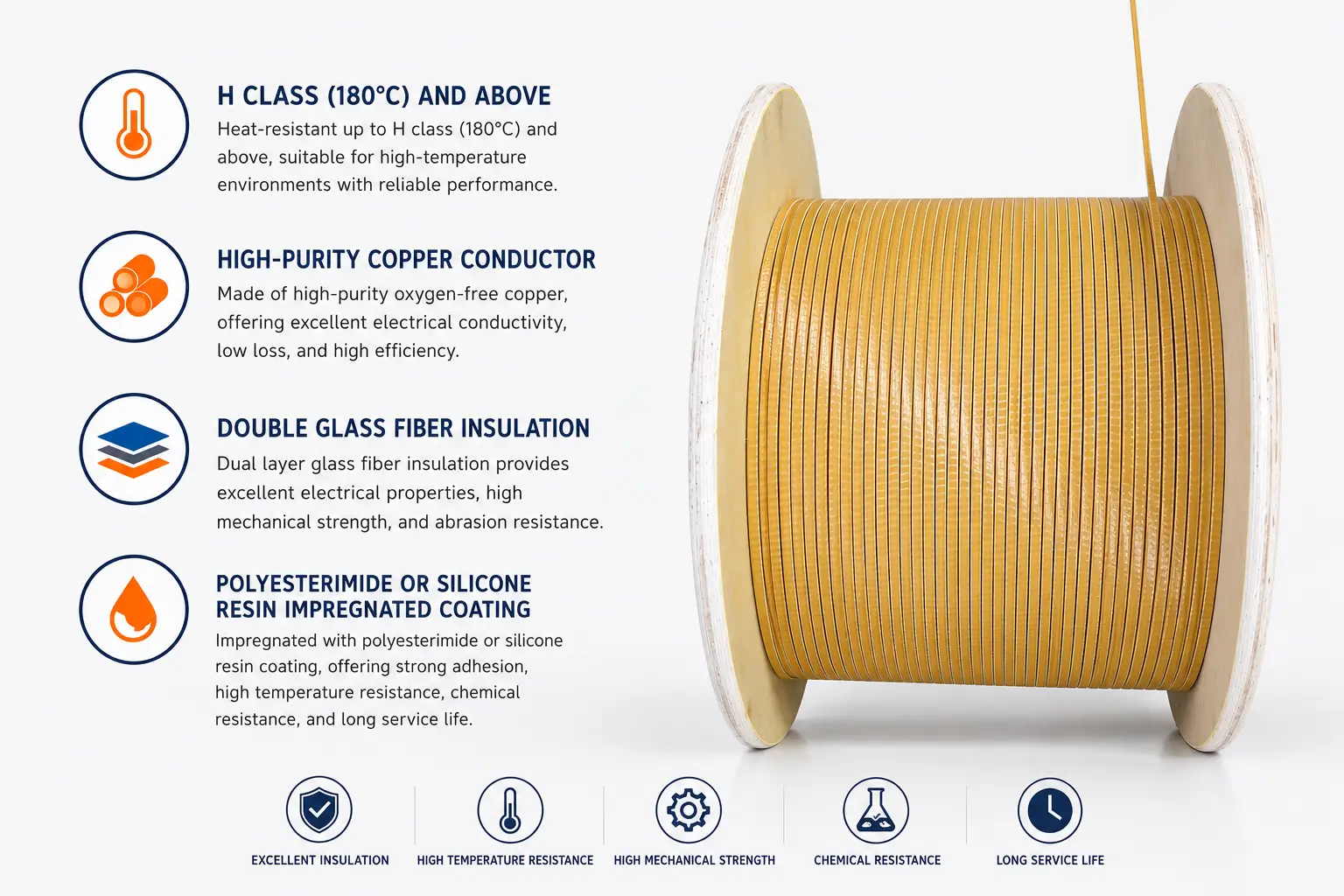
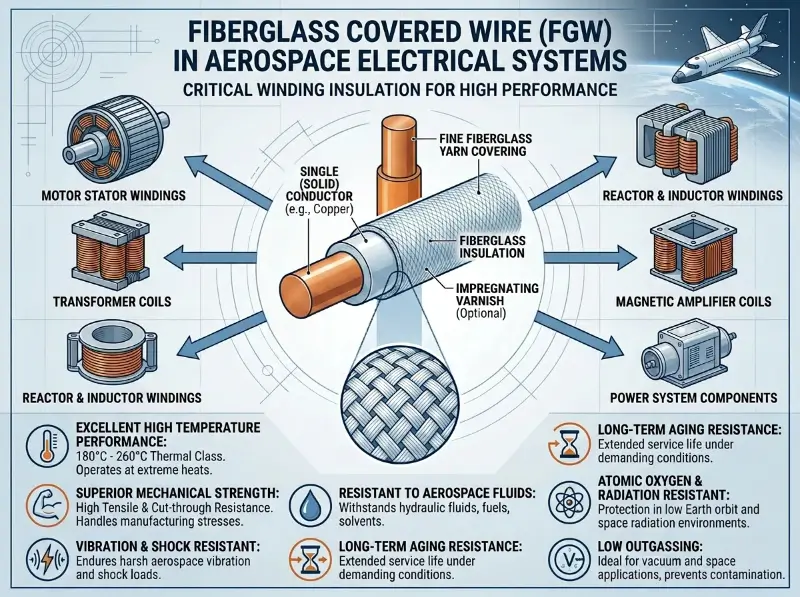
Glass-fiber-covered magnet wire serves multiple critical functions in railway equipment: high-temperature insulation, high mechanical strength, vibration and impact resistance, fire retardancy, low-smoke low-toxicity (FST) performance, oil resistance, aging resistance, and integration with intelligent monitoring systems.
Regarding the fundamental role of insulation, the high voltage (25 kV) and high power density of railway traction electrical equipment impose stringent requirements on insulation:
- Turn-to-turn insulation: Insulation between adjacent conductors; a combination of single-layer glass fiber wrapping (0.10–0.30 mm) and enamel coating achieves a breakdown voltage of 170–540 V per MW 41-C, while multilayer construction (Grade 2 enamel + double-layer glass fiber) achieves 2350–2560 V.
- Layer-to-layer insulation: Insulation between different layers within the same winding; double-layer glass fiber wrapping + impregnating resin.
- Phase-to-phase insulation: Insulation between windings of different phases; glass fiber + insulating tube + end ring.
- Ground insulation: Insulation between the winding and the core or enclosure; glass fiber + insulating varnish + impregnation.
- Main insulation (25 kV traction transformer): Multilayer Nomex + DMD + glass fiber + impregnating resin.
- Inverter-duty motor insulation: Corona-resistant enamel coating + glass fiber + AIW enamel coating.
Regarding high-temperature resistance, the H- and C-class high-temperature operation of railway traction electrical equipment imposes stringent requirements on winding insulation:
- Long-term temperature resistance: 155–220 °C (glass fiber + PEW/EIW/AIW enamel coating)
- Softening breakdown temperature: ≥330–350 °C (glass fiber + AIW enamel coating)
- Short-term overload capability: 1.2–1.5× rated current for several hours, temperature rise ≤15 K
- Short-circuit thermal endurance: No damage after 5 seconds at 300 °C
- Flame retardancy: UL 94 V-0 rating (self-extinguishing, low smoke, low toxicity)
Regarding mechanical reinforcement of the core, the vibration, shock, and acceleration environments encountered by railway equipment impose stringent requirements on the mechanical properties of windings.
- Vibration resistance: The high tensile strength (2000–3500 MPa) of fiberglass provides exceptional vibration resistance.
- Impact resistance: The fiberglass + impregnating resin combination withstands emergency braking impacts of 5–10 g.
- Acceleration resistance: Fiberglass-covered wire sustains steady-state acceleration of 0.1–0.3 g during continuous operation.
- Bend resistance: Excellent bend resistance with small bending radius (4–15d).
- Short-circuit electromagnetic force resistance: Withstands traction transformer short-circuit electromagnetic forces of 25–100 kA/1 s without damage.
Regarding fire, smoke, and toxicity (FST) performance, fire resistance requirements for railway equipment represent a key differentiating requirement for railway insulation.
- Flame retardancy: Glass fiber + AIW coating meets UL 94 V-0 rating (self-extinguishing)
- Low smoke: Smoke density (Ds) ≤ 200 (EN 45545-2 R7 / TB/T 3237)
- Low toxicity: Toxicity index (CIT) ≤ 10 (TB/T 3237)
- Heat release rate: HRR ≤ 65 kW/m² (TB/T 3237)
- The combination of inherent flame retardancy of glass fiber and flame-retardant impregnating resin is standard for railway insulation
Regarding oil resistance, railway oil-immersed transformers require resistance to transformer oil:
- Mineral Oil: Glass fiber + AIW coating, 1000–2000 hours
- Synthetic Ester Oil: Glass fiber + AIW coating, 1000–2000 hours
- Natural Ester Oil: Glass fiber + AIW coating, 1000–2000 hours
Regarding aging resistance, railway equipment requires a service life of 30 years, demanding high aging resistance.
– Temperature Index: Nomex 410 TI 220, Glass Fiber + AIW TI 220
– Thermal Aging: UL 1446 / IEC 61857
– Vibration Aging: 30-year vibration fatigue
– Chemical Aging Resistance: Resistant to lubricating oils and cleaning agents
Regarding intelligent monitoring integration, modern railway equipment requires integrated intelligent monitoring functionality:
- Optical fiber temperature sensor: Distributed optical fiber (Brillouin/Raman scattering) for real-time winding temperature monitoring
- PD sensor: Built-in HFCT or UHF sensor for real-time partial discharge monitoring
- Vibration sensor: Built-in piezoelectric accelerometer
- Data transmission: MVB/WTB Multifunction Vehicle Bus
- AI-based predictive maintenance: Multi-parameter AI model
Comparison of Fiberglass Covered Wire with Other Magnet Wire Insulation Materials
Glass-fiber-covered magnet wire is a commonly used insulating material for magnet wire in railway electrical equipment, offering distinct advantages over other types of magnet wire—such as enameled wire, paper-covered wire, and composite-insulated wire—in terms of temperature resistance, mechanical properties, electrical performance, chemical resistance, fire-smoke-toxicity (FST) characteristics, and cost.
Fiberglass-Clad Wire (FGW) vs. Enamel-Coated Wire (EWW):
| Item | Glass-Fiber-Insulated Wire | Enamel-Insulated Wire |
|---|---|---|
| Temperature Rating | 155–260 °C | 105–240 °C (Polyimide, PI, maximum) |
| Mechanical Strength | High (glass-fiber reinforced) | Medium (enamel film) |
| Vibration Resistance | Excellent | Medium |
| Impact Resistance | Excellent | Medium |
| Dielectric Breakdown Voltage | 2350–2560 V (Grade 2 + double-layer) | 2000–8000 V (enamel film) |
| Dielectric Strength | ≥10 kV/mm | ≥200 kV/mm (PI) |
| Fire, Smoke, and Toxicity (FST) Performance | Excellent (UL 94 V-0, EN 45545-2) | Poor–Medium (dependent on enamel type) |
| Low Smoke Emission | Low (glass fiber) | Medium–High (dependent on enamel type) |
| Low Toxicity | Low (halogen-free glass fiber) | Medium (dependent on enamel type) |
| Oil Resistance | Excellent (AIW enamel) | Medium |
| Process Maturity | Mature (60+ years in rail applications) | Mature |
| Cost | High (glass fiber + impregnation) | Low–Medium |
Fiberglass-Clad Wire (FGW) vs. Paper-Clad Wire (PCW):
| Item | Glass-Fiber-Insulated Wire | Paper-Insulated Wire |
|---|---|---|
| Temperature Rating | 155–260 °C | 105–220 °C |
| Mechanical Strength | High (glass-fiber reinforced) | Medium (paper-based) |
| Vibration Resistance | Excellent | Medium–High (crepe paper) |
| Fire, Smoke, and Toxicity (FST) Performance | Excellent (UL 94 V-0) | Excellent (Nomex 410) |
| Low Smoke Emission | Low | Medium (hygroscopic) |
| Dielectric Strength (Oil-Impregnated) | In air | Oil-impregnated ≥50 kV/mm (Nomex) |
| Oil Resistance | Excellent (oil-immersed transformers) | Excellent (oil-immersed main insulation) |
| Vacuum Outgassing | Low (glass fiber) | Medium (moisture absorption ≤8%) |
| Weight | Heavier (glass-fiber density 2.5 g/cm³) | Lighter |
| Process Maturity | Mature (railway applications >60 years) | Mature |
| Cost | High | Medium–High |
Glass-fiber-covered wire (FGW) vs. polyester-glass enameled wire:
- Glass-fiber-covered magnet wire: glass fiber + high-temperature enamel coating (PEW/EIW/AIW/PI), thermal class 155–260 °C
- Polyester-glass magnet wire: polyester + glass fiber + enamel coating (IEC 60317-0-8), thermal class 180 °C
- Glass-fiber-covered magnet wire is suitable for higher-temperature applications (200–260 °C)
- Polyester-glass magnet wire is suitable for standard 180 °C applications
Glass-fiber-covered magnet wire vs. Enameled Copper-Clad Aluminum Wire (ECCAW):
- Glass-fiber-covered wire: glass-fiber reinforcement + high-temperature enamel coating; high mechanical strength but higher cost
- ECCAW (enamelled copper-clad aluminum wire): aluminum core + copper cladding + enamel coating; lightweight but lower tensile strength
- Glass-fiber-covered wire is suitable for high-temperature, high-strength applications
- ECCAW is suitable for lightweight applications where cost sensitivity is critical
Glass-fiber-covered wire vs. Fully insulated enameled wire (FIW):
- Glass-fiber-covered wire: glass fiber + enamel coating (outer layer), single-layer
- FIW (fully insulated enameled copper round wire): multi-layer enamel coating (Class 4/6/8) enabling single-layer winding to replace paper-wrapped wire
- Glass-fiber-covered wire exhibits high mechanical strength but requires impregnation
- FIW does not require impregnation but has slightly lower mechanical strength
Unique Advantages of Glass-Fiber-Insulated Magnet Wire:
- Vibration and shock resistance: The exceptional mechanical properties of glass fiber (tensile strength 2000–3500 MPa) are suitable for railway vibration environments.
- Fire, smoke, and toxicity (FST) resistance: Glass fiber combined with AIW enamel coating meets the stringent flame-retardant requirements of EN 45545-2 R7, TB/T 3237, and DIN 5510-2.
- Short-circuit electromagnetic force resistance: Glass fiber wrapping plus impregnating resin increases short-circuit electromagnetic force resistance by 30–50%.
- High-temperature stability: Glass fiber (temperature resistance from –200 °C to +700 °C) combined with AIW enamel coating (220 °C rating) enables long-term operation.
- Proven manufacturing process: Applied in railway equipment for over 60 years (since the 1960s).
- Full-life reliability: High reliability over a 30-year service life.
Disadvantages of glass-fiber-covered magnet wire:
- Weight: Glass fiber density of 2.5 g/cm³ is higher than that of the enamel coating.
- Dielectric strength (single-layer) is inferior to that of polyimide (PI) magnet wire.
- Cost: High cost associated with glass fiber material and impregnation process.
- Process complexity: Multiple process steps including glass fiber wrapping, enamel coating, and impregnation.
Types and Specifications of Fiberglass Covered Wire
Glass-fiber-covered magnet wire for railway applications is classified according to insulation material, wrapping configuration, conductor type, temperature class, and specification.
By insulation material type (by thermal class):
- 155°C (F): Glass fiber + polyester enamel (PEW) coating
- Standards: NEMA MW 41-C (glass fiber–covered round copper magnet wire), MW 42-C (rectangular)
- Dielectric breakdown voltage: 170–360 V for single-layer, 315–540 V for double-layer (MW 41-C)
- Industrial applications: Standard traction motors, auxiliary transformers
- 180°C (Class H): Glass fiber + polyester-imide enamel (EIW) coating
- Standards: IEC 60317-0-8 (polyester-glass wrapped enameled rectangular copper wire), GB/T 7672.6
- Dielectric breakdown voltage:
- Bare conductor with double-layer PG2 coating: 560 V
- Grade 1 enamel coating with double-layer PG2: 1560 V
- Grade 2 enamel coating with double-layer PG2: 2560 V
- Industrial applications: High-efficiency traction motors, auxiliary power supplies
- 180°C (Class H): Glass fiber + polyester-glass fiber + high-temperature organic enamel
- Standards: NEMA MW 51-C (round copper wire with polyester-glass fiber and high-temperature organic enamel), MW 52-C (rectangular), MW 53-C (rectangular)
- Industrial applications: High-temperature traction motors, railway special equipment
- 200°C: Glass fiber + organosilicon enamel
- Standards: NEMA MW 43-C (round copper magnet wire with glass fiber braid and organosilicon enamel), MW 44-C (rectangular), MW 47-C (polyester-glass fiber organosilicon enamel), MW 48-C (rectangular)
- Dielectric strength: ≥15 kV/mm
- Industrial applications: Extreme high-temperature traction motors, deep-space magnetic levitation
- 220°C (R/C): Glass fiber + polyamide-imide enamel (AIW) coating
- Standard: NEMA MW 84-C (polyamide-imide 220°C round copper magnet wire) + glass fiber overcoat
- Softening breakdown temperature: 330–350°C
- Industrial applications: High-temperature traction motors, maglev linear motors (mainstream in railway applications)
- 240°C: Glass fiber + polyimide (PI) enamel coating
- Standard: NEMA MW 20-C (Polyimide 240°C round copper magnet wire) + glass fiber overwrap
- Dielectric strength: ≥200 kV/mm
- Industrial applications: Ultra-high-temperature traction motors, superconducting magnetic levitation
By glass fiber type (by substrate):
- E-glass (Electrical Glass):
- Composition: SiO₂ 54%, CaO 17%, Al₂O₃ 14%, B₂O₃ 10%
- Density: 2.55–2.60 g/cm³
- Tensile Strength: 2000–3500 MPa
- Dielectric Strength: ≥10 kV/mm
- Application: General-purpose railway electrical equipment (market share >90%)
- S-glass (High-Strength Glass):
- Composition: SiO₂ 64%, Al₂O₃ 25%, MgO 10%
- Density: 2.48–2.55 g/cm³
- Tensile Strength: 3500–4800 MPa
- Application: Vibration-resistant requirements for high-speed rail (350–400 km/h)
By wrapping configuration:
- Overlapping wrap: 50% overlap
- Half-lap wrap: 50% overlap per layer (IEC 60317-0-8 PG2 standard)
- Multi-lap wrap: Multiple layers of glass fiber yarn (2–3 layers)
- Helical wrap: Winding angle of 5°–15°
By conductor type:
- Round wire: diameter 0.04–7.00 mm
- Rectangular (flat) wire: width 2.00–16.00 mm × thickness 0.80–5.60 mm (within IEC 60317-0-8 scope)
- Transposed cable (CTC): multiple enameled rectangular copper wires assembled, transposed, and overall glass-fiber insulated (dominant solution for 25 kV traction transformers)
- Enameled base layer + glass-fiber overwrap (dual insulation)
- Glass-fiber overwrap for single or stranded wires
- Glass-fiber overwrap for high-strength copper alloys (Cu–Ag, Cu–Cr–Zr) (special applications)
According to specifications (IEC 60317 / NEMA MW 1000):
- Round copper wire / round aluminum wire: diameter 0.04–7.00 mm
- Rectangular copper wire / rectangular aluminum wire: width 2.00–16.00 mm × thickness 0.80–5.60 mm
NEMA MW 1000-2018 Glass-Fiber Covered Wire Standard (Mainstream for Railways):
- MW 41-C (Round 155°C Glass-Fiber-Overcoated Enamelled Wire): Glass Fiber + Polyester Enamel
- MW 42-C (Rectangular 155°C Glass-Fiber-Overcoated Enamelled Wire)
- MW 43-C (Round 200°C Glass-Fiber-Overcoated Silicone Organic Enamelled Wire)
- MW 44-C (Rectangular 200°C Glass-Fiber-Overcoated Silicone Organic Enamelled Wire)
- MW 45-C (Round 180°C Polyester-Glass-Fiber-Overcoated Enamelled Wire)
- MW 46-C (Rectangular 180°C Polyester-Glass-Fiber-Overcoated Enamelled Wire)
- MW 47-C (Round 200°C Polyester-Glass-Fiber-Overcoated Silicone Organic Enamelled Wire)
- MW 48-C (Rectangular 200°C Polyester-Glass-Fiber-Overcoated Silicone Organic Enamelled Wire)
- MW 50-C (Round 180°C Glass-Fiber-Overcoated High-Temperature Organic Enamelled Wire)
- MW 51-C (Round 180°C Polyester-Glass-Fiber-Overcoated High-Temperature Organic Enamelled Wire)
- MW 52-C (Rectangular 180°C Glass-Fiber-Overcoated High-Temperature Organic Enamelled Wire)
- MW 53-C (Rectangular 180°C Polyester-Glass-Fiber-Overcoated High-Temperature Organic Enamelled Wire)
- MW 54-C (Round 155°C Double-Layer Polyester-Glass-Fiber-Overcoated Enamelled Wire)
- MW 84-C (Round 220°C Polyamide-imide Enamelled Wire) + Glass Fiber Overcoat
- MW 20-C (Round 240°C Polyimide Enamelled Wire) + Glass Fiber Overcoat
Manufacturing Process and Quality Control of Fiberglass Covered Wire
The manufacturing process for glass-fiber-covered magnet wire for railway applications requires higher precision, stricter quality control, and greater traceability compared to that for general industrial glass-fiber-covered magnet wire.
Round fiberglass-covered magnet wire manufacturing process:
- Conductor preparation: Round copper rod (Cu ≥99.95%, C10100, C10200, C11000) or round aluminum rod (Al ≥99.5%) drawn through multiple dies to target diameter
- Continuous annealing: Copper conductor annealed at 600–650°C
- Surface cleaning: Acid–alkali cleaning to remove oxide layer
- In-line defect detection: Laser micrometer, CCD vision system
- Enamel coating (base enamel layer; PEW/EIW/AIW/PI selected per thermal class):
– Coating method: Die coating, roller coating
– Number of coating passes: 1–3 for single-layer, 4–8 for double-layer
– Baking temperature: 150–200°C; baking time: 4–12 hours - Glass fiber wrapping: Helical winding of E-glass/S-glass roving
– Roving specification: ECG 37.5, ECG 75, ECG 150
– Winding tension: 5–30 N
– Winding angle: 5–15° (overlap rate: 50–65%)
– Winding speed: 30–200 m/min - Multi-layer glass fiber wrapping: 2–3 layers of glass fiber wrapping
- Impregnation treatment: Polyester/polyester-imide/epoxy/silicone resin/AIW/PI
- Baking and curing: 150–250°C, 4–16 hours
- Vacuum pressure impregnation (VPI):
- Vacuum level: ≤100 Pa
- Pressure: 0.5–1.0 MPa
- Impregnation time: 2–8 hours
- Baking and curing: 150–200°C, 8–24 hours
- In-line partial discharge (PD) testing: HFCT detection
- In-line dielectric withstand testing: 100% spark testing (AC 1–5 kV)
- Reeling: Automatic reel machine
- Full-process traceability: MES system, batch coding
Manufacturing Process of Rectangular Glass-Fiber-Insulated Magnet Wire:
- Conductor preparation: Rectangular copper wire / rectangular aluminum wire
- Edge rounding: R 0.5–1.0 mm
- Continuous annealing: Copper at 600–650 °C / Aluminum at 350–450 °C
- Surface cleaning: Removal of oxide layer and contaminants
- Leveling: Rolling leveling (flatness ≤ 0.10 mm/m)
- Enamel coating: PEW/EIW/AIW/PI selected per thermal class
- Glass fiber wrapping: Glass fiber yarn winding
- Multi-layer glass fiber wrapping
- Impregnation treatment
- Baking and curing
- Vacuum Pressure Impregnation (VPI)
- Online partial discharge (PD) testing + spark testing
- Reeling
Transposed Cable (CTC) with Glass Fiber Wrapping Manufacturing Process:
- Single enameled rectangular copper wire: width 1–3 mm × thickness 3–8 mm
- Multiple transposition: 7–31 wires
- Transposition braiding: transposition pattern
- Overall glass fiber wrapping: complete wrapping with glass fiber yarn
- Impregnation treatment + bake curing
- Vacuum pressure impregnation (VPI)
- Reeling
Quality Control of Glass-Fiber-Insulated Magnet Wire for Railway Applications:
- Online inspection equipment:
- Laser diameter gauge
- Online partial discharge (PD) detection
- Spark test (AC 1–5 kV)
- Tension monitoring
- CCD vision system
- Online thickness measurement
- VPI impregnation parameter monitoring
- Sampling Inspection (Railway-Specific Strict Requirements):
- Breakdown Voltage: Sampling Test (≥170 V for single-layer MW 41-C; ≥2350 V for Grade 2+ double-layer per IEC 60317-0-8)
- Dielectric Strength: Sampling Test
- Elongation: Annealed Copper ≥30% (Table 2 of MW 41-C)
- Conductor Resistivity: Cu ≤0.01724 Ω·mm²/m
- Fire, Smoke, and Toxicity (FST): EN 45545-2, TB/T 3237, DIN 5510-2
- Vibration Resistance: IEC 61373 (Railway Vibration)
- Shock Resistance: IEC 61373 (Railway Shock)
- Aging Resistance: Accelerated Aging at 155–220 °C
- Flame Retardancy: UL 94 V-0 Test
- Quality Management System:
- ISO/TS 22163 (IRIS, International Railway Industry Standard)
- ISO 9001, ISO 14001
- EN 15085 (Railway Applications – Welding of Railway Vehicles)
- IRIS Silver/Gold Certification
- PPAP / APQP / FMEA / SPC
- MES System
- Critical process parameters:
- Annealing temperature: copper 600–650 °C / aluminum 350–450 °C
- Glass fiber wrapping tension: 5–30 N
- Glass fiber wrapping speed: 30–200 m/min
- Enamel curing: 150–200 °C, 4–12 hours
- VPI vacuum level: ≤100 Pa
- VPI pressure: 0.5–1.0 MPa
- VPI impregnation time: 2–8 hours
- VPI bake-cure: 150–250 °C, 8–24 hours
Applications in Traction Transformers
Railway traction transformers are the core electrical equipment of railway traction power systems, converting single-phase AC power from the overhead catenary system (25 kV/50 Hz or 25 kV/60 Hz) into DC power required by traction converters (DC 1800 V / 3600 V) and AC power required for auxiliary supplies (AC 380 V / 220 V). Traction transformers are typically oil-immersed—using either mineral oil or synthetic ester oil—with rated power ranging from 3 to 10 MVA and unit weight ranging from 10 to 20 tons.
Classification of railway traction transformers:
- Main Transformer:
- Capacity: 3–10 MVA
- Voltage: 25 kV / 1800 V or 25 kV / 3600 V
- Type: Single-phase or three-phase
- Windings: High-voltage winding (25 kV) + Traction winding (1800 V / 3600 V) + Auxiliary winding (380 V)
- Application: CRH / Fuxing EMUs, CR400AF / CR400BF
- Auxiliary Transformer:
- Capacity: 100–500 kVA
- Voltage: 25 kV/380 V or main transformer auxiliary winding/380 V
- Windings: High-voltage winding (25 kV or main transformer secondary winding) + low-voltage winding (380 V)
- Application: Train auxiliary power supply
– Traction autotransformer (AT):
– Rating: 5–20 MVA
– Voltage: 55 kV/(27.5 + 27.5) kV
– Application: AT power supply (autotransformer power supply) for traction networks
Application of Glass-Fiber-Insulated Magnet Wire in Main Transformers:
- High-voltage winding (25 kV):
- Enameled round wire/flat wire + double-layer glass fiber wrapping + AIW enamel coating
- Main insulation: multiple layers of kraft paper + crepe paper + Nomex 410 + glass fiber + impregnation
- Oil-immersed: using mineral oil/synthetic ester oil/natural ester oil
- Dielectric breakdown voltage: ≥30 kV (high-voltage winding to ground)
- Traction windings (1800 V / 3600 V):
- Rectangular copper wire + double-layer glass fiber wrapping + AIW enamel coating
- Or transposed cable (CTC) + glass fiber wrapping + AIW enamel coating
- High-current windings: CTC is the mainstream solution for 25 kV traction transformers
- Oil-immersed: impregnated with insulating oil
- Auxiliary winding (380 V):
- Enameled round wire / rectangular wire + fiberglass overwrap (double-layer) + AIW enamel coating
- Low-voltage winding
Application of Glass-Fiber-Insulated Magnet Wire in Auxiliary Transformers:
- High-voltage windings:
- Enameled round wire + double-layer glass fiber wrapping + AIW enamel coating
- Insulation for 25 kV high-voltage windings shall have a dielectric breakdown voltage ≥25 kV
- Low-voltage winding:
- Enameled rectangular wire + double-layer glass fiber wrapping + AIW enamel coating
- 380 V low-voltage winding
Application of Glass-Fiber-Insulated Magnet Wire in AT Autotransformers:
- 55 kV high-voltage winding:
- Enamelled round wire/flat wire + multi-layer glass fiber wrapping + AIW enamel coating
- Main insulation: multi-layer Nomex + kraft paper + glass fiber + impregnation
- Dielectric breakdown voltage: ≥55 kV
Fire, Smoke, and Toxicity (FST) Requirements:
- EN 45545-2 R7 (European Railways): HL1–HL3 classes
- TB/T 3237 (China EMU)
- DIN 5510-2 (German Railways)
- Glass fiber + AIW enamel coating + impregnating resin collectively meet flame, smoke, and toxicity (FST) requirements
Applications in Traction Motors
Railway traction motors are the core power components of electric multiple units (EMUs) and electric locomotives, with individual unit power ratings of 300–1500 kW (for EMUs) or 800–1600 kW (for electric locomotives). Traction motors operate under harsh conditions, including vibration, mechanical shock, thermal cycling, humidity, oil contamination, and dust.
Classification of railway traction motors:
- Asynchronous Induction Motor:
- Applications: Mainstream models including CRH1/CRH2/CRH5, CR400AF, and HXD1/HXD2/HXD3
- Construction: Squirrel-cage rotor (cast aluminum or copper bar rotor)
- Power rating: 300–1500 kW
- Speed range: 0–6000 rpm
- Power density: 4–6 kW/kg
- Advantages: Mature technology, high reliability, low cost
- Permanent Magnet Synchronous Motor (PMSM):
- Applications: CR450 (test phase), Beijing Metro Lines 16/19 (partial deployment), high-end overseas EMUs
- Construction: Rare-earth permanent magnets (NdFeB)
- Power rating: 300–1500 kW
- Efficiency: >96% (2–3 percentage points higher than induction motors)
- Power density: >5 kW/kg
- Advantages: High power density, high efficiency, lightweight design
- Direct Drive Permanent Magnet Synchronous Motor (PMSM):
- Applications: Magnetic levitation, direct-drive metro systems
- Construction: Rare-earth permanent magnet direct drive (gearbox-free)
- Power rating: 100–500 kW
- Advantages: Low noise, high efficiency, long service life
- High-speed permanent magnet motors:
- Application: Traction for high-speed EMUs
- Rotational speed: 8000–15000 rpm
- Advantages: High power density
- High-altitude traction motors:
- Applications: Qinghai–Tibet Railway, Sichuan–Tibet Railway
- Altitude: 5000 m
- Features: Enhanced insulation for low atmospheric pressure, low-temperature startup, heat dissipation in rarefied air
- Condensation- and salt fog–resistant traction motors:
- Application: Coastal/maritime railways
- Features: IP65 protection, 1000-hour salt fog resistance
Application of Glass-Fiber-Insulated Magnet Wire in Traction Motor Stators:
- Form-wound windings:
- Enameled rectangular wire (PEW/EIW/AIW) + double-layer fiberglass covering + VPI impregnation
- Turn-to-turn insulation: Grade 2 enamel coating + double-layer fiberglass (IEC 60317-0-8 dielectric breakdown ≥2350 V)
- Main insulation: Fiberglass + mica tape + VPI impregnation
- End winding binding: Fiberglass + impregnating resin
- Slot insulation: NMN + fiberglass
- Hair-pin winding (dominant for permanent magnet synchronous motors):
- Bare rectangular copper wire + double-layer glass fiber wrapping + vacuum pressure impregnation (VPI)
- Turn-to-turn insulation: double-layer glass fiber wrapping
- Main insulation: glass fiber + impregnating resin
- High slot fill factor: hair-pin design increases slot fill factor by over 50%
- High-Altitude Enhanced Insulation:
- Enameled rectangular wire + double-layer glass fiber wrapping + AIW enamel coating
- Main insulation: glass fiber + thickened mica tape + VPI impregnation
- Low-pressure resistance: increased insulation thickness (20–30% thickness increase at 5,000 m altitude)
- Enhanced condensation- and salt fog–resistant insulation:
- Enameled rectangular wire + dual-layer glass fiber wrapping + AIW enamel coating
- Protection rating IP65
- Moisture-proof heater (anti-condensation during parking)
Application of Glass-Fiber-Insulated Magnet Wire in Traction Motor Rotors:
- Asynchronous motor rotors (squirrel-cage type):
- Copper-bar rotors (large-size): rectangular copper bars + fiberglass wrapping + end-ring welding
- Cast-aluminum rotors (small-size): aluminum die-casting process
- Fiberglass wrapping is applied to the ends of copper bars in copper-bar rotors
- Permanent Magnet Rotor (Permanent Magnet Synchronous):
- Rare Earth Permanent Magnets (NdFeB)
- Rotor Core (Stacked Electrical Steel Laminations)
- Fiberglass Tape for Binding and Insulation
Applications in EMUs and Electric Locomotives
EMU (Electric Multiple Unit) trains and electric locomotives—including metro and urban rail transit systems—are core application scenarios for railway electrical equipment.
China EMU (CRH/Fuxing) applications:
- CRH1/CRH2/CRH3/CRH5 (Existing EMUs):
- Traction motors: Asynchronous traction motors
- Traction transformers: Oil-immersed
- Glass-fiber-covered magnet wire applications: Glass fiber + PEW/EIW (180 °C) + VPI (mainstream)
- CR400AF/CR400BF (Fuxing):
- Traction motor: Asynchronous traction motor (350 kW/unit)
- Traction transformer: Oil-immersed (5.6 MVA)
- Glass-fiber-covered magnet wire application: Glass fiber + PEW/EIW/AIW (180–220 °C) + VPI
- CR450 (China Standard High-Speed Train):
- Speed: 400+ km/h
- Traction motor: High-power-density (>5 kW/kg) permanent magnet synchronous or induction motor
- Fiberglass-covered magnet wire application: High-power-density fiberglass + AIW + VPI
Overseas EMU Applications:
- Japan Shinkansen:
- Models: N700S, E5, E6
- Traction motors: Asynchronous motors + permanent magnet (partial)
- Glass-fiber insulated wire application: Glass fiber + AIW (220 °C)
- France TGV/AGV:
- Models: TGV POS, TGV 2N2, AGV
- Glass-fiber-covered wire applications: Glass fiber + AIW
- Germany ICE:
- Types: ICE 1/2/3/4
- Glass-fiber-covered wire applications: glass fiber + AIW
Electric locomotive applications:
- HXD1/2/3 (Eight-Axle Electric Locomotive):
- Power: 9600 kW
- Traction Motor: Asynchronous Motor
- Glass-Fiber-Insulated Magnet Wire Application: Glass Fiber + AIW + VPI
- HXD2B/3B (Six-Axle Electric Locomotive):
- Power: 6000 kW
- Glass Fiber-Insulated Wire Application: Glass Fiber + AIW
Metro and Urban Rail Applications:
- Beijing Subway (Lines 1, 2, 4, 16, and 19):
- DC 750 V / 1500 V
- Traction motors: Asynchronous motors
- Glass-fiber-covered magnet wire applications: Glass fiber + PEW/EIW (155–180 °C)
- Shanghai Metro (Lines 1, 14, 15, 16, 17, and 18):
- Traction motors: Asynchronous motors + Permanent Magnet Synchronous Motors (PMSM) (partial application)
- Glass-fiber-covered magnet wire applications: Glass fiber + PEW/EIW/AIW
- MTR Hong Kong, Shenzhen Metro, Guangzhou Metro:
- Traction motors: Asynchronous + Permanent Magnet
- Fiberglass-covered wire applications: Fiberglass + AIW
- High-speed maglev (Shanghai Maglev TR08):
- Long-stator linear motor: long-stator winding (glass fiber + AIW enamel coating)
- Levitation electromagnet: glass fiber + AIW
- Speed: 430 km/h
- Characteristics of long-stator linear motors: The long stator is mounted on the ground, the vehicle is motorless, and the traveling-wave magnetic field generated by current in the long stator propels the vehicle.
Applications in Maglev Systems
Magnetic levitation (Maglev) is a cutting-edge technology in railway systems, categorized into electromagnetic suspension (EMS) and electrodynamic suspension (EDS).
Electromagnetic Suspension (EMS)
- Shanghai Maglev TR08:
- Long Stator Linear Motor:
- Stator winding: Rectangular copper wire + glass fiber wrapping + AIW enamel coating + Vacuum Pressure Impregnation (VPI)
- Stator length: 30–50 km (entire line length)
- Speed: 430 km/h
- Thrust: Static drive + continuous drive
- Suspension Electromagnet:
- DC electromagnet winding: Round/rectangular copper wire + glass fiber wrapping + AIW enamel coating + VPI
- Levitation air gap: 8–10 mm
- Control: Closed-loop gap feedback
- Glass fiber wrapped wire application: Withstands high-frequency electromagnetic force-induced vibration
- Changsha Maglev, Fenghuang Maglev:
- Medium-speed maglev (100–200 km/h)
- Glass fiber-covered wire application: glass fiber + AIW + VPI
- Beijing Medium- and Low-Speed Maglev (S1 Line):
- Speed: 100–120 km/h
- Glass-Fiber-Insulated Wire Application: Glass Fiber + AIW + VPI
Electrodynamic Suspension (EDS)
- Japan’s Yamanashi Maglev L0 Series (Chuo Shinkansen):
- Speed: 600 km/h
- Superconducting Magnets (Nb-Ti):
- Superconducting Coils: Glass Fiber + AIW Enamel Coating (Cryogenic Insulation) + Vacuum Pressure Impregnation (VPI)
- Operating Temperature: 4–10 K (Liquid Helium)
- Glass-Fiber-Insulated Wire Application: Cryogenic Performance Testing of Glass Fiber at Extreme Low Temperature (4 K)
- Propulsion Coils (Track-Side):
- Rectangular Copper Wire + Glass Fiber Covering + AIW Enamel Coating + VPI
- Levitation Coils (Track-Side):
- Rectangular Aluminum Wire + Glass Fiber Covering + Resin Impregnation
– Qingdao, China, 600 km/h high-temperature superconducting maglev:
– High-temperature superconductors (YBCO):
– Superconducting coils: fiberglass + cryogenic impregnation
– Fiberglass-covered wire application: specialized insulation for high-temperature superconductors
Long-stator linear motor:
- The long stator is the core component of maglev trains, installed along the track.
- The stator core laminations are stacked on the ground.
- The three-phase stator windings (glass fiber–covered wire + AIW enamel + VPI) generate a traveling magnetic field when energized with three-phase AC current.
- The traveling magnetic field propels the vehicle (moving part).
- Glass fiber–covered wire applications:
- Three-phase stator windings (copper wire + glass fiber + AIW enamel + VPI)
- End-winding tie-downs (glass fiber + impregnating resin)
- Slot insulation (glass fiber + NMN)
Applications in Railway Signaling, Communication, and Control Systems
Railway signaling, communication, and control systems are critical systems ensuring railway operational safety and efficiency. Glass-fiber-covered magnet wire is primarily used in key magnetic components in this field, such as transformers, filters, and inductors.
Railway Signaling Systems:
- Signal Transformer:
- 25 kV / Low Voltage: Glass Fiber + AIW (220 °C) + VPI
- Power supply for signaling equipment in electrified sections
- Track Circuit Transformer:
- Transformer: Glass fiber + AIW
- Track circuit signal transmission
- Balise:
- High-frequency transformer: fiberglass + AIW + high-frequency insulation
- BTM readout
- Point machine turnout motor:
- DC motor / three-phase motor: fiberglass + PEW/EIW + VPI
- Used for railway turnout actuation
- Frequent start-stop cycles, wide operating temperature range
- Signal relays:
- Transformers/inductors: Glass fiber + PEW/EIW
Railway Communication Systems
- GSM-R Communication Power Transformer:
- Glass Fiber + PEW/EIW (155–180 °C) + VPI
- GSM-R Mobile Communication Base Station
- LTE/5G-R communication power transformer:
- Glass fiber + AIW (220°C) + VPI
- 5G-R mobile communication
Railway Control Systems:
- CBTC (Communication-Based Train Control) power supply:
- Glass fiber + PEW/EIW + VPI
- CBTC signal power supply
- ATP/ATO (Automatic Train Protection/Operation) power supply:
- Glass fiber + PEW/EIW + VPI
- ATP/ATO signal power supply
- Centralized Traffic Control (CTC) Power Supply:
- Glass fiber + PEW/EIW + VPI
- Centralized Traffic Control Monitoring
Applications in Railway Power Supply Systems
The railway power supply system is the electrical infrastructure for railway operations, comprising overhead catenary systems, traction substations, and power supply systems.
Overhead Contact System (OCS)
- Contact Wire: Copper–magnesium alloy, copper–tin alloy
- Catenary: Copper, copper–magnesium
- Dropper: Copper stranded wire
- Insulator: Porcelain, composite, silicone rubber
- Disconnecting Switch:
- Glass fiber + impregnated resin (insulating pull rod, contact insulation)
- Insulation rated for 25 kV high voltage
- Overhead Catenary System Surge Arrester:
- Glass fiber + zinc oxide insulation
Traction Substation:
- Main transformer (110 kV / 25 kV):
- Rating: 20–50 MVA
- Voltage: 110 kV / 25 kV (sometimes with a 10 kV tap for local loads)
- Type: Oil-immersed (mineral oil / synthetic ester / natural ester)
- Glass-fiber wrapped wire applications:
- HV winding: Enamelled rectangular wire + glass fiber + AIW + main insulation (Nomex + kraft paper)
- LV winding: Enamelled rectangular wire + glass fiber + AIW
- Main insulation: Kraft paper + crepe paper + Nomex 410 + glass fiber + impregnation
- AT Autotransformer:
- Capacity: 5–20 MVA
- Voltage: 55 kV/(27.5 + 27.5) kV
- Glass-fiber-wrapped wire application: Glass fiber + AIW + Main insulation
- Vacuum Circuit Breaker (VCB):
- Glass fiber + impregnated resin (insulating pull rod)
- 25 kV vacuum interruption
- Current Transformers (CT):
- Enameled round wire + fiberglass overwrap + AIW enamel coating
- 25 kV CT insulation
- Voltage Transformer (VT):
- Enameled round wire + fiberglass overwrap + AIW enamel coating
- 25 kV VT insulation
- Disconnector Switch (DS):
- Fiberglass + Impregnated (Insulated Operating Rod)
- 25 kV Distribution
Power Supply:
– Line-side power transformers:
– 10 kV/0.4 kV transformers: fiberglass + PEW/EIW + impregnation
– Power supply for railway line-side station buildings
- Distribution transformers:
- Glass fiber + PEW/EIW + impregnation
- Railway distribution
- Power supply for station signal building:
- Glass fiber + PEW/EIW + impregnation
- Traction power supply SCADA monitoring system power supply:
- Glass fiber + PEW/EIW + impregnated
- Monitoring system power supply
Regenerative Braking Energy Absorption System
- Inverter Transformers:
- Glass fiber + PEW/EIW + Impregnation
- Regenerative braking energy feedback to the grid
- Energy Storage Transformers:
- Glass Fiber + PEW/EIW + Impregnation
- Energy Storage (Supercapacitors, Flywheels, Batteries)
Key Performance Requirements and Testing Methods
Key performance requirements for glass-fiber-covered magnet wire used in railway applications include: electrical properties, mechanical properties, thermal properties, chemical resistance, flame, smoke, and toxicity (FST) performance, and reliability.
Electrical properties:
- Breakdown Voltage (IEC 60317-0-8, Polyester-Glass Enamelled Rectangular Copper Wire):
- Bare conductor, single-layer coating PG1: 350 V
- Bare conductor, double-layer coating PG2: 560 V
- Grade 1 enamel film, single-layer PG1: 1350 V
- Grade 1 enamel film, double-layer PG2: 1560 V
- Grade 2 enamel film, single-layer PG1: 2350 V
- Grade 2 enamel film, double-layer PG2: 2560 V
- Dielectric breakdown voltage (NEMA MW 41-C, glass-fiber-covered enameled round copper wire, 155°C):
- Single-layer, 4/0–9.5 AWG: ≥170 V
- Single-layer, 10–23.5 AWG: ≥360 V
- Single-layer, 24–30 AWG: ≥225 V
- Double-layer, 4/0–9.5 AWG: ≥315 V
- Double-layer, 10–23.5 AWG: ≥540 V
- Double-layer, 24–30 AWG: ≥400 V
- Dielectric strength: ≥10 kV/mm (in air, glass fiber + enamel coating)
- Loss tangent (tan δ): ≤0.5%
- Withstand voltage: 3–10 times rated voltage for 1 minute
- Partial discharge: ≤5 pC (IEC 61262)
- Lightning impulse: ≤150 kV (for 25 kV system)
Mechanical properties (NEMA MW 41-C):
- Tensile strength: glass fiber 2000–3500 MPa
- Elongation (with glass fiber coating):
- 4/0–1/0 AWG: ≥35%
- 1–8 AWG: ≥30%
- 9–15 AWG: ≥20%
- 16–21 AWG: ≥15%
- 22–28 AWG: ≥20%
- Springback:
- Bare copper wire with glass fiber coating, 4/0–13 AWG: ≤5°
- Enamelled wire with glass fiber coating, 4–13 AWG: ≤5.5°
- Bendability: mandrel test per MW 41-C
- Vibration resistance: random vibration 5–2000 Hz (IEC 61373)
- Shock resistance: shock during train start-up, braking, and emergency braking (IEC 61373)
Thermal performance:
- Continuous operating temperature:
- 155°C (Class F): Glass fiber + Polyester Enamel Wire (MW 41-C)
- 180°C (Class H): Glass fiber + Enameled Iron Wire (EIW) or Polyester-glass fiber + Organic enamel (MW 45-C/MW 51-C)
- 200°C: Glass fiber + Silicone organic enamel (MW 43-C/MW 47-C)
- 220°C (Class R/C): Glass fiber + Aromatic Imide Enamel (AIW) — mainstream for railway applications
- 240°C: Glass fiber + Polyimide (PI) enamel
- Softening breakdown temperature: 330–350°C for glass fiber + AIW enamel
- Short-circuit thermal resistance: Withstands 300°C for 5 seconds under short-circuit conditions
- Flame retardancy: UL 94 V-0 rating
Chemical Properties:
- Resistance to transformer oil (mineral oil/synthetic ester/natural ester): 1000–2000 hours
- Resistance to lubricating oil: 1000–2000 hours
- Resistance to cleaning agents: 500–1000 hours
Fire, Smoke, and Toxicity (FST) – Critical Differentiating Requirements for Railway Applications:
- EN 45545-2 R7 classification: HL1–HL3
- TB/T 3237 EMU standard
- DIN 5510-2 fire protection classes 1–4
- NFPA 130
- UL 94 V-0 (self-extinguishing, low smoke, low toxicity)
- Smoke density (Ds): ≤200 (at 4 minutes)
- Toxicity index (CIT): ≤10
- Heat release rate (HRR): peak ≤65 kW/m²
Reliability:
- Service life: 30 years (design life of EMUs/electric locomotives)
- MTBF: >100,000 hours
- Vibration resistance: 30-year vibration fatigue
- Thermal cycling resistance: –40 °C to +55 °C (outdoor), –25 °C to +45 °C (indoor), 500–1,000 cycles
- Salt mist resistance: 96–1,000 hours (coastal/marine environments)
- Fungal resistance: 28 days (humid and hot environments)
Test method standards:
- Breakdown voltage: IEC 60851, ASTM D149, NEMA MW 1000
- Dielectric strength: ASTM D149, IEC 60243
- Dissipation factor (tan δ): ASTM D150, IEC 60250
- Tensile strength/elongation: ASTM E8
- Thermal endurance: UL 1446, ASTM D2304
- Flame retardancy: UL 94, EN 45545-2, TB/T 3237, DIN 5510-2
- Vibration/impact: IEC 61373, EN 50155
- Salt spray: ASTM B117, IEC 60068-2-52
- Fungal resistance: ASTM G21, IEC 60068-2-10
- Aging: UL 1446, IEC 61857
- Railway EMC: EN 50121, IEC 62236
- Quality management system: ISO/TS 22163 (IRIS)
Selection Decision Recommendations
Selection of glass-fiber-covered magnet wire for railway applications shall be based on comprehensive evaluation of speed class, train type, power rating, thermal class, voltage class, insulation medium (oil-immersed/dry-type), fire, smoke, and toxicity (FST) rating, and operating environment.
Model-specific recommendations:
- High-speed EMUs (CRH/Fuxing/CR450):
- Traction transformers: Glass fiber + AIW + VPI (220°C long-term high-temperature operation)
- Traction motors: Glass fiber + EIW/AIW + VPI (180–220°C)
- Auxiliary power supplies: Glass fiber + PEW/EIW + VPI (155–180°C)
- Electric Locomotives (HXD Series):
- Traction Transformers: Glass Fiber + AIW + VPI
- Traction Motors: Glass Fiber + EIW/AIW + VPI
- Metro (DC 750/1500 V):
- Traction motors: Glass fiber + PEW/EIW (155–180 °C) + VPI
- Auxiliary power supply: Glass fiber + PEW/EIW
- Maglev (Shanghai Maglev TR08):
- Long-stator linear motor: fiberglass + AIW + VPI
- Levitation electromagnet: fiberglass + AIW + VPI
- EDS superconducting maglev (L0 series, future):
- Superconducting coil insulation: fiberglass + special cryogenic impregnation
- Propulsion/suspension coils: fiberglass + AIW + VPI
Recommended by speed class:
- 80–160 km/h: Glass fiber + PEW/EIW (155–180 °C) + VPI
- 200–250 km/h: Glass fiber + PEW/EIW/AIW + VPI
- 250–350 km/h: Glass fiber + EIW/AIW (180–220 °C) + VPI (high-speed EMUs)
- 350–400+ km/h: Glass fiber + AIW (220 °C) + high-strength VPI (CR450)
Recommended by power rating:
- Auxiliary motors (<100 kW): Glass fiber + PEW (round wire) + VPI
- Medium- and small-size traction motors (100–500 kW): Glass fiber + EIW/AIW (round/flat wire) + VPI
- Large traction motors (500–1500 kW): Glass fiber + AIW (flat wire/CTC) + high-strength VPI
- Traction transformers (5–10 MVA): CTC + glass fiber + AIW + VPI
Insulation material selection by thermal class:
- 155°C (Class F): Glass fiber + Polyester Enamel Wire (PEW) per MW 41-C
- 180°C (Class H): Glass fiber + Enameled Iron Wire (EIW) or Polyester-Glass + Organic Enamel per MW 45-C/MW 51-C
- 200°C: Glass fiber + Silicone Organic Enamel per MW 43-C/MW 47-C
- 220°C (Class R/Class C): Glass fiber + Aluminum-Iron Wire (AIW) enamel coating (widely adopted in railway applications)
- 240°C: Glass fiber + Polyimide (PI) enamel coating
Recommended by Fire, Smoke, and Toxicity (FST) rating:
- EN 45545-2 HL1: Glass fiber + PEW/EIW (standard grade)
- EN 45545-2 HL2: Glass fiber + EIW + flame-retardant impregnating resin (medium hazard level, long tunnel)
- EN 45545-2 HL3: Glass fiber + AIW + high flame-retardant impregnating resin (deeply buried metro / ultra-long tunnel)
- TB/T 3237: Glass fiber + AIW + flame-retardant impregnating resin
- DIN 5510-2: Glass fiber + AIW + flame-retardant impregnating resin
Recommended by operating environment:
- Standard: Glass fiber + PEW/EIW + VPI
- High-altitude (>4000 m): Glass fiber + AIW + 20–30% increased insulation thickness + VPI
- Coastal/marine: Glass fiber + AIW + 1000-hour salt fog resistance + IP65 protection
- Extreme cold (<−40 °C): Glass fiber + AIW + low-temperature startup design
- High humidity: Glass fiber + AIW + moisture-proof heater
- High-altitude low-pressure: Glass fiber + AIW + increased insulation thickness
Recommended by insulation medium:
- Oil-immersed (mineral oil): Glass fiber + AIW + main insulation (Nomex + kraft paper)
- Oil-immersed (synthetic ester): Glass fiber + AIW + main insulation (synthetic ester-compatible)
- Oil-immersed (natural ester): Glass fiber + AIW + main insulation (eco-friendly natural ester)
- Dry-type transformer: Glass fiber + AIW + DMD/NMN
- Dry-type motor: Glass fiber + AIW + resin encapsulation
Recommended by application area:
- Traction transformer HV winding (25 kV):
- CTC + fiberglass + AIW + main insulation
- Traction transformer LV winding (1800 V / 3600 V):
- CTC + fiberglass + AIW + VPI
- Traction motor stator:
- Enameled rectangular wire + fiberglass + AIW + VPI
- or Hair-pin rectangular wire + fiberglass + AIW + VPI
- Traction motor rotor:
- Copper bar / cast aluminum rotor (no fiberglass covering)
- Traction reactor:
- Enameled rectangular wire + fiberglass + AIW + VPI
- Auxiliary transformer:
- Enameled rectangular wire + fiberglass + PEW/EIW + VPI
- Long-stator linear motor:
- Enameled rectangular wire + fiberglass + AIW + VPI
Recommended according to reliability requirements:
- Standard transportation: Standard glass-fiber magnet wire
- High reliability (EMU): ISO/TS 22163 + EN 45545-2 + IRIS Silver/Gold
- High speed (350+ km/h): High-strength glass-fiber + AIW + high-strength VPI
- Long life (30 years): Accelerated aging testing + long-life materials
Not recommended solution:
- Civil-grade glass-fiber-wrapped wire for high-speed EMUs: inadequate flame, smoke, and toxicity (FST) performance, mechanical properties, and environmental adaptability
- Enamelled wire (without glass fiber) for high-speed traction motors: insufficient vibration resistance
- Paper-wrapped wire for lightweight high-speed EMUs: fails to meet weight and flame-retardant requirements
- Glass-fiber-wrapped wire for low-altitude, low-cost applications: excessively high cost
- Non-IRIS-certified glass-fiber-wrapped wire for railway supply chains: risk of certification failure
- Glass fiber + polyester-imide enamelled wire (PEW) for high-speed EMUs operating above 200 °C: insufficient thermal endurance
- Conventional glass-fiber-wrapped wire for maglev superconducting coils: inadequate low-temperature performance
Conclusion
Fiberglass-covered wire is a critical core insulation material for railway systems, serving key electrical components—including traction transformers, traction motors, traction reactors, on-board transformers, signaling transformers, maglev linear motors, and railway power supply equipment—with essential functions such as winding insulation, high-temperature resistance, mechanical reinforcement, vibration and impact resistance, fire-smoke-toxicity (FST) performance, low smoke/low toxicity, oil resistance, aging resistance, and integrated intelligent monitoring. Fiberglass-covered wire—manufactured via E-glass/S-glass fiberglass combined with PEW/EIW/AIW/PI enamel coatings and vacuum pressure impregnation (VPI) processing—delivers comprehensive performance: thermal classes ranging from 155°C to 260°C; breakdown voltages spanning 170–2560 V; tensile strength of 2000–3500 MPa; UL 94 V-0 flame retardancy; EN 45545-2 R7 and TB/T 3237 railway fire protection compliance; and low smoke/low toxicity characteristics.
Railway-grade glass-fiber-covered magnet wire is categorized by train type into high-speed EMUs (CRH/Fuxing), electric locomotives, metro/urban rail transit, maglev (EMS/EDS/HTS), and freight railways; by thermal class into Class F/H/C (155–220 °C); by glass fiber type into E-glass and S-glass; and by insulation medium into oil-immersed (mineral oil/synthetic ester/natural ester) and dry-type.
CRCC (China), UIC (International Union of Railways), EN 45545-2 (Europe), TB/T 3237 (Chinese EMU), DIN 5510-2 (Germany), NFPA 130 (North America), and ISO/TS 22163 (IRIS Railway Industry Quality Management System) are core fire safety standards for railway supply chains and rolling stock. EN 50155 (Railway Applications – Electronic Equipment for Rolling Stock) and IEC 61373 (Railway Applications – Shock and Vibration Tests) are environmental standards for railway equipment.
Future technical development of glass-fiber-insulated magnet wire for railway applications will focus on high-speed operation (400–600 km/h), high-temperature superconducting (HTS) maglev systems, intelligent integration (smart glass-fiber-insulated wire + digital twin + AI-driven predictive maintenance), environmental sustainability (bio-based glass fiber, basalt fiber, natural ester oil, halogen-free glass fiber), 3D-printed customization, hydrogen fuel cell / lithium battery-powered locomotives, and urban rail / suburban railway systems. Railway engineers must select appropriate glass-fiber-insulated wire types, dimensions, thermal classes, glass fiber types, enamel materials, impregnation processes, and optional functional enhancements—based on specific vehicle types (high-speed EMUs, electric locomotives, metro trains, maglev trains), speed grades (80–600 km/h), power ratings, voltage levels, thermal classes, fire-smoke-toxicity (FST) ratings, and operating environments (standard, plateau, coastal, extreme cold)—to ensure high efficiency, high power density, high reliability (30-year service life), FST certification, lightweight design, and long-term operational safety of railway equipment.