

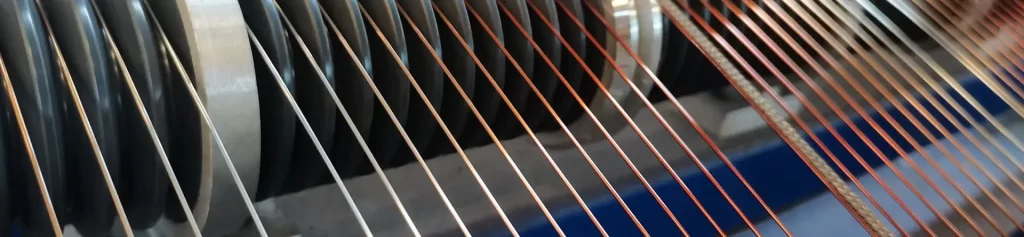
Paper-covered wire (PCW) is the “heart” insulation material for windings in critical power equipment such as oil-immersed transformers, medium and large-sized motors, and high-voltage reactors. It uses copper or aluminum as the conductor, with 1-3 layers of insulating paper tape such as kraft paper, cable paper, NOMEX 410, or HPI-Green wrapped around it. The performance of the paper-covered wire directly determines the insulation reliability, lifespan, temperature rise, and safety margin of electrical equipment. However, the performance of paper-covered wire is not determined by a single factor—from conductor material, paper type, paper layer thickness to operating temperature, impregnation medium, mechanical stress, manufacturing process, and storage environment, any malfunction in any of these aspects can lead to a precipitous drop in performance.
Conductor Material Factors: The “Genes” Determining Conductivity
Conductor material is the primary determinant of paper-insulated wire performance. The three main materials—copper, aluminum, and copper-clad aluminum—differ significantly in four dimensions: conductivity, mechanical strength, cost, and weight.
copper conductor (Copper): Performance benchmark
Copper is the most commonly used conductor material for paper-insulated wire. Advantages: Highest conductivity, good mechanical strength, less prone to breakage during winding, and a lifespan of 30+ years. Disadvantages: Heavy (approximately 3.3 times that of aluminum) and high cost (2-3 times that of aluminum). Applicable Scenarios: High-voltage transformers, medium and large-sized motors, traction transformers, and critical power equipment.
| Parameter | Value |
|---|---|
| Conductivity | 100% IACS (baseline) |
| Density | 8.96 g/cm³ |
| Tensile Strength | 220–400 MPa |
| Resistivity | 1.724 × 10⁻⁸ Ω·m |
| Temperature Coefficient | 0.00393/°C |
| Mechanical Elongation | 30% (round wire ≤ 2.5 mm) |
aluminum conductor (Aluminum): Cost-effective alternatives
Aluminum is an economical alternative to copper. Advantages: Lightweight (approximately 1/3 the weight of copper), low cost (40-50% of copper), and abundant resources. Disadvantages: Conductivity is only 61% of copper (requiring 1.6 times the cross-sectional area for equivalent resistance), tensile strength is low (requiring less tension during winding), and it is prone to oxidation (copper-aluminum connections require special treatment). Suitable Applications: Rural power grid distribution (transformers), low-cost industrial motors, and oil-immersed transformers below 35 kV.
| Parameter | Value |
|---|---|
| Conductivity | 61% IACS |
| Density | 2.70 g/cm³ |
| Tensile Strength | 90–180 MPa |
| Resistivity | 2.83 × 10⁻⁸ Ω·m |
| Temperature Coefficient | 0.00403/°C |
| Mechanical Elongation | 12–25% |
Copper-clad Aluminum (CCA): A Compromise
Copper-clad aluminum strikes a balance between performance and cost. Advantages: Higher electrical conductivity than aluminum, superior mechanical properties, lighter weight than copper, and cost between the two. Disadvantages: Copper-aluminum interface bonding issues (interface diffusion at high temperatures), and greater processing difficulty. Applicable Scenarios: Medium-frequency induction motors, lightweight transformers, and special-purpose motors.
| Parameter | Value |
|---|---|
| Conductivity | 70–85% IACS (determined by copper layer ratio) |
| Density | 3.5–6.0 g/cm³ (copper ratio 10–40%) |
| Copper Layer Volume Ratio | Typically 15–30% |
| Typical Applications | Medium-frequency motors, lightweight transformers |
Conductor Shape Factors
The conductor shape affects the performance of paper-insulated wire primarily in terms of insulation uniformity, slot fill factor, and heat dissipation capacity. Round wire offers the most uniform insulation and is suitable for high voltage; flat wire has a high slot fill factor and good heat dissipation, making it suitable for compact motors.
Paper Type and Quality Factors: The “Core” Determinant of Insulation Capacity
Paper is the main component of paper-wrapped wire insulation. Different types of paper vary greatly in terms of temperature resistance, pressure resistance, moisture absorption, mechanical strength, and oil compatibility.
| Shape | Applicable Specifications | Characteristics |
|---|---|---|
| Round Wire | Diameter 1.0–7.0 mm | Suitable for high-voltage windings, uniform insulation, low cost |
| Flat Wire | Thickness 1.0–10.0 mm / width ratio ≤ 8:1 | Slot fill rate +30%+, good heat dissipation, suitable for compact design |
| Square Wire | Side length 1.5–5.0 mm | Suitable for special motors, high coil utilization |
| CTC | Multiple enameled flat wires combined | Large transformer anti-eddy current, capacity ≥ 110 kV |
Kraft Paper: The Main Material for Oil Impregnation and Variation
Kraft paper is the primary paper used in oil-immersed transformer applications. Advantages: Fully compatible with transformer oil (no chemical reaction), excellent oil absorption (significantly improves insulation strength after impregnation), lowest cost, and high mechanical strength. Disadvantages: Temperature resistance is only 105°C (limits dry-type applications), easily absorbs moisture (requires sealed storage). Typical Applications: 10 kV / 35 kV oil-immersed transformers, windings for small and medium-sized motors.
| Parameter | Value |
|---|---|
| Thickness | 0.05 / 0.08 / 0.10 / 0.13 mm |
| Temperature Class | Class A (105°C) |
| Single-Layer Breakdown Voltage | ≥ 600 V (0.05 mm) / ≥ 1000 V (0.08 mm) |
| Density | 0.8–1.0 g/cm³ |
| Tensile Strength | ≥ 3.5 kN/m (longitudinal) |
| Moisture Content | ≤ 8% (ex-factory) |
Cable Paper: The Mainstay for Medium and High Voltage Cables
Cable paper has a breakdown voltage 30–50% higher than kraft paper of the same thickness. Advantages: Higher withstand voltage, more uniform density, and lower dielectric loss. Disadvantages: Slightly higher cost than kraft paper. Typical Applications: 35 kV oil-immersed transformers, high-voltage cable windings, and high-voltage motors.
| Parameter | Value |
|---|---|
| Thickness | 0.08 / 0.10 / 0.13 / 0.17 mm |
| Temperature Class | Class A (105°C) |
| Single-Layer Breakdown Voltage | ≥ 1000 V (0.08 mm) / ≥ 1500 V (0.13 mm) / ≥ 2000 V (0.17 mm) |
| Density | 0.9–1.1 g/cm³ |
| Typical Applications | 35 kV and below high-voltage cables, transformers |
NOMEX 410: The Preferred Choice for High-Temperature Dry Processing
NOMEX 410 is DuPont’s Aramid Paper, a benchmark in the field of high temperature resistance. Advantages: Temperature resistance up to 220°C (far exceeding the 105°C of kraft/cable paper), compatible with all varnishes/adhesives/transformer oils/refrigerants, radiation resistant, and extremely high mechanical strength. Disadvantages: Cost 10–20 times that of kraft paper, requires import. Typical Applications: Dry-type transformers, wind turbines, new energy vehicle drive motors, rail transit traction transformers, and motors of H-class and above.
| Parameter | Value |
|---|---|
| Thickness | 0.05 / 0.13 / 0.25 / 0.51 / 0.76 mm |
| Temperature Class | Class R (220°C, up to 240°C short-term) |
| Single-Layer Breakdown Voltage | ≥ 1000 V (0.05 mm) / ≥ 5000 V (0.25 mm) / ≥ 9000 V (0.51 mm) |
| Density | 0.8 g/cm³ |
| Moisture Content | ≤ 0.5% (ex-factory) |
HPI-Green: An Environmentally Friendly Upgrade
HPI-Green is a new generation of environmentally friendly insulating paper. Advantages: Temperature resistance up to 130°C (Class B), recyclable, compatible with traditional kraft paper equipment, single-layer breakdown voltage ≥ 1500 V (0.13 mm). Disadvantages: Cost is between kraft paper and NOMEX. Typical Applications: EU export transformers, green certified products.
Marker Paper: Identification and Auxiliary Materials
Marking paper is used for color mark identification (different colors distinguish winding phase sequence). Features: Thickness 0.05–0.10 mm, surface colored (yellow/red/blue/green), does not affect main insulation performance. Typical applications: Multiphase windings of motors, transformer lead identification.
The Influence of Paper Quality on Performance
Even minor differences in paper quality can lead to fluctuations of 50%+ in paper wrapping line performance. Key Quality Indicators:
Insulation Thickness and Number of Paper Layers: The “Law” Determining Voltage Withstand Capacity
Insulation thickness is the most direct factor affecting breakdown voltage. The choice of single-layer, double-layer, or triple-layer directly impacts three major dimensions: withstand voltage, heat dissipation, and cost.
| Indicator | Qualified Value | Impact |
|---|---|---|
| Moisture Content | ≤ 8% (Kraft/Cable) / ≤ 0.5% (NOMEX) | Moisture > 10% → breakdown voltage drops 50% |
| Thickness Uniformity | ± 5% | Thickness fluctuation → local electric field concentration |
| Tensile Strength | ≥ 3.5 kN/m | Insufficient strength → wrapping breakage |
| Ash Content | ≤ 1% | High ash → dielectric loss increases |
| pH Value | 6.5–8.0 | Acidic → accelerated copper corrosion |
Single-layer vs. Double-layer vs. Triple-layer Comparison
| Layer Count | Single-Layer Thickness | Breakdown Voltage | Heat Dissipation | Cost |
|---|---|---|---|---|
| Single Layer | 0.05–0.13 mm | 600–2000 V | Best | Lowest |
| Double Layer | 0.10–0.26 mm | 1500–4500 V | Good | Medium |
| Triple Layer | 0.15–0.39 mm | 3000–7000 V | Average | High |
Insulation Thickness Selection Rules
- 10 kV Distribution Transformer: Single layer 0.13 mm cable paper or double layer 0.08 mm kraft paper → Breakdown voltage ≥ 2000 V – 35 kV Distribution Transformer: Double layer 0.13 mm cable paper → Breakdown voltage ≥ 4500 V – 110 kV Transformer: Double layer 0.17 mm high-voltage cable paper + triple layer NOMEX 410 0.25 mm → Breakdown voltage ≥ 9000 V – Dry-type Transformer (SCB): Double layer NOMEX 410 0.25 mm → Breakdown voltage ≥ 9000 V – H-class Motor: Double layer NOMEX 410 0.25 mm + glass fiber → Breakdown voltage ≥ 10000 V
Influence of Thickness Tolerance on Performance
Key Reminder: The dimensional increase caused by paper tape wrapping should be clearly stated in the agreement between the buyer and seller. Excessive negative tolerances can lead to localized insulation weaknesses and cause breakdown.
| Thickness (mm) | Minimum Increase | Maximum Increase | Overall Dimension Deviation |
|---|---|---|---|
| Below 0.50 | 100% | – | ± 0.05 mm |
| 0.50–1.25 | 92.5% | – | ± 0.10 mm |
| Above 1.25 | 50% | – | ± 0.15 mm |
Nonlinear Relationship between Breakdown Voltage and Thickness
Breakdown voltage is not a simple linear superposition. The actual breakdown voltage of double-layered 0.08 mm paper (theoretically 2000 V) is only 1500–1700 V (with a loss of 15–25%). This is because:
- Interface Effect: Tiny air gaps exist at the interlayer interfaces; air gap breakdown precedes the paper itself. 2. Electric Field Concentration: Electric field distortion occurs at the interlayer overlap. 3. Impreg Effect: Double-layer impregnation results in smaller gaps, improving overall paper quality by 30-50%.
IV. Insulation Structure Factors: The “Formula” that Determines Overall Performance
The insulation structure is the “formula” of the conductor, enamel coating, paper, and adhesive. Different structures correspond to different application scenarios.
Five Mainstream Insulation Structures
| Structure | Full Name | Conductor | Film | Paper | Typical Application |
|---|---|---|---|---|---|
| PCW | Paper Covered Wire | Cu/Al | None | Single/Double layer paper | Oil-immersed DT (old type) |
| PCEW | Paper Covered Enameled Wire | Cu/Al | Single layer | Single/Double layer paper | Oil-immersed DT (mainstream) |
| PCECW | Paper Covered Enameled Copper Wire | Cu | Single layer (PEI) | Single/Double layer paper | 10 kV / 35 kV oil-immersed DT |
| PCEAW | Paper Covered Enameled Aluminum Wire | Al | Single layer | Single/Double layer paper | Rural DT, low-cost motor |
| PCEFW | Paper Covered Enameled Flat Wire | Cu/Al flat | Single layer | Double layer paper | Medium-large motor, dry-type transformer |
| Glass Fiber + Paper Composite | Glass Fiber + Paper | Cu flat | Film | NOMEX + Glass Fiber | 180°C motor, traction transformer |
Influence of Insulation Structure on Breakdown Voltage
| Structure | Breakdown Voltage (Double Layer 0.13 mm) | Improvement |
|---|---|---|
| Bare copper + Single layer paper | 1500 V | Baseline |
| Film + Single layer paper (PCEW) | 2500 V | + 67% |
| Film + Double layer paper (PCEW) | 4500 V | + 200% |
| Film (PEI) + Double layer cable paper (PCECW) | 5500 V | + 267% |
| Film (PI) + Triple layer NOMEX 410 | 12000 V | + 700% |
The function of enamel coating
The enamel coating (PEI / PAI / PI) serves as the first layer of insulation (“undercoating film”), and its performance is critical.
- Polyester (PE): Temperature resistance 130°C, low cost. – Polyester Imine (PEI): Temperature resistance 155°C (Class F), mainstream. – Polyamide Imine (PAI): Temperature resistance 200°C (Class N), used with NOMEX. – Polyimide (PI): Temperature resistance 220°C (Class R), highest temperature resistance.
NEMA MW 1000-2018 stipulates that the film coating of paper-insulated wire must meet at least Class 90, otherwise it cannot form a co-insulation with the paper layer.
Operating Voltage Factor: Determines the “Level” of Insulation Requirements
Operating voltage is the direct factor determining the withstand voltage rating of paper-insulated wire. The higher the voltage rating, the greater the insulation thickness required, and the more layers of paper are needed.
Voltage Levels and Breakdown Voltage Requirements
| Voltage Class | Equipment Type | Breakdown Voltage Requirement | Recommended Paper Layer |
|---|---|---|---|
| 400 V Low Voltage | Distribution transformer LV winding | ≥ 1500 V | Single layer 0.05 mm Kraft |
| 10 kV Medium Voltage | DT HV winding | ≥ 2500 V | Single layer 0.13 mm cable paper |
| 35 kV Medium Voltage | DT / Station transformer | ≥ 4500 V | Double layer 0.13 mm cable paper |
| 110 kV High Voltage | Substation main transformer | ≥ 7000 V | Double layer 0.17 mm + Single layer NOMEX |
| 220 kV Extra-High Voltage | Main transformer HV side | ≥ 12000 V | Triple layer NOMEX 410 0.25 mm |
| 550 kV UHV | UHV main transformer | ≥ 25000 V | Triple layer NOMEX 410 + oil-immersed barrier |
Safety Margin of Breakdown Voltage
International standards require a safety margin of 3–5 times:
- Design Breakdown Voltage = Test Voltage × 1.5–2.0 – Rated Breakdown Voltage ≥ Operating Voltage × 3–5 (depending on voltage rating) – 110 kV Rating: Rated Breakdown ≥ 7000 V, Test ≥ 5000 V
Partial Discharge and Electric Field Concentration
Under high voltage, paper-insulated wires also require attention to partial discharge (PD):
- PD start-up voltage > 1.5 × operating voltage – PD shutdown voltage > operating voltage – Electric field concentration often occurs at interlayer overlap, conductor surface burrs, and insulation defects – Elimination measures: Rounding treatment + oil impregnation + vacuum pressure impregnation (VPI)
VI. Operating Temperature: The “Clock” that Determines Lifespan
Operating temperature is an exponential determinant of thermal aging life. The Arrhenius equation shows that for every 10°C increase in temperature, the lifespan is halved.
Operating Temperature Factor: The “Clock” Determining Service Life
Temperature Class and Temperature
The thermal aging life of paper-covered wire follows the Arrhenius rule. According to the Arrhenius equation, the lifespan decreases by half for every 10°C increase in temperature.
Temperature Characteristics of Oil-Immersed Transformers
Typical temperature distribution of 10 kV / 35 kV oil-immersed transformers:
- Top oil temperature: 85–95°C (Class A 105°C) – Average winding temperature rise: ≤ 65 K (oil-immersed) / ≤ 80 K (dry-type) – Winding hot spot temperature: ≤ 105°C (Class A safety limit) – Maximum winding temperature (2 s after short circuit): ≤ 250°C (copper) / ≤ 200°C (aluminum)
The Influence of Temperature on Lifespan
Arrhenius formula:
> L = L₀ × 2^((T₀ – T) / 10)
Where L is the lifespan, L₀ is the rated lifespan, T₀ is the rated temperature, and T is the actual temperature.
- Class A (105°C) Lifespan 20–30 years – Class F (155°C) Lifespan 15–25 years – Class H (180°C) Lifespan 10–20 years – Lifespan doubles for every 10°C decrease (typical empirical value)
Immersion Media Factors: The “Environment” that Determines Compatibility
The impregnation medium (oil or resin) is in direct contact with the paper-wrapped thread and must be chemically compatible.
Mineral Oil: Traditional Mainstream
Advantages: Fully compatible with all types of paper (kraft paper/cable/NOMEX), high breakdown voltage, low cost, and mature technology. Disadvantages: Low flash point (safety risk), non-degradable (environmental pressure).
| Parameter | Mineral Oil |
|---|---|
| Breakdown Voltage | ≥ 30 kV / 2.5 mm |
| Dielectric Loss tan δ | ≤ 0.005 (90°C) |
| Flash Point | ≥ 135°C |
| Fire Point | ≥ 165°C |
| Paper Compatibility | Excellent (oil absorption 15–25%) |
| Lifespan | 30+ years |
| Application | 10–550 kV oil-immersed DT / main transformer |
Vegetable Oils (FR3): An Environmentally Friendly Alternative
Advantages: Flash point is 200°C higher than mineral oil (fire retardant), biodegradable (90 days), and better compatibility with paper. Disadvantages: Cost is 3–5 times that of mineral oil, and has high viscosity at low temperatures (requires heating below -20°C).
| Parameter | FR3 Vegetable Oil |
|---|---|
| Breakdown Voltage | ≥ 35 kV / 2.5 mm |
| Flash Point | ≥ 330°C (far higher than mineral oil) |
| Fire Point | ≥ 350°C |
| Paper Compatibility | Excellent (oil absorption 20–30%) |
| Lifespan | 30+ years |
| Application | High-rise buildings, subways, underground substations |
Dry process (epoxy resin/vacuum pressure impregnation VPI)
The “impregnation medium” for dry transformer is epoxy resin or impregnation varnish:
- Epoxy Casting (SCB): NOMEX 410 paper + epoxy resin vacuum casting – VPI (Vacuum Pressure Impregnation): NOMEX 410 + impregnation varnish → heat curing – thermal class: Class F (155°C) or Class H (180°C)
Advantages: Oil-free, fireproof, suitable for indoor installation, and easy to maintain. Disadvantages: High cost, poor heat dissipation (requires air cooling), and difficult insulation repair.
Mechanical Stress Factors: The “Test” that Determines Insulation Integrity
Mechanical stress is a common cause of paper-insulated wire failure. Short circuits, vibration, bending, and impacts can all cause insulation damage.
| Impregnation Medium | Breakdown Voltage Improvement | Heat Dissipation Improvement | Lifespan Impact |
|---|---|---|---|
| No Impregnation (Dry Air Wound) | Baseline | Baseline | Baseline |
| Mineral Oil Impregnation | + 50–100% | + 30% | Extended 30% |
| FR3 Vegetable Oil Impregnation | + 60–120% | + 35% | Extended 35% |
| Epoxy Resin Casting | + 30% | + 0% | Extended 20% |
| VPI Impregnating Varnish | + 40% | + 10% | Extended 25% |
Short-circuit electrodynamics
When the secondary side of the transformer is short-circuited, the primary winding withstands an electrodynamic force of 10–25 times the rated current.
- Radial force: Compresses the inner winding inward and expands the outer winding outward. Axial force: Presses the windings vertically. Duration: ≤ 2 s (protection action time). Peak acceleration: 30–50 g.
Impact on paper-insulated wires: Tearing of insulation paper, conductor deformation, and short circuits between turns. Preventive measures: Rounding corners, increasing end insulation, and strengthening the support structure.
Vibration and Shock
The substation transformer is subjected to power grid harmonic vibrations for extended periods:
- Fundamental frequency vibration: 100 Hz (2nd harmonic of 50 Hz power supply) – Harmonic vibration: 200 / 300 / 400 Hz – Vibration acceleration: 0.5–2 g (normal operation) – Seismic acceleration: 0.2–0.5 g (magnitude 7 earthquake)
Impact on paper-insulated wire: Loosening of the insulation layer, conductor wear, and cracking of the enamel coating. Preventive measures: Use high-strength enamel coating, double-layer paper insulation, and tight winding process.
Bending Radius
The minimum bending radius of paper-insulated wire is a key parameter in the winding process:
- round wire: Minimum bending radius ≥ 3 times wire diameter (d ≤ 2.5 mm) – round wire: Minimum bending radius ≥ 2 times wire diameter (d > 2.5 mm) – flat wire: Bending radius ≥ thickness × 3 (bending along the thickness direction) – flat wire: Bending radius ≥ width × 5 (bending along the width direction)
Insufficient bending can lead to insulation layer cracking and conductor deformation. This is one of the common causes of paper-insulated wire failure.
Tensile Stress
Paper-insulated wire is subjected to tension during the winding process:
- Tensile stress of round wire: ≤ 50 MPa (d ≤ 2.5 mm) / ≤ 80 MPa (d > 2.5 mm) – Tensile stress of flat wire: ≤ 50 MPa – Tensile strength of insulating paper: ≥ 3.5 kN/m (kraft paper/cable)
Exceeding the tensile limit will cause conductor breakage and insulation layer damage.
Manufacturing Process Factors: The “Source” that Determines Quality
Manufacturing process is the starting point for quality control of paper-wrapped yarn. 5 key process parameters determine product performance.
Wrapping Tension Control
Insufficient tension → insulation loosening, displacement after oil immersion → breakdown; Excessive tension → conductor stretching, insulation rupture.
| Tension Level | Applicable Specifications | Effect |
|---|---|---|
| Low Tension | d ≤ 1.5 mm round wire | Prevent thin wire stretching |
| Medium Tension | d 1.5–4.0 mm round wire | Balance tension and winding |
| High Tension | d > 4.0 mm round wire / flat wire | Ensure tight wrapping |
Wrapping Angle and Overlap Rate
- Overlap Rate: 10–50% (depending on the number of paper layers) – Wrapping Angle: Typically 5–15° (spiral wrapping) – Rotation Direction per Layer: Alternate between forward and reverse (to prevent insulation layer slippage) – Edge Alignment: Flat wires must be strictly aligned (to avoid electric field concentration)
Adhesive Use
NEMA MW 1000 specifies:
“Except for adhesives used to secure the ends of the paper tape, no adhesive or bonding materials may be used.”
- Permitted: Adhesive for securing the ends of the paper tape. – Prohibited: Adhesive used between paper layers (affects oil impregnation performance).
Moisture Content Control
Moisture is the “invisible killer” of paper packaging lines:
- Exit Moisture Content: ≤ 8% for leather/cables, ≤ 0.5% for NOMEX 410. – Impact of Moisture Content: Moisture + 10% → Breakdown voltage decreases by 50%. – Transportation and Storage: Sealed packaging, moisture-proof treatment. – Incoming Inspection: Moisture content retesting.
Surface Cleanliness
NEMA MW 1000 specifies:
“When inspecting the conductor on the original spool or coil, its surface should be substantially free of copper powder and other impurities.”
- Copper powder: Causes electric field concentration and decreases breakdown voltage. – Oil stains: Affect the impregnation effect. – Dust: Causes partial discharge. – Cleaning process: Clean immediately after wire drawing and clean online before wrapping.
Storage and Operating Environment Factors: The “Environment” that Determines the Aging Rate
Storage and operating environments are key factors in long-term aging.
Storage Conditions
| Parameter | Recommended Value | Impact |
|---|---|---|
| Temperature | 5–35°C | High temperature accelerates paper aging |
| Relative Humidity | ≤ 65% | High humidity causes paper to absorb moisture |
| Light | Avoid light | UV accelerates paper degradation |
| Storage Period | ≤ 12 months | Exceed 12 months require re-inspection |
| Packaging | Sealed moisture-proof | Prevent moisture intrusion |
Operating Temperature Cycle
The transformer can withstand diurnal temperature variation and seasonal temperature variation during long-term operation.
- Diurnal temperature range: 10–30°C (outdoor) – Seasonal temperature range: 50–80°C (northern outdoor) – Temperature cycle count: 10,000+ times (30-year lifespan)
Impact on paper-insulated wire: Thermal expansion and contraction can cause the insulation layer to loosen and the enamel coating to crack. Preventive measures: Use a high-ductility enamel coating and sufficient insulation thickness.
Chemically Corrosive Environment
| Environment | Impact | Protection |
|---|---|---|
| Coastal Salt Spray | Cu-Al corrosion | Sealed design + regular maintenance |
| Industrial Pollution | Acid rain corrosion | Anti-pollution flashover coating |
| Underground Moisture | Insulation moisture absorption | Moisture-proof sealing + heating dehumidification |
| High Altitude | Strong UV | Strengthen outer sheath |
Maintenance and Care
Regular maintenance can extend the life of paper-insulated wire by 20–30%.
- Oil sample testing: every 1–3 years – Electrical testing: every 3–6 years (insulation resistance, dielectric loss) – Infrared thermometry: every 6–12 months – Load monitoring: avoid prolonged overload (> 1.1 times rated)
Five Practical Suggestions from Engineers
Based on the above 10 major influencing factors, here are 5 practical suggestions:
Design Phase
- Voltage Withstand Design: Breakdown voltage ≥ Operating voltage × 3–5, providing sufficient safety margin. 2. Temperature Selection: thermal class ≥ Actual operating temperature + 10 K (Class F is superior to Class A for high-temperature applications). 3. Impregnation Compatibility: Paper and impregnation media must be chemically compatible (NOMEX 410 is compatible with all media).
Selection Phase
- Balance of Cost-Effectiveness: NOMEX 410 is used for Class F/H high-temperature applications (high cost), while kraft/cable paper is used for Class A oil-immersed transformers (low cost). 5. Supplier Evaluation: Suppliers with ISO 9001, NEMA MW 1000, and IEC 60317 certifications are selected (to ensure quality stability).
Operation and Maintenance
- Regular Inspections: Annual testing of oil samples, insulation resistance, and dielectric loss. 7. Load Management: Avoid prolonged overload (> 1.1 times rated load). 8. Environmental Control: Temperature, humidity, and chemical corrosion protection.
Glossary of 20 Entries
| Term | English | Explanation |
|---|---|---|
| PCW | Paper Covered Wire | Paper-covered wire |
| PCEW | Paper Covered Enameled Wire | Paper-covered enameled wire |
| PCECW | Paper Covered Enameled Copper Wire | Paper-covered enameled copper wire |
| PCEAW | Paper Covered Enameled Aluminum Wire | Paper-covered enameled aluminum wire |
| PCEFW | Paper Covered Enameled Flat Wire | Paper-covered enameled flat wire |
| NOMEX 410 | – | DuPont T410 aramid paper |
| Kraft Paper | – | Kraft insulating paper |
| Cable Paper | – | Cable insulating paper |
| HPI-Green | – | Eco-friendly insulating paper |
| Marker Paper | – | Identification marker paper |
| PEI | Polyesterimide | Polyesterimide enamel |
| PAI | Polyamideimide | Polyamideimide enamel |
| PI | Polyimide | Polyimide enamel |
| VPI | Vacuum Pressure Impregnation | Vacuum pressure impregnation |
| CTC | Continuously Transposed Conductor | Continuously transposed conductor |
| tan δ | Dielectric Dissipation Factor | Dielectric loss tangent |
| PD | Partial Discharge | Partial discharge |
| LI | Lightning Impulse | Lightning impulse withstand voltage |
| CCA | Copper Clad Aluminum | Copper-clad aluminum |
| FR3 | – | Natural ester vegetable insulating oil |
About LP Winding Wire
LP Winding Wire (LNPU) specializes in the research and manufacturing of paper-insulated wire, enameled wire, and continuously transposed conductors (CTC), with an annual production capacity exceeding 10,000 tons. Its products are widely used in:
- Oil-immersed transformer (10 kV – 550 kV) – Dry-type transformer (SCB10 / SCB11 / SCB12 / SCB13) – HVDC converter transformer (±200 – ±800 kV) – New energy step-up transformer (wind power/photovoltaic) – Traction transformer (electrified railway) – Instrument transformer/reactor
Core product line:
- PCECW: Paper-insulated enameled round copper wire/flat copper wire (diameter 1.0–7.0 mm, thickness 1.0–10.0 mm) – PCEAW: Paper-insulated enameled aluminum wire (7 wire types) – PCEFW: Paper-insulated enameled flat wire (high slot fill factor design) – NOMEX 410 Composite Wire: Temperature resistant up to 220°C – Glass fiber paper-insulated flat copper wire: Heat grade 180 – CTC Continuously Transposed Conductor: 5–80 transposed enameled flat wires
Certification Standards: ISO 9001 / ISO 14001 / UL / CE / RoHS / REACH / NEMA MW 1000 / IEC 60317 / GB/T 7673
For paper-insulated wire specifications, sample testing, or customization, please contact the LP Winding Wire technical team.