


For magnet wire used in motors, transformers, and home appliances, environmental compliance is no longer a nice-to-have — it is a hard entry barrier to the EU, North American, and Chinese markets. What do the five major frameworks — RoHS, REACH, UL, IEC 60317, and China’s new RoHS — each regulate, and how do you put them into practice? This article covers it all in one read. What you’ll find here is not generic advice, but an operational checklist we have repeatedly validated while helping European and American customers through compliance audits over the years — the mistakes we have made, the agreements we have signed, the reports we have supplemented.
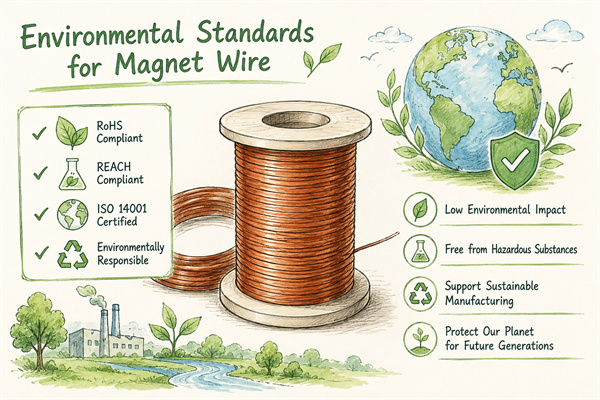
1. EU: RoHS + REACH as Double Insurance
RoHS 3 (Directive EU/2015/863) restricts 10 hazardous substances — lead, mercury, cadmium, hexavalent chromium, PBB, PBDE, DEHP, BBP, DBP, and DIBP. Both the enamel coating and the copper/aluminum conductor of magnet wire must comply, with limits calculated per homogeneous material. RoHS answers the question of “whether or not” — it is a product-level mandatory certification, and without the certificate you cannot enter EU customs. Amazon’s European marketplace will also force your listings down if you don’t have it.
REACH (EC 1907/2006) requires ECHA to update the SVHC (Substances of Very High Concern) Candidate List every year — by 2024 it had grown to more than 235 entries. If any SVHC is present in the magnet wire at >0.1% w/w, the information must be passed down the supply chain. This regulation is stricter than RoHS — the list only grows, having expanded 15-fold from the original 15 entries in 2008, and it will continue to expand. The EU updates the list in January and June each year, so anyone doing export business should make it a habit to check the ECHA website every six months.
Operational points: magnet wire exported to the EU must come with a RoHS test report + REACH SVHC declaration from the supplier, kept on file for 5 years. We recommend third-party testing by SGS or CTI before each bulk shipment for higher credibility. A common mistake: only doing RoHS but skipping REACH, then being forced to return goods when SVHC upgrades — we ran into exactly this in 2023 with an Italian customer whose shipment was held at customs for two weeks, ultimately having to fly in replacement goods at a cost of €8,000 in extra freight that wiped out the entire order profit.
2. North America: UL + TSCA Dual Track
UL 1446 is the North American standard for thermal evaluation of magnet wire insulation systems, and it is a common basis for motor factory export certification. To clarify the distinction: UL 1446 covers the insulation system (finished motor), while UL 1445 covers the magnet wire itself — do not confuse the two when sourcing. Motor plants generally review the full UL 1446 system report; if you are purchasing bare wire, look at UL 1445. UL reports are usually charged by “system” — a full package runs ¥50,000 to ¥100,000, while single-wire certification costs only ¥20,000 to ¥30,000.
TSCA + EPA: the United States has its own controls on PBT substances, lead, PFOA, and others. There is no RoHS in the US, but there are similar lists (such as California’s Prop 65). California customers typically require a separate Prop 65 compliance declaration; without one, you can be fined. Prop 65’s defining features are “long list, heavy fines” — many Chinese suppliers get hit with warning letters on their first test, with single violations fined up to $2,500 per day.
Operational recommendation: when North American customers audit the factory, beyond reviewing your UL certificate, they will also check your SDS (Safety Data Sheet). An incomplete SDS results in an immediate fail — you do not even get a chance to be audited. We had a US customer last year who brought a chemical analyst on-site to sample-test solvent residue; the content exceeded the limit by 0.3%, and purchasing was suspended on the spot. The SDS must use the 16-section GHS (Globally Harmonized System) format, with both Chinese and English versions prepared.
3. China: New RoHS Enters the “10-Substance Era”
From January 1, 2026, GB/T 26572-2011 Amendment 1 and SJ/T 11364-2024 take effect, expanding the regulated substances from 6 to 10 items (4 phthalates added). GB 26572-2027 will become a mandatory national standard on August 1, 2027, at which point the limits will have direct legal binding force and violating companies will be placed on a blacklist that affects future bidding.
Chinese motor factories exporting magnet wire to the EU must meet the 10-item national standard simultaneously — simply follow the EU RoHS 3’s 10 items, saving the cost of a separate test. Our practical experience is that the national and European limits are basically consistent, and one report can be used to declare both systems at the same time. On testing costs, a single 10-item test runs approximately ¥3,000 to ¥5,000, about 30% more expensive than a single 6-item test, but you save the time cost of duplicate submissions.
It should be noted that China’s RoHS also requires label compliance — the product itself or its packaging must carry the “Environmental Protection Use Period” label and the “Hazardous Substance Content Table”. SJ/T 11364-2024 has clear requirements on label format, and JD, Tmall, and Douyin e-commerce platforms have all mandated that merchants upload RoHS label images.
4. Production Side: ISO 14001 as a Hidden Threshold
Large motor plants (Bosch, Siemens, ABB) generally require suppliers to hold ISO 14001 Environmental Management System certification during factory audits. This is a hidden threshold — without it, you basically cannot make it onto the qualified supplier list. In Bosch’s qualified supplier roster, over 90% hold ISO 14001; in Siemens’s SQP (Supplier Quality Program) assessment form, ISO 14001 is scored as a separate item.
What about small and medium-sized enterprises? ISO 14001 certification takes 3 to 6 months and costs ¥30,000 to ¥80,000, but once obtained, customer development efficiency can improve by more than 30%. If budget is tight, secure the RoHS + REACH + UL three certificates first and put ISO 14001 in the second tier. You can also do it together with ISO 9001 (quality system); combining the two systems can save 20% in consulting fees.
Practical reminder: ISO 14001 is not just a certificate — it is a system. If the production site is messy after certification, or if chemical leaks are caught during customer spot-checks, the certificate can be suspended at any time. We saw a supplier in Zhejiang whose used paint barrels were stacked right outside the workshop door — Bosch blacklisted them immediately, and it took a full two years to regain supply qualification, with lost order value exceeding ¥8 million. A system is not about writing documents — it is about daily inspections, hazardous-waste ledgers, and emergency drills as one complete set of actions.
5. Procurement Decision Checklist (5 Steps)
- Where is the target market? EU: RoHS + REACH. North America: UL + TSCA. China: 10 items.
- Which documents are needed? RoHS report, SVHC declaration, UL certificate, ISO 14001 certificate, SDS.
- Do we need third-party test reports? For large orders, we recommend SGS/CTI spot-checks.
- Certificate validity? SVHC is updated annually — certificates cannot last forever.
- Risk contingency? Reserve 1–2 backup suppliers to avoid being stuck by a single source’s environmental issue.