

In the motor and transformer industry, the word “environmental protection” is frequently mentioned, but if you really ask, customers are actually asking three completely different questions: What emissions did the factory release when this enamel coating was applied? Will the product meet European regulations if sold there? What should be done with the enameled copper wire after the motor has been scrapped for ten years? These three issues belong to three stages of the life cycle—manufacturing, compliance, and end-of-life. What truly connects them is the chemical system of the enameled copper wire coating film. I am a professional in the enameled copper wire industry at Zhengzhou LP Industry Co., Ltd., with 30 years of experience in this field. Our factory covers 60 acres and has its own production lines for everything from copper rod drawing to coating and curing. We have full UL, REACH, and RoHS certifications, and our products are exported to over 50 countries. In this article, I want to clarify one thing: The differences in environmental performance between different paint film types stem from their chemical structure, not from marketing claims. .
How Enamel Chemistry Determines the Environmental Footprint
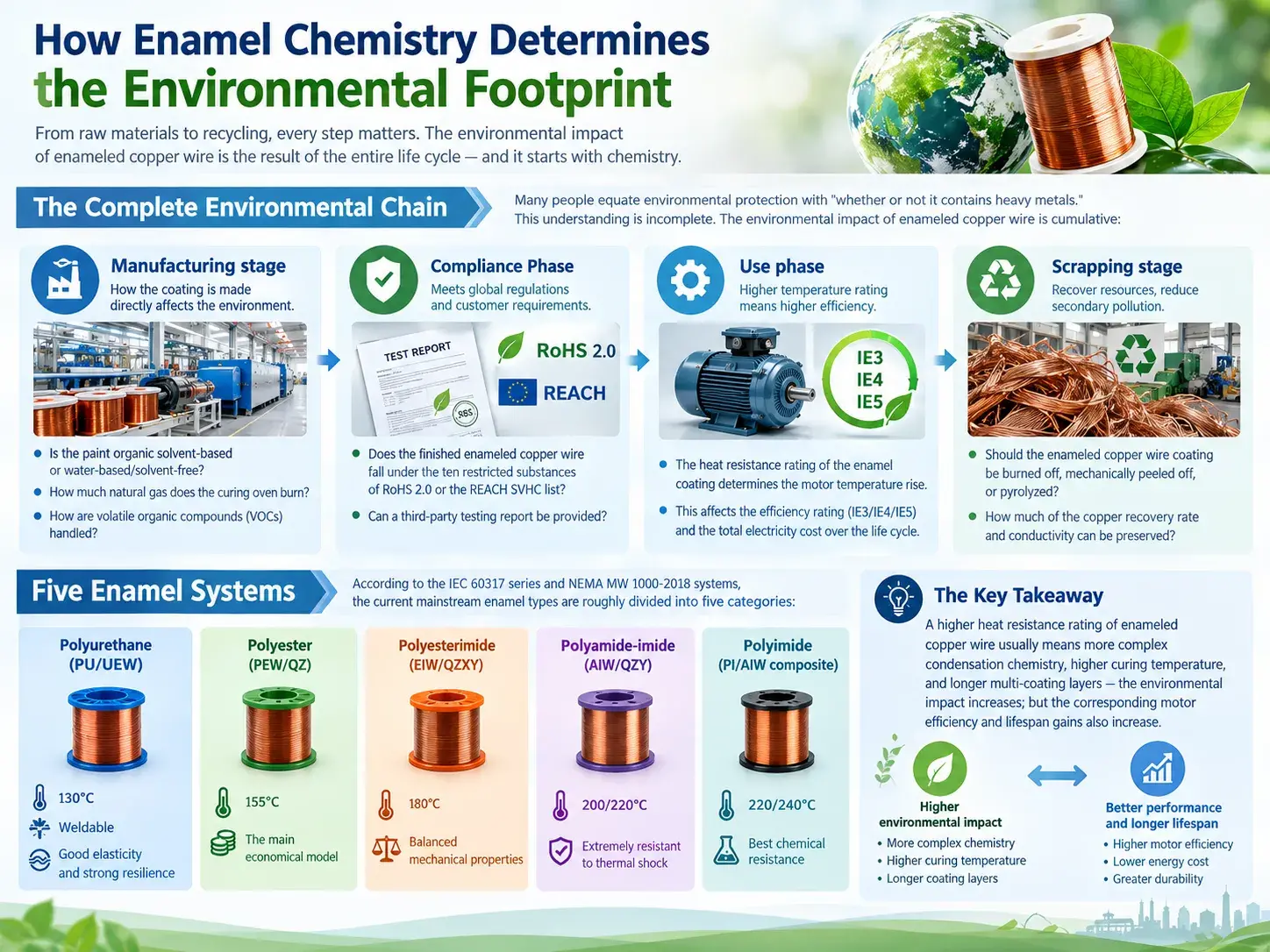
The Complete Environmental Chain
Many people equate environmental protection with “whether or not it contains heavy metals.” This understanding is incomplete. The environmental impact of enameled copper wire is cumulative:
- Manufacturing stage —Is the paint used for coating enameled copper wire an organic solvent-based or water-based/solvent-free system? How much natural gas does the curing oven burn? How are volatile organic compounds (VOCs) handled?
- Compliance Phase —Does the finished enameled copper wire fall under the ten restricted substances of RoHS 2.0 or the REACH Substances of Very High Concern (SVHC) list? Can a third-party testing report be provided?
- Use phase —The heat resistance rating of the enameled copper wire coating directly determines the temperature rise of the motor, which in turn determines the efficiency rating (IE3/IE4/IE5) and the total electricity cost over the entire life cycle.
- Scrapping stage —Should the enameled copper wire coating be burned off, mechanically peeled off, or pyrolyzed? How much of the copper recovery rate and conductivity can be preserved?
Five Enamel Systems in One Line Each
According to the IEC 60317 series and NEMA MW 1000-2018 systems, the current mainstream enamel types are roughly divided into five categories:
- Polyurethane (PU/UEW) —130°C, weldable, good elasticity and strong resilience
- Polyester (PEW/QZ) ——155°C, the main economical model
- Polyesterimide (EIW/QZXY) —180°C, balanced mechanical properties
- Polyamide-imide (AIW/QZY) —200/220°C, extremely resistant to thermal shock
- Polyimide (PI/AIW composite) —Best chemical resistance at 220/240°C
The following chapters will break this down one by one. For now, just remember this main storyline: A higher heat resistance rating of enameled copper wire usually means more complex condensation chemistry, higher curing temperature, and longer multi-coating layers—the environmental impact increases; but the corresponding motor efficiency and lifespan gains also increase.
Environmental Profile of Six Enamel Systems
The table below is what I consider the most useful starting point when making your purchase. Look at the overall picture first, then the details.
| Enamel System | Abbreviation / Model | Thermal Class | VOC Tendency | RoHS/REACH Status | Recycling Difficulty | Typical Applications |
|---|---|---|---|---|---|---|
| Polyurethane | PU / UEW(QA) | 130°C | Mainly solvent-based, high baking volatiles | Standard compliance | Low (thin film peels easily) | Small motors, appliances, tools |
| Polyvinyl formal | PVF | 155°C | Solvent-based, relatively heavy smoke | Standard compliance | Medium (acetal condensation smell) | Appliance motors, specialty wire |
| Polyester | PEW / QZ | 155°C | Solvent-based, high-solids or water-based possible | Standard compliance | Medium | Transformers, appliance motors |
| Polyesterimide | EIW / QZXY | 180°C | Solvent-based, higher curing temperature | Standard compliance | Medium-high (densified after imidization) | Industrial motors, transformers |
| Polyamideimide | AIW / QZY | 200/220°C | Solvent-based, heaviest curing burden | Standard compliance | High (aromatic structure resists degradation) | Traction motors, wind, inverter-driven |
| Polyimide | PI / QZY-PI | 220/240°C | Solvent-based, N₂-protected curing | Standard compliance (batch-by-batch testing) | Highest (carbonized residue) | Aerospace, extreme high-temperature use |
Several points need to be elaborated: Regarding VOCs. The actual measurement data I obtained is based on industry regulations—New Hampshire’s NH Admin Rules Env-A 1210.02 sets an emission limit of 0.20 kg VOC/L for the coating process of magnetic wire insulation (approximately 1.7 lb/gal, excluding water and exempted compounds). This is one of the few quantitative standards that directly address enameled copper wire coating in regulations, and it is very telling: traditional PU and PEW rely on solvent evaporation, while VOCs are subject to rigid constraints. A detail about polyurethane. The PU coating on enameled copper wire itself is very thin and soft, and can be quickly peeled off with hot air or mechanical scraping, making recycling the easiest process. However, its heat resistance is only 130°C, so it can only be used as an entry-level solution in high-temperature applications. About polyesterimide (EIW). The technical documentation in KB mentions something very practical: EIW inherits the genes of polyester resin, and its adhesion, flexibility, hardness, and scratch resistance are all well-balanced. It can also withstand hard bending and winding (such as power tool rotors); however, pure polyester coatings are relatively weak in long-term chemical resistance, which EIW makes up for by imidization. About polyamide-imide (AIW). Official ratings for enameled copper wire are mostly around 220°C, but the softening breakdown temperature is usually greater than 330–350°C. This data is crucial—under sudden thermal shocks above 200°C, the internal stress of the paint film is extremely low, and it will never crack. The trade-off is that it is also the most difficult type to recycle. Regarding Full Insulation (FIW). Our internal specifications define FIW (Insulation Integrity) as “No pinholes or air bubbles allowed.” This directly relates to reliability in high-power applications—a single pinhole is a potential discharge initiation point.
Manufacturing Footprint: VOC Emissions and Curing Energy
Three Environmental Costs of the Conventional Process
Here is a peer-reviewed paper from IEEE ICSD 2013, “Properties of a New Ecoefficient Coating for Magnet Wire,” which studies enameled copper wire coating chemistry directly and explains the environmental costs of traditional enameled copper wire. I’ve extracted the key points:
- Traditional insulating varnishes are mostly based on polyesterimide and polyamideimide. Multiple dip coatings are required The paint in the paint tank contains solvents.
- The VOCs emitted from the solvent are collected and incinerated. However, combustion itself produces a large amount of CO₂
- A portion of the residue is directly released into the atmosphere, escaping the treatment system.
- The process itself Energy-intensive Curing requires multiple coats, with solvent evaporation and heating to promote cross-linking.
An alternative path proposed in the literature for enameled copper wire is: Solvent-free process + UV curing The goal is to achieve zero CO₂ and zero NOx emissions by coating a UV-polymerized polyester acrylate (PEA) layer with an extruded polyphenylene sulfide (PPS) thermosetting resin. The significance of this approach lies in demonstrating that “environmental protection” and “high performance” are not necessarily contradictory.
The Industrial Push from EU VOC Rules
An industry trend statistic: By the end of 2025, approximately 35%–45% of the production capacity of European enameled copper wire manufacturers had been converted to high-solids or solvent-free varnish systems. This figure is based on industry research reports. Not a legally mandated ratio However, the direction is very clear—VOC emission control is the real external pressure driving the upgrading of enameled copper wire technology.
Common Reduction Pathways
Based on our own production line experience and publicly available process data, the main paths in the industry are:
- High solids paint —For the same enameled copper wire coating thickness, solvent usage is significantly reduced, and baking emissions are reduced year-on-year.
- Water-based paint —Using water instead of organic solvents results in a higher flash point, lower odor, and is easier to store and transport.
- Solvent-free/UV crosslinking —Eliminating VOCs at the source, but addressing the issue of uneven curing in UV shaded areas is still necessary.
- N₂ Protective Curing —Commonly found in PI/AIW systems, reducing oxidative cracking and resulting in more stable furnace temperatures.
- Increase the solids content of a single coat —Reducing the total number of enameled copper wire coating passes directly reduces total furnace time and total energy consumption.
It should be noted that the above five points are a summary of common industry practices. This does not mean that every aspect of our factory is currently in place. The specific configuration for a particular model or production line will depend on our process documentation.
Compliance Framework: RoHS, REACH and Product Certification
What the Two Regulations Cover
RoHS (EU Directive 2015/863) The restrictions on the use of ten categories of restricted substances in electronic and electrical equipment primarily target lead, mercury, cadmium, hexavalent chromium, and two of the four phthalates and brominated flame retardants. For enameled copper wire, the key areas of control are: whether the pigments and fillers contain heavy metals such as lead/chromium, whether the flame retardant additives are compliant, and whether they are below the limits. REACH (EC 1907/2006 Regulation) The logic is different. It doesn’t directly restrict the use of a specific substance, but rather requires that substances on the Substances of Very High Concern (SVHC) list , if present in concentrations exceeding 0.1% by mass, must be communicated downstream. For enameled copper wire, the key focus is: whether the SDS and SVHC declarations from suppliers of resin raw materials, solvents, and additives are complete and traceable. The practical result of the overlapping of two sets of regulations is a single procurement action: Obtain third-party testing reports (issued by organizations such as SGS) from the supplier. Instead of accepting a verbal promise that “we comply with RoHS”.
Two Pitfalls Specific to Enameled Wire
Pitfall 1: Flame retardant and low smoke formulation Halogenated flame retardants added to enameled copper wire to meet the UL 94 V-0 flame retardancy rating are RoHS sensitive items. Switching to a halogen-free flame retardant system (such as hydrotalcite) usually does not affect electrical performance, but it will change the thermal stability of the coating film, requiring a new type test. Pit 2: Thermal conductive paint and functional additives Thermally conductive fillers added to improve motor heat dissipation are a newly added compliance variable in recent years—the chemical composition and heavy metal content of the thermally conductive fillers need to be evaluated separately, and reports for ordinary paints cannot be used.
Product Standards and Certification Systems
The product standard system for enameled copper wire itself is clear:
- IEC 60317 series —Globally accepted technical specifications for winding wires, clearly defining dimensional tolerances, insulation systems, temperature ratings, and electrical/mechanical/thermal/chemical properties for various varnish types.
- NEMA MW 1000-2018 North American system, process quality baseline
- IEC 60851-6 — Thermal shock testing method to evaluate the cracking behavior of paint films under drastic temperature changes.
- UL 1446 –Insulation system certification of finished enameled copper wire products in the whole machine
- UL 758 / UL 83 —Approval mark for the corresponding product category
What should a test report include? My recommendation for each enamel type is to include: enameled copper wire coating chemical type and curing system, RoHS report (including test date and limits), REACH SVHC declaration, breakdown voltage, thermal shock, softening breakdown, adhesion and rebound angle data, and chemical resistance verification. These can form a complete procurement review document.
End-of-Life and Recycling: Three Process Routes Compared
This is the chapter I personally want to elaborate on the most. Many customers don’t consider this part at all during the procurement phase, but the bill is only truly settled on the day the motor is scrapped.
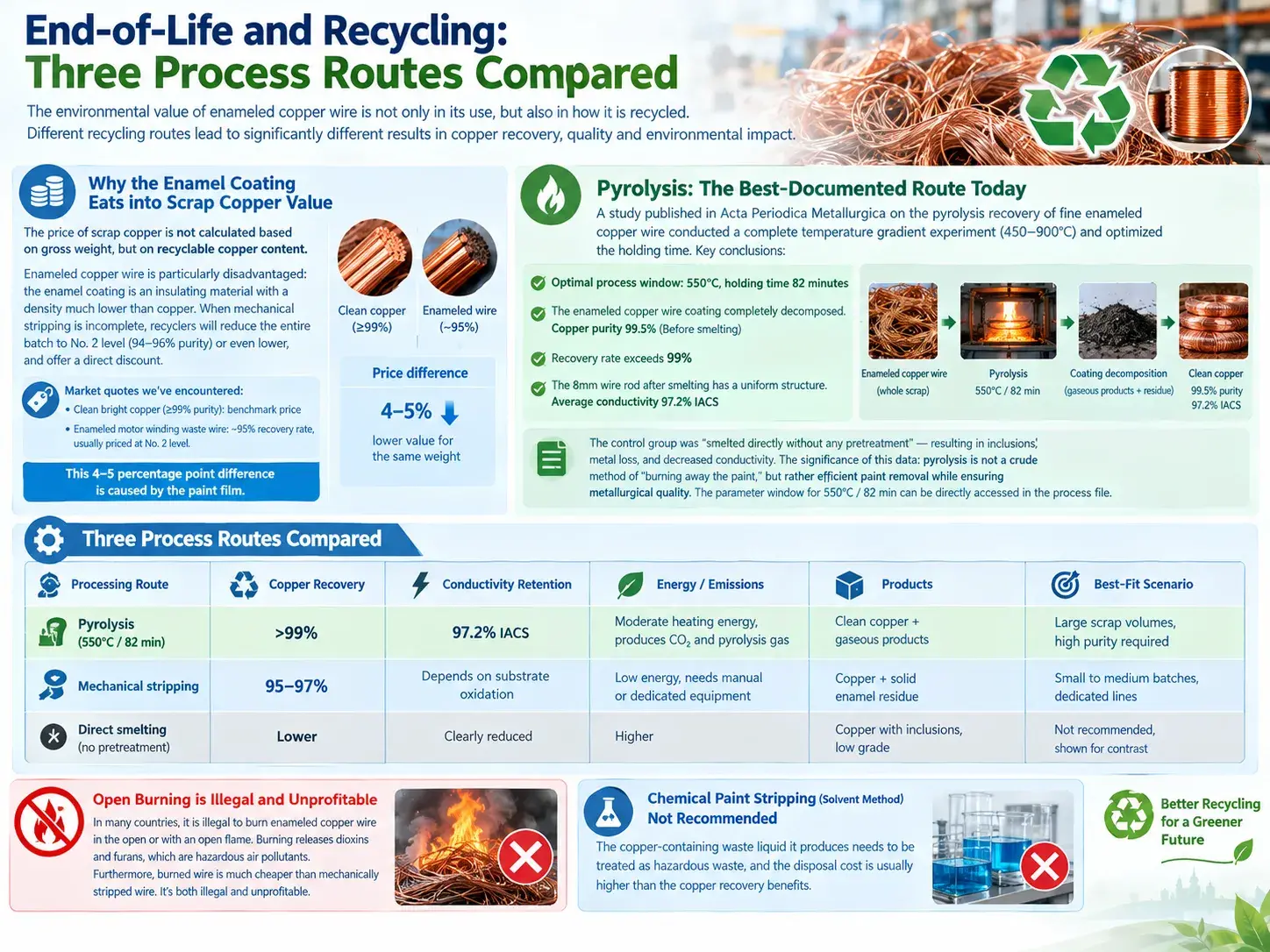
Why the Enamel Coating Eats into Scrap Copper Value
The price of scrap copper is not calculated based on gross weight, but on… Recyclable copper content Enameled copper wire is particularly disadvantaged: the enamel coating is an insulating material with a density much lower than copper. When mechanical stripping of the enamel is incomplete, recyclers will reduce the entire batch of material to No. 2 level (94–96% purity) or even lower, and offer a direct discount. The market quotes we’ve encountered are priced as follows: clean bright copper (≥99% purity, unpainted and unsoldered) is the benchmark price; enameled motor winding waste wire, due to its recycling rate of approximately 95%, is usually priced at No. 2 level. This 4–5 percentage point difference is caused by the paint film.
Pyrolysis: The Best-Documented Route Today
A study published in Acta Periodica Metallurgica on the pyrolysis recovery of fine enameled copper wire conducted a complete temperature gradient experiment (450–900°C) and optimized the holding time. Key conclusions:
- Optimal process window: 550°C, holding time 82 minutes
- The enameled copper wire coating completely decomposed. Copper purity 99.5% (Before smelting)
- Recovery rate exceeds 99%
- The 8mm wire rod after smelting has a uniform structure. Average conductivity 97.2% IACS It meets industrial wire drawing standards for enameled copper wire.
The control group was “smelted directly without any pretreatment”—resulting in inclusions, metal loss, and decreased conductivity. The significance of this data: pyrolysis is not a crude method of “burning away the paint,” but rather… Efficient paint removal while ensuring metallurgical quality The parameter window for 550°C / 82 min can be directly accessed in the process file.
Three Process Routes Compared
| Processing Route | Copper Recovery | Conductivity Retention | Energy / Emissions | Products | Best-Fit Scenario |
|---|---|---|---|---|---|
| Pyrolysis (550°C / 82 min) | >99% | 97.2% IACS | Moderate heating energy, produces CO₂ and pyrolysis gas | Clean copper + gaseous products | Large scrap volumes, high purity required |
| Mechanical stripping | 95–97% | Depends on substrate oxidation | Low energy, needs manual or dedicated equipment | Copper + solid enamel residue | Small to medium batches, dedicated lines |
| Direct smelting (no pretreatment) | Lower | Clearly reduced | Higher | Copper with inclusions, low grade | Not recommended, shown for contrast |
One counterexample needs to be added: In many countries, It is illegal to burn enameled copper wire in the open or with an open flame. —Burning releases dioxins and furans, which are hazardous air pollutants. Furthermore, burned wire is much cheaper than mechanically stripped wire. It’s both illegal and unprofitable. As a side note, the “chemical paint stripping” (solvent method) mentioned at the beginning of this article is not recommended as a large-scale recycling route—the copper-containing waste liquid it produces needs to be treated as hazardous waste, and the disposal cost is usually higher than the copper recovery benefits.
In-Use Performance: How Thermal Class Drives Motor Efficiency
The Transmission Chain from Coating to Electricity Bill
This is a section that many people overlook: Heat resistance rating of the enameled copper wire coating → Allowable temperature rise of windings → Motor losses → Energy efficiency rating → Total life-cycle electricity cost . Compared to IE3 motors, IE4 motors reduce losses by approximately 15% at the same power (this difference is most noticeable above 7.5 kW under continuous operation). However, improving the energy efficiency rating is a systemic process—high-grade silicon steel sheets, low-resistance copper windings, and optimized air gaps work together to reduce winding temperature rise, allowing the Class F (155°C) insulation system to truly have sufficient margin. Conversely, a lower temperature rise means slower insulation aging and a longer winding life.
A Worked Example
A 45 kW motor, operating for 6000 hours per year: IE3 efficiency 94.6%, IE4 efficiency 95.6%. The motor input for IE4 is approximately 45/0.956 = 47.07 kW, and for IE3 it is approximately 45/0.946 = 47.57 kW. The difference is approximately 0.5 kW, resulting in annual electricity savings of approximately 3000 kWh. Note: This benefit is contingent upon… Winding temperature rise is effectively controlled If the heat resistance rating of the enameled copper wire coating is insufficient, the only way to reduce the temperature rise is by derating the operation, which will limit efficiency. Therefore, choosing a paint film is essentially choosing whether the efficiency can be delivered.
The Environmental Value of High Thermal-Class Enamel
From an environmental perspective, the contribution of high heat-resistant coatings lies in… Prolong life :
- Increased heat resistance rating → Allows for higher temperature rise operation → Reduces heat dissipation design pressure → Or conversely, allows for more rational design of winding current density at the same temperature rise.
- More stable enameled copper wire coating → slower aging rate → longer inspection and rewinding cycles → reduced repeated carbon emissions during manufacturing.
- Good chemical resistance (e.g., PI system) → Higher compatibility with impregnation varnishes → Improved overall system reliability and reduced premature failure and scrapping.
Conversely, the cost is heavier manufacturing for enameled copper wire: more coating layers, higher curing temperatures, and longer oven times. This is an exchange that requires a comprehensive assessment; it’s not simply a matter of “the more environmentally friendly, the better.”
Overall Environmental Performance Scorecard by Enamel System
Compress the dimensions from the previous six chapters into a comparable table. Scoring instructions: 5 points is the best, 1 point is the worst; the score is based on a comprehensive judgment of engineering practice, not any standard prescribed value.
| Evaluation Dimension | PU (130°C) | PEW (155°C) | EIW (180°C) | AIW (200/220°C) | PI (220/240°C) |
|---|---|---|---|---|---|
| Manufacturing VOC load | 4 | 3 | 3 | 2 | 2 |
| Manufacturing energy use | 4 | 3 | 3 | 2 | 1 |
| RoHS/REACH compliance certainty | 5 | 5 | 4 | 4 | 3 |
| Recycling ease (higher = easier) | 5 | 4 | 3 | 2 | 1 |
| In-use efficiency contribution | 1 | 2 | 3 | 4 | 5 |
| In-use lifespan contribution | 1 | 2 | 3 | 4 | 5 |
| Full lifecycle composite | 3.3 | 3.2 | 3.2 | 3.0 | 2.8 |
How to Read This Table
Looking at the entire table, one thing will be noticeable: There is no enameled copper wire coating with “optimal environmental performance in all aspects”. PU is the cleanest material in terms of manufacturing and recycling, but its heat resistance is too low, transferring environmental costs to the user (low efficiency, short lifespan, and the need for frequent rewinding). PI is the opposite. Therefore, the real selection logic is: First, determine the thermal requirements at the user end, then work backward to determine the enameled copper wire coating grade, and then compare the compliance performance at the manufacturing and recycling ends within the same grade range.
Selection Recommendations by Application
- Home appliances, small tool motors, low-temperature environments —Sufficient PU/PVF content, relatively controllable VOCs in manufacturing, and the easiest recycling process.
- Conventional industrial motors and transformers PEW/EIW represent the cost-effectiveness range, covering the vast majority of operating conditions, and third-party reports are readily available.
- Variable frequency drive, traction motor, new energy vehicle drive motor AIW (200/220°C) is almost a must, ensuring that dv/dt and PDIV tests are passed while providing sufficient margin for thermal shock resistance.
- Aerospace, extreme high temperature environments —PI (240°C), but the cost, energy consumption, and recycling difficulty must be taken into account in the overall calculation.
- Product lines exported to the EU Regardless of the category chosen, RoHS reports and REACH SVHC declarations for enameled copper wire must be traceable on a batch-by-batch basis.
Conclusion: A Five-Step Environmentally Compliant Selection Framework
Based on the preceding analysis, I have summarized it into five steps:
- Fixed working conditions First, determine the actual hot spot temperature of the enameled copper winding, VFD voltage stress (dv/dt), and PDIV requirements, then work backwards to deduce the minimum heat resistance grade of the varnish film.
- Fixed system —Among the candidates that meet the heat rating, select the most energy-efficient solution in terms of manufacturing (high solids content/water-based/solvent-free), and obtain the actual process configuration specifications for this model from the supplier.
- Compliance verification —Requires third-party RoHS reports (including testing dates and limits), REACH SVHC declarations, and type test data from IEC 60317 series and NEMA MW 1000, with traceability for each batch.
- Calculate recycling —The disposal path for enameled copper wire should be taken into consideration when the plan is finalized: whether the paint film is easy to peel off, whether the pyrolysis parameter window is feasible, and what level of recycling price should be used for settlement.
- Settle the accounts —A life-cycle comparison for enameled copper wire: manufacturing energy consumption + service life efficiency gains + reduced rewinding due to extended lifespan + residual value from recycling at the end of life. Looking solely at “which coating is the most environmentally friendly” will lead to incorrect conclusions.
Closing Remarks
Environmental performance of enameled copper wire is not just a label, but a whole chain. The coating chemistry system is the starting point of this chain, and it also determines the factory’s emissions, whether the products can enter the EU market, whether the motors can save on electricity costs, and how much the pile of waste wires will be worth in ten years. At Zhengzhou LP Industry Co., Ltd., we offer round wires ranging from 0.016 to 7.0mm in thickness and flat wires ranging from 0.8 to 10mm in thickness and 2 to 25mm in width, with copper and aluminum conductors available. Heat resistance ratings cover 155/180/200/220/240°C, conforming to IEC/GB/JIS/NEMA standards. We have complete UL, REACH, and RoHS certifications and have exported to over 50 countries. With 30 years of experience exporting enameled copper wire, we have a 60-acre self-built production base and are ISO9001/ISO14001/ISO45001 certified (audited by SGS). If your project is undergoing environmental compliance review, or if you need a complete third-party testing report and recycling plan assessment, send us your specifications, and our technical team will provide a suggested solution and quotation within one business day.
- Email: office@cnlpzz.com
- WhatsApp: 0086-19337889070