

Enameled Wire for Oil-Immersed Transformer I. Overview of Oil-Immersed Transformers
1.1 Working Principle of Oil-Immersed Transformers
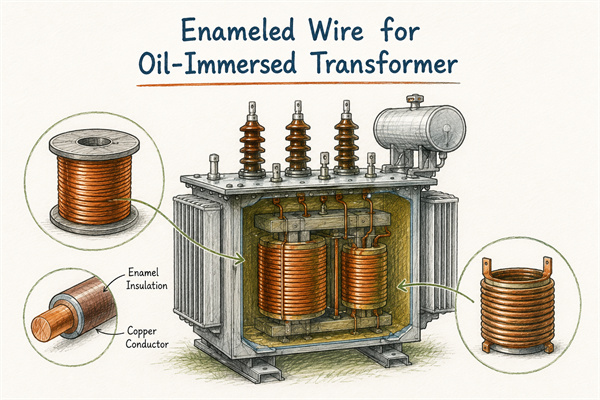
Oil-immersed transformers use mineral oil (transformer oil) as the insulation and cooling medium. The windings (wound by enameled wire) are immersed in transformer oil, and the heat generated by the windings is taken away through the circulation of the oil.
Main cooling methods: ONAN (oil natural circulation + air natural cooling), ONAF (oil natural circulation + air forced cooling), OFAF (oil forced circulation + air forced cooling), ODAF (oil directed circulation + air forced cooling).
1.2 Oil-Immersed vs Dry-Type Transformers
| Characteristic | Oil-Immersed Transformer | Dry-Type Transformer |
|---|---|---|
| Insulation Medium | transformer oil | air/epoxy resin/SiR |
| Capacity Range | 50 kVA to 1,500 MVA | 5 kVA to 50 MVA |
| Rated Voltage | ≤ 1,200 kV | ≤ 36 kV |
| Fire Resistance | medium (oil is combustible) | high (no liquid) |
| Installation Location | outdoor / independent substation | indoor / inside building |
| Maintenance Cost | medium | low |
| Expected Life | 30 to 40 years | 20 to 25 years |
| Typical Application | power transmission / distribution | commercial building / industrial / metro |
Oil-immersed transformers are the first choice in high-capacity, ultra-high voltage, and high-reliability applications — enameled wire as winding material must meet stringent engineering requirements.
1.3 Market Position of Oil-Immersed Transformers
The global oil-immersed transformer market in 2024 is approximately USD 28 billion, and is expected to reach USD 40 billion by 2030, with a CAGR of 5.0 percent.
Main market regions: North America (30 percent), Europe (20 percent), China (25 percent), India (10 percent), others (15 percent).
Main application fields: power companies (60 percent), industrial (20 percent), commercial buildings (10 percent), rail transit (5 percent), new energy (5 percent).
II. Technical Requirements of Enameled Wire
2.1 Oil
Resistance
The primary requirement of enameled wire for oil-immersed transformers is oil resistance. The enamel must be immersed in transformer oil for a long time (65°C long-term operating temperature, hot spot temperature can reach 95 to 110°C) and remain intact, without swelling, without falling off.
Typical test methods: ASTM D971 (oil absorption rate of enamel in oil), ASTM D3455 (oil-enamel compatibility), IEC 60851-4 (enamel liquid resistance test).
Oil-resistant enamel types: polyesterimide (PEI), polyamide-imide (PAI), polyimide (PI), polyvinyl formal (PVF, less used now).
2.2 Heat
Resistance
The hot spot temperature of oil-immersed transformers is usually 95 to 110°C. Enameled wire must meet the heat resistance grades of Class F (155°C), Class H (180°C), or Class N (200°C).
Typical selection: distribution transformer uses Class F (155°C), power transformer uses Class H (180°C), ultra-high voltage and UHV transformers use Class N (200°C).
2.3 Insulation Strength
Transformer windings are subjected to multiple effects of power frequency voltage (50/60 Hz), impulse voltage (lightning wave, operating wave), and harmonic voltage during operation. Enameled wire must meet strict insulation requirements.
Typical breakdown voltage requirements (1.0 mm diameter round wire):
Distribution transformer (≤ 35 kV): Grade 2 (≥ 4,200 V).
Power transformer (110 to 220 kV): Grade 3 (≥ 6,000 V).
Ultra-high voltage transformer (≥ 500 kV): Grade 3 + special thickened enamel (≥ 8,000 V).
2.4 Mechanical Properties
Transformer windings are subjected to various mechanical stresses during winding, assembly, and operation. Enameled wire must have sufficient flexibility, tensile strength, and wear resistance.
Key tests: elongation ≥ 30 percent (1.0 mm diameter round wire), scratch resistance (≥ 5.0 N load), chemical resistance (oil, acid, alkali), low temperature winding (no cracking at -40°C).
2.5 Dual Requirements of Oil
Resistance and Heat Resistance
Enameled wire for oil-immersed transformers faces dual challenges of oil resistance and heat resistance. The presence of oil may accelerate enamel aging — this is a problem that dry-type transformers do not have.
Typical applications: distribution transformer (Class F + mineral oil, operating 30 years), power transformer (Class H + mineral oil, operating 40 years), special transformer (Class N + ester oil or silicone oil, operating 40+ years).
III. Conductor Selection
3.1 Copper Enameled Wire
Copper enameled wire is the most commonly used conductor material for oil-immersed transformers — especially in power transformers and high-end distribution transformers.
Advantages: high conductivity (101 percent IACS), good mechanical properties, strong processability, recyclable.
Disadvantages: high cost, heavy weight (density 8.96 g/cm³), strategic resource risk (copper mine geopolitical risk).
Typical applications: power transformers above 35 kV, all high-end special transformers, all offshore wind power transformers.
3.2 Aluminum Enameled Wire
Aluminum enameled wire has been widely used in distribution transformers — especially in the US, European, and Indian markets.
Advantages: low cost (about 1/3 of copper), light weight (density 2.70 g/cm³), abundant strategic resources.
Disadvantages: low conductivity (61 percent IACS), cross-section needs to be enlarged by 1.63 times, weak mechanical properties, complex connection process.
Typical applications: distribution transformers ≤ 35 kV (American box transformer, European oil transformer), wind/solar step-up transformers, special engineering transformers.
3.3 Copper Clad
Aluminum (CCA)
Copper Clad Aluminum (CCA) is a new material developed in the 21st century — it retains the surface conductivity of copper while reducing weight and cost.
Structure: aluminum core + copper skin (copper volume ratio 10 to 30 percent).
Performance: conductivity 65 to 85 percent IACS, density 3.3 to 4.5 g/cm³, price 20 to 40 percent lower than copper.
Applications: mid-range distribution transformers, mobile transformers, offshore wind power transformers.
3.4 Conductor Material Comparison
The following table summarizes the comparison of key parameters of 3 mainstream conductor materials for oil-immersed transformers:
| Conductor Material | Conductivity (% IACS) | Density (g/cm³) | Unit Price (USD/ton) | Typical Application |
|---|---|---|---|---|
| Copper (Cu) | 101 | 8.96 | 9,200 | power transformer, high-end distribution |
| Aluminum (Al) | 61 | 2.70 | 2,400 | distribution transformer |
| Copper Clad Aluminum (CCA) | 65 to 85 | 3.3 to 4.5 | 5,500 to 7,500 | mid-range distribution, mobile |
IV. Enamel Grade
4.1 Enamel Selection for Oil-Immersed Transformers
The enamel selection of enameled wire for oil-immersed transformers follows the following principles: heat resistance grade matches transformer insulation grade, enamel thickness matches voltage grade, enamel type is compatible with oil.
Typical combinations:
Distribution transformer (≤ 35 kV, Class F): polyesterimide (PEI) enamel, Grade 2.
Power transformer (110 to 220 kV, Class F or H): polyesterimide (PEI) or polyamide-imide (PAI) enamel, Grade 3.
Ultra-high voltage transformer (≥ 500 kV, Class H or N): polyamide-imide (PAI) or polyimide (PI) enamel, Grade 3 + special thickened.
4.2 Common Enamel Materials
Polyesterimide (PEI):
Heat resistance: Class F (155°C), Class H (180°C) some formulas.
Oil resistance: good.
Chemical resistance: good.
Cost: medium.
Application: mainstream choice for distribution transformer, power transformer.
Polyamide-imide (PAI):
Heat resistance: Class H (180°C), Class N (200°C).
Oil resistance: excellent.
Chemical resistance: excellent.
Cost: relatively high.
Application: power transformer, special transformer.
Polyimide (PI):
Heat resistance: Class N (200°C) and above, Class R (220°C) some formulas.
Oil resistance: excellent.
Chemical resistance: excellent.
Cost: high.
Application: ultra-high voltage, UHV, nuclear power station transformer.
4.3 Enamel Thickness Selection
The enamel thickness of oil-immersed transformers is usually one level higher than that of dry-type transformers — because the presence of oil may amplify enamel defects.
Typical selection:
≤ 35 kV: Grade 2 (1.0 mm diameter round wire ≥ 4,200 V).
110 to 220 kV: Grade 3 (≥ 6,000 V).
≥ 500 kV: Grade 3 + special thickened (≥ 8,000 V).
V. Standards and Specifications
5.1 IEC 60076 Series
IEC 60076 is the international core standard for oil-immersed transformers — specifying the design, manufacturing, testing, and operation requirements of transformers.
IEC 60076-1: General requirements.
IEC 60076-2: Temperature rise requirements.
IEC 60076-3: Insulation level, dielectric test.
IEC 60076-4: Lightning impulse and operating impulse test guide for power transformers and reactors.
IEC 60076-5: Ability to withstand short circuit.
5.2 Enameled Wire Related Standards
IEC 60317 series: enameled wire general standard.
IEC 60851 series: enameled wire test methods.
IEC 60317-0-1: enameled round copper wire general requirements.
IEC 60317-27: enameled flat copper wire 180°C polyesterimide.
IEC 60317-29: enameled flat copper wire 200°C polyamide-imide.
5.3 Other Main Standards
IEEE C57 (United States): oil-immersed transformer design and test.
GB 1094 (China): power transformer.
JIS C 4301 (Japan): oil-immersed transformer general standard.
CSA C88 (Canada): power transformer.
IS 2026 (India): power transformer.
5.4 Test Methods
Special tests required for enameled wire for oil-immersed transformers:
Oil resistance test: ASTM D3455 (enamel-oil compatibility test), ASTM D971 (oil absorption rate).
Heat shock: IEC 60851-6 (heat shock test).
Breakdown voltage: IEC 60851-5 (breakdown voltage test).
Chemical resistance: ASTM D543 (enamel chemical resistance test).
Scratch resistance: IEC 60851-3 (scratch resistance test).
VI. Winding Structure
6.1 Round Wire Winding
Round wire winding is the mainstream choice for distribution transformers — using enameled round wire with diameter 0.5 to 3.15 mm.
Advantages: simple winding process, low cost, suitable for automated production.
Disadvantages: low slot fill factor (60 to 75 percent), low space utilization.
Typical applications: distribution transformers ≤ 1,600 kVA, low voltage windings.
6.2 Flat Wire Winding
Flat wire winding is the mainstream choice for power transformers — using enameled flat wire with thickness 0.80 to 5.60 mm and width 2.00 to 16.0 mm.
Advantages: high slot fill factor (80 to 95 percent), good heat dissipation, high mechanical strength, high space utilization.
Disadvantages: complex winding process, high cost, need special equipment.
Typical applications: power transformers ≥ 1,600 kVA, high voltage windings, large capacity transformers.
6.3 Continuously Transposed
Conductor (CTC)
Continuously Transposed Conductor (CTC) is the core material of ultra-large capacity transformers — composed of multiple enameled flat wires (7 to 15 strands) in continuous transposition.
Advantages: significantly reduce eddy current loss (50 to 80 percent), reduce circulating current, high efficiency, high mechanical strength.
Disadvantages: extremely high cost, complex manufacturing process, need professional equipment.
Typical applications: power transformers ≥ 100 MVA, ultra-high voltage, UHV transformers, nuclear power transformers.
6.4 Winding Structure Comparison
The following table summarizes the comparison of key parameters of 3 winding structures:
| Winding Type | Conductor Cross-Section (mm²) | Slot Fill Factor | Eddy Current Loss | Applicable Capacity | Main Application |
|---|---|---|---|---|---|
| Round Wire | 0.20 to 7.85 | 60 to 75% | High | ≤ 1,600 kVA | distribution transformer |
| Flat Wire | 1.6 to 89.6 | 80 to 95% | Medium | 1,600 kVA to 100 MVA | power transformer |
| CTC | 30 to 200+ | 95%+ | Low (50 to 80% reduced) | ≥ 100 MVA | UHV, extra-high voltage |
VII. Common Problems and Faults
7.1 Enamel Swelling
Phenomenon: the enamel swells in transformer oil, thickness increases, mechanical properties decrease, breakdown voltage decreases.
Cause: enamel and transformer oil are chemically incompatible.
Prevention: select oil-resistant enamel (PEI, PAI, PI), use qualified transformer oil, conduct enamel-oil compatibility test.
7.2 Partial Discharge
Phenomenon: windings undergo partial discharge under high voltage — long-term partial discharge causes enamel corrosion and breakdown.
Cause: enamel defects, air bubbles, impurities, water in oil.
Prevention: improve enamel quality (Grade 3+), oil vacuum degassing treatment, avoid impurities mixing.
7.3 Short Circuit Deformation
Phenomenon: during transformer short circuit, windings are subjected to huge electromagnetic force impact, which may cause deformation, enamel damage, and winding collapse.
Cause: insufficient short circuit resistance, insufficient enamel mechanical strength.
Prevention: improve enamel scratch resistance, use CTC winding, increase transformer short circuit impedance design.
7.4 Oil-Enamel Interaction
Phenomenon: long-term contact between transformer oil and enamel may cause chemical reactions, producing acids, water, and gas.
Cause: some components in enamel (such as plasticizer, curing agent residues) are released into the oil.
Prevention: use low-release enamel, control enamel curing process, regularly detect oil quality.
7.5 Life Degradation
Phenomenon: after long-term operation of the transformer, the enamel performance gradually decreases — breakdown voltage decreases, elongation decreases, enamel becomes brittle.
Cause: thermal aging, electrical aging, chemical aging, mechanical fatigue.
Prevention: select Class N 200°C enamel, control operating temperature, regularly detect oil samples, transformer load management.
VIII. Conclusion
Oil-immersed transformers are the core of the power system — enameled wire as winding material directly determines transformer performance.
Core principles of selection: conductor selection (copper/aluminum/CCA) matches capacity grade, enamel grade (Class F/H/N) matches insulation grade, enamel thickness (Grade 0 to 3) matches voltage grade, winding structure (round wire/flat wire/CTC) matches capacity grade.
Standards system: IEC 60076 (transformer) + IEC 60317 (enameled wire) + IEC 60851 (test methods) + IEEE C57/GB 1094/JIS C 4301 (regional standards).
For transformer manufacturers: when selecting enameled wire suppliers, focus on their oil-resistant enamel capability, long-term thermal aging data, special test capability — these determine product reliability.
For enameled wire manufacturers: oil-immersed transformer is a high-profit, high-technical-barrier application field — investing in Class N enamel, CTC flat wire, special thickened enamel is worthwhile.
For end users: the 30 to 40 year life of oil-immersed transformers requires enameled wire to have the same durability — price is not the only consideration, long-term reliability is the core.
Future trends: Class N 200°C enamel, CTC continuously transposed conductor, copper clad aluminum (CCA), environmentally friendly ester oil (replacing mineral oil) — will drive continuous innovation in enameled wire technology for oil-immersed transformers.