

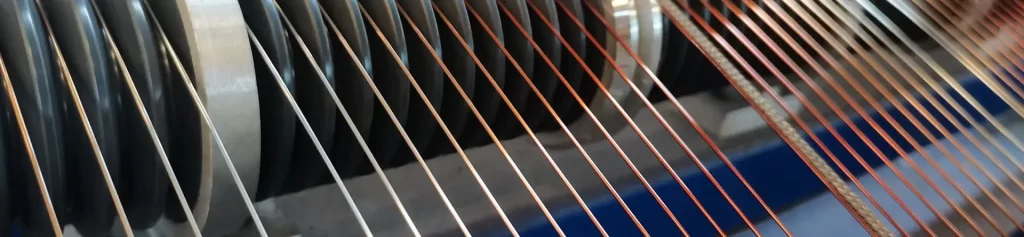
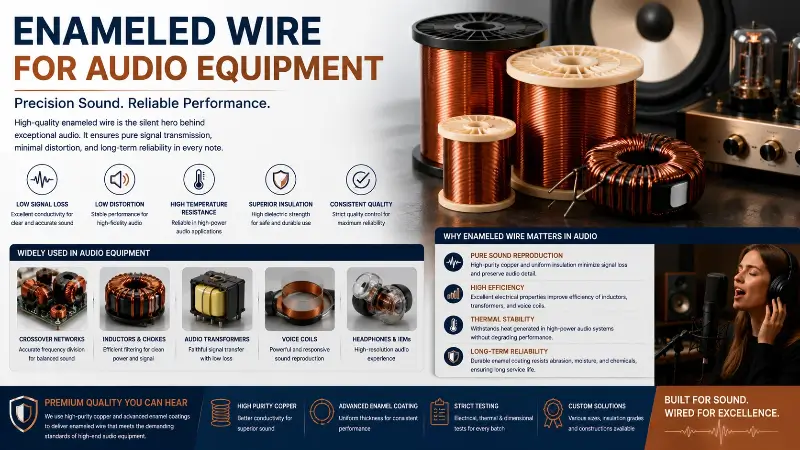
Enameled wire for audio equipment is a category of high-purity enameled winding wire specifically designed for audio signal transmission and electromagnetic induction applications. Unlike power frequency magnet wire and motor magnet wire, audio magnet wire must deliver extremely low signal distortion, extremely low dielectric loss, and stable electromagnetic performance in the 20 Hz to 20 kHz audio frequency band while meeting strict listening-quality requirements. These magnet wires are widely used in speaker voice coils, headphone drivers, microphones, audio transformers, inductors, mixing consoles, professional amplifiers, and instrument pickups.
Enameled wire for audio equipment is a highly specialized niche field. The core challenge lies in the fact that audio signals are analog continuous waveforms with extremely high requirements on magnet wire linearity, purity, and insulation performance — any conductor impurities, enamel film non-uniformity, or dielectric loss deviations will manifest as harmonic distortion (THD), intermodulation distortion (IMD), frequency response non-uniformity, and other audible artifacts. Consequently, the material selection, manufacturing process, and testing standards of audio magnet wire have formed an independent engineering system.
From a physics perspective, audio magnet wire faces three major engineering challenges. First, the skin effect at 20 kHz still yields a skin depth of 0.66 mm, so single-strand enameled round wire (Φ0.10–0.50 mm) can be used normally in most audio applications, but Litz wire (multi-strand) further reduces AC losses in high-end applications. Second, conductor purity directly affects signal transmission quality, with 6N copper (99.9999%) and pure silver (5N–6N) used in flagship speakers. Third, the dielectric performance of enamel film affects high frequency signal attenuation, with polyurethane (UEW), polyesterimide (EIW), and polyimide (PI) offering different dielectric constants and loss tangents.
This guide systematically discusses the fundamental concepts, key physical parameters, mainstream product types, typical application scenarios, selection methods, and quality control of enameled wire for audio equipment from five dimensions, aiming to provide a complete engineering reference for audio engineers, headphone driver designers, tube amplifier DIY enthusiasts, audio transformer designers, and electrical procurement engineers.
Fundamental Concepts and Classification of Audio Magnet Wire
Definition and Performance Requirements
Audio magnet wire refers to specialty enameled winding wire used for audio signal transmission, electromagnetic induction, and mechanical vibration generation in audio equipment. Compared with general motor and transformer magnet wire, audio magnet wire has special requirements in the following five dimensions:
- Conductor purity: standard copper ≥ 99.95% (C11000), high fidelity ≥ 99.9999% (6N copper)
- Enamel dielectric performance: low dielectric constant (εᵣ < 4), low loss tangent (tan δ < 0.01 @ 1 kHz)
- Enamel uniformity: thickness tolerance ±10%, to avoid inter-turn capacitance variation causing frequency response non-uniformity
- DC resistance tolerance: ±2% (standard), ±1% (Hi-Fi applications)
- Flexibility: withstand high-density winding (>200 turns/cm³) and prolonged vibration
Core Differences from Power Frequency and Motor Magnet Wire
The core differences between audio magnet wire and power frequency magnet wire (50/60 Hz) and motor magnet wire are reflected in the following aspects:
| Dimension | Audio Magnet Wire | Power Frequency Magnet Wire | Motor Magnet Wire |
|---|---|---|---|
| Working frequency | 20 Hz–20 kHz | 50/60 Hz | 50 Hz–10 kHz |
| Skin depth | 0.66–9.33 mm | 9.33 mm | 1.0–9.33 mm |
| Conductor purity | 99.95%–99.9999% | 99.5% | 99.95% |
| Enamel requirement | Low loss, uniform | General insulation | Mechanical strength |
| Key indicator | Dielectric loss, signal purity | DC resistance, insulation voltage | Temperature resistance, impact resistance |
| Distortion requirement | Extremely low (THD < 0.01%) | N/A | N/A |
| Unit price | 5–50× | 1× | 1–3× |
Application Classification
By audio equipment type, audio magnet wire can be classified into the following categories:
- Speaker voice coil wire: Φ0.04–0.30 mm, for dynamic loudspeakers
- Headphone driver wire: Φ0.02–0.05 mm, for dynamic / balanced armature / planar magnetic drivers
- Microphone inductor wire: Φ0.02–0.08 mm, for condenser microphone transformers
- Audio transformer wire: Φ0.05–0.40 mm, for input / output / inter-stage coupling
- Mixing console inductor wire: Φ0.05–0.20 mm, for signal processing circuits
- SMPS EMI filter wire: Φ0.10–0.50 mm, for professional amplifiers
- Instrument pickup wire: Φ0.05–0.10 mm, for guitars and bass
Key Physical Parameters of Audio Magnet Wire
Conductor Materials and Purity
The conductor material of audio magnet wire directly affects signal transmission quality. Mainstream conductor materials include:
Pure Copper (OFC, C10100, C10200)
- OFC (Oxygen-Free Copper): oxygen content ≤ 10 ppm
- C10100: oxygen-free copper, purity ≥ 99.99%
- C10200: contains small amount of deoxidizer, purity ≥ 99.95%
- Application: standard Hi-Fi speakers, audio transformers, microphones
High-Purity Copper (6N, 7N)
- 6N copper: purity ≥ 99.9999% (six nines)
- 7N copper: purity ≥ 99.99999% (seven nines)
- Application: flagship Hi-Fi speakers, ultra-high-end audio transformers
- Price: 10–100× standard copper
Pure Silver (5N, 6N)
- 5N silver: purity ≥ 99.999%
- 6N silver: purity ≥ 99.9999%
- Application: flagship speaker voice coils, high-end condenser microphones
- Price: 50–200× standard copper
Copper Clad Aluminum (CCA)
- Copper layer proportion 10%–15%
- Cost 30%–50% of pure copper
- Application: consumer headphones, entry-level speakers
- Drawback: high-frequency signal transmission slightly inferior to pure copper
Silver-Copper Alloy (AgCu)
- Silver content 0.1%–5%
- Improves high frequency signal transmission
- Application: high-end audio transformers, high-end microphones
Enamel Insulation and Dielectric Performance
The enamel film of audio magnet wire must not only meet insulation requirements but also provide low dielectric loss and stable electrical characteristics. Mainstream enamel types:
Polyurethane (UEW)
- Dielectric constant (εᵣ): 3.5–4.0
- Loss tangent (tan δ @ 1 kHz): 0.015–0.025
- Breakdown voltage: Grade 1 ≥ 1.8 kV
- Thermal class: 130
- Advantages: solderability, low-temperature curing
- Application: consumer headphones, dynamic microphones
Polyester (PEW)
- Dielectric constant: 3.0–3.5
- Loss tangent: 0.010–0.015
- Breakdown voltage: Grade 2 ≥ 2.5 kV
- Thermal class: 155
- Application: audio transformers, power inductors
Polyesterimide (EIW)
- Dielectric constant: 3.2–3.6
- Loss tangent: 0.008–0.012
- Breakdown voltage: Grade 2 ≥ 3.0 kV
- Thermal class: 180
- Application: high-end audio transformers, professional audio
Polyamide-Imide (AIW)
- Dielectric constant: 3.5–4.0
- Loss tangent: 0.005–0.010
- Breakdown voltage: Grade 2 ≥ 3.5 kV
- Thermal class: 200
- Application: flagship audio transformers, high-end microphones
Polyimide (PI)
- Dielectric constant: 3.0–3.5
- Loss tangent: 0.003–0.008
- Breakdown voltage: Grade 3 ≥ 5.0 kV
- Thermal class: 220–240
- Application: military audio equipment, aerospace audio
Diameter and Geometric Precision
The diameter precision of audio magnet wire directly affects the consistency of electromagnetic parameters. Diameter ranges for different application scenarios:
| Application | Single-Strand Diameter | Enamel Thickness |
|---|---|---|
| Headphone drivers | Φ0.02–0.05 mm | Grade 0/1 (5–15 μm) |
| Microphone inductors | Φ0.02–0.08 mm | Grade 1 (10–25 μm) |
| Speaker voice coils | Φ0.04–0.30 mm | Grade 1 (10–25 μm) |
| Audio transformers | Φ0.05–0.40 mm | Grade 1/2 (10–40 μm) |
| Mixing console inductors | Φ0.05–0.20 mm | Grade 1 (10–25 μm) |
| EMI filters | Φ0.10–0.50 mm | Grade 2 (25–40 μm) |
Tolerance requirements:
- Diameter tolerance: ±2% (standard), ±1% (Hi-Fi)
- Roundness: ≥ 0.95 (maximum diameter / minimum diameter)
- Enamel thickness uniformity: ±10%
Resistance and Inductance Characteristics
The resistance and inductance characteristics of audio magnet wire are core parameters for audio signal transmission:
DC Resistance (DCR)
- Resistance at 20°C: Φ0.05 mm copper wire approximately 8.7 Ω/m
- Temperature coefficient: 0.00393 /°C (copper)
- Tolerance: ±2% standard, ±1% Hi-Fi
AC Resistance (ACR)
- At 20 kHz, Φ0.10 mm copper wire ACR/DCR ≈ 1.0
- At 20 kHz, Φ0.30 mm copper wire ACR/DCR ≈ 1.05
- Litz wire at 20 kHz ACR/DCR ≈ 1.0 (close to ideal)
Inductance and Quality Factor (Q)
- Single-layer coil Q value: 50–150
- Honeycomb coil Q value: 150–300
- Ferrite core coil Q value: 200–500
- Frequency response: 20 Hz–20 kHz ripple < ±0.5 dB
Mainstream Audio Magnet Wire Product Types
Single-Strand Enameled Round Wire
Single-strand enameled round wire is the most fundamental form of audio magnet wire. In the 20 Hz to 20 kHz audio frequency band, the skin depth is 0.66 to 9.33 mm, far greater than the single-strand diameter, so single-strand round wire can still be used normally in audio applications.
Main Application Scenarios:
- Audio transformer primary / secondary windings
- Crossover network inductors
- Mixing console signal processing inductors
- Tube amplifier output transformers
- Microphone coupling transformers
Technical Features:
- Diameter range: Φ0.05–0.50 mm
- Enamel: UEW, PEW, EIW, PI
- Conductor: pure copper, OFC, 6N copper
- Packaging: 30–150 kg Poly-wood spool (per ECCAW industry standard)
Litz Wire (Multi-Strand)
Litz wire is made by twisting multiple independently insulated fine enameled wires at precise pitch, which minimizes skin effect losses in audio applications. At 20 kHz, the ACF of standard Litz wire (7–60 strands) is close to 1.0.
Main Application Scenarios:
- High-end audio transformers (Hi-Fi flagship)
- Condenser microphone transformers (electret, XLR interfaces)
- Balanced armature headphone drivers
- High-end mixing console signal processing
- Flagship speaker voice coils
Technical Features:
- Single-strand diameter: Φ0.02–0.10 mm
- Strand count: 7–660 strands (audio applications typically 7–60 strands)
- Pitch: ≤ 8 × single-strand diameter
- Braid angle: 30°–60°
- Insulation: UEW, PEW, EIW single-strand insulation
Rectangular (Flat) Enameled Wire
Rectangular (flat) enameled wire has a rectangular cross-section with higher slot fill and lower DC resistance. In audio applications, flat wire is mainly used for compact transformers and inductors.
Main Application Scenarios:
- High-power SMPS transformers (professional amplifiers)
- Compact inductors (speaker crossover)
- High-power audio transformers
Technical Features:
- Thickness: 0.05–0.30 mm
- Width: 0.50–5.00 mm
- Enamel: PEW, EIW, AIW
- Slot fill: >80% (far higher than round wire 50%–60%)
Braided Wire (Copper Braid)
Copper braid is made by weaving multiple fine copper wires, mainly used for grounding, shielding, and low-impedance connection in audio equipment.
Main Application Scenarios:
- Equipment grounding (chassis, signal ground)
- Shielding layer (microphone cable, microphone line)
- Speaker crossover connection
Technical Features:
- Single-strand diameter: Φ0.05–0.20 mm
- Braid strand count: 16–256
- Cross-section area: 0.5–50 mm²
- Working temperature: -40°C to +200°C
Self-Bonding Enameled Wire
Self-bonding enameled wire adds a thermal-melt or solvent-activated bonding layer outside the conventional enamel film, allowing the coil to self-cure after winding through heating or solvent treatment. It is widely used for bobbin-less winding of speaker voice coils and headphone drivers.
Main Application Scenarios:
- Speaker voice coils (bobbin-less)
- Headphone drivers (micro-coils)
- Micro-inductors
- Hearing aid coils
Technical Features:
- Base enamel: UEW, PEW, EIW
- Self-bonding layer: polyamide hot-melt adhesive (180°C activation) or solvent type
- Activation temperature: 150–180°C
- Bond strength: ≥ 5 N/cm
Speaker Voice Coil and Headphone Driver Applications
Speaker Voice Coil
The speaker voice coil is one of the most important application scenarios of audio magnet wire. The voice coil sits in the magnetic field of the speaker’s magnetic circuit, carrying audio current to produce reciprocating motion that drives the diaphragm to produce sound.
Core Requirements of Voice Coil Wire:
- Weight minimization: voice coil weight directly affects speaker transient response
- High conductivity: low resistance reduces power loss
- High temperature resistance: voice coil working temperature up to 150–200°C
- Vibration resistance: withstand long-term high-amplitude vibration
- Dimensional precision: voice coil gap tolerance ±0.05 mm
Voice Coil Wire Selection Parameters:
| Speaker Type | Voice Coil Diameter | Magnet Wire Diameter | Conductor Material |
|---|---|---|---|
| Tweeter | Φ25–50 mm | Φ0.04–0.10 mm | Pure copper, 6N copper |
| Midrange | Φ25–100 mm | Φ0.10–0.20 mm | Pure copper, aluminum foil |
| Woofer | Φ50–150 mm | Φ0.20–0.50 mm | Pure copper, aluminum foil |
| Flagship woofer | Φ100–200 mm | Φ0.30–0.80 mm | Pure copper, pure silver, aluminum foil |
Voice Coil Design Engineering Experience:
- Voice coil weight should be controlled within 30% of diaphragm weight
- Voice coil fill factor > 80%
- Choose Grade 1 enamel thickness (minimum enamel weight)
- Prefer self-bonding enameled wire (bobbin-less structure)
Headphone Drivers and Micro Speakers
Headphone drivers and micro speakers are a fast-growing field for audio magnet wire. The core requirements for magnet wire parameters are extremely fine diameters and high consistency.
Dynamic Headphone Drivers
- Voice coil diameter: Φ8–20 mm
- Magnet wire diameter: Φ0.02–0.05 mm
- Conductor: pure copper, CCA, 6N copper
- Enamel: UEW (self-bonding type)
- Number of turns: 50–300 turns
Balanced Armature Headphone Drivers
- Armature size: Φ2–5 mm
- Magnet wire diameter: Φ0.025–0.04 mm
- Conductor: pure copper, Litz wire (7 strands)
- Enamel: UEW, PEW
- Number of turns: 100–500 turns
Planar Magnetic Headphones
- Diaphragm conductor: Φ0.02–0.05 mm enameled wire mesh
- Conductor: 6N copper, pure silver
- Enamel: UEW (thin enamel film)
- Mesh density: 50–200 wires/cm²
True Wireless Stereo (TWS) Micro Speakers
- Voice coil diameter: Φ6–10 mm
- Magnet wire diameter: Φ0.025–0.04 mm
- Conductor: pure copper, CCA
- Enamel: UEW (self-bonding type)
- Trend: developing toward CCA and ultra-fine enameled wire
Microphone Inductors and Transformers
Microphones are another important application area of audio magnet wire. Condenser microphones require high-voltage bias transformers, and dynamic microphones require voice coil windings.
Dynamic Microphone Voice Coils
- Voice coil diameter: Φ10–25 mm
- Magnet wire diameter: Φ0.02–0.05 mm
- Conductor: pure copper, 6N copper
- Enamel: UEW, PEW
- Number of turns: 30–150 turns
Condenser Microphone Transformers
- Transformer size: Φ10–30 mm
- Magnet wire diameter: Φ0.03–0.08 mm
- Conductor: pure copper, Litz wire (7–25 strands)
- Enamel: PEW, EIW
- Turn ratio: 1:5 to 1:30
- Litz advantage: flat high-frequency response (>20 kHz)
Audio Transformer and Inductor Applications
Audio Transformer
Audio transformers are a traditional application area of audio magnet wire, mainly used for impedance matching, signal coupling, and balanced / unbalanced conversion. In Hi-Fi audio and professional audio equipment, audio transformers have a decisive impact on sound quality.
Core Requirements of Audio Transformer Wire:
- Low signal distortion: THD < 0.01%
- Wide frequency response: 20 Hz–20 kHz ±0.5 dB
- Low dielectric loss: reduce high-frequency signal attenuation
- High insulation reliability: avoid audio signal crosstalk
- Long-term stability: magnet wire parameters do not age
Transformer Types and Applications:
| Transformer Type | Application Scenario | Magnet Wire Diameter | Conductor Material |
|---|---|---|---|
| Input transformer | Microphone preamplifier | Φ0.05–0.10 mm | Pure copper, Litz |
| Inter-stage coupling transformer | Vacuum tube / transistor coupling | Φ0.05–0.15 mm | Pure copper, 6N copper |
| Output transformer | Vacuum tube amplifier (OTL / single-ended) | Φ0.10–0.30 mm | Pure copper, pure silver |
| Balanced transformer | XLR interface, differential signal | Φ0.05–0.10 mm | Pure copper, Litz |
| Microphone transformer | Condenser microphone bias | Φ0.03–0.08 mm | Pure copper, Litz |
Tube Amplifier Output Transformer
Tube amplifiers are the traditional high-end application of audio magnet wire. Tube output transformers need to handle the 20 Hz to 20 kHz wideband audio signal, and have extremely stringent requirements on magnet wire performance.
Single-Ended Class A Output Transformer:
- Power: 2–50 W
- Operating point: static current DC bias
- Magnet wire diameter: Φ0.10–0.30 mm
- Conductor: pure copper, 6N copper
- Enamel: PEW, EIW
- Core: silicon steel sheet or permalloy
Push-Pull Class B Output Transformer:
- Power: 10–200 W
- Operating point: zero current switching
- Magnet wire diameter: Φ0.15–0.40 mm
- Conductor: pure copper, pure silver
- Enamel: PEW, EIW
- Special requirements: low leakage inductance, low distributed capacitance
Audio Inductors and Filters
Audio inductors are used in crossovers, impedance compensation, notch filters, and power filtering.
Speaker Crossover Inductors
- Inductance value: 0.1–10 mH
- Magnet wire diameter: Φ0.20–0.50 mm
- Conductor: pure copper, aluminum foil
- Enamel: PEW, EIW
- Core: ferrite, air core
- Error: ±3%
Power Supply EMI Filters
- Frequency range: 100 kHz–30 MHz
- Magnet wire diameter: Φ0.10–0.30 mm
- Litz wire (high frequency section)
- Enamel: PEW, EIW, AIW
- Core: ferrite, nanocrystalline
Microphone Coupling Inductors
- Inductance value: 1–100 mH
- Magnet wire diameter: Φ0.05–0.15 mm
- Litz wire (reduce dielectric loss)
- Enamel: UEW, PEW
- Core: permalloy, ferrite
Mixing Console, Professional Amplifier and Instrument Applications
Mixing Consoles and Mixers
Mixing consoles and mixers internally use large amounts of audio magnet wire for signal processing, filtering, and coupling circuits.
Mixing Console Magnet Wire Applications:
- Channel level control inductors
- EQ filter inductors
- Auxiliary output transformers
- Bus coupling transformers
- Fader potentiometer compensation inductors
Magnet Wire Parameter Requirements:
- Signal frequency response: 20 Hz–20 kHz ±0.5 dB
- Crosstalk attenuation: >80 dB @ 1 kHz
- Distortion: THD < 0.005%
- Long-term stability: magnet wire parameters do not vary with temperature
Magnet Wire Selection:
- Diameter: Φ0.05–0.20 mm
- Conductor: pure copper, 6N copper
- Enamel: PEW, EIW
- Core: ferrite, permalloy
Professional Amplifiers and Switching Power Supplies
Professional amplifiers (such as performance-grade PA amplifiers) require high-efficiency switching power supplies. The high frequency transformers and EMI filters inside also use audio magnet wire.
Professional Amplifier Magnet Wire Applications:
- SMPS high frequency transformers (50–500 kHz)
- EMI filters (common mode inductors, differential mode inductors)
- PFC inductors
- Buffer inductors
Magnet Wire Selection:
- Diameter: Φ0.10–0.50 mm
- Conductor: pure copper
- Enamel: PEW, EIW, AIW
- Litz wire (>100 kHz applications)
Instrument Pickups
Pickups for electric guitars, electric bass, and other instruments use permanent magnets and enameled wire windings to convert string vibration into electrical signals.
Pickup Magnet Wire Parameters:
- Diameter: Φ0.05–0.10 mm (42 AWG to 38 AWG)
- Conductor: pure copper (42 AWG enameled wire) / 6N copper (high-end)
- Enamel: PEW, UEW
- Number of turns: 5000–10000 turns (single coil)
- DC resistance: 5–10 kΩ (single coil), 10–15 kΩ (humbucker)
Pickup Types:
- Single coil: bright, clear
- Humbucker: noise-cancelling, thick
- P-90: single-coil family
- Active pickup: built-in preamplifier
Digital Audio and Interface Equipment
With the development of digital audio technology, digital audio interfaces (USB, HDMI, optical fiber, etc.) are increasingly popular, but analog audio equipment still widely uses audio magnet wire.
Analog-to-Digital Conversion (ADC):
- Input transformer: Φ0.05–0.10 mm Litz wire
- Anti-aliasing filter inductor: Φ0.05–0.20 mm
- Sampling clock inductor: Φ0.10–0.30 mm
Digital Signal Processing (DSP):
- Power filter inductor: Φ0.10–0.30 mm
- Signal coupling inductor: Φ0.05–0.15 mm
Audio Magnet Wire Selection Methods and Quality Control
Selection Decision Matrix
The selection of audio magnet wire requires comprehensive consideration of the following factors:
| Selection Factor | Key Question | Impact |
|---|---|---|
| Application scenario | Speaker / headphone / microphone / transformer | Determines diameter range |
| Performance requirements | Frequency response, distortion, efficiency | Determines conductor purity |
| Working temperature | Room temperature / high temperature / extreme environment | Determines enamel type |
| Cost budget | Consumer / mid-range / Hi-Fi | Determines material grade |
| Packaging constraints | Coil size / weight | Determines diameter precision |
| Process requirements | Manual / automatic / bobbin-less | Determines self-bonding enameled wire |
Skin Depth and Single-Strand Diameter Selection
Skin depths in the audio frequency band (20 Hz to 20 kHz) are as follows:
| Frequency | Skin Depth (Copper) |
|---|---|
| 20 Hz | 9.33 mm |
| 100 Hz | 4.16 mm |
| 1 kHz | 2.09 mm |
| 10 kHz | 0.66 mm |
| 20 kHz | 0.47 mm |
Selection Points:
- 20 Hz–1 kHz: single-strand enameled round wire (Φ0.10–0.50 mm) sufficient
- 1–10 kHz: single-strand enameled round wire (Φ0.05–0.30 mm) adequate
- 10–20 kHz: single-strand enameled round wire (Φ0.05–0.20 mm) adequate
- Litz wire: >20 kHz marginal benefit significant, Hi-Fi still commonly used
Engineering experience: when diameter ≤ skin depth (0.47 mm at 20 kHz), skin effect losses can be controlled within 5%.
Conductor Purity Selection
Different audio equipment has different requirements for conductor purity:
| Equipment Type | Conductor Purity | Price Multiplier |
|---|---|---|
| Consumer headphones | 99.5%–99.95% | 1× |
| Standard Hi-Fi | 99.95% (C11000) | 2–3× |
| High-end Hi-Fi | 99.99% (C10100) | 5–10× |
| Flagship Hi-Fi | 99.9999% (6N) | 20–100× |
| Recording studio professional | 99.9999%–99.99999% | 50–200× |
Enamel Selection Principles
By working temperature and performance requirements:
| Working Temperature | Recommended Enamel | Dielectric Loss |
|---|---|---|
| ≤ 105°C | UEW (polyurethane) | Medium |
| 105–130°C | PEW (polyester) | Low |
| 130–155°C | PEW / EIW | Low |
| 155–180°C | EIW (polyesterimide) | Very low |
| 180–200°C | AIW (polyamide-imide) | Extremely low |
| 200–240°C | PI (polyimide) | Extremely low |
Low dielectric loss applications (flagship Hi-Fi, condenser microphone transformers) prioritize EIW, AIW, PI.
Standards System and Certification
International standards system for audio magnet wire:
- IEC 60317-0-1: General requirements for enameled round copper wire
- IEC 60317-11: Class 130 polyurethane enameled round copper wire
- IEC 60317-0-3: General requirements for enameled round aluminum wire
- IEC 60268: Sound system equipment standard (including speakers, microphones)
- AES 2-1984: AES audio standard
- NEMA MW 1000: North American enameled wire standard (including MW 35-C 150°C enamel)
- GB/T 6109: China enameled wire standard
- JIS C 3202: Japan enameled wire standard
Related Certifications:
- UL 1446: Audio coil insulation system certification
- IEC 60950 / IEC 62368: Audio equipment safety standard
- RoHS / REACH: Environmental compliance
Quality Inspection and Reliability Verification
Key quality indicators for audio magnet wire:
| Indicator | Requirement | Test Method |
|---|---|---|
| Diameter tolerance | ±2% (standard), ±1% (Hi-Fi) | Laser diameter gauge |
| Enamel thickness | Grade 1/2/3 | Microscope thickness gauge |
| DC resistance | ±2% (20°C) | Resistance bridge |
| Breakdown voltage | Grade 1 ≥ 1.8 kV | High voltage tester |
| Enamel continuity | ≤ 5 pinholes / 30 m | Pinhole tester |
| Dielectric loss | tan δ < 0.01 @ 1 kHz | LCR meter |
| Insulation resistance | ≥ 100 MΩ·km | High resistance meter |
| Conductor purity | ≥ 99.95% (standard) | ICP spectroscopy |
| Aging resistance | 130°C × 1000 h | Oven aging |
Listening Tests (Hi-Fi Specific):
- Frequency response: 20 Hz–20 kHz ±0.5 dB
- Total harmonic distortion (THD): < 0.01% @ 1 kHz
- Intermodulation distortion (IMD): < 0.005%
- Signal-to-noise ratio: > 100 dB
- Subjective listening: dynamic range, transient response, spatial sense
Summary: Audio Equipment Enameled Wire Selection Engineering Guide
The application selection of enameled wire for audio equipment first depends on the application scenario. Speaker voice coils (Φ0.04–0.30 mm) require low weight, high conductivity, and precise dimensions. Headphone drivers and micro speakers (Φ0.02–0.05 mm) require extremely fine diameters and high consistency. Microphone inductors and transformers (Φ0.02–0.08 mm) require low dielectric loss and high insulation reliability. Audio transformers (Φ0.05–0.40 mm) require wideband frequency response and low signal distortion. Mixing consoles and professional amplifiers require stable and reliable inductors and filters. In selection, conductor purity should match the application grade (consumer 99.95%, Hi-Fi 99.99%–99.9999%, flagship 99.9999%–99.99999%). Enamel selection should satisfy working temperature (Class 130 UEW, Class 155 PEW, Class 180 EIW, Class 200 AIW, Class 220–240 PI). Single-strand diameter should be ≤ 20 kHz skin depth (≤ 0.47 mm). Litz wire offers significant advantages in frequency bands above 20 kHz and high-fidelity flagship applications.
The core difference between audio magnet wire and general motor magnet wire and power frequency magnet wire lies in the ultimate pursuit of signal purity and listening quality. General motor magnet wire focuses on cost, efficiency, and mechanical strength, while audio magnet wire focuses on signal distortion, dielectric loss, frequency response, and purity consistency. This engineering trade-off determines that audio magnet wire must be produced by professional magnet wire manufacturers, with process barriers in ultra-fine diameter control (Φ0.02 mm grade), high-purity copper smelting (OFC / 6N copper), precision enamel coating (10–25 μm uniform enamel film), and low defect rate (pinhole count ≤ 3/30 m). This is also the fundamental reason why audio magnet wire prices are typically 5–50 times that of general motor magnet wire, with flagship 6N copper or pure silver magnet wire reaching 50–200 times standard magnet wire prices.
The core quality indicators of audio magnet wire are conductor purity, enamel dielectric performance, and signal distortion. Conductor purity directly determines signal transmission quality, with 6N copper reducing harmonic distortion by 30%–50% compared to standard copper. Enamel dielectric performance affects high-frequency signal attenuation, with tan δ < 0.01 being the Hi-Fi music threshold. Signal distortion is reflected by comprehensive indicators such as frequency response, THD, and IMD. The IEC 60317 series standards provide basic specifications for audio magnet wire, while IEC 60268 and AES standards impose additional requirements for audio equipment characteristics. In specific applications, comprehensive selection must combine the three dimensions of application scenario, performance grade, and cost budget, prioritizing suppliers with IEC 60317 + NEMA MW 1000 + audio certification (such as AES equipment certification) triple certification systems. Conductor purity test reports, enamel dielectric constant and loss tangent measured data, and listening test reports (frequency response + THD + IMD) are the three core dimensions for evaluating the technical capability of audio magnet wire suppliers.