

In the field of electrical wire, copper wire has the rule for a long time. However, in recent years, aluminum conductors(enameled wire) through its basic cost advantages and light weight, it continues to appear in more application fields. To be honest, many of us have a prejudice against aluminum wire that we consider it inferior to copper wire. Yet this attitude is one-sided. For certain application fields, aluminum wire can be not only practical but also be used to save many cost for enterprises. Today, I am going to make a brief introduction about enameled round aluminum wire-what it is used, what application fields it is suitable for and what we should pay attention to when selecting.
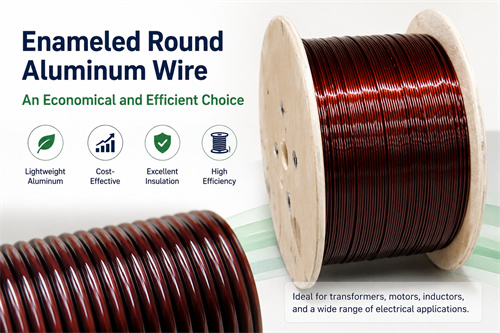
First, Let’s Understand: What Exactly Is Enameled Round Aluminum Wire?
Enameled round aluminum wire. In English just a round wiring with aluminum as a core conductor and coating insulating outside. Its structure is the same with enameled copper wire, they are constructed of:
Conductor layer round aluminum wire is stretched out from an aluminum rod;
Insulation layer–high-temperature resistance insulation coating (used for example polyester, polyurethane, polyester imide enamel coating).
Aluminiums conductivity is approximately 61% of copper. This implies that an aluminum wire of the same resistance would have a cross section that is about 64% larger than the cross section of a copper wire of the same resistance. Aluminum‘s density is only 30% of copper‘s so even though it has a larger cross-sectional area it would still be significantly lighter;
One misconception is that aluminum wire is always worse than copper.
This is a partially true statement. Both aluminum and copper wires have their pros and cons which are more useful in certain situations than the other. The best compromise is to select the best fit.
Aluminum Wire vs. Copper Wire: What Are the Core Differences?
Many people struggle with whether to choose aluminum or copper wire. Let me clarify:
Conductivity: The conductivity of copper is 39% higher than that of aluminum. Therefore, for the same size cross-sectional area, copper wire carries lower resistance and higher current transmission efficiency. On the other hand, adjusting the cross-sectional area of aluminum wire to match the resistance results in similar temperature rise for both.
Weight: Copper has a density of 8.9g/cm3 where aluminum‘s is 2.7g/cm3. Aluminum is approximately 69% less than that of copper. This is obviously more desirable where Light weight equipment is needed.
Cost: Aluminum pricing is one-third of copper. Aluminum wire can effectively control raw material costs during natural copper price volatility.
Welding Process: This is one of the problem with aluminum wire. Aluminum oxidizes rapidly so inert gas protection has to be supplied for welding, requiring more demanding equipment. But nowadays most manufacturers are providing pre-coat aluminum wire, which greatly improves the operation of welder.
Coefficient of Expansion: Coefficient of expansion of Aluminum wire is approximately 23% greater than copper. Aluminum wire of joints is more likely to loosen up during long term thermal cycling. This problem can be overcome if correct connection methods are employed.
Enameled Coating Type: How to Choose?
The enamel coating types of enameled aluminum wire are as diverse as those of enameled copper wire. The choice depends mainly on your operating temperature and process requirements:
| Enameled Coating Type | Code | Thermal Class | Features | Applicable Scenarios |
|---|---|---|---|---|
| Polyurethane | UEW | 130°C | Can be directly soldered, no need for paint scraping | Precision instruments, electronic components |
| Polyester | PEW | 155°C | Good heat resistance, high cost performance | General motors, transformers |
| Polyester Imide | EIW | 180-200°C | Heat resistant, chemical corrosion resistance | Industrial motors, compressors |
| Polyamide-Imide | AIW | 200°C+ | High temperature resistance, wear resistant | Automotive motors, aerospace equipment |
A selection suggestion: For ordinary household appliance motors, polyester (PEW) is sufficient, offering the best cost performance. If used in high-temperature environments or in contact with chemicals such as refrigerants and lubricants, it is recommended to choose polyester imide (EIW) or polyamide-imide (AIW).
Common Specifications: What Types of Aluminum Wire Can You Buy?
According to IEC standards and manufacturer practices, the mainstream specifications for enameled round aluminum wire are as follows:
Round wire diameter: 0.5mm – 7.0mm (standard range, finer wires are also available upon request)
Insulation class: E (120°C), B (130°C), F (155°C), H (180°C), C (200°C)
Enameled coating class: Grade 1 (standard insulation), Grade 2 (thickened insulation)
Special specifications can also be customized, such as:
- 200 grade polyester imide-coated amide-imide aluminum round wire (high temperature resistance above 200°C)
- Solderable aluminum wire (surface pre-coated with solder for easy tinning)
Typical Application Scenarios: Where Is Aluminum Wire Used?
The application of insulate enameled round aluminum wire is in fact very widely, and a few of the more typical ones are listed below:
Household Appliances electric fans, range hoods, washing machine motors, refrigerator compressors, etc. They usually have low power and some requirements for size and weight, so aluminum wire is the matured type.
Electric tools: electric drills, angle grinder, hair dryer, etc. Electric tools always work in the START-STOP mode, so also they require effective and durable motors. Aluminum wire has been used in these devices for several years.
Transformers and Inductors– Aluminum wire is used in the winding of transformers which is quite common. Many transformers are heavy and weight savings make a big difference in aluminum wire‘s weight and cost.
Components of New Energy Vehicles Main drive motors are generally made with copper wire while some neighboring motors and parts of the charging station can be made of Aluminum wire
Industrial General-Purpose Motors: Aluminum wire is a reasonable optimization solution for low power industrial motors (particularly for cost-sensitive applications).
Selection Checklist: Check These Points Before Ordering
- Is the operating temperature correct? Confirm the equipment’s operating environment temperature and select the corresponding thermal rating.
- Is the enameled coating type suitable for the process? Do you need direct welding? Do you have ultrasonic welding equipment?
- Are the dimensions appropriate? Do the diameter of the round wire and the thickness of the enamel coating meet the design requirements?
- Has the joint process been considered? The connection method for aluminum wire differs from that of copper wire.
- Has a cost calculation been done? Aluminum wire saves material, but may require an increased cross-sectional area; a comprehensive calculation is necessary for an accurate estimate.
- Are the certification requirements met? UL, RoHS, REACH, etc., depending on the requirements of the target market.
Aluminum Wire Connection Processing: Many People Fall Into This Trap
Aluminum wire quality will be closely related to the connection process.
On the surface of Al, aluminum oxide film(Al O) is formed readily. Its high resistance impacts the conductivity and tends togenerate heat. So, the connection of aluminum wire should giveattention to:
Method One: Mechanical Connection
Special aluminum terminals can be used; or cold pressing technology. It features highly reliable, which is the mainstream technology in industrial.
Method Two: Soldering
If soldering is necessary, you should:
Inert gas protection (N2, Ar) should be used.
Choose aluminum solder
Select the right aluminum solder is by far the most important part of cleaning the aluminum to prepare it for the wash coat; the important part of that process is applying the heat to them.
Choose a permissible range of soldering temperature. If possible, maintain the temperature within a certain range to prevent overheating.
Method Three: Using Pre-Tinned Aluminum Wire
Pre-tinned aluminum wire has now become available from many makers. This wire can be soldered straight away like a regular wire, with just normal soldering techniques, without the problem of having to use inert gas shielding. We have this solderable aluminum wire available at our factory.
A piece of advice, from someone who has experience, I would never use the connection techniques on aluminum wire as I use on copper wire. Aluminum has it‘s own processing techniques, use the correct techniques to save money, use the wrong techniques to cause problems.