

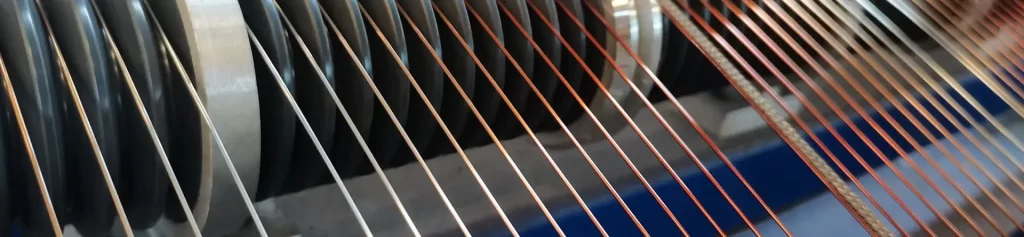
Enameled wire is one of the core materials for electrical equipment such as motors, transformers, and inductors. In conductor material selection, enameled copper wire and enameled aluminum wire are the two main choices, each with unique technical characteristics and application scenarios. Enameled copper wire has long been the mainstream choice for electrical windings, occupying an important position with its excellent conductivity and mature processes. However, with increasing raw material cost pressures and lightweight requirements, enameled aluminum wire demonstrates unique advantages in many application scenarios.
Basic Material Properties Comparison
Physical Parameters
| Property | Copper | Aluminum |
|---|---|---|
| Density (g/cm³) | 8.9 | 2.7 |
| Resistivity (Ω·mm²/m) | 0.0175 | 0.0282 |
| Conductivity (IACS %) | 100 | 61 |
| Melting Point (°C) | 1085 | 660 |
| Thermal Conductivity (W/(m·K)) | 397 | 237 |
| Tensile Strength (MPa) | 220-300 | 80-150 |
From the basic data, copper has clear advantages in conductivity, strength, and melting point; while aluminum performs well in weight and cost.
Electrical Performance Comparison
Copper’s resistivity is approximately 0.62 times that of aluminum, with far superior conductivity. This means at the same cross-sectional area, copper wire’s resistance is much lower than aluminum wire. At the same conductivity, aluminum conductor’s cross-sectional area needs to increase to 1.6 times that of copper. Nevertheless, aluminum wire’s total weight is still only about one-third of copper’s. Skin depth is proportional to the square root of resistivity, so aluminum’s larger skin depth may become an advantage in extremely high-frequency applications. However, in power frequency and low-medium frequency applications, skin effect is not significant, and copper’s superior conductivity occupies an absolute advantage.
Technical Advantages of Enameled Copper Wire
Excellent Conductivity
Copper’s high conductivity is the most prominent advantage of enameled copper wire. In applications requiring low loss such as transformers, motors, and inductors, enameled copper wire is the preferred material. For high-power motors and high-efficiency motors, copper’s low resistance characteristics directly translate into lower copper loss and higher system efficiency. With increasingly stringent energy efficiency standards, motors at IE3 and above almost entirely use copper windings.
High Mechanical Strength
Copper’s tensile strength and elongation are both superior to aluminum, allowing enameled copper wire to withstand greater tension without damage during winding. Enameled copper wire performs well in high-speed automatic winding. Its moderate flexibility allows it to closely conform to slot shape while maintaining shape stability during winding.
Strong Corrosion Resistance
Copper’s chemical stability is better than aluminum. The copper oxide film that forms on copper in air is dense, protecting the interior metal from further oxidation. Enameled copper wire has better durability in humid and corrosive environments, more suitable for industrial harsh environment applications.
Reliable Connections
Copper’s connection technology is mature, with various methods such as welding, crimping, and terminal connections all achieving reliable electrical connections. Copper’s low resistivity and good conductivity result in low contact resistance at connections and stable long-term operation.
Limitations of Enameled Copper Wire
Higher Cost
Copper’s raw material price is much higher than aluminum. Under market conditions with rising copper prices, copper winding cost pressure increases significantly. For price-sensitive consumer electronics and household appliances, copper winding’s cost proportion may become a constraint on product market competitiveness.
Greater Weight
Copper’s density is 3.3 times that of aluminum. At the same conductivity, copper winding’s weight is much higher than aluminum winding. In weight-sensitive applications such as new energy vehicles and aerospace, copper winding’s weight disadvantage becomes prominent.
Higher Processing Energy Consumption
Copper’s higher melting point results in relatively higher energy consumption during processing. This becomes a non-negligible cost factor in mass production.
Technical Advantages of Enameled Aluminum Wire
Significant Cost Advantage
Aluminum’s raw material price is typically only a fraction of copper’s. In terms of resource reserves and supply stability, aluminum also has clear advantages. For price-sensitive mass-market products such as household appliances, power tools, and small motors, enameled aluminum wire can effectively reduce costs. At the same conductivity, aluminum wire’s material cost is approximately 20%-30% of copper wire’s, with significant economic advantages.
Light Weight
Aluminum’s density is only 30% of copper’s, one of the most prominent advantages of enameled aluminum wire. In weight-sensitive fields such as electric vehicles, wind power generation, and aerospace, enameled aluminum wire’s lightweight advantage can bring significant system benefits. For large transformers and motors, aluminum windings can substantially reduce equipment weight, facilitating transportation and installation.
Good Heat Dissipation
Although aluminum’s thermal conductivity is lower than copper’s, it still belongs to a good level. Higher specific surface area and lighter weight facilitate heat dissipation. Aluminum windings may have lower temperature rise than copper windings at the same power because aluminum wire at the same conductivity has a larger cross-sectional area and thus larger surface area.
Abundant Resources
Aluminum is extremely abundant in the earth’s crust, with mature mining and processing technology. This provides a guarantee for aluminum wire’s long-term supply. Under the background of increasingly tight copper resources, aluminum’s supply stability advantage becomes more prominent.
Limitations of Enameled Aluminum Wire
Lower Conductivity
Aluminum’s resistivity is 1.6 times that of copper. At the same cross-sectional area, aluminum wire’s resistance is significantly higher than copper. This means enameled aluminum wire needs a larger cross-sectional area to achieve the same conductivity in applications, indirectly increasing the winding’s volume.
Low Mechanical Strength
Aluminum’s tensile strength is approximately one-third of copper’s. Enameled aluminum wire is prone to tensile deformation or fracture during winding. To compensate for insufficient mechanical strength, winding process parameters need to be adjusted appropriately, such as reducing winding tension and using dedicated winding equipment.
Oxidation Issues
Aluminum rapidly forms aluminum oxide film in air. This film has high resistance, affecting electrical connection quality. Special surface treatment is required before connection processing, such as mechanical scraping, chemical cleaning, or using special flux. Connection process requirements are high, and long-term reliability needs strict control.
Thermal Expansion Differences
Aluminum’s thermal expansion coefficient is approximately 1.3 times that of copper. In application environments with large temperature variations, the stress issues brought by thermal expansion need to be considered. Thermal expansion coefficient matching between windings and insulation materials requires special design, otherwise it may cause insulation aging or mechanical damage.
Welding Difficulties
Aluminum’s surface oxide film makes welding difficult. Special welding processes are required, such as ultrasonic welding, energy storage welding, or special aluminum flux. Traditional tin soldering processes are difficult to apply directly to aluminum wire, requiring dedicated aluminum soldering equipment and processes.
Performance Comparison Analysis
Loss Characteristics
| Property | Enameled Copper | Enameled Aluminum |
|---|---|---|
| DC Resistance | Low | High (1.6x) |
| Copper Loss | Low | High |
| Efficiency | High | Lower |
| Weight at Same Resistance | 1.0 | 0.5 |
| Volume at Same Resistance | 1.0 | 1.6 |
In low-frequency high-power applications, copper wire’s low loss advantage is significant. But in high-frequency, low-power applications, the difference between the two decreases.
Dimensions and Weight
Enameled aluminum wire has larger dimensions but lighter weight, with different effects on spatial layout and weight control.
Process Performance
Enameled copper wire has more mature technology and more complete equipment support in processing. Lower winding difficulty with copper, but higher welding difficulty with aluminum. Copper has simpler terminal connections while aluminum requires special treatment. Copper has lower repair difficulty while aluminum has higher.
Application Scenarios
Main Applications of Enameled Copper Wire
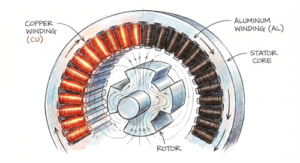
New energy vehicle drive motors, industrial robot servo motors, precision instrument motors, and other high-end motors have extremely high requirements for efficiency, reliability, and performance, almost entirely using enameled copper wire windings. Precision measurement transformers, medical equipment transformers, audio transformers, and other applications with high electrical performance requirements, enameled copper wire is the first choice. Power inductors, PFC inductors, transformers, and other high-power magnetic components typically use enameled copper wire to ensure low loss and good heat dissipation.
Main Applications of Enameled Aluminum Wire
Air conditioning compressors, refrigerator compressors, washing machine motors, range hood motors, and other mass-market household appliances generally use enameled aluminum wire to reduce costs. Handheld electric drills, electric wrenches, cutting machines, and other power tools’ series motors mostly use enameled aluminum wire. Distribution transformers, control transformers, and other medium-low voltage transformers are increasingly using aluminum windings under cost pressure. Some reactors and fluorescent lamp ballasts widely use enameled aluminum wire.
New Composite Materials
Copper-clad aluminum wire (CCA) combines copper’s conductivity and aluminum’s lightweight advantages, emerging in some special applications. This bimetallic material has copper on the outside and aluminum inside, achieving reliable inter-layer bonding through special processes. At the same conductivity, the weight is about 40%-50% lighter than pure copper.
Selection Decision Recommendations
When to Choose Enameled Copper Wire
| Choose Enameled Copper | Choose Enameled Aluminum |
|---|---|
| IE3 and above motors | Cost-sensitive products |
| High-performance applications | Weight-sensitive applications |
| High-frequency precision applications | Medium-low power applications |
| High long-term reliability | Resource supply considerations |
High-efficiency grade motors (IE3 and above). Large power, high performance applications. Weight-insensitive but efficiency-sensitive applications. High-frequency precision applications. Long-term reliable operation requirements. High connection and repair convenience requirements.
When to Choose Enameled Aluminum Wire
Cost-sensitive mass products. Weight-sensitive applications (electric vehicles, aerospace, etc.). Medium-low power applications. Not extremely demanding on efficiency. Able to handle special connection processes. Resource supply considerations.
Considering New Materials
Need both copper and aluminum advantages simultaneously. Special application scenarios. Innovation design requirements.
Development Trends
Enameled Copper Wire Technology Advancement
High-purity oxygen-free copper application improves enameled copper wire’s conductivity. Flat wire technology and Hair-pin winding development further improve copper wire’s application efficiency.
Enameled Aluminum Wire Technology Improvement
New aluminum alloy wire research is dedicated to improving mechanical strength and corrosion resistance. Automated aluminum winding production line application improves aluminum winding’s processing quality.
Composite Material Innovation
Copper-clad aluminum wire has unique value in balancing performance and cost. Multi-layer composite structures, nanomodified materials, and other new technologies provide more possibilities for future winding materials.
Environmental Requirements
Environmental regulations on winding materials are becoming increasingly stringent. Lead-free and cadmium-free environmentally friendly enamel materials and sustainable production processes are becoming industry focus points.
Summary
Enameled copper wire and enameled aluminum wire each have their advantages and disadvantages, with no absolute superiority. Enameled copper wire has advantages in electrical performance, mechanical strength, and connection reliability, making it the first choice for high-performance applications; enameled aluminum wire has advantages in cost, weight, and resource supply, making it an economical choice for mass-market cost-sensitive products. Selection requires comprehensive consideration of electrical performance requirements, mechanical constraints, cost budgets, application environments, and other factors. For applications meeting performance requirements and cost-sensitive, enameled aluminum wire is a reasonable choice; for key applications requiring high performance and long lifespan, enameled copper wire is a reliable guarantee. With continuous progress in material technology, both enameled copper wire and enameled aluminum wire are developing toward higher performance and higher reliability, and motor and electrical equipment manufacturers will have more quality choices.