

Introduction
Enameled copper wire (magnet wire) is a core conductor material in electromagnetic devices such as motors, transformers, and inductors. Its specifications system determines three key engineering properties: current carrying capacity, thermal stability, and mechanical reliability—choosing the wrong specifications can drastically reduce the lifespan of an entire device from decades to just a few years. From a global standards perspective, the specifications system for enameled copper wire consists of three dimensions: Wire Gauge, Thermal Class, and Insulation Type and Grade. These three dimensions are independent yet interconnected—for example, AWG 22 enameled wire with Class F thermal class and Grade 2 Polyesterimide enamel is a typical combination for household appliance motors; while AWG 22 with Class R thermal class and Grade 2 Polyimide enamel enters the application scope of aerospace electrical circuits. Understanding these three dimensions is the foundation for engineers, purchasing staff, and technical sales personnel to establish a decision-making framework for selecting enameled copper wire.
AWG Wire Gauge System: Logarithmic Decreasing Pattern From 0000 to 40 AWG
AWG (American Wire Gauge) is the mainstream wire gauge system in the North American wire industry. Its mathematical essence is logarithmic decrease—the cross-sectional area approximately halves with each increment; the diameter decreases linearly but proportionally remains stable. The mathematical model for AWG is: $$d_n = 0.127 \times 92^{(36-n)/39} \text{ mm}$$ where dₙ is the nominal diameter (mm), and n is the AWG designation. 0000 AWG (written as 4/0) has the largest diameter in the AWG system; 40 AWG has the smallest. 0000 AWG is used for high-power transformer main windings; 40 AWG is used in miniature precision coils and medical electronics. The correspondence between AWG and metric diameters covers the full power range from high-power industrial motors to miniature precision coils. Typical Application Comparison: – AWG Larger Size (Larger Diameter): High-power electrical transformers, industrial motor main windings, control circuits – AWG Medium Size (Medium Diameter): Household appliance motors, relay coils, small transformers – AWG Smaller Size (Smaller Diameter): Precision instruments, sensors, micro motors, medical devices It is important to note that there are differences between AWG and SWG (Standard Wire Gauge), IEC 60228 metric cross-sectional area (mm²), and GB/T 3956 national standard cross-sectional area. Under the same nominal cross-sectional area, the actual diameter of metric and AWG units differs significantly; accurate conversion is necessary when selecting a model.
Thermal Class System: Dual-track Naming of IEC 60085 and NEMA MW 1000
The thermal class of enameled copper wire is defined as the maximum continuous operating temperature that no part of the winding can exceed, in degrees Celsius, corresponding to a rated life of 20,000 hours (based on an extrapolation of the Arrhenius thermal life model). ### IEC 60085 Letter Naming (Global Mainstream) IEC 60085 specifies a 9-letter designation for the thermal class, which is the dominant system in the EU, Asia, and international markets. The Class system ranges from Y to 250, corresponding to different enamel coating combinations: | Class | Typical enamel coating system | |——|————–| | Class Y (lowest class) | Cotton, paper, unimpregnated | | Class A | Oil-based resin | | Class E | Polyvinyl acetal (PVF) | | Class B | Polyurethane (PU) | | Class F | Polyester imide (PEI) | | Class H | Polyamide-imide (PAI) | | Class N | Polyamide-imide composite | | Class R | Polyimide (PI) | | Class 250 (highest class) | Specialty polyimides | ### NEMA MW 1000 Numerical Naming (North American System) NEMA MW 1000-2018 (ANSI/NEMA recognized standard) uses purely numerical temperature designations, corresponding to Class in the North American market. Key classes include 130/155/180/200/220/240. There is a direct correspondence between the two systems: Class B corresponds to Class 130, Class F to Class 155, Class H to Class 180, Class N to Class 200, and Class R to Class 220 (up to Class 240). Comparing standards to IEC 60085 and NEMA MW 1000 is a crucial step in cross-border procurement and project design. The relationship between thermal class and lifespan follows the Arrhenius empirical formula: for every approximately 10°C decrease in temperature, lifespan approximately doubles. Class F (155°C) enameled wires show a significantly extended lifespan at an operating temperature of 145°C; at 135°C, the lifespan further doubles. This pattern is crucial for calculating hotspot margins in motor design.
Conductor Materials and Geometry
The conductor of the enameled copper wire is made of C11000 ETP (Electrolytic Tough Pitch copper, containing trace amounts of Cu₂O oxide phase), with a conductivity of 100% IACS (International Annealed Copper Standard), the highest conductivity among all commercially available conductive materials. ASTM B3 specifies the rod type, ASTM B49 specifies the round wire for drawing, and ASTM B193 specifies the resistivity test method. The conductor diameter range covers the entire spectrum from medical microcoils to high-power transformers. Tolerances become more stringent as the diameter decreases—precision microwires have the strictest tolerances, standard industrial wires have moderate tolerances, and large industrial-grade wires have wider tolerances. Ellipticity (the difference between the maximum and minimum diameters of the same cross-section) is typically required to not exceed a certain percentage of the tolerance. Surface roughness must reach a fine polishing level to ensure uniform enamel coating adhesion.
Insulation Type I: PVF and PU (Low Grade)
Polyvinyl Formal (PVF / Class E 120°C)
Polyvinyl Formal (PVF) was the dominant material for early enameled wire enamel coatings, primarily used in oil-immersed transformers. Typical advantages of PVF enamel coatings include excellent flexibility, good oil resistance, and compatibility with mineral oils. However, its thermal class is only Class E (120°C), and it has been replaced by PEI/PAI in modern motors, currently mainly used in high-voltage windings of power transformers (oil-immersed environments).
Polyurethane (PU / Class B 130°C)
Polyurethane (PU) represents a medium thermal class. The most significant feature of PU enamel is its solderable enamel, allowing for direct stripping and soldering under a soldering iron without the need for mechanical removal of the insulation layer—crucial for relays, miniaturized transformer coils, and electronic transformers. PU enameled wire is widely used in electronic manufacturing applications requiring automated winding and soldering, such as high-frequency transformers, transformer windings, appliance relays, and magnetic ring inductors. It is important to note that PU enamel has relatively low thermal shock resistance; tension must be controlled during winding to prevent cracking. Class B (130°C) rating is suitable for low- to medium-low temperature applications such as appliance manufacturing, low-voltage motors, and control transformers.
Insulation Type II: PE and PEI (Medium to High Grade)
Polyester (PE / Class F 155°C)
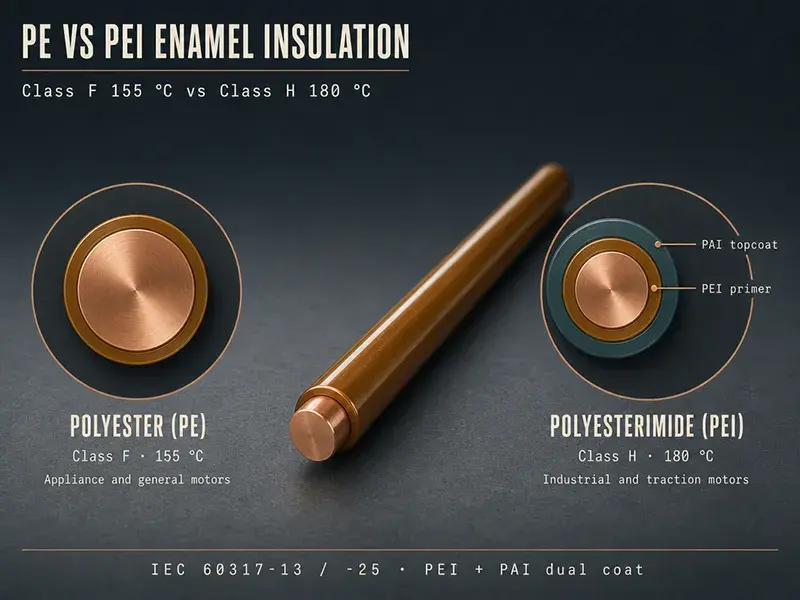
Polyester (PE) is currently the most widely used enameled wire type globally, corresponding to Class F (155°C). The core advantage of PE enamel is its cost-effectiveness—low raw material costs, mature production processes, and balanced overall performance. It dominates the fields of household appliance motors, general motors, and low-voltage transformers. However, pure PE enamel has the limitation of a relatively low thermoplastic temperature, and may soften and fail under overload or localized hot-spot conditions. This has driven the widespread adoption of PEI enamel.
Polyesterimide (PEI / Class H 180°C)
Polyesterimide (PEI) is an upgraded version of PE, corresponding to Class H (180°C). PEI significantly improves thermal stability by introducing an imide ring (-CONCO-) into the polyester molecular chain, making it the mainstream enamel for Class H enameled wires. PEI enamel is widely used in mid-to-high-end applications such as industrial motors, traction motors, wind turbines, and transformers. Another advantage of PEI is its ability to form a dual-coating system with PAI—PEI as the primer (strong adhesion to the copper conductor) and PAI as the topcoat (high temperature resistance, chemical resistance), resulting in superior overall performance compared to a single coating. This is a typical structure in high-end standards such as IEC 60317-13/-25.
Insulation Type III: PAI and PI (High Grade)
Polyamide-imide (PAI / Class N 200°C)
Polyamide-imide (PAI) is a representative of high-grade enameled wire, corresponding to Class N (200°C). Key properties of PAI enamel include: excellent chemical resistance (resistance to refrigerants such as R-134a and R-1234yf), high temperature resistance (long-term at 200°C), and compatibility with refrigeration oils. This makes PAI enameled wire the de facto standard for air conditioner/refrigerator compressor motor windings—refrigerant environments such as R-134a, R-410A, and R-290 place extremely high demands on the chemical stability of insulation enamel, which PE/PU enamel cannot meet. PAI enamel is also widely used in high-temperature, high-load applications such as power tool motors, new energy vehicle drive motor accessories, and traction motors.
Polyimide (PI / Class R 220°C+)
Polyimide (PI) is the highest grade representative of enameled wire, corresponding to Class R (220°C) or higher (up to Class 240°C). The engineering value of PI lies in three aspects:
1. Extreme temperature resistance: Long-term operation at 220-240°C, short-term resistance to ultra-high temperatures (aircraft engines, military electronics)
2. Radiation resistance: Resistant to space and nuclear radiation, making it the only choice for spacecraft motors
3. Chemical inertness: Resistant to almost all organic solvents, acids, and alkalis (except concentrated sulfuric acid)
The limitations of PI are high cost and low flexibility (the bending radius needs to be controlled when winding large-diameter wires). Typical applications include aerospace magnetic wire coils, nuclear power equipment instrument coils, special transformers, and high-end military electronics.
Double Coating and Self-Bonding Enamel
Dual-Coat System
Dual-coated enameled wire combines the advantages of two enamels through a composite structure of base coat and top coat:
– PEI + PAI: Copper conductor adhesion + high temperature and chemical resistance → High-end motors, compressors
– PEI + PI: Copper conductor adhesion + extreme temperature resistance → Aerospace
– PAI + PI: High temperature resistance + extreme temperature resistance → Nuclear power, military
– PE + PEI: Cost-effectiveness + enhanced temperature resistance → Industrial motors
Dual-coated enameled wire is clearly defined in standards such as IEC 60317-13, IEC 60317-25, and IEC 60317-38.
Self-Bonding Enamel
Self-bonding enamel involves applying a hot-melt adhesive layer (typically polyamide resin) over a regular enamel coating. Upon heating, the enameled wires bond together without the need for impregnation or mechanical fixing.
Typical applications include:
– Bobbinless coils: Self-bonded enameled wire wound and then heated to form the desired shape
– Precision inductors: Magnetic ring inductors, transformers, requiring no impregnation process
– High-frequency Litz wires: Wireless charging, RFID, induction heating
Typical heat ratings for self-bonding enamel are 130-180°C (depending on the underlying enamel grade).
Enamel Thickness Grade: Grade 1/2/3 and Breakdown Voltage
The enamel coating of enameled wire is divided into three grades based on the single-side enamel thickness: Grade 1 (thin), Grade 2 (standard), and Grade 3 (extra-thick). Each grade corresponds to different breakdown voltages and mechanical strengths:
| Grade | Thickness | Breakdown Voltage | Typical Applications |
|---|---|---|---|
| Grade 1 (thin) | Thin layer | Low | Space-sensitive small inductors, transformers |
| Grade 2 (standard) | Standard layer | Medium | Standard motors, transformers, household appliances |
| Grade 3 (extra-thick) | Extra-thick layer | High | High-voltage motors, transformers, harsh operating conditions |
The thicker the enamel coating, the higher the breakdown voltage, but it also increases the wire diameter and reduces the space factor. Grade 2 is the global standard for motor rewinding—a double-coated enamel balances breakdown strength and winding maneuverability. Grade 1 is only for applications with extreme space factor sensitivity.
Breakdown voltage testing follows IEC 60851-3 (50 Hz AC boost test) and ASTM D149 (Standard Test Method for Dielectric Breakdown Voltage).
Test Methods and Quality Verification
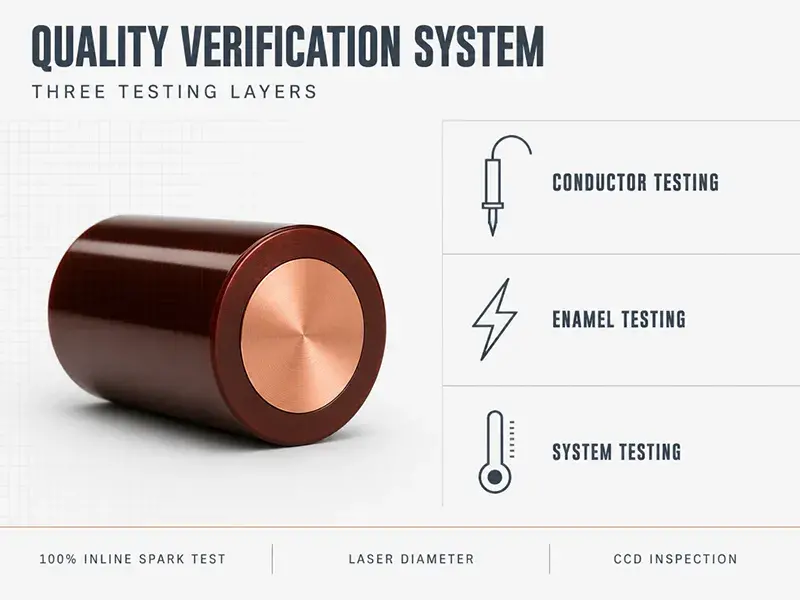
The quality verification system for enameled wire consists of three layers: conductor testing, enamel testing, and system testing.
Conductor Testing
– Resistivity: ASTM B193, copper conductor corresponding to 100% IACS
– Elongation: IEC 60851-3 §3.3, soft-state high elongation
– Tensile Strength: IEC 60851-3 §3.4
Enamel Testing
– Breakdown Voltage: IEC 60851-3 §4.2 (twisted pair method)
– Continuity: IEC 60851-5 (high-voltage mercury electrode continuity test)
– Thermal Shock Resistance: IEC 60851-6 §3.1
– Scratch Resistance: IEC 60851-3 §5.1
– Solderability: IEC 60851-4
– Chemical Resistance: IEC 60851-4 §4.5 (refrigerant, acid-base testing)
System Testing
– Thermal Life Assessment: IEC 60172 (Arrhenius Model, ≥20,000 hours extrapolation)
– Temperature Index (TI): ASTM D2307 (sealed tube aging + breakdown voltage test)
Our modern factory employs 100% online spark testing, automatic diameter laser micrometers, and CCD enamel surface defect detection to ensure that every meter of enameled wire meets standards.
Global Standards System and Compliance Framework
The standard system for enameled copper wire consists of three levels: international, regional, and national.
International Standards (IEC)
– IEC 60317-0-1: General technical requirements (round wire)
– IEC 60317-1: PVF enameled round copper wire (Class 105)
– IEC 60317-3: PU enameled round copper wire (Class 130, self-soldering)
– IEC 60317-8: PU enameled round copper wire (Class 130, recoated)
– IEC 60317-11: PU enameled round copper wire stranded (Class 130)
– IEC 60317-13: PEI enameled round copper wire (Class 180)
– IEC 60317-25: PEI+PAI double coating (Class 200)
– IEC 60317-38: PEI+PAI self-adhesive coating (Class 200)
– IEC 60317-46: PI enameled round copper wire (Class 240)
– IEC 60851-1~6: Test method series
– IEC 60172: Thermal life Arrhenius assessment
– IEC 60085: Definition of electrical insulation thermal class
North American Standards (NEMA / ASTM / UL)
– NEMA MW 1000-2018: General specification for magnet wire (including MW 15-C/35-C/36-C/73-C/79-C/102-C, etc.)
– ASTM B3: Copper conductor rods
– ASTM B49: Round copper wire for drawing
– ASTM B193: Resistivity test
– ASTM D149/D1676/D2307: Dielectric, chemical, thermal life of enamel
– UL 1446: Electrical Insulation System (EIS) rating
– UL 1581: Wire and cable testing
Asian Standards (GB / JIS / KS)
– GB/T 6109: Enameled round winding wire (22 parts, corresponding to IEC 60317 series)
– GB/T 4074: Test methods for enameled wire (corresponding to IEC 60851 series)
– JIS C 3202: Enameled wire (Japan)
– JIS C 3210/3211/3212: Self-adhesive, polyurethane, polyester enameled wire
– KS C 3111 (Korea)
Compliance Certification
– RoHS 2.0 (2011/65/EU): Heavy metal restrictions (Pb/Hg/Cd/Cr⁶⁺/PBB/PBDE)
– REACH (SVHC): Restriction of substances of very high concern
– UL Certification: North American market access
– VDE Certification: European electrical safety
– CCC Certification: Chinese market access
– IATF 16949: Automotive quality management system
Summary: How to Read and Apply Enameled Copper Wire Specifications
The specifications system for enameled copper wire is a three-dimensional coordinate:
– Wire Gauge (AWG / mm²)—determines current carrying capacity and winding space
– Thermal Class (Class B/F/H/N/R)—determines thermal life and reliability
– Insulation Type (PVF/PU/PE/PEI/PAI/PI) + Grade (1/2/3)—determines electrical, mechanical, and chemical performance
The selection decision framework for engineers should follow three steps:
1. Locate the thermal class: Select the Class based on the equipment operating temperature + 25-30°C safety margin (B/F for home appliances; H/N for new energy vehicles; R+ for aerospace).
2. Select the enamel type: Based on the chemical environment (refrigerant/oil/acid/alkali) + process requirements (self-soldering/self-adhesive/double coating) + cost constraints.
3. Determine the wire gauge and Grade: Based on current density (A/mm²) + space factor + breakdown voltage requirements.
Mastering the AWG-Class-Insulation three-dimensional coordinate is a core capability for selecting enameled copper wire. Whether facing Class F PEI Grade 2 AWG 22 for household appliance motors or Class R PI Grade 3 AWG 30 for aerospace applications, engineers can make optimal decisions within the same framework.