

Enameled Aluminum Wire Design Considerations: 6 Key Dimensions I. Electrical Design Considerations
1.1 Current Carrying Capacity and Cross-sectional Area Enlargement
The current carrying capacity design of enameled aluminum wire is the primary electrical consideration. According to the conductor resistance requirements of the IEC 60317-0-3 standard, the maximum resistivity of pure aluminum conductor at 20°C is 0.02801 Ω·mm²/m, approximately 1.64 times that of copper (0.01724 Ω·mm²/m). This means that under the same current carrying capacity requirement, the cross-sectional area of the aluminum conductor needs to be increased by a factor of 1.64. When selecting aluminum wire specifications, design engineers must calculate the following three parameters: the required cross-sectional area (A_Al = 1.64 × A_Cu), the corresponding conductor diameter (d_Al = √1.64 × d_Cu ≈ 1.28 × d_Cu), and the actual available enameled aluminum wire specifications.
1.2 AC
Resistance and Skin Effect In AC applications, the skin effect of aluminum wire differs significantly from that of copper wire. The skin depth δ is calculated as δ = √(2ρ/ωμ), where ρ is resistivity, ω is angular frequency, and μ is permeability. At a power frequency of 60 Hz, the skin depth of aluminum is approximately 10.5 mm, while that of copper is approximately 9.4 mm. However, in mid-to-high frequency applications above 10 kHz, aluminum has a more significant advantage because its skin depth is approximately 12% greater than that of copper. This characteristic allows aluminum enameled wire to have lower AC resistance than copper wire in certain mid-frequency transformers (such as induction heating and welding machines). During design, the skin effect loss under actual operating conditions must be calculated according to IEEE 118 and IEC 60076 standards.
1.3 Dielectric Loss and Insulation System
The dielectric loss of enameled aluminum wire mainly depends on the loss tangent (tan δ) of the insulation coating. According to the NEMA MW 1000 standard requirements for enamel coating grades, the tan δ of polyester imide enamel coating at 1 kHz and 180°C should be less than 0.025; for polyamide-imide enamel coating, it should be less than 0.020 under the same conditions. When designing for high-frequency applications, polyamide-imide enamel coating systems (such as EIW/180, EIW/200) should be preferred.
1.4 Insulation Withstand Voltage and Creepage Distance
The insulation withstand voltage of enameled aluminum wire depends on the enamel coating thickness. According to IEC 60317, the minimum breakdown voltage of Grade 2 standard enamel coating is 4,200 V (single layer, room temperature); Grade 3 thickened enamel coating can reach over 6,000 V. When designing high-voltage windings, the coordination of enamel coating thickness, number of winding layers, creepage distance, and clearance distance must be calculated to avoid insulation breakdown caused by partial discharge (PD) during long-term operation.
II. Mechanical Design Considerations
2.1 Bending Radius and Flexibility
The elongation of aluminum is approximately 8-15% (annealed state), lower than copper’s 20-30%. This means that enameled aluminum wire is more prone to microcracks when bent. According to ASTM B233, 1.0 mm diameter aluminum wire should show no enamel coating cracks at a bending radius of 1 × diameter (1d); 0.5 mm diameter aluminum wire should pass a bending test of 2 × diameter (2d). When designing miniaturized transformers, the bending radius of the aluminum wire needs to be increased accordingly, which will sacrifice some slot fill factor.
2.2 Tensile Strength and Winding Stress
The tensile strength of aluminum is 70-180 MPa (annealed state), significantly lower than that of copper (220-400 MPa). During the winding process of transformers or motors, winding tension can lead to localized stress concentration in the aluminum wire. When designing winding machine parameters, it is recommended to control the winding tension at 8-12% of the tensile strength of the aluminum wire (12-18% for copper wire). Simultaneously, the effect of the electromagnetic force F = B²A/2μ₀ during a winding short circuit on the tensile strength of the aluminum wire should be calculated. The mechanical margin of the aluminum wire should generally be at least 2.5 times.
2.3 Vibration and Fatigue
Resistance The fatigue limit of aluminum under cyclic stress is approximately 30% of its tensile strength (approximately 35-40% for copper), and aluminum is highly sensitive to stress corrosion cracking (SCC). When designing high-vibration applications such as EV drive motors and aerospace motors, annealed (O-state) aluminum enameled wire should be prioritized to improve fatigue resistance, and the fatigue life under 10⁷ cycles should be calculated.
2.4 Slot Fill Factor and Winding Density
Since the cross-sectional area of aluminum needs to be increased by 1.64 times to achieve the same current carrying capacity as copper, the slot fill factor of enameled aluminum wire windings is usually 15-25% lower than that of copper wire. When designing motor or transformer slot types, the slot fill factor must be recalculated (it is recommended to control it within 70-78%) to avoid engineering problems such as “not being able to fit”. Zhengzhou LP Industry can provide slot fill factor calculation services for aluminum enameled wire and provide optimal wire diameter recommendations for specific customer slot types.
III. Thermal Design Considerations
3.1 Insulation Class and Thermal Life
The thermal life of enameled aluminum wire mainly depends on the thermal class of the enameled coating. According to UL 1446 standard, common enamel coating grades include: 105°C (Class A), 130°C (Class B), 155°C (Class F), 180°C (Class H), 200°C (Class N/C), and 220°C (Class R). The most commonly used grades for aluminum enameled wire are 180°C Class H (polyester imide/polyamide-imide composite enamel coating EIW/180) and 200°C Class N (polyamide-imide AIW/200). It is recommended to maintain a temperature margin of 10-15°C under each class (the actual operating temperature of Class H should not exceed 165°C).
3.2 Thermal Conductivity and Heat Dissipation
Aluminum has a thermal conductivity of 237 W/(m·K), approximately 60% of that of copper (401 W/(m·K)). This means that under the same current carrying capacity, the temperature rise of aluminum wire windings is 30-50% higher than that of copper wire windings. Enhanced heat dissipation measures should be implemented during design, such as oil immersion cooling (oil’s thermal resistance is 10-30 times lower than air), forced air cooling, or water cooling. In oil immersion, aluminum enameled wire exhibits good compatibility with the oil (according to ASTM D345), but attention should be paid to the long-term stability of the enamel coating in high-temperature oil.
3.3 Thermal Expansion and Thermal Stress
The coefficient of linear expansion of aluminum is 23.1 × 10⁻⁶ /°C, approximately 1.4 times that of copper (16.5 × 10⁻⁶ /°C). Under temperature cycling conditions, the significant difference in thermal stress between the aluminum enameled wire winding and the core and insulation materials may lead to cracking of the enamel coating or damage to the insulation. During the design phase, an elastic buffer material should be placed between the winding and the core, and the thermal fatigue life under temperature cycling (according to IEC 60068-2-14) should be calculated.
3.4 Thermal Runaway and Protection
The temperature rise rate of aluminum wire under overload conditions is higher than that of copper wire (because aluminum has a lower upper limit for current carrying capacity). When designing a thermal protection system, a more sensitive temperature sensor (such as a PTC thermistor or PT100 platinum resistance thermometer) should be used, and over-temperature protection logic should be configured (typical threshold 150°C alarm, 170°C trip).
IV. Chemical and Environmental Considerations
4.1 Corrosion
Resistance Aluminum naturally forms an Al₂O₃ protective film in the atmosphere, providing good corrosion resistance. However, aluminum requires special protection in the following environments: salt spray environments (coastal/marine applications), acidic environments (battery electrolytes, seawater), and alkaline environments (concrete/cement dust). The enamel coating itself provides a second layer of protection—according to IEC 60317, the enamel coating should pass a 168-hour salt spray test (5% NaCl, 35°C) without breakdown.
4.2 Oil and Chemical
Resistance Transformer oils (mineral oil, synthetic esters, silicone oils) have a softening or swelling effect on the enamel coating of enameled aluminum wire. According to ASTM D345 and IEC 60296 standards, after immersion in mineral oil at 100°C for 168 hours, the hardness change of polyester imide/polyamide-imide enamel coating (EIW/180) should not exceed 10%. When designing oil-immersed transformers, the chemical compatibility between the enamel coating and the transformer oil should be confirmed.
4.3 Damp Heat Aging
Damp heat environments are one of the main causes of insulation failure in enameled aluminum wires. According to IEC 60068-2-78 standard, Class H enameled aluminum wire should withstand 1,000 hours of aging test at 85°C/85% RH, with a breakdown voltage retention rate of not less than 80%. For tropical or outdoor applications, Class H or higher enameled aluminum wire systems should be preferred.
4.4 Flame Retardancy and Fire Safety
According to UL 1446 and IEC 60317 standards, the flame retardancy rating of enameled aluminum wire should meet the fire protection requirements of the application scenario. Polyamide-imide (AIW) has a UL 94 V-0 flame retardancy rating. For high fire protection scenarios such as building wiring, rail transit, and coal mines, flame-retardant enameled aluminum wire should be selected and appropriate overcurrent protection should be configured.
V. Geometric and Manufacturing Considerations
5.1 Wire Diameter Selection
The standard wire diameter range for enameled aluminum wire is 0.10-5.00 mm (according to IEC 60317 standard). During design, a standardized wire diameter series (such as AWG 18, 20, 22, or SWG) should be selected, provided that current carrying capacity, slot fill factor, and mechanical strength requirements are met. The core principles for wire diameter selection are: sufficient current carrying capacity + allowable slot fill factor + sufficient mechanical strength + standardized procurement.
5.2 Enamel Coating Thickness Selection Enamel coating thickness
is divided into Grade 1 (thin enamel), Grade 2 (standard), and Grade 3 (thick enamel). Grade 2 is the most commonly used thickness, providing a breakdown voltage of 4,200 V. Grade 1 can be used when designing high-density windings (saving space but with slightly lower withstand voltage); Grade 3 (6,000 V breakdown voltage, more corrosion resistant) should be used when designing high-voltage scenarios or harsh environments.
5.3 Round Wire vs. Flat Wire Round wire is the most common form
of enameled aluminum wire, suitable for automatic winding. Flat wire (rectangular wire) is suitable for high slot fill factor and high power density applications (such as hairpin windings for EV drive motors), with a cross-sectional area utilization rate 15-20% higher than round wire. Zhengzhou LP Industry offers both round wire and flat wire product series, covering AWG 18-44 and flat wire 2.0×4.0 mm – 8.0×12.0 mm specifications.
5.4 Winding Process
The winding process of enameled aluminum wire differs from that of copper wire in the following ways: tension setting (8-12% tensile strength vs. copper 12-18%), bending radius (≥2d vs. copper ≥1d), and welding process (ultrasonic/resistance/laser vs. copper-tin solder). When designing an automatic winding machine, winding parameters should be adjusted according to the characteristics of aluminum wire, and process verification should be conducted during the first trial production.
VI. Regulatory and Certification Considerations
6.1 International Safety Certification Enamelled aluminum wire
Requires the following certifications to enter the international market: UL (USA, based on UL 1446 insulation system certification), IEC (EU, based on IEC 60317 series standards), VDE (Germany), CE (EU), CSA (Canada), and CCC (China). These certifications focus on the thermal life and electrical safety of the insulation system.
6.2 Environmental Compliance
According to EU RoHS 2.0 (2011/65/EU) and REACH (EC 1907/2006) regulations, the enamel coating of enamelled aluminum wire must not contain hazardous substances such as lead, mercury, cadmium, and hexavalent chromium. The CBAM (Carbon Border Adjustment Mechanism) will be fully implemented in 2026, and the carbon footprint of the aluminum conductor will become a new compliance requirement.
When designing, it is recommended to purchase enameled aluminum wire with complete certification documentation and retain the EPD (Environmental Product Declaration).
6.3 Industry-Specific Certifications Different application scenarios require additional industry certifications: Medical (ISO 13485), Automotive (IATF 16949), Aerospace (AS9100D), Food Grade (FDA 21 CFR), Explosion-proof (ATEX/IECEx).
When designing products with high compliance requirements such as medical, aerospace, and rail transportation, the scope of certifications and the completeness of documentation should be confirmed with the supplier during the selection phase.
6.4 Long-Term Supply Chain Stability
The global supply chain of enameled aluminum wire is significantly affected by aluminum ingot prices (LME aluminum price), energy prices, and trade policies (such as US Section 232 and EU CBAM). During the design phase, the supplier’s production capacity stability (annual capacity ≥ 5,000 tons is recommended), multi-site layout, and long-term supply agreements should be assessed. Zhengzhou LP Industry has an annual production capacity of 8,000 tons of aluminum and 12,000 tons of copper, and holds full certifications including UL, IEC, ISO 9001, CE, VDE, BV, and SGS, ensuring a stable supply to global customers. ## VII. Conclusion
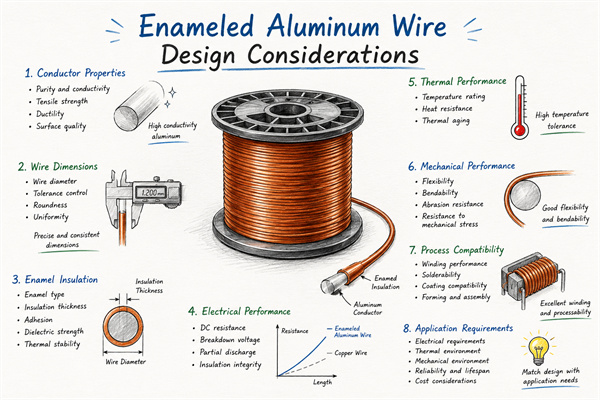
The design considerations for enameled aluminum wire are a multi-dimensional, interdisciplinary system engineering project. From electrical design (current carrying capacity, AC resistance, dielectric loss) to mechanical design (bending radius, tensile strength, fatigue resistance), from thermal design (insulation class, thermal conductivity, thermal expansion) to chemical environment (corrosion resistance, oil resistance, damp heat resistance, flame retardancy), from geometric manufacturing (wire diameter, enamel coating, round wire/flat wire) to regulatory certifications (UL/IEC/RoHS/REACH/CBAM)—each dimension requires systematic evaluation in the early stages of product design. For design engineers: It is recommended to use the six-dimensional framework outlined in this article to conduct a complete evaluation of enameled aluminum wire during the selection phase to avoid discovering critical issues later in product development.
For procurement engineers: When evaluating enameled wires suppliers, three dimensions should be considered simultaneously: technical capabilities (design support, process verification), certification completeness (UL/IEC/RoHS/REACH), and production capacity stability (annual capacity, number of production bases, supply history). For suppliers: Technical capabilities are not only reflected in product quality but also in the ability to provide customers with complete services from design selection to process verification to certification support. The selection of conductor materials is the foundation of product design, and design considerations are the key to ensuring the robust implementation of this foundation.
The design of enameled aluminum wire needs to move from “selecting materials” to “selecting a system”—choosing a complete solution that can support the technology, compliance, and supply chain stability throughout the product’s entire lifecycle.