


Introduction
The comparison between ECCA Wire and Copper Wire in Motors is a topic of significant engineering and commercial value in the motor manufacturing industry. The stator and rotor windings of a motor are key components for electromagnetic energy conversion, and the choice of conductor material for the windings directly affects the motor’s electrical, mechanical, thermal, weight, cost, and lifespan. Pure copper wire has long been the standard conductor material for motor windings, but the scarcity of copper resources, its cost volatility, and its weight disadvantage have prompted the motor industry to explore alternatives. Electrical Copper Clad Aluminum Wire (ECCA), as an engineering balance between copper and aluminum, has the potential to replace pure copper wire in several motor applications.
From the perspective of electrical engineering practice, comparing the application of ECCA (enameled wire) and pure copper in motor windings involves multiple engineering dimensions: conductor material fundamentals (physicochemical differences between copper and copper-clad aluminum), electrical performance (DC resistance, AC resistance, impact on motor efficiency), mechanical performance (strength, flexibility, vibration resistance), thermal performance (heat dissipation, thermal expansion, thermal cycling reliability), motor design and manufacturing process (winding processing, end forming, impregnation process), weight and cost (lightweight effect, cost savings), typical motor applications (small and medium-sized motors, household appliance motors, new energy vehicle motors, special motors), and selection decision framework (selection by motor type, selection by application scenario, selection by performance requirements).
Understanding the differences between ECCA (enameled wire) and pure copper (enameled wire) in motor applications is a core knowledge requirement for motor design engineers, motor procurement engineers, motor application engineers, and motor cost control engineers. This article systematically explains the engineering implications of ECCA Wire vs. Copper Wire in Motors from five dimensions: conductor comparison, performance comparison, impact on motor design, application scenarios, and selection strategies, providing a systematic engineering reference for motor manufacturers, motor design engineers, and procurement engineers.
Conductor Material Comparison
The comparison between ECCA (enameled wire) and pure copper (enameled wire) in motor applications is primarily determined by their conductor materials.
Pure Copper Conductor Foundation
Pure copper enameled wire, using electrical grade pure copper (ETP, Electrolytic Tough Pitch Copper) as the conductor material, is the mainstream choice for enameled wire used in motor windings. The engineering advantages of pure copper as a conductor material include:
Excellent electrical conductivity: Copper has low resistivity and ranks among the top practical metals in terms of conductivity. Pure copper has the best conductivity in power frequency and medium frequency applications and is the traditional first choice for motor windings.
Good mechanical properties: Copper has good ductility, toughness and tensile strength, and can withstand the stress (tension, bending and torsion) of winding processing, which meets the automated processing requirements of high-speed winding machines.
Excellent connection performance: Copper has better brazing, crimping and welding properties than aluminum, making it the preferred material for motor lead wire connections, terminal connections and winding joints.
Good corrosion resistance: Copper has good chemical stability in the atmospheric environment and has a low risk of corrosion during long-term operation.
Disadvantages of pure copper in engineering: higher density (copper’s density is about three times that of aluminum), scarcity of resources, and higher cost (copper prices fluctuate greatly due to global supply and demand).
ECCA Conductor Foundation
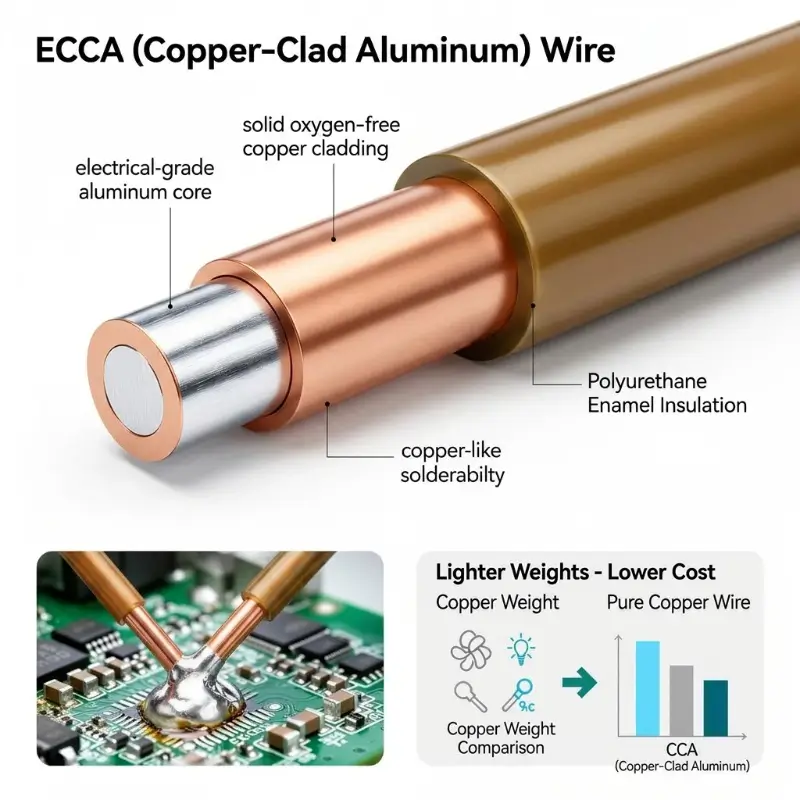
ECCA (enameled wire) uses a copper-clad aluminum bimetallic structure as its conductor material. The outer copper layer and the inner aluminum core are bonded together using a metallurgical process to form an integrated conductor. Engineering advantages of ECCA conductors in motor applications:
Significant weight reduction: Copper-clad aluminum conductors have a significantly lower density than pure copper conductors, resulting in a substantial weight reduction for the same outer diameter. Weight reduction is of great importance for motors in new energy vehicles, portable motors, and aerospace motors.
Cost savings: Aluminum is abundant and cheaper than copper, and the material cost of ECCA is generally lower than that of pure copper.
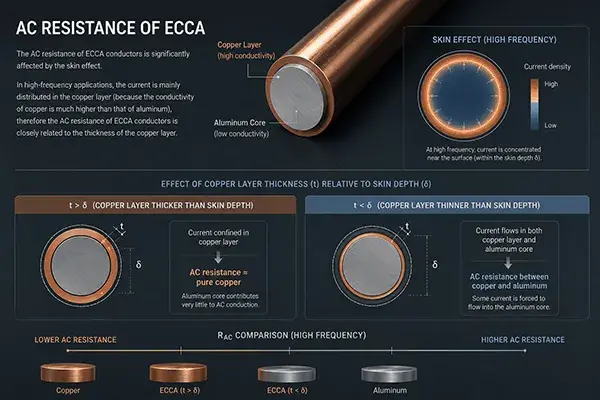
Surface conductivity: In high-frequency applications, current is concentrated in the skin layer. ECCA enameled wire achieves high-frequency conductivity close to that of pure copper through a surface copper layer.
Improved connectivity: Compared to pure aluminum wire, ECCA wire offers significantly improved solderability and connectivity.
The engineering disadvantages of ECCA are: its DC conductivity is lower than that of pure copper (depending on the copper layer volume ratio), its interface stability requires special attention, its mechanical strength is lower than that of pure copper, and its coefficient of thermal expansion is higher than that of pure copper.
Conductor Diameter Equivalence Principle
In motor design, when replacing pure copper wire with ECCA (enameled wire), the “equivalent outer diameter” principle is typically adopted: for the same conductor outer diameter, the DC resistance of ECCA is slightly higher than that of pure copper, but the core slot fill factor, winding structure, and insulation system do not require major adjustments. This replacement method requires minimal changes to the motor design and is easy to implement in engineering.
In scenarios where optimal electrical performance is desired, the “equivalent DC resistance” principle can be adopted: select ECCA enameled wire with a larger copper layer volume ratio so that its DC resistance is close to that of pure copper enameled wire, but the conductor outer diameter may be slightly larger than that of pure copper enameled wire, and the core slot fill factor needs to be re-evaluated.
Electrical Performance Comparison
Electrical performance is the core comparative dimension between ECCA enameled wire and pure copper enameled wire in motor applications.
DC Resistance and Conductivity
DC resistance and conductivity directly affect the copper loss (I²R loss) and efficiency of a motor. Under the same conductor outer diameter conditions, the DC resistance of ECCA (enameled wire) is generally higher than that of pure copper. The copper layer volume ratio is a key parameter for the DC conductivity of ECCA.
Low copper layer volume ratio (10%-15%): DC resistance is about 130%-150% of that of pure copper, suitable for motors that are extremely cost-sensitive and have general electrical performance requirements.
Medium copper layer volume ratio (20%-30%): DC resistance is approximately 110%-130% of that of pure copper, suitable for most general motor applications.
High copper layer volume ratio (30%-40%): DC resistance is about 100%-110% of that of pure copper, close to the conductivity of pure copper, suitable for high-performance motor applications.
The selection of the copper layer volume ratio needs to take into account conductivity requirements, weight requirements, and cost constraints.
AC Resistance and Motor Frequency
AC resistance is directly related to the motor’s operating frequency. The motor’s operating frequency is determined by the number of poles and its speed. Small and medium-sized motors typically operate at mains frequency or variable frequency speed control frequency (within several hundred hertz), where the skin effect has a relatively small impact on conductor resistance. In mains frequency applications, the difference in AC resistance between ECCA (enameled wire) and pure copper is mainly determined by the difference in DC resistance, with the skin effect having a relatively small additional impact.
In variable frequency motor applications (switching frequencies of several kilohertz), the current harmonic frequency is high, and the effect of the skin effect needs to be carefully evaluated. ECCA (enameled wire) exhibits better AC resistance characteristics than pure aluminum under high-frequency harmonics, but may still be higher than pure copper.
Motor Efficiency Impact
Motor efficiency is affected by multiple factors, including copper loss (I²R loss), iron loss (core loss), mechanical loss (friction, wind resistance), and stray loss. Winding copper loss is an important component of the total motor loss, and its magnitude is determined by the winding resistance and motor current.
When ECCA (enameled wire) replaces pure copper, the increased DC resistance leads to increased copper losses in the windings, potentially causing a slight decrease in motor efficiency. The extent of this efficiency decrease depends on the copper layer volume ratio and the motor’s operating point. In scenarios with a low copper layer volume ratio (ECCA replacing pure copper), the efficiency decrease may be more significant, requiring evaluation to determine if the motor meets energy efficiency standards. In scenarios with a high copper layer volume ratio (ECCA replacing pure copper), the efficiency decrease is smaller.
Current Density and Thermal Load
Current density is a key parameter in motor winding design. It is defined as the amount of current carried per unit cross-sectional area of the motor winding and directly affects the winding’s heating and temperature rise.
ECCA (enameled wire) and pure copper (enameled wire) have similar enamel coating thickness levels and winding design principles, but the thermal conductivity of ECCA (enameled wire) (aluminum core) may be superior to that of pure copper. Under the same current density design conditions, the temperature rise of ECCA windings may be slightly lower than that of pure copper windings (due to the better thermal conductivity of aluminum), but the increased copper losses in the windings lead to increased heat generation. The overall thermal effect needs to be evaluated through specific motor thermal simulation.
Mechanical Performance Comparison
Mechanical properties are an important dimension for comparison between ECCA (enameled wire) and pure copper (enameled wire) in motor applications.
Strength and Flexibility
Tensile strength: Pure copper has a higher tensile strength than ECCA wire. In automated winding on high-speed winding machines, special attention must be paid to the winding tension setting of ECCA wire to avoid damage to the coating or conductor breakage due to excessive tension.
Elongation: Pure copper wire has a better elongation than ECCA wire. In windings with small bending radii (such as concentrated windings and special slot windings), the bending performance of ECCA wire requires special evaluation.
Flexibility: Pure copper wire has better flexibility than ECCA wire. However, ECCA wire may face increased processing difficulties in fabricating irregularly shaped or complex windings.
Vibration and Impact Resistance
Vibrations (electromagnetic vibration, mechanical vibration) and shocks (starting shock, load shock) during motor operation pose a challenge to the long-term reliability of windings. The difference in vibration tolerance between ECCA (enameled wire) and pure copper wire mainly stems from differences in mechanical properties.
Pure copper exhibits good vibration tolerance and fatigue resistance during long-term operation. However, the copper-aluminum interface of ECCA (enameled wire) may face the potential risk of interface separation under long-term vibration, requiring verification of its long-term reliability through motor operation tests.
Winding Process Compatibility
The winding process imposes requirements on the mechanical properties of the enameled wire. High-speed winding, winding, shaping, and binding processes all impose requirements on the flexibility, tensile strength, and surface quality of the enameled wire.
Special attention should be paid to the following during the winding process of ECCA enameled wire: proper setting of winding tension (avoiding excessive tension that could damage enamel coating or conductor), control of bending radius (avoiding excessive bending that could cause copper layer cracking), and stability of the copper-aluminum interface (avoiding processing stress that could cause interface separation).
Thermal Performance Comparison
Thermal performance is a key comparative dimension between ECCA (enameled wire) and pure copper (enameled wire) in motor applications.
Heat Generation and Dissipation
Heat generation: ECCA has a higher DC resistance than pure copper, and therefore generates more heat than pure copper under the same current.
Heat dissipation: The aluminum core of ECCA wire has better thermal conductivity than pure copper wire, allowing heat to be conducted from the conductor’s interior to the enamel coating surface more quickly. However, the thermal resistance of the enamel coating is the main bottleneck for heat dissipation; therefore, the overall heat dissipation performance of ECCA wire is not significantly different from that of pure copper wire.
Overall thermal effects: The temperature rise of the ECCA winding may be slightly higher than that of the pure copper winding (due to increased heat generation), but the specific difference needs to be evaluated through motor thermal testing.
Thermal Class Compatibility
Thermal class is determined by the enamel coating system and is not directly related to the conductor material. ECCA enameled wire and pure copper enameled wire can use the same enamel coating system (polyester, polyurethane, polyester imide, polyamide-imide, polyimide) to achieve the same thermal class.
In practical engineering, attention should be paid to the performance changes of the aluminum core of ECCA enameled wire at high temperatures (such as the low softening temperature of aluminum), but the long-term operating temperature of the motor winding is usually within the enamel coating thermal range, and the impact on the aluminum core is limited.
Thermal Expansion and Thermal Cycling
Coefficient of thermal expansion: Aluminum has a higher coefficient of thermal expansion than copper. The overall thermal expansion characteristics of ECCA (enameled wire) are influenced by the combined effects of the copper layer and the aluminum core, and may be slightly higher than those of pure copper (enameled wire).
Thermal cycling reliability: During long-term operation, motor windings are subjected to temperature cycling changes (start-run-stop), and differences in thermal expansion may lead to interfacial stress. The stability of the copper-aluminum interface of ECCA enameled wire during thermal cycling requires special attention. Excellent ECCA enameled wire products should have their reliability verified through accelerated thermal cycling tests.
Motor Design and Manufacturing Impact
The influence of ECCA (enameled wire) and pure copper in motor design and manufacturing is multi-dimensional.
Slot Fill Factor and Winding Design
Slot fill factor is a key parameter in motor stator winding design, defined as the percentage of the copper conductor cross-sectional area to the core slot cross-sectional area. Slot fill factor affects the motor’s power density and heat dissipation performance.
When replacing pure copper wire with ECCA (enameled wire), if the equivalent outer diameter principle is adopted, the slot fill factor remains unchanged, but the winding resistance increases. If the equivalent DC resistance principle is adopted, the conductor outer diameter increases, and the slot fill factor may rise, requiring a reassessment of the winding process and insulation system.
Winding Process Adjustments
The adjustment requirements for winding processing technology include:
Wire tension: The winding tension of ECCA enameled wire should be slightly lower than that of pure copper enameled wire (considering the difference in mechanical properties) to avoid excessive tension damaging the enamel coating or conductor.
Embedding process: ECCA enameled wire has low flexibility, and special attention needs to be paid to copper layer cracking and interface stability during the embedding process.
End forming: The end forming of ECCA enameled wire requires adjustment of forming parameters to avoid damage to the copper-aluminum interface during the forming process.
Binding process: The binding tension of ECCA enameled wire needs to be set reasonably to ensure that the winding is reliably fixed without damaging the enamel coating.
Impregnation Process Compatibility
The insulation impregnation process is a key step in motor winding manufacturing. It involves filling the gaps inside the winding with impregnating varnish, improving insulation performance, enhancing heat dissipation, and improving mechanical strength.
ECCA (enameled wire) and pure copper (enameled wire) generally have good compatibility in the impregnation process, but attention should be paid to: the chemical reaction of the impregnation varnish on the aluminum core (the compatibility between the impregnation varnish and aluminum needs to be evaluated), and the effect of impregnation temperature on the copper-aluminum interface (high temperature may accelerate the growth of intermetallic compounds at the interface).
Connection and Termination
The reliability of winding leads, terminals, and connections is crucial for the long-term operation of a motor. ECCA (enameled wire) connections offer better performance than pure aluminum connections, but are inferior to pure copper connections.
Adjustment requirements for connection process: selection of solder for immersion soldering (copper-based solder has better compatibility), terminal design for crimp connections (considering the mechanical characteristics of ECCA enameled wire), and long-term reliability verification of connection parts.
Weight and Cost Comparison
Weight and cost are the main driving factors for ECCA enameled wire to replace pure copper enameled wire.
Weight Reduction Analysis
The weight reduction of ECCA (enameled wire) compared to pure copper depends on the copper layer volume ratio:
Low copper volume ratio (10%-15%): Weight reduction of over 40%. Medium copper volume ratio (20%-30%): Weight reduction of approximately 30%. High copper volume ratio (30%-40%): Weight reduction of approximately 20%.
The engineering value of weight reduction for motors: extended driving range for motors in new energy vehicles (each 1 kg reduction can extend the driving range), improved portability of portable motors, increased payload of aerospace motors, and improved motion performance of special motors (such as robot joint motors).
Cost Reduction Analysis
The cost savings of ECCA (enameled wire) compared to pure copper wire depend on copper and aluminum prices, the copper layer volume ratio, and market supply and demand. ECCA wire with a lower copper layer volume ratio offers the greatest cost savings.
The engineering value of cost savings: reduced overall material costs for motors, enhanced market competitiveness, increased insensitivity to copper price fluctuations, and cost advantages from large-scale procurement.
Comprehensive Cost-Benefit Analysis
A comprehensive cost-benefit analysis needs to consider:
Direct cost savings: Reduced material costs (ECCA material price is lower than pure copper).
Indirect cost changes: potential increases in process adjustment costs, potential increases in operating costs due to decreased motor efficiency, and potential changes in maintenance costs due to long-term reliability risks.
Value of the motor: The value of improved motor performance brought about by lightweighting (depending on the application scenario), and the value of improved market competitiveness brought about by cost reduction.
Typical Motor Application Scenarios
ECCA (enameled wire) and pure copper (enameled wire) have different focuses in their suitability for motor applications.
Small and Medium Motor Applications
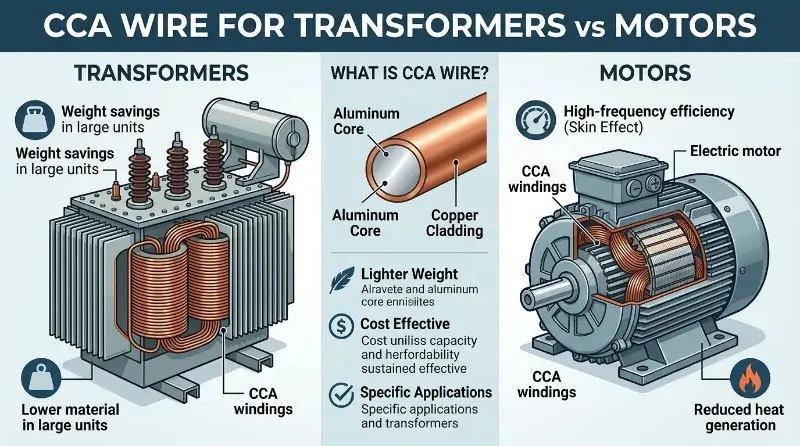
Small and medium-sized general-purpose motors (motors for household appliances, power tools, fans, and pumps) are potential application areas for ECCA enameled wire. These motors are cost-sensitive and have moderate requirements for weight and size; the cost advantage of ECCA enameled wire has engineering value.
Application considerations: The motor has moderate power density, low operating frequency (mainly industrial frequency), the motor efficiency requirement is only that it meets the relevant energy efficiency standards, the winding processing technology is relatively simple, and the number of connection parts is small.
Home Appliance Motor Applications
Electric motors for home appliances (air conditioner compressor motors, washing machine motors, refrigerator compressor motors, fan motors) are an important application area for ECCA (enameled wire). The home appliance market is highly cost-sensitive, and lightweight design is crucial for the portability and ease of installation of appliances.
Application considerations: Home appliance motors are produced in large batches, operate under relatively stable conditions, have high requirements for long-term reliability, and have strict safety certification requirements such as UL/CE.
Automotive Motor Applications
Automotive motors (starter motors, power window motors, wiper motors, seat adjustment motors, and auxiliary motors for new energy vehicles) are sensitive to both weight and cost, making them one of the application areas for ECCA (enameled wire). However, new energy vehicle drive motors (which require high power density, high efficiency, and high long-term reliability) typically still prioritize the use of pure copper wire.
Application considerations: The automotive working environment is complex (wide temperature range, large vibration), has high long-term reliability requirements, and meets the requirements of automotive quality systems such as IATF 16949.
Industrial Motor Applications
Industrial motors (variable frequency motors, servo motors, high-efficiency motors) have high performance requirements and are typically preferred for pure copper enameled wire. However, in cost-sensitive specific industrial motor applications, ECCA enameled wire can be used as a supplementary option.
Application considerations: Industrial motors operate under harsh conditions (heavy load, long-term operation) and have high requirements for motor efficiency and reliability.
Special Motor Applications
Specialized motors (robot joint motors, aerospace motors, special vehicle motors, medical equipment motors) are highly sensitive to weight and volume, making them a potential application area for ECCA enameled wire.
Application considerations: Special motors have high requirements for lightweight design, relatively low sensitivity to cost, and extremely high requirements for long-term reliability.
Selection Strategy Framework
The selection decision between ECCA (enameled wire) and pure copper (enameled wire) requires comprehensive consideration of motor type, application scenario, performance requirements, and cost constraints.
Motor Type-Driven Selection
Selection preferences for enameled wire vary depending on the type of motor:
High-efficiency motors (IE4/IE5 high-efficiency motors): Pure copper enameled wire is preferred to meet energy efficiency standards.
General purpose motors (IE2/IE3 standard motors): Based on a cost-performance trade-off, ECCA enameled wire with a medium copper layer volume ratio can be considered.
For cost-sensitive motors: ECCA enameled wire with a low copper layer volume ratio can be considered, but the motor efficiency must be verified to meet basic standards.
Lightweight priority motors: ECCA enameled wire with a high copper layer volume ratio is preferred to balance lightweight and electrical performance.
Application Scenario-Driven Selection
Selection preferences for enameled wire in different application scenarios:
For new energy vehicles (drive motors), pure copper wire is preferred (due to high efficiency and high power density requirements).
For home appliance motors (air conditioners, washing machines, refrigerators): ECCA enameled wire can be selected (cost-sensitive, lightweight requirements).
General-purpose industrial motors: selected based on a trade-off between cost and performance.
Special application motors (aerospace, medical): Selected according to specific needs.
Performance-Driven Selection
Electrical performance is a priority (high efficiency, high power density): pure copper enameled wire.
Mechanical properties preferred (high strength, high flexibility): pure copper enameled wire.
Prioritize thermal performance (high heat dissipation, low temperature rise): Select according to the specific scenario.
Lightweight priority: ECCA enameled wire (high copper layer volume ratio).
Cost priority: ECCA enameled wire (medium to low copper layer volume ratio).
Long-term reliability is a priority: pure copper enameled wire (with longer engineering verification).
Future Development Trends
The future development of ECCA (enameled wire) and pure copper (enameled wire) in motor applications will continue to advance along the lines of material innovation, process optimization, and application expansion.
Advanced ECCA Material Development
The research and development direction of new ECCA enameled wire is: ECCA enameled wire with a higher copper layer volume ratio (above 40%), better copper-aluminum interface bonding process (reducing the thickness of the intermetallic compound layer), optimized enamel coating system (adapting to ECCA conductor characteristics), and more precise conductor diameter tolerance control (improving the accuracy of motor design).
Motor Industry Acceptance
The acceptance of ECCA (enameled wire) in the electrical machinery industry is gradually increasing. Driving factors include: strong demand for lightweighting in new energy vehicles, the continued cost sensitivity of the home appliance market, long-term fluctuations in copper prices, continuous improvements in ECCA manufacturing processes, and the accumulation of long-term reliability verification data.
ECCA (enameled wire) may gain acceptance in more motor applications in the future, but pure copper will remain dominant in high-end motor applications with high efficiency, high power density, and high reliability requirements.
Standards and Certification Evolution
The standardization and certification system for ECCA enameled wire will continue to improve. International standards (IEC, ASTM), national standardization organization standards (GB/T), and industry standards (UL, CSA, CE) will gradually establish or improve specific standards and certification requirements for ECCA enameled wire in motor applications, providing more comprehensive technical specifications for the engineering application of ECCA enameled wire.
Conclusion
The engineering implications of ECCA Wire vs Copper Wire in Motors encompass multiple engineering dimensions, including conductor material comparison (physicochemical differences between pure copper and copper-clad aluminum, equivalent conductor outer diameter principle), electrical performance comparison (DC resistance, AC resistance, impact on motor efficiency, current density and heat load), mechanical performance comparison (strength, flexibility, vibration resistance, winding process compatibility), thermal performance comparison (heat generation and dissipation, thermal level compatibility, thermal expansion and thermal cycling), impact on motor design and manufacturing (slot fill factor, winding process, impregnation process, connection process), weight and cost comparison (lightweighting effect, cost savings, comprehensive cost-benefit analysis), typical motor applications (small and medium-sized motors, household appliance motors, automotive motors, industrial motors, special motors), and selection strategy framework (selection by motor type, selection by application scenario, selection by performance requirements).
ECCA (enameled wire) offers a potential alternative to pure copper wire in lightweight, cost-sensitive motor applications with moderate efficiency requirements. Pure copper wire will remain dominant in high-end motor applications demanding high efficiency, high power density, and high reliability. The selection between ECCA and pure copper wire requires comprehensive consideration of multiple engineering factors, including motor type, application scenario, performance requirements, cost constraints, and long-term reliability.
With the continued development of new energy vehicles, home appliances, and industrial automation, the demand for lightweight, low-cost, and high-performance ECCA (enameled wire) products in the motor industry will continue to grow. ECCA manufacturers should continuously improve their material processing capabilities, deepen their research on motor applications, expand their product portfolios, and perfect their quality assurance systems to provide the motor industry with high-quality, high-performance, and highly reliable ECCA products.
About the Author
Zhengzhou LP Industry Co., Ltd. is a source manufacturer of enameled wire with 30 years of export experience. With a modern 60-acre production base, it specializes in manufacturing copper/aluminum/copper-clad aluminum enameled round wire, flat wire, and square wire, offering a full range of heat treatment grades. Certified by ISO 9001/14001/45001, UL, REACH, and RoHS, its products are exported to over 50 countries.
Contact Information: – 📧 Email:<office@cnlpzz.com> – 📱 WhatsApp: 0086-19337889070 – 🌐 Website:<https://lpenamelwire.com/>