

Introduction
ECCA Wire is the English abbreviation for Enameled Copper Clad Aluminum Wire, a composite winding wire used in the winding wire manufacturing industry, featuring Copper Clad Aluminum (CCA) as the conductor and coated with an insulating enamel film. ECCA wire integrates the superior electrical conductivity, solderability, and corrosion resistance of copper conductors with the lightweight and cost-effective engineering advantages of aluminum conductors, making it the preferred alternative to pure copper enameled wire in applications such as small- and medium-sized motors, household appliances, transformers, inductors, and reactors. Understanding the conductor base, enamel system, core advantages, typical applications, engineering comparisons with pure copper and pure aluminum wires, design selection considerations, and quality inspection standards for ECCA wire is of significant practical importance for motor manufacturers, household appliance manufacturers, transformer manufacturers, winding wire selection engineers, and procurement engineers.
ECCA wire is a typical composite-conductor winding wire within the magnet wire product portfolio. Its engineering value lies in balancing three core parameters—electrical conductivity, weight, and cost—through a copper–aluminum composite conductor design. ECCA wire serves as an effective technical solution for replacing pure-copper magnet wire in applications such as small- and medium-sized motors, household appliances, low-voltage transformers, and coil inductors.
ECCA Wire: Everything You Need to Know systematically elaborates the engineering implications of ECCA from eight dimensions: fundamental ECCA concepts and conductor construction, ECCA enamel coating systems, analysis of ECCA’s core advantages, typical application areas for ECCA, engineering comparison of ECCA versus pure copper wire and pure aluminum wire, ECCA design and selection considerations, ECCA quality inspection standards, and ECCA manufacturing processes and quality control. This article provides a systematic engineering reference for motor manufacturers, household appliance manufacturers, transformer manufacturers, winding wire selection engineers, and procurement engineers.
ECCA Fundamental Concepts and Conductor Structures
ECCA Wire Fundamentals
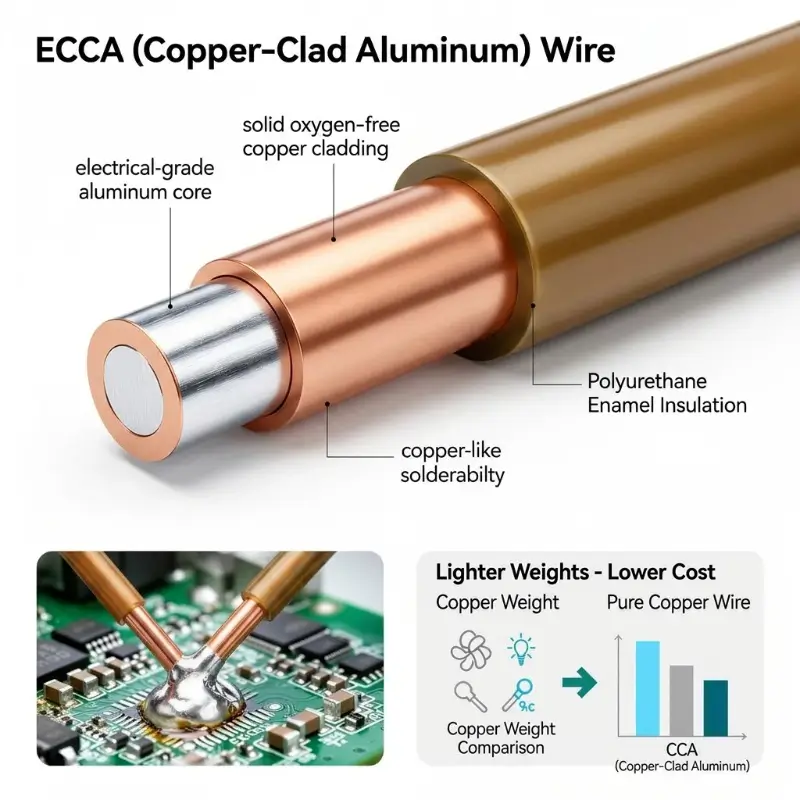
ECCA wire (Enameled Copper Clad Aluminum Wire) is a composite winding wire consisting of a copper-clad aluminum conductor (CCA) coated with an insulating enamel layer. The CCA conductor is a bimetallic composite conductor formed by metallurgical bonding between an aluminum core and a copper cladding. An enamel layer is applied over the CCA conductor surface to provide electrical insulation.
ECCA wire, as a composite conductor winding wire, integrates the surface properties of copper—namely conductivity, solderability, and corrosion resistance—with the core properties of aluminum—namely lightweight and low cost. The copper cladding provides electrical connection points, soldering interfaces, and surface conductivity of the conductor, while the aluminum core supplies the primary conductor cross-sectional area and mechanical support. The metallurgical bond between the copper cladding and aluminum core ensures structural integrity of ECCA wire during winding processing and long-term operation.
Copper-Clad Aluminum Conductor Structural Characteristics
Structural characteristics of copper-clad aluminum (CCA) conductors include the copper cladding thickness ratio, copper–aluminum interfacial bonding, uniformity of copper layer distribution, and conductor surface quality. The copper cladding thickness ratio is a critical parameter for CCA conductors, typically expressed as either the copper volume fraction or the ratio of the copper cross-sectional area to the total cross-sectional area. Common copper cladding ratios are 10%, 15%, 20%, and 30%, with different ratios suited to distinct application scenarios.
Copper–aluminum interfacial bonding is the core technology of CCA conductors. The metallurgical bonding interface shall be uniform, dense, free of inclusions and defects, and its bond strength shall satisfy winding processing and long-term operational requirements. Copper layer thickness uniformity affects the electrical and mechanical properties of CCA conductors; CCA conductors with uniform copper layer thickness exhibit stable performance during winding processing. Conductor surface quality influences enamel coating adhesion; the copper layer surface shall be smooth, free of oxide layers and contaminants.
Conductor Specifications and Tolerances
The conductor specifications of ECCA wire include nominal diameter, conductor tolerance, ovality, copper layer ratio, conductor resistance, tensile strength, and elongation. The nominal diameter is a critical specification of ECCA wire, with common sizes ranging from fine windings to general-purpose motor windings. Conductor tolerance is typically maintained within a narrow range to ensure consistency of winding parameters.
Conductor resistance is a key electrical parameter of ECCA wire, closely related to the copper cladding ratio and conductor diameter. At the same conductor diameter, the resistance of ECCA wire is higher than that of pure copper wire but lower than that of pure aluminum wire. Conductor tensile strength reflects the mechanical performance of ECCA wire, with the aluminum core providing the primary mechanical strength.
ECCA Enamel System
Base Insulation System
The enamel system of ECCA wire is similar to that of pure copper enameled wire, primarily employing polyester enamel, polyurethane enamel, polyester-imide enamel, and polyamide-imide enamel. Selection of the enamel system is determined comprehensively based on the application scenario of ECCA wire, temperature class requirements, processability requirements, and cost considerations. Polyester enamel serves as the base enamel system for ECCA wire, compatible with Class 130 temperature rating. Polyurethane enamel is compatible with Class 130 to Class 155 temperature ratings and exhibits excellent solderability.
Polyesterimide enamel is compatible with Class 180 (H-class) thermal rating and is the preferred enamel system for high-temperature ECCA wire. Polyamide-imide enamel is compatible with Class 200 to Class 220 thermal ratings and serves as the enamel system for premium-grade ECCA wire.
Compatibility of Insulation Coating with CCA Conductors
Compatibility of the enamel coating with the CCA conductor is a critical consideration in the ECCA wire enamel system. The copper cladding on the CCA conductor provides the substrate for enamel adhesion; the copper cladding surface must be clean, dry, and free of oxide layers to ensure proper enamel adhesion. The enamel coating process must be adjusted according to the characteristics of the CCA conductor to avoid damaging the copper cladding during coating.
The difference in coefficient of thermal expansion (CTE) between the aluminum core and copper cladding of CCA conductors must be considered during the enamel coating and curing processes. Since aluminum has a higher CTE than copper, dimensional changes in copper-clad aluminum conductors under temperature variations must be compensated through enamel design to prevent cracking or reduced adhesion of the enamel film during long-term thermal cycling. Enamel flexibility and adhesion are critical performance indicators of the ECCA wire enamel system.
Enamel Coating Thickness Classes
The film build-up grades of ECCA wire comply with international standards (IEC 60317, NEMA MW 1000, GB/T 7095). Grade 1 film is the basic thickness, suitable for low-voltage ECCA wire applications. Grade 2 film is the medium thickness, suitable for general-purpose ECCA wire applications. Grade 3 film is the heavy thickness, suitable for high-voltage and severe-duty ECCA wire applications.
ECCA Core Competitive Advantages Analysis
Light weighting Advantages
One of the most prominent core advantages of ECCA wire is its light weighting benefit. Aluminum’s density is approximately one-third that of copper, resulting in a significant weight reduction for ECCA wire compared to pure copper enameled wire at the same conductor diameter. ECCA wire with a copper cladding ratio of 10% to 15% achieves a weight reduction of approximately 30% to 40% relative to pure copper enameled wire, while ECCA wire with a copper cladding ratio of 20% to 30% achieves a weight reduction of approximately 20% to 30%.
The light weighting advantage of ECCA wire delivers significant value in applications such as motors for portable devices, power tools, household appliances, drones, and electric vehicles. This light weighting advantage not only reduces overall unit weight but also lowers inertia, reduces vibration, and enhances dynamic response performance.
Cost Advantage
Another core advantage of ECCA wire is its cost efficiency. The market price of aluminum is typically significantly lower than that of copper, resulting in substantially reduced material costs for ECCA wire compared to pure copper enameled wire at the same conductor diameter. The cost advantage of ECCA wire is closely related to the copper cladding ratio; ECCA wire with a lower copper cladding ratio exhibits a more pronounced cost advantage.
The cost advantage of ECCA wire is highly valuable for cost-sensitive applications such as mid- to low-end motors, household appliances, low-voltage transformers, and coil inductors. While maintaining performance and quality, ECCA wire represents an effective technical solution for reducing magnet wire material costs.
Electrical Conductivity and Solderability Characteristics
The electrical conductivity of ECCA wire lies between that of pure copper wire and pure aluminum wire. At the same conductor diameter, the resistance of ECCA wire is higher than that of pure copper wire but lower than that of pure aluminum wire. In high-frequency applications, the skin effect in ECCA wire causes high-frequency current to flow predominantly through the copper cladding, thereby leveraging the high conductivity advantage of the copper cladding.
ECCA wire exhibits superior solderability compared to pure aluminum wire. The copper cladding provides a solderable interface, enabling conventional joining methods—including tin soldering, brazing, and laser welding—on the pure copper surface. This solderability advantage renders ECCA wire comparable to pure copper enameled wire in terms of processability for winding interconnections.
Corrosion Resistance Characteristics
The corrosion resistance of ECCA wire is comparable to that of pure copper magnet wire and superior to that of pure aluminum wire. The copper cladding provides primary corrosion protection, while the aluminum core is isolated from the external environment by the copper cladding. The superior corrosion resistance of ECCA wire confers advantages in applications exposed to humid or corrosive gas environments.
ECCA Typical Application Areas
Applications in Small and Medium-Sized Motors
The core application area of ECCA wire is in medium- and small-sized motors. Medium- and small-sized motors include household appliance motors (e.g., air-conditioner compressor motors, washing machine motors, refrigerator motors), power tool motors (e.g., electric drill motors, electric saw motors), and general-purpose small motors (e.g., small water pump motors, small fan motors). The windings of medium- and small-sized motors impose comprehensive requirements on the winding wire regarding weight, cost, electrical conductivity, and mechanical properties; the overall performance advantages of ECCA wire render it widely applicable in the medium- and small-sized motor sector.
Household appliance motors typically use ECCA wire with a copper cladding ratio of 10% to 15%, enamel coating thickness grade Grade 1 or Grade 2, and thermal class Class 130 or Class 155. Power tool motors typically use ECCA wire with a copper cladding ratio of 15% to 20%, enamel coating thickness grade Grade 2, and thermal class Class 155 or Class 180.
Low-Voltage Transformer and Coil Inductor Applications
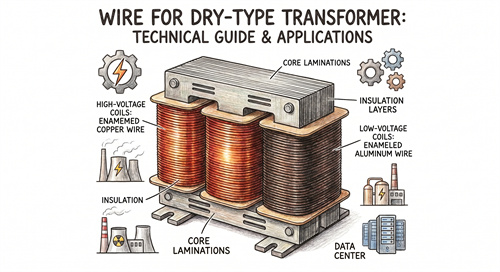
ECCA wire is applied in the low-voltage transformer sector, including small-power power transformers, isolation transformers, control transformers, and electronic transformers. Winding wires for low-voltage transformers must meet integrated requirements regarding cost, electrical conductivity, and insulation performance; ECCA wire’s cost advantage and balanced performance render it valuable for applications in the low-voltage transformer sector.
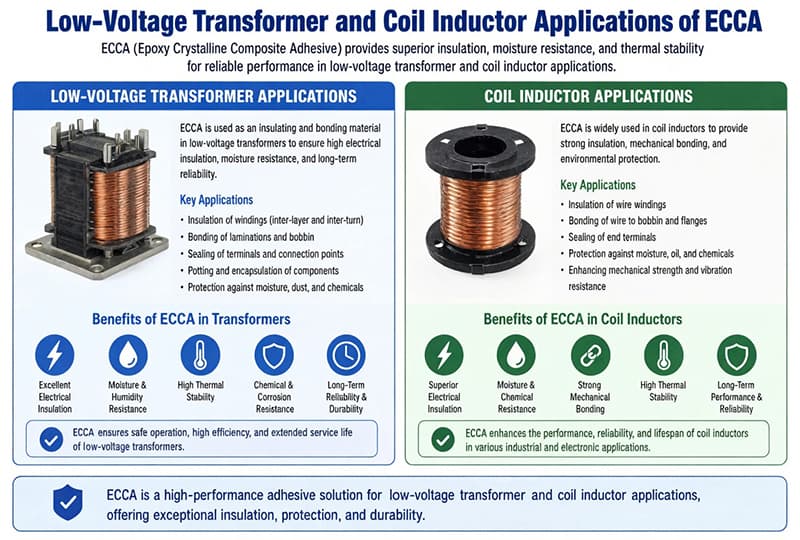
ECCA wire finds niche applications in the inductor and reactor sectors. Inductor applications impose high requirements on the Q factor (quality factor) of winding wire, and the copper cladding of ECCA wire helps reduce high-frequency losses.
Household Appliances and Special Applications
ECCA wire is applied on a large scale in the household appliance sector. The motor windings, transformer windings, and inductor windings of household appliances—including air conditioners, washing machines, refrigerators, televisions, microwave ovens, rice cookers, vacuum cleaners, and electric fans—are the primary application areas for ECCA wire. The household appliance sector’s requirements for high-volume production, low cost, and lightweight design align closely with the core advantages of ECCA wire.
ECCA wire is applied in specialized application fields, including power tools, electric bicycles, low-speed electric vehicles, garden tools, and toy motors. These applications impose integrated requirements on winding wire regarding cost, weight, and reliability; ECCA wire’s comprehensive advantages render it valuable for such specialized applications.
Engineering Comparison of ECCA vs. Pure Copper Wire / Pure Aluminum Wire
Comparison with Pure Copper Magnet Wire
Engineering comparison between ECCA wire and pure copper magnet wire covers electrical conductivity, weight, cost, solderability, corrosion resistance, and mechanical properties. Regarding electrical conductivity, pure copper magnet wire outperforms ECCA wire: the conductivity (IACS) of pure copper wire is approximately 100%, whereas that of ECCA wire is approximately 60% to 70%. With respect to weight, ECCA wire is significantly lighter than pure copper magnet wire, with a weight reduction of approximately 20% to 40%. In terms of cost, ECCA wire is substantially less expensive than pure copper magnet wire, with a cost reduction of approximately 20% to 50%.
Regarding solderability, pure copper magnet wire exhibits performance comparable to that of ECCA wire. In terms of corrosion resistance, pure copper magnet wire is slightly superior to ECCA wire. With respect to mechanical properties, pure copper magnet wire demonstrates higher tensile strength and elongation than ECCA wire. Regarding application scenarios, pure copper magnet wire is suitable for high-end, demanding, and high-reliability applications, whereas ECCA wire is suitable for mid-to-low-end, moderately demanding, and cost-sensitive applications.
Comparison with Pure Aluminum Magnet Wire
The engineering comparison between ECCA wire and pure aluminum magnet wire also covers multiple dimensions. In terms of electrical conductivity, ECCA wire outperforms pure aluminum magnet wire; the conductivity (IACS) of pure aluminum wire is approximately 61%, whereas the conductivity of ECCA wire is significantly higher. Regarding weight, ECCA wire is slightly heavier than pure aluminum magnet wire but remains substantially lighter than pure copper magnet wire. In terms of cost, ECCA wire is marginally more expensive than pure aluminum magnet wire but remains significantly less costly than pure copper magnet wire.
Regarding solderability, ECCA wire significantly outperforms pure aluminum magnet wire (poor solderability being the primary application limitation of pure aluminum wire). Regarding corrosion resistance, ECCA wire significantly outperforms pure aluminum magnet wire (the copper cladding provides corrosion protection). Regarding mechanical properties, ECCA wire exhibits higher tensile strength than pure aluminum magnet wire. Regarding application scenarios, pure aluminum magnet wire is suitable for dedicated pure aluminum applications, whereas ECCA wire is suitable for medium-requirement applications requiring solderability.
Comprehensive Considerations for Engineering Comparison
Engineering comparison between ECCA wire and pure copper wire/pure aluminum wire must be conducted based on specific application scenarios. Selection decisions require a balanced evaluation of multiple factors, including electrical conductivity, weight, cost, solderability, corrosion resistance, and mechanical properties. General guidelines are: pure copper wire is preferred for high-end, demanding applications; ECCA wire is preferred for mid-tier applications with moderate requirements; and pure aluminum wire is selected for dedicated aluminum-specific applications.
The engineering value of ECCA wire lies in bridging the gap between pure copper wire (high cost, high weight, high performance) and pure aluminum wire (low cost, low weight, low performance). Proper selection and application of ECCA wire enables optimization of cost and weight while maintaining moderate performance.
ECCA Design Selection Considerations
Fundamental Selection Principles
The fundamental principle for selecting ECCA wire is a comprehensive trade-off among multiple factors—including electrical performance, weight, cost, reliability, and processability—based on the specific application. Electrical performance is the primary consideration in ECCA wire selection; current density, voltage rating, and insulation requirements determine the conductor diameter, enamel coating thickness class, and enamel system. Weight is an important consideration in ECCA wire selection, particularly for applications with stringent lightweighting requirements.
Cost is the practical boundary for ECCA wire selection, and the cost advantage of ECCA wire is the core driver for selection. Reliability forms the foundation for ECCA wire selection; the long-term reliability of ECCA wire must meet the design life requirements of the application. Processability constitutes an engineering consideration for ECCA wire selection; the processing performance—including winding, insertion, shaping, and welding—of ECCA wire must satisfy production requirements.
Selection Recommendations for Different Application Scenarios
For household appliance motor applications, ECCA wire with a copper cladding ratio of 10% to 15%, enamel coating thickness grade Grade 1 or Grade 2, and thermal class Class 130 or Class 155 is recommended. For power tool motor applications, ECCA wire with a copper cladding ratio of 15% to 20%, enamel coating thickness grade Grade 2, and thermal class Class 155 or Class 180 is recommended.
For low-voltage transformer applications, ECCA wire with a copper cladding ratio of 10% to 15% and insulation film thickness grade Grade 1 or Grade 2 is recommended. For coil inductors and reactor applications, ECCA wire with a copper cladding ratio of 15% to 25% is recommended (higher copper cladding ratios are required for high-frequency applications to reduce skin effect losses). For special applications—such as power tools, electric bicycles, and garden tools—standard-specification ECCA wire is recommended.
Common Selection Misconceptions
Common misconceptions in ECCA wire selection include excessively pursuing a low copper cladding ratio (thereby compromising electrical conductivity and solderability), excessively pursuing a high copper cladding ratio (undermining the cost and weight advantages of ECCA wire), neglecting the interfacial bond quality between copper and aluminum, neglecting the compatibility between the enamel coating and the CCA conductor, and neglecting the limitations of ECCA wire under extreme operating conditions.
Accurate selection based on actual engineering requirements is essential to avoid misselection. The copper cladding ratio must be optimized to balance electrical conductivity, weight, and cost. The interfacial bond quality between copper and aluminum is a core quality indicator for ECCA wire and must be ensured through supplier qualification and quality inspection.
ECCA Quality Inspection Standards
International and Chinese Standards
The IEC 60317 series standards include the corresponding product standards for ECCA wire, specifying key technical parameters such as conductor dimensions, copper cladding ratio, enamel coating thickness, electrical properties, and mechanical properties. The IEC 60851 series standards are test method standards for enameled wire and apply to critical performance testing of ECCA wire. The NEMA MW 1000 series standards are North American enameled wire standards, with certain standards covering ECCA wire.
The GB/T 7095 series standards are the Chinese national standards for magnet wire, incorporating product standards applicable to ECCA wire. The GB/T 4074 series standards specify test methods for magnet wire and apply to critical performance testing of ECCA wire.
Key Quality Inspection Items
Key quality inspection items for ECCA wire include conductor specification inspection (diameter, tolerance, ovality), copper cladding ratio inspection, copper–aluminum interface bond strength inspection, enamel coating thickness inspection, enamel coating continuity inspection (pinhole test), dielectric strength inspection (dielectric breakdown voltage, dielectric withstand voltage test), mechanical property inspection (tensile strength, elongation, enamel adhesion), thermal property inspection (temperature index, thermal shock, softening breakdown), and chemical property inspection (chemical resistance, damp heat resistance, salt spray resistance).
Copper cladding ratio inspection is a special test item for ECCA wire and shall be conducted using specific methods (e.g., density method, cross-sectional area method, spectroscopic method, etc.). Copper–aluminum interface bond strength inspection is also a special test item for ECCA wire and can be evaluated via peel testing, bending testing, flattening testing, etc.
Quality Management System
ECCA wire manufacturers’ quality management system includes ISO 9001 Quality Management System certification, ISO 14001 Environmental Management System certification, and IATF 16949 Automotive Industry Quality Management System certification (for automotive applications). A comprehensive quality management system forms the foundation for ECCA wire quality assurance.
ECCA Manufacturing Process and Quality Control
Key Manufacturing Process Technologies
The key manufacturing technologies for ECCA wire encompass CCA conductor production, copper–aluminum metallurgical bonding, conductor drawing, annealing, enamel coating application, enamel curing, and winding/packaging. The core of CCA conductor production is copper–aluminum bimetallic compositing, with common methods including clad drawing, continuous casting, and hydrostatic extrusion.
Copper–aluminum metallurgical bonding is a critical technology in CCA conductor manufacturing. The clad-drawing method achieves copper–aluminum interfacial metallurgical bonding through multiple drawing passes and intermediate annealing. The continuous casting method achieves copper–aluminum interfacial metallurgical bonding by enveloping an aluminum core with molten copper. CCA conductors manufactured by these different methods differ in interfacial bond strength, copper-layer uniformity, and production cost.
Enamel Coating and Quality Control
The enamel coating process for ECCA wire is similar to that for pure copper magnet wire, employing die coating. During coating, the characteristics of the CCA conductor must be considered: for ECCA wire with a thin copper cladding, mechanical stress at the coating die must be appropriately controlled to prevent damage to the copper cladding. The enamel formulation must be optimized specifically for CCA conductors to ensure adequate adhesion of the enamel film to the copper cladding surface.
Curing of the enamel coating is a critical process in ECCA wire manufacturing. Key curing parameters include curing temperature, curing time, and curing atmosphere. The enamel coating curing temperature typically ranges from 300 °C to 500 °C (depending on the enamel system), and the curing process must be precisely controlled.
Key quality control points for ECCA wire encompass raw material quality control (incoming inspection of aluminum rods, copper strips, insulating varnishes, etc.), in-process quality control (control of critical process parameters for ECCA manufacturing, conductor drawing, and enamel coating), and finished product quality inspection. Batch-to-batch consistency of ECCA wire is the cornerstone of quality control. Manufacturers must establish a robust SPC (Statistical Process Control) system and a CPK (Process Capability Index) evaluation system.
Conclusion
ECCA Wire: Everything You Need to Know covers eight core engineering dimensions: fundamental ECCA concepts and conductor structures; ECCA enamel coating systems; analysis of ECCA’s core advantages; typical ECCA application areas; engineering comparison of ECCA versus pure copper wire and pure aluminum wire; ECCA design and selection considerations; ECCA quality inspection standards; and ECCA manufacturing processes and quality control.
ECCA wire, as a representative composite conductor winding wire, finds broad application in small- and medium-sized motors, household appliances, low-voltage transformers, coil inductors, and reactors. Its advantages—including lightweight design, cost efficiency, and superior weldability—make ECCA wire an effective technical solution for replacing pure copper enameled wire. The engineering value of ECCA wire lies in bridging the gap between pure copper wire (high cost) and pure aluminum wire (low performance).
ECCA wire design and application require a comprehensive trade-off among multiple dimensions—including electrical performance, weight, cost, reliability, and processability—based on the specific application scenario. ECCA wire selection must avoid excessively pursuing either low or high copper-clad ratios; instead, precise selection shall be based on actual engineering requirements. Quality control of ECCA wire shall establish a robust manufacturing process control system and quality inspection system to ensure product consistency and reliability.
ECCA wire manufacturers shall continuously optimize the copper–aluminum metallurgical bonding process, improve enamel coating quality, and strengthen quality control capabilities to supply motor manufacturers, household appliance manufacturers, and transformer manufacturers with higher-performance, more reliable, and more cost-competitive ECCA wire products.