

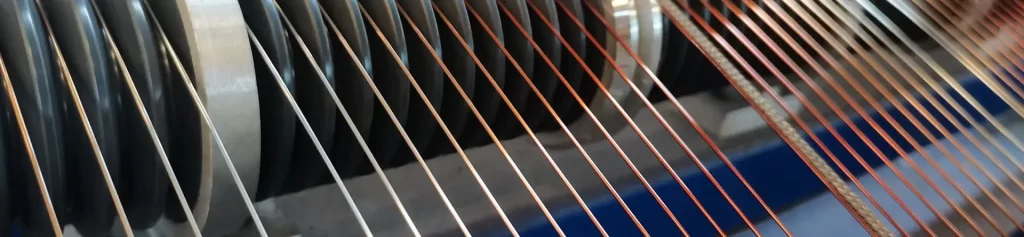
Direct-solder-type enameled copper wire is primarily based on a polyurethane (UEW or QA) insulation system. Through formulation and process optimization, it offers two heat resistance ratings: 155°C (Class F) and 180°C (Class H). The 155°C-rated enameled wire is currently the most widely used product on the market, offering a balance of cost-effectiveness and performance; the 180°C-rated enameled wire maintains excellent coating properties while enhancing heat resistance, making it suitable for applications with higher operating temperatures or more stringent reliability requirements.
Technical Principles and Classification of Direct-Solderable Enameled Copper Wire
Technical Principles of Direct-Solderable Enameled Copper Wire
The core of direct-solderable enameled copper wire lies in the self-fusing design of its insulation coating. While traditional enameled wire requires mechanical or chemical stripping before soldering, the coating on direct-solderable enameled wire automatically decomposes, melts, and is replaced by solder at soldering temperatures, eliminating the need for pretreatment.
This self-fusing principle relies on the coating’s appropriate melt flow properties, good wettability with solder, and non-contaminating thermal decomposition products; Solderability is measured by the wire’s weldability; high-quality products require a self-stripping rate of over 95%, ensuring reliable joint strength.
The insulation coating of direct-solderable enameled copper wire employs a self-fusing design. At soldering temperatures, the coating automatically decomposes, melts, and is replaced by solder through the heat and reactivity of the solder, enabling direct soldering without pretreatment.
The self-fusing principle of direct-solder type enameled copper wire is based on the following technical characteristics: the insulation coating possesses suitable melt flow properties at soldering temperatures; there exists an interface between the coating and the solder that can be wetted and penetrated by the solder; and the thermal decomposition products of the coating do not contaminate the solder joint nor affect the solder’s wettability.
Solderability is typically measured by “weldability” indicators, including: the completeness of the varnish layer’s automatic peeling during soldering, the reliability of joint formation, and the stability of post-soldering bond strength. For high-quality direct-solderable enameled copper wire, under appropriate soldering process parameters, the self-peeling rate of the varnish layer should reach over 95%, and the bond strength of the solder joint should be reliable.
Insulation System and Temperature Rating of Direct-Solderable Enameled Copper Wire
Direct-solder enameled copper wire is based on polyurethane insulation and is primarily classified into two categories according to heat resistance class:
The 155°C class (UEW/QAE) features modified polyurethane insulation (Class F) and is the most widely used. It allows for rapid enamel stripping at 260–300°C to form bright solder joints, is compatible with lead-free solder, offers excellent high-frequency performance, and is available in a variety of colors.
The 180°C class (Class H) is an upgraded version of the 155°C class formulation, offering enhanced heat resistance. It requires higher soldering temperatures (300–350°C) or extended processing times and is suitable for high-temperature, high-reliability applications.
155°C Direct-Solder Type Enameled Copper Wire (UEW/QAE)
155°C direct-solder type enameled copper wire is currently the most widely used direct-solder product on the market. Its insulation system is modified polyurethane, with a heat resistance rating of Class F (155°C). While maintaining excellent direct-solder performance, it also offers good mechanical and electrical properties.
180°C Class Direct-Solder Enameled Copper Wire
Building upon the 155°C class product, the 180°C class direct-solder enameled copper wire achieves a Class H (180°C) heat resistance rating through formulation upgrades. While maintaining excellent direct-solder performance, this product expands the applicable operating temperature range to meet application requirements under higher temperature conditions.
Differences Between Direct-Solderable and Self-Adhesive Enameled Wires
Direct-solderable and self-adhesive enameled wires have distinct characteristics: Direct-solderable (UEW) wires rely on the polyurethane insulation layer to peel away automatically during soldering, enabling direct soldering and simplifying the process; self-adhesive wires use a cured adhesive layer on the surface to secure the coil, which is non-conductive and cannot replace soldering. The two can be used in combination to achieve both coil positioning and electrical connection.
Solder-Under-Insulation (UEW) Enameled Wire: Based on polyurethane insulation, its core feature is that the insulation layer automatically peels off at soldering temperatures, enabling direct soldering. Its main advantages are simplifying the soldering process and reducing production costs.
Core Advantages of Direct-Solder Enameled Copper Wire
Simplified Soldering Process
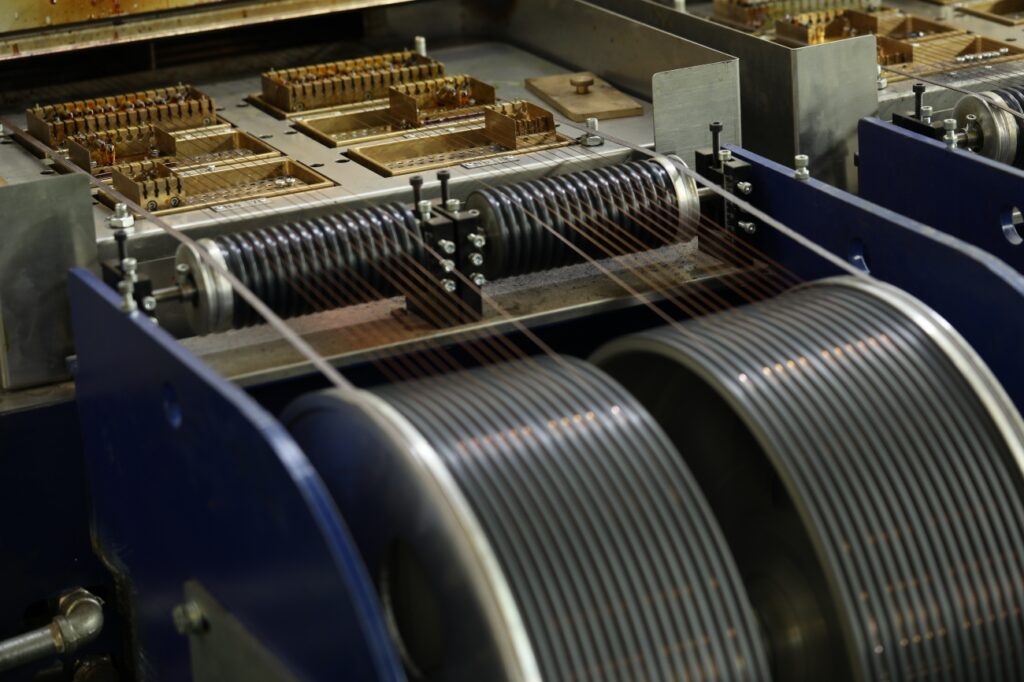
Direct-solder enameled copper wire eliminates the need for traditional processes such as varnish stripping and chemical treatment, streamlining the process into three steps: winding, inspection, and direct soldering. This significantly reduces labor and equipment costs while minimizing scrap caused by varnish removal.
Improved Soldering Quality and Reliability
Direct-solder enameled copper wire eliminates cold solder joints caused by residual varnish from traditional scraping methods. The solder fully wets the conductor to form a high-strength intermetallic bond, resulting in solder joints with superior vibration and fatigue resistance, making it suitable for electronic devices operating in vibrating environments.
Suitable for Automated Precision Soldering
Direct-solder enameled copper wire offers strong compatibility with automated winding and soldering equipment. It ensures stable varnish removal and consistent solder joints while eliminating the need for a varnish-stripping mechanism. Its precise wire diameter and uniform varnish coating guarantee product consistency in automated production, with the 155°C grade being particularly well-suited for such processes.
Excellent High-Frequency Electrical Performance
Direct-solder enameled copper wire (polyurethane insulation) features low high-frequency dielectric loss and minimal heat generation. At 1 MHz, its tanδ can be below 0.01, outperforming polyester materials. It is widely used in high-frequency electronic applications such as high-frequency transformers, RF coils, and high-frequency sensors.
Multiple Color Options for Streamlined Production Management
Direct-solder type enameled copper wire is available in a variety of insulation colors. Color-coding allows for easy differentiation of specifications, facilitating production identification and traceability. It also simplifies the process of distinguishing pin polarity and phase sequence, thereby supporting production management.
Typical Application Areas for Direct-Solder Enameled Copper Wire
Consumer Electronics
Consumer electronics represent the largest market for direct-solder enameled copper wire, primarily used in various high-frequency magnetic components. Industry demands are characterized by bulk purchasing, cost sensitivity, high automation, and strict environmental requirements. The 155°C grade dominates the market due to its high cost-effectiveness.
Automotive Electronics
Automotive electronics impose stringent requirements on direct-solder enameled copper wire, demanding wide temperature resistance, vibration resistance, long service life, and traceability. It is primarily used in magnetic components such as on-board chargers and motor drivers. The 180°C grade is recommended to ensure long-term reliability in high-temperature environments.
Industrial Power Supplies and Power Electronics
The industrial power supply and power electronics sectors (switching power supplies, inverters, etc.) demand high efficiency and reliability from direct-solder-type enameled copper wire. It is frequently used in high-frequency magnetic components; 155°C or 180°C grade products can be selected based on operating temperature and heat dissipation conditions.
Medical Equipment
Medical equipment imposes extremely high requirements on the reliability and safety of direct-solder type enameled copper wire. It must comply with relevant medical standards; some applications require low outgassing and must pass biocompatibility testing. When selecting products, clearly define requirements with the supplier and choose industry-validated products.
Communications and Networking Equipment
As communications and networking equipment evolves toward higher frequencies and miniaturization, the low dielectric loss characteristics of direct-solder type enameled copper wire (especially the 155°C grade) make it suitable for high-frequency magnetic components in devices such as 5G base stations and switches. It meets the requirements for high-density assembly and weather resistance.
Key Points of the Soldering Process for Direct-Solder Enameled Copper Wire
Control of Soldering Temperature and Time
Soldering requires precise control of temperature and time: for 155°C-grade wire, 260–300°C for 1–3 seconds is recommended; for 180°C-grade wire, 300–350°C or extended time is required. Improper temperature or time settings may lead to incomplete removal of the enamel coating or conductor oxidation. Parameters must be optimized and validated based on actual application scenarios.
If the soldering temperature is too low or the duration too short, the enamel may not peel off completely; conversely, if the temperature is too high or the duration too long, conductor oxidation or substrate damage may occur. For 180°C-grade direct-solder enameled copper wire, due to its insulation system’s higher heat resistance, the recommended soldering temperature range is typically 300–350°C, or the soldering time should be extended within the 260–300°C range.
Specific process parameters must be optimized based on the actual enameled wire specifications, solder type, and substrate to be soldered, and confirmed through process validation.
Solder Selection
Direct-solder type enameled copper wire can use leaded (e.g., Sn63Pb37) or lead-free solder (e.g., Sn96.5Ag3Cu0.5); 155°C-grade wire has good compatibility with lead-free solder; Common fluxes include medium-activity or rosin-based types; for environmentally friendly applications, low-solid-content no-clean fluxes may be selected.
Leaded solder: e.g., Sn63Pb37 (melting point 183°C), which offers excellent direct soldering performance and a wide soldering window.
Lead-free solder: e.g., Sn96.5Ag3Cu0.5 (melting point approx. 217–220°C) and Sn99.3Cu0.7 (melting point approx. 227°C), which are currently the mainstream choices in the electronics manufacturing industry. 155°C-grade direct-solder enameled copper wire exhibits good compatibility with mainstream lead-free solders.
The selection of flux is also critical. For direct-solder enameled copper wire applications, medium-activity (RA) or rosin-based (RMA) fluxes are typically selected to achieve good wettability and controllable residues. For applications with high environmental requirements, low-solid-content no-clean fluxes may be used.
Preheating and Post-Soldering Treatment
Precision coils or large-area solder joints require preheating at 100–150°C, with the duration adjusted according to the workpiece size; After soldering, residues of active flux must be cleaned, and varnish-coated coils must be baked to cure and restore insulation properties.
Post-soldering treatment consists of two main steps: cleaning and curing inspection. When using active flux for soldering, solder joints must be cleaned promptly to remove residues; for varnish-coated coil assemblies, curing treatment (such as baking) is required after soldering to fully restore insulation properties.
Conclusion
Direct-solder enameled copper wire (155°C/180°C) plays an irreplaceable role in modern electronics manufacturing due to its unique advantage of requiring no pretreatment and allowing direct soldering. The 155°C grade dominates the consumer electronics and telecommunications equipment sectors with its excellent direct-solder performance, high-frequency characteristics, and cost-effectiveness; the 180°C grade, with its higher heat resistance rating, meets the more stringent reliability requirements of applications such as automotive electronics and industrial power supplies.
When selecting direct-solderable enameled copper wire, engineers and procurement decision-makers must comprehensively consider factors such as heat resistance rating, conductor specifications, insulation thickness, supplier qualifications, and environmental compliance to choose the product best suited to specific application needs.
As the electronics manufacturing industry continues to evolve toward greater environmental sustainability, higher frequencies, and greater intelligence, direct-solderable enameled copper wire technology will also undergo continuous iteration and upgrades, providing the industry with higher-quality, more reliable, and more environmentally friendly product solutions.