

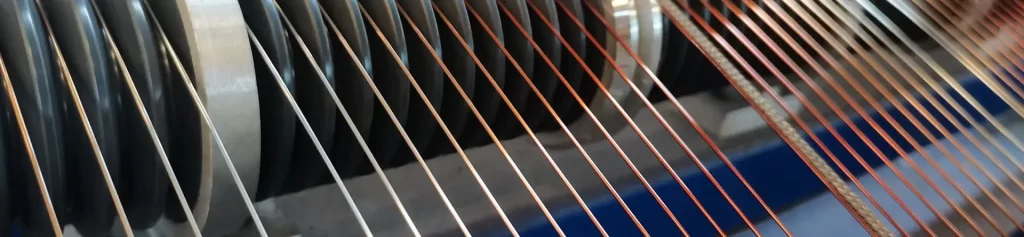
Difference between Copper and Aluminum Magnet Wire
I. Introduction
In the magnetic wire industry, copper and aluminum are two of the most common winding conductor materials. Both use a metallic conductor as the base material and are coated with an insulating layer. However, due to fundamental differences in physical properties, electrical performance, and cost structure, copper and aluminum each have their own advantages and disadvantages in practical applications.
For motor design engineers, transformer manufacturers, and purchasing decision-makers, making a reasonable choice between copper and aluminum wire not only affects the electrical performance, size, weight, and service life of the product, but also directly relates to manufacturing costs and market competitiveness. This article aims to systematically compare and analyze the core differences between copper and aluminum wire from multiple dimensions, including conductivity, mechanical properties, thermal performance, economy, and application scenarios, providing professional selection references for relevant technical personnel.
II. Basic Definitions of Copper Magnet Wire and Aluminum Magnet Wire
2.1 Copper Magnet Wire
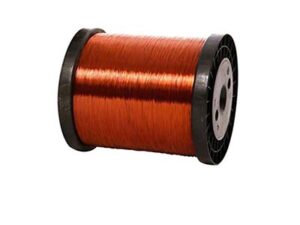
Copper magnet wire is a winding wire with a high-purity oxygen-free copper conductor as the base material and an insulating coating on the surface. Its conductivity is typically ≥101% IACS (International Annealed Copper Standard), making it the most widely used and technologically mature conductor material in the electrical industry.
2.2 Aluminum Magnet Wire
Aluminum magnet wire is a winding wire with a high-purity electrical aluminum conductor as the base material and an insulating coating on the surface. Its conductivity is approximately 61% IACS, lower than copper, but due to its significant cost advantage and lightweight characteristics, it occupies an important position in specific application areas.
III. Core Differences Between Copper and Aluminum Wires
3.1 Conductivity Comparison
Conductivity is the most critical difference between copper and aluminum wires.
| Performance Indicators | Copper | Aluminum |
|---|---|---|
| Conductivity | ≥101% IACS | ≈61% IACS |
| Resistivity (20°C) | ≤0.017241 Ω·mm²/m | ≤0.028264 Ω·mm²/m |
| Resistivity Ratio (Aluminum/Copper) | Baseline | Approximately 1.64 times |
As can be seen from the data, the resistivity of aluminum is approximately 1.64 times that of copper. This means that, for the same cross-sectional area, aluminum has a resistance approximately 64% higher than copper, resulting in higher copper losses (I²R losses) and greater heat generation.
To replace copper with aluminum for the same resistance, the cross-sectional area needs to be increased by approximately 64%, or the conductor diameter by approximately 28%. This difference directly affects the winding volume and space utilization.
3.2 Density and Weight Comparison
The density difference is one of the biggest advantages of aluminum over copper.
| Material | Density (g/cm³) | Weight Ratio (Aluminum/Copper) |
|---|---|---|
| Copper | 8.90 | Baseline |
| Aluminum | 2.70 | Approximately 0.30 times |
Aluminum’s density is only about 30% of copper’s. Even though aluminum requires a larger cross-sectional area to compensate for its lower conductivity, its weight is still significantly lower than that of copper.
For the same resistance, aluminum weighs approximately 50% of copper. This advantage is particularly important in weight-sensitive applications such as aerospace, new energy vehicles, and portable devices.
3.3 Comparison of Mechanical Properties
| Performance Indicators | Copper | Aluminum |
|---|---|---|
| Tensile Strength | High (Soft state ≥250 MPa, Hard state ≥400 MPa) | Lower (Soft state ≥80 MPa, Hard state ≥160 MPa) |
| Elongation | Excellent (≥30%) | Good (≥15%) |
| Bending Performance | Excellent, not easy to break | Good, but prone to fatigue under repeated bending |
| Welding Performance | Good, strong welds | Poor, prone to oxidation, requires special welding process |
| Creep Characteristics | Small creep, good long-term stability | Large creep, prone to deformation under long-term stress |
Copper is superior to aluminum in terms of mechanical strength, flexibility, and welding performance. Aluminum wire is more prone to breakage during winding, especially with fine wires (diameter <0.5mm).
Welding is another major challenge in aluminum wire applications. Aluminum surfaces readily form a dense alumina film (Al₂O₃), which has high resistivity and a melting point as high as 2050°C, severely hindering the welding process. Therefore, welding aluminum wire typically requires specialized fluxes, ultrasonic welding, or cold pressing processes.
3.4 Thermal Performance Comparison
| Performance Indicators | Copper | Aluminum |
|---|---|---|
| Thermal Conductivity | ≈400 W/(m·K) | ≈237 W/(m·K) |
| Coefficient of Thermal Expansion | 17×10⁻⁶/°C | 24×10⁻⁶/°C |
| Melting Point | 1083°C | 660°C |
Copper has a higher thermal conductivity than aluminum, meaning that copper windings have better heat dissipation performance. Aluminum has a larger coefficient of thermal expansion, and its dimensional changes are more significant during temperature cycling, which may lead to increased winding stress and damage to the insulation layer.
3.5 Corrosion Resistance Comparison
Copper forms a dense copper oxide protective film in the atmosphere, exhibiting good corrosion resistance. Although aluminum can form a protective alumina film, its corrosion resistance is significantly weaker than copper in humid, salt spray, or acidic/alkaline environments.
Aluminum is prone to electrochemical corrosion (also known as “galvanic corrosion”) in humid environments. When the aluminum conductor comes into contact with copper terminals or other metal parts, the difference in electrode potential causes aluminum to act as the anode and corrode more rapidly. This problem is particularly pronounced at the terminals of transformers and motors.
3.6 Economic Comparison
Price is the core competitive advantage of aluminum.
| Cost Factors | Copper | Aluminum |
|---|---|---|
| Raw Material Prices (based on 2026 reference prices) | ≈$9,000~10,000/ton | ≈$2,500~3,000/ton |
| Material Cost Ratio | Benchmark | Approx. 25%~30% |
| Manufacturing Cost | Benchmark | Slightly Higher (requires special welding and processing) |
| Overall Cost | High | Low Approx. 40%~50% |
From the perspective of raw material prices, aluminum is only about 25%~30% the price of copper. Even considering the additional costs associated with increasing the cross-sectional area and special processes required for aluminum, the overall cost of aluminum is still about 40%~50% lower than that of copper.
This cost advantage makes aluminum a highly competitive product in cost-sensitive products such as motors for household appliances and small power distribution units.
IV. Comparison of Application Areas of Copper and Aluminum Wires
4.1 Main Applications of Copper Wires
Copper wires, due to their excellent conductivity, mechanical strength, and weldability, are widely used in the following fields:
- Industrial Motors: Large industrial motors, high-voltage motors, special motors
- New Energy Vehicle Drive Motors: High power density, high reliability requirements
- Power Transformers: High-voltage windings, large-capacity transformer windings
- Precision Electronic Components: Relay coils, solenoid valves, precision inductors
- Aerospace Equipment: High reliability, long lifespan requirements
- Servo Motors and Stepper Motors: High-precision control, high dynamic response
4.2 Main Applications of Aluminum Wires
Aluminum wires, due to their lightweight and cost advantages, are mainly used in the following fields:
- Household Appliance Motors: Air conditioner compressor motors, refrigerator compressor motors, washing machine motors
- Small Power Distribution Transformers: Cost-sensitive products
- Fluorescent Lamps and LED Drivers: Low power and low cost requirements
- Consumer Electronics: High-frequency transformers in chargers and adapters
- Some Automotive Motors: Weight-sensitive automotive components
V. Copper vs. Aluminum Wire Selection Guide
5.1 Scenarios for Choosing Copper Wire
Copper wire is recommended as the preferred choice in the following scenarios:
- High power density requirements: Need for small size and high current output
- High reliability requirements: Aerospace, military, medical equipment, etc.
- High temperature and humidity environments: Copper has better corrosion resistance
- Frequent vibration or impact: Copper has higher mechanical strength and better fatigue resistance
- Precision welding requirements: Copper has mature welding technology and reliable weld points
5.2 Scenarios for Choosing Aluminum Wire
Aluminum wire can be considered as the preferred choice in the following scenarios:
- Cost-sensitive products: Mass-produced household appliances
- Lightweight Requirements: Aerospace, New Energy Vehicles (Non-core Power Components)
- Low Power Applications: Situations where conductivity requirements are not high
- Sufficient Space: Acceptable larger winding volume
VI. Common Misconceptions and Precautions
6.1 Misconception 1: Aluminum enameled wire is of poor quality
Fact: The “disadvantage” of aluminum enameled wire is not a quality issue, but rather due to the material’s physical properties. In suitable application scenarios, aluminum enameled wire can fully meet product performance requirements and has significant cost and weight advantages.
6.2 Misconception 2: Aluminum enameled wire cannot be used in motors
Fact: Aluminum enameled wire has been used in the field of household motors for decades. Many well-known household appliance brands use aluminum enameled wire in their compressor motors, which operate stably and reliably. The key lies in the reasonable design of the winding cross-sectional area, improved heat dissipation conditions, and the use of reliable connection processes.
6.3 Misconception 3: Copper is always superior to aluminum.
Fact: Copper and aluminum each have their advantages and disadvantages; there is no absolute “superior” or “inferior.” Selection should be based on a comprehensive evaluation of the specific application scenario, including performance requirements, cost budget, space constraints, weight limitations, etc.
6.4 Precautions: Copper-Aluminum Connection Process
When aluminum windings need to be connected to copper terminals, special connection processes must be adopted to prevent electrochemical corrosion:
- Use copper-aluminum transition joints: Avoid direct contact between copper and aluminum.
- Apply anti-corrosion grease: Prevent electrochemical corrosion in humid environments.
- Ultrasonic welding: Achieve reliable copper-aluminum welding.
- Cold pressing process: Suitable for large cross-section conductor connections.
VII. Conclusion
Copper and aluminum are two important conductor materials in the electrical industry, each with its unique advantages and applicable scenarios.
Copper wire is known for its excellent conductivity, mechanical strength, weldability, and corrosion resistance, making it suitable for applications requiring high power density and high reliability.
Aluminum wire, on the other hand, excels in cost and lightweight characteristics, making it suitable for cost-sensitive products and lightweight applications.
When selecting products, one should not simply use “copper is better than aluminum” or “aluminum is cheaper” as the sole criterion. Instead, factors such as conductivity, mechanical properties, thermal properties, corrosion resistance, cost budget, and application scenario should be comprehensively considered to make the optimal choice.
Zhengzhou LP Industry Co., Ltd. specializes in the research and development and manufacturing of electrical wire products, with 30 years of export experience. We offer high-quality copper wire, aluminum wire, paper-insulated wire, and fiberglass-coated wire, widely used in industrial motors, generators, transformers, and home appliances.
Our factory is ISO9001/ISO14001/ISO45001 certified, and our products comply with IEC/GB/JIS/NEMA international standards.
Please contact us for a quote:
Email: office@cnlpzz.com
WhatsApp: 0086-19337889070