

Last week, a customer working on offshore wind power asked: we need to use aluminum enameled wire in salt spray environments, and regular enamel cracks in 2 years. Is there a corrosion-resistant solution? I said: it depends on which type of corrosion you face. Salt spray, acid rain, humid heat, or chemical media. Different corrosion mechanisms correspond to different enamel solutions.
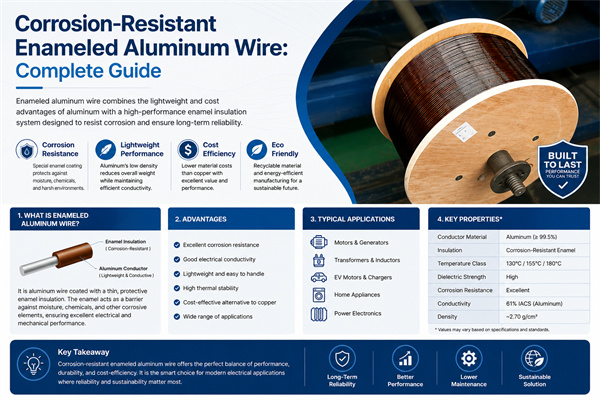
The “corrosion resistance” of aluminum enameled wire is a seriously underestimated topic. Copper enameled wire relies on the chemical stability of copper itself, while aluminum enameled wire relies entirely on enamel insulation. Once the enamel fails, the aluminum wire is corroded through within 1 to 2 months.
This article breaks down corrosion resistance thoroughly. Why aluminum wire is particularly vulnerable to corrosion, 4 typical corrosion mechanisms, 6 anti-corrosion enamel solutions, and 5 selection questions.
Why Aluminum Enameled Wire Is Especially Vulnerable to Corrosion
Copper has high chemical stability and forms a stable copper oxide layer in air at room temperature. Copper enameled wire mainly relies on enamel protection, with low dependence on enamel.
Aluminum is completely different. Aluminum forms an aluminum oxide film (Al₂O₃) in air. This film is dense but extremely thin (2 to 3 nm), and it continues to thicken in humid environments. An 8 to 10 nm oxide film affects enamel adhesion. A 20 to 30 nm oxide film causes enamel peeling.
More critically, aluminum’s oxide film is loose and porous. Unlike copper’s dense protective oxide film, aluminum oxide continues to oxidize underneath, producing pitting corrosion, and eventually penetrates. This means aluminum enameled wire has 100 percent dependence on enamel. Any enamel defect causes the aluminum substrate to start corroding.
Core insight: copper enameled wire is “double insurance” (copper plus enamel). Aluminum enameled wire is “single insurance” (enamel only). This is why corrosion-resistant aluminum enameled wire is technically more difficult and the enamel solution is more complex than corrosion-resistant copper enameled wire.
4 Typical Corrosion Mechanisms
Mechanism One: Salt Spray Corrosion (Offshore, Coastal, Marine Engineering)
Salt spray corrosion is the most common severe environmental corrosion. Cl⁻ ions in salt spray break down aluminum’s oxide film and directly corrode the aluminum substrate.
Typical scenarios: offshore wind power, port equipment, marine platforms, coastal outdoor transformers, marine vessels.
Failure speed: ordinary aluminum enameled wire in ASTM B117 salt spray test (5 percent NaCl solution, 35°C continuous spray) shows pitting corrosion after 168 hours. After 1,000 hours, enamel peels off and aluminum wire cross-section thins.
Salt spray corrosion mechanism on aluminum: Cl⁻ ions have small radius and strong penetration, preferentially attacking aluminum oxide film defects (scratches, pinholes, uneven enamel), forming pitting corrosion pits. Once pitting pits form, occluded cells form inside the pits, accelerating corrosion, and eventually penetrating the enamel.
Mechanism Two: Acid-Alkali Corrosion (Chemical, Electroplating, Industrial Environments)
Acid-alkali corrosion is a typical failure mode in the chemical industry.
Acidic environment (pH below 4): hydrochloric acid, sulfuric acid, nitric acid mist rapidly corrode aluminum. Aluminum is an amphoteric metal, vulnerable to both acids and alkalis.
Alkaline environment (pH above 9): sodium hydroxide and potassium hydroxide solutions dissolve aluminum’s oxide film. Aluminum corrodes 100 to 1,000 times faster in alkaline environments than in neutral environments.
Typical scenarios: chemical plants, electroplating workshops, pickling workshops, battery factories, pesticide factories, fertilizer factories.
Failure speed: ordinary aluminum enameled wire in pH 2 to 3 acidic environment shows pitting within 30 days. In pH 11 to 12 alkaline environment, pitting within 7 days.
Mechanism Three: Humid Heat Corrosion (Tropical, Subtropical, Indoor Damp Heat)
Humid heat corrosion is a common failure mode in subtropical, tropical, and underground environments.
Mechanism: when temperature is 40 to 60°C and relative humidity exceeds 85 percent, enamel water absorption rises (polyester enamel absorbs 2 to 3 percent water), water penetrates to the enamel-aluminum interface, causing enamel blistering and peeling.
Typical scenarios: Southeast Asian home appliances, underground parking lots, tunnel equipment, tropical outdoor transformers, air conditioner outdoor units.
Failure speed: ordinary aluminum enameled wire in 85°C/85 percent RH humid heat test shows blistering after 500 to 1,000 hours.
Special variant: humid heat plus salt spray (coastal areas) plus industrial atmospheric pollution (SO₂, NOx) form “composite corrosion,” with failure speed 3 to 5 times faster than single factors.
Mechanism Four: Electrochemical Corrosion (Stray Current, Dissimilar Metal Contact)
Electrochemical corrosion is a frequently overlooked failure mode.
Mechanism: when aluminum contacts dissimilar metals (copper, iron, stainless steel), galvanic corrosion forms. Aluminum has the most negative potential (-1.66 V) and becomes the anode, accelerating corrosion.
Typical scenarios: aluminum-copper connections, aluminum-iron bracket contacts, aluminum wiring harnesses passing through galvanized steel conduits, aluminum winding to copper lead wire contacts in transformers.
Failure speed: aluminum-copper galvanic couple in salt spray environment shows obvious corrosion within 24 hours. Galvanic corrosion is 10 to 100 times faster than uniform corrosion.
Special note: many customers think “aluminum and copper cannot be directly connected,” but this is unavoidable in actual engineering. The solution is to use copper-aluminum transition joints, nickel-plated aluminum terminals, or corrosion-resistant enamel insulation.
6 Anti-Corrosion Enamel Solutions
For different corrosion mechanisms, the industry has developed 6 mature enamel solutions.
Solution One: Modified Polyesterimide Enamel (Salt Spray Resistant)
Polyesterimide enamel (180°C class) through formulation modification can withstand ASTM B117 salt spray test for 500 to 1,000 hours.
Technical points: adding crosslinkers in enamel to improve density, adding UV absorbers for light aging resistance, adding coupling agents to enhance adhesion with aluminum.
Applicable scenarios: coastal outdoor, marine engineering, offshore wind power.
Cost: 15 to 25 percent more expensive than standard polyesterimide enamel.
Solution Two: Polyamide-Imide Composite Enamel (Acid-Alkali Resistant)
Polyamide-imide enamel (200°C class) has extremely high chemical stability, withstanding pH 1 to 13 range.
Technical points: amide bonds are stable in acid-alkali environments, enamel is dense and pinhole-free, glass transition temperature is high (280°C).
Applicable scenarios: chemical equipment, acid-alkali electroplating workshops, battery factories.
Cost: 30 to 50 percent more expensive than polyesterimide (200°C class itself is more expensive).
Solution Three: Polyimide Enamel (High Temperature and Corrosion Resistant)
Polyimide enamel (220°C class and above) is one of the enamels with the best corrosion resistance.
Technical points: imide ring chemical bonds are extremely stable, enamel is dense, temperature class is high.
Applicable scenarios: high temperature plus corrosion composite environments (aircraft engines, downhole equipment, chemical high-temperature reactors).
Cost: 50 to 100 percent more expensive than polyamide-imide, one of the most expensive of all enamels.
Solution Four: Fluorocarbon Enamel (Weather Resistant, UV Resistant)
Fluorocarbon enamel has excellent gloss and color retention under long-term outdoor exposure, no chalking or cracking for 15 years.
Technical points: F-C bond has high bond energy (485 kJ/mol), UV rays can hardly break it.
Applicable scenarios: outdoor photovoltaic, long-term exposed transformers, photovoltaic combiner boxes, charging stations.
Cost: 100 to 200 percent more expensive than standard enamel, but life is 3 to 5 times that of ordinary enamel.
Solution Five: Epoxy Modified Enamel (Humid Heat Resistant)
Epoxy modified enamel performs excellently in humid heat environments, withstanding 85°C/85 percent RH test for over 2,000 hours without blistering.
Technical points: epoxy groups form strong chemical bonds with aluminum substrate, enamel water absorption is low (below 1 percent), humid heat adhesion retention rate is high.
Applicable scenarios: subtropical home appliances, underground equipment, tunnel engineering, humid environment motors.
Cost: 10 to 20 percent more expensive than standard polyester enamel.
Solution Six: Nano-Modified Enamel (High-End Comprehensive Solution)
Nano-modified enamel (with nano SiO₂, nano Al₂O₃ added) is a new generation comprehensive anti-corrosion solution.
Technical points: nano particles fill enamel micropores, forming labyrinth effect, blocking corrosion medium penetration, while improving mechanical strength and heat resistance.
Applicable scenarios: high-demand comprehensive environments (offshore wind power plus high temperature plus UV), military aerospace, marine platforms.
Cost: 50 to 100 percent more expensive than standard enamel, but with the best overall performance.
5 Selection Questions
When buyers and engineers face corrosion-resistant aluminum enameled wire selection, ask 5 questions first.
Question one: what type of corrosion is your environment? Salt spray, acid-alkali, humid heat, electrochemical, or composite corrosion? Different corrosions correspond to different enamel solutions. Getting the corrosion type wrong makes even the most expensive enamel useless.
Question two: what temperature class is required? Enamel temperature class and corrosion resistance are not completely consistent. 200°C enamel is usually more corrosion-resistant than 130°C enamel, but cost is also higher. Temperature class must be met, but no need for over-configuration.
Question three: what is the product life requirement? 5 years, 10 years, 20 years, or 30 years? The longer the life requirement, the stronger the enamel solution needs to be. Ordinary enamel 5 to 8 years, corrosion-resistant enamel 15 to 30 years.
Question four: are dissimilar metal contacts involved? Aluminum-copper, aluminum-iron, aluminum-stainless steel connections? The threat of galvanic corrosion is much greater than uniform corrosion. Transition joints or isolation enamel must be used.
Question five: what is the cost sensitivity? Corrosion-resistant enamel is 15 to 200 percent more expensive than standard enamel. Select by value, not by price. An offshore wind turbine set is worth tens of millions. Saving a few thousand on enamel cost is not worth it.
Enamel Recommendations for Different Scenarios
Offshore wind power: modified polyesterimide enamel (180°C) plus epoxy primer plus overall sealing. Expected life 20 to 25 years.
Coastal outdoor transformer: modified polyesterimide enamel (180°C) plus UV protection additives. Expected life 15 to 20 years.
Chemical acid-alkali environment: polyamide-imide enamel (200°C) or polyimide enamel (220°C). Expected life 10 to 15 years.
Humid heat subtropical: epoxy modified enamel (Class F 155°C or Class H 180°C). Expected life 12 to 18 years.
Outdoor photovoltaic: fluorocarbon enamel (Class F or Class H). Expected life 15 to 20 years.
Marine platform: nano-modified polyimide enamel (220°C plus). Expected life 25 to 30 years.
Downhole high temperature: polyimide enamel (220 to 240°C). Expected life 5 to 10 years (greatly affected by temperature).
Three Engineering Reminders
Reminder one: enamel thickness matters. The thickness of corrosion-resistant enamel is 30 to 50 percent thicker than standard enamel. National standard GB/T 6109 Grade 1 enamel plus 30 percent is the minimum requirement for corrosion-resistant enamel.
Reminder two: terminal connections need special treatment. The ends of enameled aluminum wire need to be stripped of enamel, oxide layer removed, and nickel or tin plated. Direct crimping with copper terminals will cause galvanic corrosion within 1 to 2 years.
Reminder three: storage and transportation must be standardized. Corrosion-resistant enamel is sensitive to mechanical damage. Pinholes, scratches, and indentations all become corrosion starting points. Avoid friction with hard objects during storage and transportation.