


Introduction
Copper Wire for EV Motor Windings is a critical foundational material issue for new-energy-vehicle (NEV) traction motor systems, directly impacting the traction motor’s power density, efficiency class, operational reliability, service life, and overall vehicle performance. NEV traction motors differ significantly from conventional industrial motors in terms of power density, operating frequency, thermal stress, vibration environment, and service-life requirements—imposing more stringent engineering requirements on copper magnet wire. Understanding the specific requirements of NEV traction motors for copper magnet wire and mastering the application essentials of magnet wire in EV motor windings constitute core knowledge needs for NEV traction motor manufacturers, motor design engineers, OEM procurement engineers, and electric-drive-system integrators.
From the perspective of engineering practice in new-energy vehicle (NEV) traction motors, copper magnet wire delivers engineering value in EV motors that far exceeds its traditional role as “winding conductor.” NEV traction motors typically employ permanent-magnet synchronous motor (PMSM) or asynchronous induction motor configurations, operating at high frequencies, high power densities, elevated temperatures, and under severe vibration conditions. NEV traction motor rotational speeds can reach tens of thousands of revolutions per minute (rpm), with peak power density significantly exceeding that of conventional industrial motors—imposing stringent requirements on copper magnet wire regarding temperature rating, dielectric strength, mechanical strength, skin-effect loss, and proximity-effect loss. The design service life of NEV traction motors is typically specified at over 15 years; consequently, copper magnet wire must maintain stable electrical and mechanical performance over extended periods under high-temperature, vibrational, and chemically aggressive environments.
The engineering implications of copper magnet wire for new-energy vehicle (EV) drive motor windings can be systematically elaborated from eight dimensions: core requirements of EV drive motors for copper magnet wire; insulation coating systems and thermal classes; conductor materials; winding topologies and magnet wire selection; key performance requirements; winding manufacturing processes; thermal management and reliability; and future engineering challenges. This article provides a systematic engineering reference for manufacturers of new-energy vehicle drive motors, motor design engineers, OEM procurement engineers, and electric drive system integrators.
Core Requirements for Copper Magnet Wire in EV Traction Motors
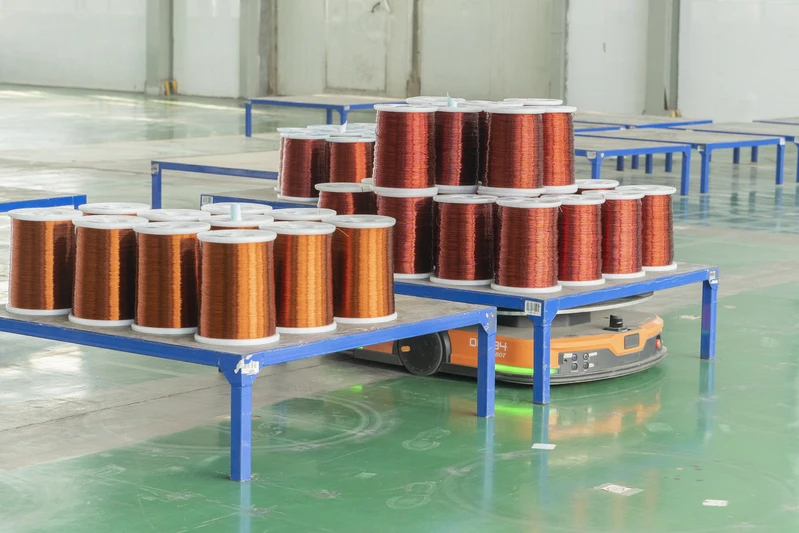
Core requirements for copper magnet wire used in EV traction motors span multiple dimensions—including electrical performance, thermal performance, mechanical performance, and long-term reliability—understanding which forms the foundation for magnet wire selection and application.
Electrical Performance Requirements
The electrical performance requirements for copper magnet wire in EV traction motors primarily focus on high efficiency and high power density. The efficiency class of EV traction motors typically ranges from IE4 to IE5; even minor efficiency variations directly impact the electric vehicle’s driving range and energy economy. The conductor resistance of copper magnet wire directly determines the motor’s copper loss (I²R loss); high-efficiency EV motors require copper magnet wire with minimal conductor resistance.
The high power density requirement of EV traction motors demands that magnet wire carry higher current within limited space. Motor power density has increased from several kilowatts per liter for conventional industrial motors to tens of kilowatts per liter for EV motors, resulting in significantly elevated current density in magnet wire. High current density requires magnet wire to exhibit excellent electrical conductivity, efficient thermal dissipation, and reliable insulation performance.
The high-frequency operation characteristics of EV traction motors impose requirements on the high-frequency performance of magnet wire. The operating frequency of EV traction motors typically ranges from several hundred hertz to several thousand hertz; harmonic currents generated by variable-frequency drives subject the magnet wire to higher skin effect losses and proximity effect losses. The high-frequency performance of magnet wire directly affects the efficiency and temperature rise of EV motors.
Thermal Performance Requirements
EV traction motors impose significantly higher thermal performance requirements on copper magnet wire than conventional industrial motors. Due to their high power density and high current density, EV traction motors operate at elevated temperatures. The peak operating temperature of EV traction motors can reach 150°C to 200°C, while the continuous operating temperature ranges from 130°C to 160°C. Although thermal management in EV traction motors is achieved via water-cooling or oil-cooling systems, the magnet wire must still withstand these elevated continuous operating temperatures.
The thermal cycling characteristics of EV traction motors impose requirements on the thermal shock performance of winding wire. During vehicle start-up, acceleration, deceleration, and shutdown, EV traction motors undergo frequent thermal cycles; the enamel coating of magnet wire must maintain its integrity over prolonged thermal cycling. Enamel aging induced by thermal cycling is one of the primary causes of insulation failure in EV motors.
Mechanical Property Requirements
The mechanical property requirements for copper magnet wire used in EV traction motors primarily focus on vibration resistance, impact resistance, and centrifugal force resistance. During vehicle operation, EV traction motors are subjected to complex vibration environments, requiring the enamel coating of the magnet wire to maintain integrity under prolonged vibration exposure. EV traction motors operate at high rotational speeds, generating substantial centrifugal forces; the centrifugal force acting on the coil end windings of the magnet wire can reach several thousand times gravitational acceleration (g). Sudden acceleration and emergency braking of EVs impose impact loads, necessitating outstanding impact resistance of the magnet wire.
Long-term reliability requirements
Long-term reliability requirements for copper magnet wire used in EV traction motors are significantly higher than those for conventional industrial motors. The design life of EV traction motors is typically required to exceed 15 years, corresponding to driving distances of several hundred thousand kilometers. During extended operation, EV traction motors are subjected to combined stresses—including high temperature, vibration, and chemical media (e.g., ATF oil, coolant, cleaning agents)—and the magnet wire must maintain stable performance under these long-term, multi-stress conditions.
Enamel System and Thermal Class
The selection of the enamel coating system and thermal class for copper magnet wire used in EV traction motors is a critical technical decision.
Primary Enamel Systems
The primary insulation film systems for copper magnet wire used in EV traction motors include polyester-imide (PEI), polyamide-imide (PAI), and polyimide (PI) films. These insulation film systems exhibit excellent high-temperature resistance, mechanical properties, and dielectric properties, making them the preferred insulation films for EV traction motors.
Polyester-imide (PEI) enamel incorporates imide bonds into a polyester base, significantly enhancing thermal stability and enabling a long-term operating temperature of up to 180°C. PEI enamel offers a relatively moderate cost and is a commonly used enamel system for EV traction motors.
Polyamide-imide (PAI) enamel exhibits higher thermal stability and dielectric strength, with a long-term operating temperature of up to 200°C. PAI enamel demonstrates excellent resistance to chemical media, making it suitable for the demanding operating environments of EV traction motors.
Polyimide (PI) enamel coating offers the highest temperature rating, with a long-term operating temperature of 220°C to 240°C. PI enamel is suitable for high-power-density applications in EV traction motors, but incurs relatively higher cost.
Thermal Class Selection
Thermal class selection for copper magnet wire used in EV traction motors must comprehensively consider the motor’s peak temperature, long-term operating temperature, design life, and reliability requirements. The mainstream thermal classes for copper magnet wire used in EV traction motors are typically Class 180 to Class 200; some high-performance EV traction motors employ Class 220 insulation systems.
The thermal class selection must be compatible with the overall insulation system of the EV traction motor. The thermal class of the insulation system is determined by the material with the lowest temperature rating within the system; therefore, the thermal class of the magnet wire must not be lower than the overall thermal class requirement of the insulation system. Selection of the thermal class for the EV traction motor’s insulation system must consider the combined temperature resistance capability of all insulation materials, including magnet wire, insulating paper, impregnating varnish, slot insulation, and end-winding insulation.
Conductor Materials
The selection of conductor material for copper magnet wire used in EV traction motors directly affects motor performance, efficiency, and service life.
High-Purity Oxygen-Free Copper
The conductor material for copper magnet wire used in EV traction motors is typically high-purity oxygen-free copper (OFC). High-purity OFC has a copper content exceeding 99.99% and an oxygen content below 0.001%, offering excellent electrical conductivity, thermal conductivity, and workability.
The application value of high-purity oxygen-free copper in EV traction motors lies in its superior electrical conductivity (low resistivity and low copper loss), excellent thermal conductivity (rapid heat dissipation and low temperature rise), outstanding workability (ease of drawing fine wires and rectangular wires), and exceptional corrosion resistance (strong oxidation resistance). These performance advantages of high-purity oxygen-free copper enable EV traction motors to achieve higher efficiency classes and extended service life.
Conductor Cross-Sectional Shape
Copper magnet wire for EV traction motors is available in a wide variety of conductor cross-sectional shapes, including round wire, rectangular (flat) wire, Litz wire, and rectangular wire for hairpin windings.
Round magnet wire is the conventional conductor form for EV drive motors, suitable for winding configurations such as distributed windings and random windings. The winding process for round magnet wire is well-established and applicable to various motor types.
Flat enameled wire (rectangular-section enameled wire) is a new conductor form for EV traction motors, suitable for high-power-density winding configurations such as hairpin windings, wave windings, and bar windings. Flat enameled wire offers high slot fill factor and excellent heat dissipation performance, making it the mainstream conductor form for EV traction motors.
Litz wire (multi-strand twisted enameled wire) is suitable for high-frequency applications in EV traction motors. Litz wire reduces skin effect losses through multi-strand twisting and is applicable to high-frequency auxiliary motors and high-frequency transformers in EV traction motors.
Hairpin windings using rectangular enameled wire represent the latest conductor configuration for EV traction motors. Hairpin windings achieve high slot fill factor and high power density through processes including flat wire forming, insertion, and welding, and constitute the core winding technology for premium traction motors employed by leading EV manufacturers such as Tesla, Lucid, and BYD.
Winding Topology and Magnet Wire
The winding topology of EV drive motors is closely related to enameled wire selection, and different winding topologies require matching enameled wires.
Distributed Windings and Round Enameled Wire
Distributed winding is the conventional winding topology for EV traction motors. In distributed windings, multiple coil sides are distributed across each stator slot, and the coils are wound using round magnet wire. Distributed windings are suitable for medium- and low-power EV traction motors, featuring a mature winding process and high fault tolerance.
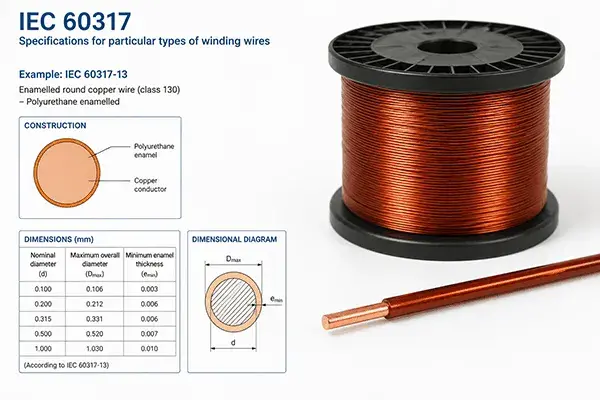
Requirements for round magnet wire used in distributed windings include conductor diameter accuracy (affecting slot fill factor and electromagnetic performance), enamel coating thickness accuracy (affecting slot fill factor and insulation reliability), enamel coating uniformity (affecting dielectric strength consistency), and enamel coating mechanical strength (affecting enamel integrity during winding processing).
Hairpin Windings and Rectangular Enameled Wire
Hairpin winding is a high-end winding topology for EV traction motors. Hairpin windings are formed by shaping rectangular enameled wire into a U-shape (hairpin shape), inserting it into stator slots, and then completing the winding via end-turn twisting, welding, and other processes. Hairpin windings feature high slot fill factor (exceeding 70%), excellent thermal dissipation performance, and high power density, making them the mainstream technological approach for high-end EV traction motors.
Requirements for rectangular enameled wire used in hairpin windings include precision of rectangular cross-sectional area (affecting slot fill factor and electromagnetic performance), precision of enamel coating thickness (affecting slot fill factor and insulation reliability), thermal endurance of the enamel coating (affecting temperature resistance during insertion welding), mechanical strength of the enamel coating (affecting enamel integrity during forming and bending), and solvent resistance of the enamel coating at wire ends (affecting enamel removal prior to welding).
Flat magnet wire for hairpin windings typically employs high-temperature enamel systems such as polyamide-imide (PAI) or polyimide (PI), capable of withstanding high-temperature processes including hairpin forming and insertion welding. Common cross-sectional dimensions for flat magnet wire used in hairpin windings comprise various combinations of width and thickness, tailored to EV traction motors of different power ratings.
Continuous Wave Winding and Rectangular Enameled Wire
Continuous-wave winding is another high-end winding topology for EV drive motors. It is formed by continuously winding flat enameled wire, resulting in a corrugated structure at the winding ends. The advantages of continuous-wave winding include compact end-turn geometry, low end-turn height, and reduced overall motor length.
Requirements for rectangular enameled wire used in continuous-wave windings are similar to those for hairpin windings, including precision of rectangular cross-sectional area, precision of enamel coating thickness, thermal endurance of the enamel coating, and mechanical strength of the enamel coating. The forming process for rectangular enameled wire used in continuous-wave windings is more complex than that for hairpin windings, imposing higher requirements on the mechanical properties of the enameled wire.
Litz Wire Winding and Litz Wire Enamel-Coated Wire
Litz wire winding is a winding topology for high-frequency applications in EV traction motors. Litz wire winding consists of twisted multiple fine enameled wires conforming to standards such as IEC 60317, NEMA MW 1000, ASTM B566, UL 1446, and IATF 16949; the twisted multi-strand structure effectively reduces skin effect losses. Litz wire winding is suitable for high-frequency auxiliary motors and high-frequency operation scenarios of EV traction motors.
Requirements for litz wire used in litz wire windings include precision of individual strand diameter (affecting skin effect control), uniformity of insulation coating on individual strands (affecting overall insulation after stranding), accuracy of stranded structure (affecting proximity effect losses), and flexibility of the stranded enameled wire (affecting winding processability).
Key Performance Requirements
Key performance requirements for copper magnet wire used in EV traction motors include dielectric strength, thermal endurance, resistance to ATF oil, and vibration resistance.
Dielectric Strength
The dielectric strength requirements for copper magnet wire used in EV traction motors are significantly higher than those for conventional industrial motors. EV traction motors operate at higher voltages (typically 400 V to 800 V), and the magnet wire must withstand elevated turn-to-turn voltage, phase-to-phase voltage, and voltage-to-ground. The variable-frequency drive of EV traction motors generates high-frequency harmonic voltages, and the magnet wire must endure the stress imposed by these high-frequency harmonic voltages.
Improvement of dielectric strength depends on increased enamel coating thickness, enhanced enamel coating quality, and improved enamel coating uniformity. Enamelled wire for EV traction motors typically employs thickened or triple-thick enamel coatings to enhance dielectric strength. The development of high-dielectric-strength enamel coatings represents a key technical direction for enamelled wire used in EV traction motors.
Thermal Class Performance
Copper magnet wire for EV traction motors requires exceptional thermal endurance. The continuous operating temperature of EV traction motors can reach 130°C to 160°C, with peak temperatures reaching 150°C to 200°C. The enamel coating must maintain stable performance under prolonged high-temperature exposure, without exhibiting failure modes such as enamel aging, cracking, or delamination.
Enhancement of thermal resistance relies on optimization of the enamel coating system, application of new materials, and improvement of the enamel coating structure. High-temperature enamel systems—such as polyamide-imide (PAI) and polyimide (PI)—are preferred for EV traction motor magnet wire. Development of novel material systems represents the technological frontier for EV traction motor magnet wire.
ATF Oil Resistance
Oil resistance of copper magnet wire for EV traction motors to automatic transmission fluid (ATF) is a specific requirement for EV motors. For EV traction motors—particularly those equipped with oil-cooling systems—the magnet wire is continuously immersed in ATF over extended periods; thus, the wire’s enamel coating must maintain stable performance under prolonged oil immersion without exhibiting failure modes such as dissolution, swelling, delamination, or powdering.
Enhancement of ATF oil resistance relies on optimization of the varnish film system, increased crosslink density of the varnish film, and improved adhesion between the varnish film and conductor. Polyimide (PI) varnish films exhibit excellent ATF oil resistance and are the preferred choice for magnet wire used in EV traction motor oil-cooled systems.
Vibration Resistance
Copper magnet wire for EV traction motors must exhibit exceptionally high vibration resistance. During vehicle operation, EV traction motors are subjected to complex vibrations, requiring the enamel coating of the magnet wire to maintain integrity over prolonged vibration exposure. The high rotational speed of EV traction motors generates substantial centrifugal force, subjecting the coil end windings to centrifugal forces far exceeding those experienced by conventional industrial motors.
Enhancement of vibration resistance depends on the tensile strength of the magnet wire, adhesion between the enamel coating and the conductor, and the fatigue resistance of the enamel coating. Flat magnet wire for hairpin windings must also withstand mechanical stresses during hairpin forming, insertion, and welding processes.
Winding Processing Technology
The winding processing technology for copper magnet wire used in EV traction motors—comprising hairpin forming, insertion, twisting, and welding—is a critical stage in magnet wire application.
Hairpin Forming Process
Hairpin forming is the core process of hairpin winding. Hairpin forming uses a dedicated hairpin forming machine to bend rectangular enameled wire into a U-shape (hairpin shape). The hairpin forming process imposes high mechanical performance requirements on the enameled wire, which must retain enamel coating integrity after bending.
Requirements for magnet wire in hairpin forming processes include film flexibility (no cracking or peeling of the insulation film after bending), film adhesion (adhesion strength between the insulation film and copper conductor), and rectangular wire cross-sectional area accuracy (affecting dimensional accuracy in hairpin forming).
Insertion Process
Insertion is the process of placing pre-formed hairpin conductors into stator slots. This insertion process imposes high requirements on enamel integrity of magnet wire, necessitating that the enamel coating remains undamaged during insertion.
Requirements for magnet wire in the insertion process include enamel coating abrasion resistance (the ability of the enamel coating to resist wear during insertion), enamel adhesion, and enamel thickness accuracy (which affects insertion smoothness).
End Twisting Process
End twisting is a process that twists the ends of hairpin conductors to a specified angle. End twisting creates connection points between the ends of adjacent hairpin conductors, preparing them for subsequent welding. End twisting imposes high requirements on the mechanical properties of the magnet wire.
Requirements for enameled wire in end twisting processes include enamel twist resistance (no cracking of the enamel coating after twisting), enamel adhesion, and rectangular wire ductility (the deformability of rectangular wire during twisting).
Soldering Process
Welding is the process of joining hairpin ends to form a complete winding. Welding methods include laser welding, resistance welding, and TIG welding. The welding process generates high temperatures, and the enamel coating of the magnet wire must maintain thermal resistance during welding.
Welding process requirements for magnet wire include enamel film resistance to soldering temperature (the enamel film remains intact during soldering) and adhesion of the enamel film to the conductor (the enamel film does not delaminate). Prior to welding, the enamel coating in the welding zone is typically removed using methods such as laser stripping, mechanical stripping, or chemical stripping.
Impregnation Process
Impregnation is a critical process in the manufacturing of EV drive motor windings. During impregnation, insulating varnish penetrates between the enameled wires within the winding to form an integral insulation system. The impregnation process imposes requirements on the solvent resistance of the enameled wire and its compatibility with the impregnating varnish.
Thermal Management and Reliability
Thermal management and reliability of copper magnet wire for EV traction motors are critical issues in magnet wire applications.
Thermal Management
Thermal management of EV traction motors is critical to the long-term reliability of magnet wire. Cooling methods for EV traction motors include water cooling, oil cooling, and natural cooling. Water cooling is the most common cooling method for EV traction motors, where coolant circulates through internal cooling channels in the motor housing to remove heat generated during motor operation. Oil cooling is a premium cooling method for EV traction motors, wherein the cooling oil directly contacts the windings, achieving significantly higher heat dissipation efficiency than water cooling.
The role of magnet wire in thermal management systems includes conducting heat generated by electromagnetic conversion (conductor heating), conducting heat generated by dielectric losses in the enamel coating (enamel heating), and transferring heat to the cooling medium (heat conduction path). The thermal conductivity of magnet wire affects motor heat dissipation efficiency, while the temperature resistance of magnet wire impacts long-term motor reliability.
Reliability Testing
Reliability testing of copper magnet wire for EV traction motors includes electrical tests (dielectric strength, film continuity, breakdown voltage), mechanical tests (tensile strength, elongation, film adhesion), thermal tests (thermal shock, thermal aging, thermal cycling), chemical tests (resistance to ATF oil, resistance to coolant), and vibration tests (fixed-frequency vibration, swept-frequency vibration, random vibration).
Accelerated aging testing is a critical method for evaluating the long-term reliability of magnet wire. By elevating the test temperature, accelerated aging testing speeds up enamel film degradation and extrapolates the magnet wire’s maximum operating temperature at its rated service life based on the Arrhenius kinetic model.
Future Engineering Challenges
Copper magnet wire for EV traction motors faces multiple future engineering challenges, including 800 V high-voltage platforms, ultra-high power density, higher efficiency classes, extended service life, and reduced cost.
800 V High-Voltage Platform
The 800 V high-voltage platform represents a development trend for EV traction motors. This 800 V platform significantly enhances the power density and efficiency class of EV traction motors, while imposing higher requirements on the dielectric strength of magnet wire. Under the 800 V platform, the turn-to-turn voltage across the magnet wire doubles that under the 400 V platform; consequently, the magnet wire must employ thicker insulation coatings or superior insulation coating systems to withstand the increased voltage stress.
Ultra-High Power Density
The power density of EV traction motors continues to increase. Higher power density means that magnet wire must carry larger currents within limited space, resulting in significantly increased current density, thermal loading, and mechanical stress on the magnet wire. Ultra-high-power-density EV motors impose higher requirements on the magnet wire’s temperature rating, dielectric strength, and mechanical strength.
Extended Service Life
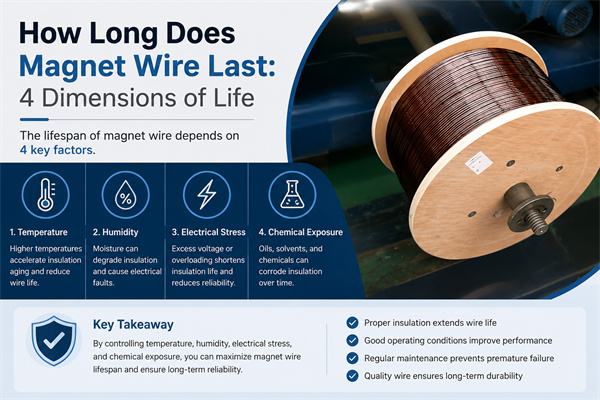
The design service life requirements for EV traction motors continue to increase. A 15-year service life is common for EV traction motors, while high-end EV traction motors may require a service life exceeding 20 years. Extended service life imposes higher demands on the thermal aging life, mechanical fatigue life, and chemical resistance of magnet wire.
Lower Cost
Cost control requirements for EV traction motors drive cost optimization of magnet wire. Magnet wire accounts for a significant proportion of the material cost of EV traction motors; therefore, magnet wire cost optimization is critical to the overall cost competitiveness of EV traction motors. Lower-cost magnet wire must be achieved—while maintaining performance—through material optimization, process optimization, and economies of scale.
Conclusion
The engineering scope of copper magnet wire for new-energy vehicle (NEV) traction motor windings encompasses eight core engineering dimensions: (1) fundamental requirements imposed by NEV traction motors on copper magnet wire—electrical performance, thermal performance, mechanical performance, and long-term reliability; (2) insulation coating systems and thermal classes—including polyester-imide, polyamide-imide, and polyimide high-temperature coatings, rated from Class 180 to Class 220; (3) conductor materials—high-purity oxygen-free copper, available in round wire, rectangular (flat) wire, Litz wire, and hairpin-shaped rectangular wire; (4) winding topologies and corresponding magnet wire types—distributed windings, hairpin windings, continuous wave windings, and Litz wire windings; (5) critical performance requirements—dielectric strength, thermal endurance, resistance to automatic transmission fluid (ATF), and vibration resistance; (6) winding manufacturing processes—hairpin forming, insertion, twisting, welding, and impregnation; (7) thermal management and reliability—thermal management strategies and reliability testing; and (8) future engineering challenges—including 800 V high-voltage platforms, ultra-high power density, extended service life, and reduced cost.
Copper magnet wire for new-energy-vehicle (NEV) traction motors is the core foundational material governing the performance, efficiency, reliability, and service life of EV traction motors. Magnet wire selection must comprehensively consider multidimensional factors including motor power density, efficiency class, operating temperature, winding topology, service life requirements, and cost constraints. Requirements for copper magnet wire in NEV traction motors are significantly more stringent than those for conventional industrial motors; therefore, magnet wire manufacturers must continuously enhance product performance, deepen application research specific to EVs, and expand their product portfolio to supply EV traction motor manufacturers with high-quality, high-performance, and highly reliable magnet wire products.