

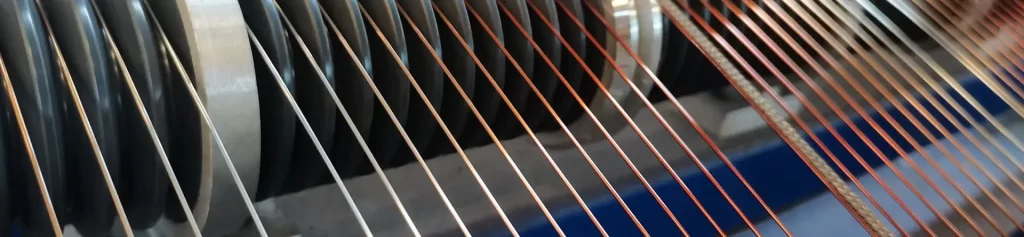
Motor repair and manufacturing are crucial links in the motor industry chain. From the mass production of new motors in the factory to the rewinding of burnt-out motors in the industrial field, high-quality copper winding wire is indispensable. The selection of copper winding wire directly determines the electrical performance, mechanical reliability, lifespan, and maintenance costs of the motor. This article systematically elaborates on the selection principles, enamel coating system, specifications matching, key process points, and quality control of copper winding wire in motor repair and manufacturing, providing a complete technical reference for motor engineers and maintenance technicians.
Classification and Structure of Motor Winding Copper Wire
Motor winding copper wire is classified into round enameled copper wire and rectangular/square enameled copper wire according to its cross-sectional shape. Round enameled copper wire is suitable for general windings in small and medium-sized motors, transformers, inductors, etc., and is the most widely used type of winding wire. Rectangular/square enameled copper wire is suitable for large motors, high-power transformers, and high-density windings, and can significantly improve the slot fill factor.
Based on insulation structure, motor winding copper wires can be classified into single-layer enameled copper, double-layer enameled copper, self-bonded enameled copper, fiberglass-coated, and paper-coated enameled composite types. Ordinary motor stator windings typically use Grade 2 single-layer enameled copper round wire; high-frequency motors and micro-motors for household appliances use Grade 1 enameled copper round wire; high-voltage motors and traction motors use Grade 3 thickened enameled copper; high-temperature motors use PAI or PI double-layer enameled copper; self-bonded enameled wire self-bonds under heating conditions, eliminating the need for impregnation.
Regarding copper conductor materials, motor winding copper wire typically uses oxygen-free copper (OFC) or electrolytic tough-pitch copper (ETP). OFC has a copper purity ≥99.97%, conductivity ≥101% IACS, and resistivity ≤0.01707 Ω·mm²/m; ETP has a copper purity ≥99.90% and conductivity ≥100% IACS. OFC has superior ductility, weldability, and resistance to hydrogen embrittlement compared to ETP, making it the preferred choice for high-end motors and precision windings. Flat enameled copper wire conductors typically use TU1 oxygen-free copper to meet the requirements of high current and high slot fill factor.
Enamel Grade and Insulation Class System
The enamel coating build grade and insulation class are two core dimensions for selecting motor winding wires. The enamel coating build grade determines the enamel coating thickness, while the insulation class determines the maximum operating temperature of the enamel coating.
According to the IEC 60317 standard, the thickness of enameled copper wire is divided into Grade 1 (thin enameled coating, minimum enameled coating thickness), Grade 2 (thick enameled coating, the mainstream industrial grade, approximately 1.4 times that of Grade 1), and Grade 3 (extremely thick enameled coating, approximately 1.8 times that of Grade 1). According to the NEMA MW 1000-2018 standard, it is divided into Single Build, Heavy Build (thick layer, most commonly used), Triple Build, and Quadruple Build. Grade 1 is suitable for precision micromotors, quartz clock coils, and high-density miniature inductors, offering optimal slot fill factor; Grade 2 is the standard choice for industrial motors, household appliances, power tools, and automotive electrical components; Grade 3 is suitable for high-voltage large transformers, railway traction motors, crane motors, the nuclear industry, and submersible pumps.
According to IEC 60085, insulation class directly corresponds to thermal class. Class E (120°C/248°F) uses polyurethane or polyvinyl alcohol acetal coating; Class B (130°C/266°F) uses polyester enamel coating; Class F (155°C/311°F) uses modified polyester or polyester imide enamel coating; Class H (180°C/356°F) uses polyester imide enamel coating; Class C (200°C/392°F) uses polyester imide/PAI double coating enamel coating; Class R (220°C/428°F) uses PAI enamel coating; and Class 240 uses PI enamel coating. When repairing a motor, it is essential to use wire with the same insulation class as the original motor, or select a product of a higher class to improve reliability.
NEMA MW 1000-2018 Part 2 provides a detailed table of specifications for motor windings. MW 46-C to MW 48-C are polyester fiberglass-coated enameled round/flat copper wires, thermal class 155-200°C; MW 50-C to MW 53-C are fiberglass-coated wires with high-temperature organic varnish treatment, 180°C; MW 54-C to MW 55-C are polyester fiberglass-coated wires with varnish treatment, 155°C; MW 60-A to MW 61-C are aromatic polyamide paper-wrapped wires, 220°C; MW 64-A to MW 65-C are polyimide tape-wrapped wires, 240°C; MW 72-C to MW 77-C are polyester/polyimide/polyurethane enameled wires, 130-220°C. Motor maintenance engineers should select the appropriate model according to NEMA MW specifications or IEC 60317 specifications.
Chemical Structure and Properties of Enamel Materials
The enamel coating material determines the thermal class, mechanical strength, insulation performance, and chemical resistance of the enameled copper wire, and is a core technical factor in the selection of motor winding wires. Enamel coating materials are classified into two main categories based on their chemical structure: physically drying enamel (thermoplastic) and chemically drying enamel (thermosetting).
Physically drying lacquer consists of volatile solvents and polymers (such as nitrocellulose). After the solvent evaporates, the insulation layer is composed of linear polymers, which soften upon heating and can be redissolved. Physically drying lacquer, also known as thermoplastic lacquer, is typically used as the outer layer of a double-layered enameled wire, utilizing its heat-softening properties to facilitate adhesion during coil shaping and insulation. Chemically drying lacquer, on the other hand, involves molecular reactions to form a three-dimensional network structure (cross-linked structure). It does not soften upon heating and is resistant to common solvents (such as alcohols, ketones, and esters), making it the ideal choice for the insulation layer of enameled wire. Chemically drying lacquer, also known as thermosetting lacquer, includes polyester, polyester imide, polyamide-imide, and polyimide.
Polyurethane enamel coating (UEW, 130°C) is solderable and automatically decomposes and peels off at welding temperatures, requiring no mechanical removal. It is a common choice for small motors, transformers, and relay coils. Polyester enamel coating (PEW, 130-155°C) has high mechanical strength, good scratch resistance, and a moderate price, making it the standard enamel coating for B/F class motor windings. Polyester imide enamel coating (PEI, 180°C) has better heat resistance than polyester and is the preferred enamel coating for H class motor windings. Polyamide-imide enamel coating (PAI, 220°C) has a softening breakdown temperature of 330-350°C and does not crack under rapid heating and cooling, making it the preferred choice for C class and above high-temperature motors. Polyimide (PI, 240°C) coating has the best heat resistance and is the preferred coating for 240°C high-temperature special motors and aerospace applications.
When repairing motors, the selection of enamel coating materials should be based on the following principles: the insulation class (E/B/F/H/C/R) indicated on the original motor nameplate; the repair budget and reliability requirements; the motor’s operating environment (temperature, humidity, vibration, chemical corrosion); and the expected lifespan after repair. The repair engineer should record the enamel coating material, specification number, manufacturer, and batch number in the repair record for subsequent traceability and quality control.
Selection Differences in Winding Wire between Motor Repair and Manufacturing
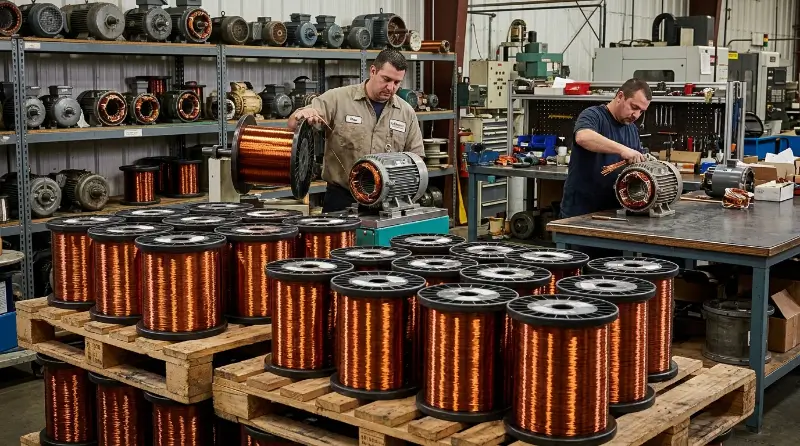
There are significant differences in winding wire selection between motor repair and motor manufacturing. Motor repair aims to replace damaged windings, and the winding wire selection must strictly match the electrical parameters of the original motor. Motor manufacturing aims to mass-produce newly designed motors, and the winding wire selection can be flexibly chosen as long as performance requirements are met.
The selection principles for winding wires in motor repair scenarios include: insulation class matching (must be consistent with the original motor); enamel coating material matching (high-temperature resistant enamel coating can replace low-temperature resistant enamel coating, but not vice versa); enamel coating grade matching (Grade 2 enamel coating is recommended for repair to improve reliability); wire diameter matching (strictly follow the original design wire diameter, with an error ≤ ±0.005mm); and slot fill factor matching (the total cross-sectional area of the winding wires should not exceed 75-80% of the core slot area). Before disconnecting the wires, the repair engineer should record the original winding wire diameter, number of turns, span, winding method, and lead wire position, and take photos for archiving.
The principles for selecting winding wires in motor manufacturing include: calculating the wire diameter and number of turns based on motor power, speed, and efficiency requirements; selecting the enamel coating material based on the working environment (PEW for normal temperature environments, PEI/PAI/PI for high temperature environments); selecting the enamel coating grade based on automated winding requirements (Grade 2 with a self-adhesive layer is recommended for high-speed winding); selecting the enamel coating grade based on cost budget (Grade 1 enamel coating is thinner and 5-15% cheaper than Grade 2); and selecting specifications based on certification requirements (UL, CSA, CE, and CCC certifications have different requirements). Motor manufacturers should specify the winding wire specifications, enamel coating material, enamel coating grade, and manufacturer in the design documents.
Common enamel coating material alternatives in maintenance scenarios: E-grade (UEW) can be replaced by B-grade (PEW) or F-grade (PEI); B-grade (PEW) can be replaced by F-grade (PEI) or H-grade (PEI/PAI); F-grade (PEI) can be replaced by H-grade (PEI/PAI) or C-grade (PAI/PI). However, when replacing materials, it is crucial to ensure that motor cooling is improved simultaneously. Simply upgrading the enamel coating grade without optimizing heat dissipation may lead to other malfunctions.
Rewinding Process Flow
Rewinding is the core process of motor repair, which includes seven steps: wire removal, slot cleaning, winding, wire embedding, shaping, varnishing, and drying.
The wire removal process involves removing the damaged old winding from the core slots. Before removal, all electrical parameters of the original winding (wire diameter, number of turns, span, winding method, and lead-out position) should be recorded. Wire removal can be performed using three methods: mechanical removal (cutting and pulling out), thermal removal (heating until the coating softens and then pulling out), and chemical removal (dissolving the coating with a solvent and then pulling out). Thermal removal temperatures are typically controlled at 300-400°C, while chemical removal can use dimethylformamide (DMF) or a specialized coating solvent.
The core cleaning process involves removing old insulating paper, enamel coating residue, and impurities from the core slots. Cleaning can be done using a wire brush, sandpaper, compressed air, or specialized cleaning tools. After cleaning, the core should be inspected for damage, and the core length and slot dimensions should be measured to ensure they conform to the original specifications. Incomplete cleaning will lead to a decrease in the insulation strength of the new winding.
The winding process involves winding enameled copper wire into a coil according to design parameters. Winding can be done manually, using a semi-automatic winding machine, or a fully automatic CNC winding machine. During winding, tension (usually 10-15% of the wire diameter to avoid damaging the enameled coating), winding speed (to avoid friction damage to the enameled coating), and wire alignment accuracy (to avoid gaps between wires) should be controlled. After winding, the circular enameled wire coil needs to be formed to match the coil shape to the slot shape of the iron core.
The winding process involves embedding the wound coil into the slots of the iron core. Before winding, slot insulation should be placed in the slots. Commonly used materials include DMD (polyester film/polyester fiber nonwoven fabric composite), NMN (Nomex paper/polyester film/Nomex paper composite), and DMDM (DMD double-sided). Special tools should be used during winding to avoid mechanical damage to the enamel coating. After winding, slot wedges should be used to secure the winding.
The shaping process is the final shaping of the wound windings after winding, ensuring that the winding ends meet design requirements. Shaping can be done using a wooden mallet, rubber mallet, or shaping mold. After shaping, the winding resistance and DC resistance imbalance should be measured to confirm that the winding electrical parameters meet design requirements.
The impregnation and drying processes are crucial for motor rewinding, determining the motor’s insulation strength, mechanical strength, heat dissipation performance, and moisture resistance. Impregnation can be performed using three methods: dip impregnation, vacuum pressure impregnation (VPI), and vacuum impregnation (VI). VPI is the standard process for high-end and high-voltage motors, significantly improving the winding’s insulation strength and moisture resistance. After impregnation, drying and curing (typically 150-180°C for 4-8 hours) are necessary to ensure the insulating varnish fully cures.
Motor Types and Winding Wire Selection
Different types of motors have different requirements for winding wires. Induction motors are the most commonly used type of motor in industrial fields, and the selection of winding wires is relatively flexible, typically using PEW enameled copper round wire (Grade 2, 130-155°C). DC motors, due to the presence of commutators and brushes, require winding wires with good corona resistance and insulation strength, commonly using PEI or PAI enameled copper round wire (155-180°C).
Servo motors require high-frequency response, high dynamic performance, and low temperature rise. Therefore, their winding wires must be made of high-purity oxygen-free copper conductor, PEI/PAI enamel coating, and precision wire diameter (tolerance ≤ ±0.003mm). Servo motors often use flat enameled copper wire to improve slot fill factor and power density. Household appliance motors, including air conditioner compressor motors, washing machine motors, refrigerator motors, and fan motors, typically use PEW or PEI enameled copper round wire (Grade 2, 130-180°C) to balance cost and reliability.
The requirements for winding wires in new energy vehicle drive motors (EV Traction Motors) are the highest, demanding high power density, high efficiency, high reliability, and high thermal class. EV drive motors commonly use flat enameled copper wire (Hairpin, Wave Winding, Bar Winding processes) with PEI/PAI enamel coating (180-220°C). Some high-end motors use PEEK enamel coating or PAI/PI double-coating enamel coating. The enamel coating thickness of EV drive motors is typically 20-30% thicker than that of industrial motors, and the breakdown voltage requirement is ≥3000V.
For the maintenance of motors in special scenarios such as high-voltage industrial motors, traction motors, nuclear motors, mining motors, and submersible motors, the selection of winding wires must meet professional standards such as GB/T 11021, IEEE 522, and IEC 60034. Maintenance engineers should refer to relevant standards to select enamel coating materials, coating grades, and insulation classes, and complete the impregnation process according to VPI (Vacuum Injection Process).
Quality Control and Testing Methods
Quality control and inspection of motor winding wires are crucial for ensuring the quality of motor repair and manufacturing. Pre-shipment inspection, warehousing inspection, pre-repair inspection, and post-repair inspection are the four core quality control checkpoints.
Pre-shipment testing is performed by the winding wire manufacturer, and includes tests for wire diameter, outer diameter, enamel coating thickness, enamel coating continuity (pinhole test), breakdown voltage, DC resistance, elongation, springback angle, scratch resistance, adhesion, thermal shock, softening breakdown, solvent resistance, and thermal aging. NEMA MW 1000-2018 Part 1 specifies the pre-shipment testing items and acceptance criteria for winding wires, while the IEC 60817 series of standards specifies the corresponding IEC testing methods. Incoming inspection is performed by the motor repair shop or motor manufacturer, and includes tests for wire diameter, outer diameter, enamel coating thickness, enamel coating continuity, breakdown voltage, and visual inspection.
Pre-repair inspection is performed by the repair engineer, focusing on the appearance of the winding wires (whether the enamel coating is intact, free of bubbles and impurities), wire diameter (tolerance ≤ ±0.005mm), enamel coating continuity (tested with a pinhole tester), and breakdown voltage (using the stranded wire method or foil electrode method). Winding wires that fail the pre-repair inspection should not be used.
Post-repair testing includes insulation resistance testing (megohmmeter, 500V/1000V/2500V), withstand voltage testing (high voltage tester, 1.5-2 times rated voltage), DC resistance testing (bridge, three-phase imbalance ≤5%), phase sequence testing, and inter-turn insulation testing (inter-turn impulse withstand voltage tester). Only motors that pass the post-repair testing can be put into use.
The storage of winding wires is also a crucial aspect of quality control. Enameled copper wires should be stored in a dry environment (relative humidity ≤60%), protected from light (avoiding ultraviolet radiation), and at room temperature (5-30°C) for no more than 1-2 years. Wires stored for excessively long periods should undergo breakdown voltage, thermal shock, and adhesion tests again before use.
Selection Decision Recommendations
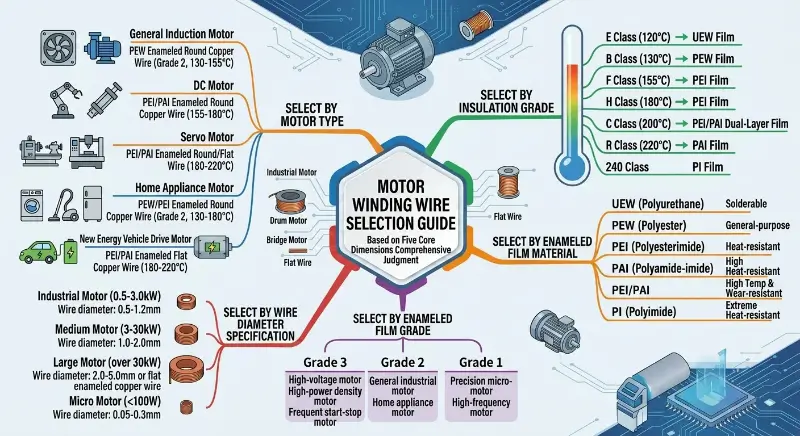
The selection of copper winding wire for motor repair and manufacturing should be based on a comprehensive judgment of five core dimensions: motor type, insulation class, enamel coating material, enamel coating grade, and wire diameter specifications.
Select the appropriate type of wire based on motor type: For general induction motors, choose PEW enameled copper round wire (Grade 2, 130-155°C); for DC motors, choose PEI/PAI enameled copper round wire (155-180°C); for servo motors, choose PEI/PAI enameled copper flat wire (180-220°C); for household appliance motors, choose PEW/PEI enameled copper round wire (Grade 2, 130-180°C); for new energy vehicle drive motors, choose PEI/PAI enameled flat copper wire (180-220°C).
Selection based on insulation class: Class E (120°C) select UEW (enamel coating); Class B (130°C) select PEW (enamel coating); Class F (155°C) select PEI (enamel coating); Class H (180°C) select PEI (enamel coating); Class C (200°C) select PEI/PAI double coating (enamel coating); Class R (220°C) select PAI (enamel coating); Class 240 selects PI (enamel coating).
Select motors according to their enamel coating level: Grade 3 for high-voltage, high-power-density, and frequently start-stop motors; Grade 2 for general industrial motors and household appliance motors; and Grade 1 for precision micro-motors and high-frequency motors.
Select wire diameter according to specifications: Industrial motors (0.5-3.0kW) should use wire diameters of 0.5-1.2mm; medium-sized motors (3-30kW) should use wire diameters of 1.0-2.0mm; large motors (above 30kW) should use wire diameters of 2.0-5.0mm or flat enameled copper wire; micro motors (<100W) should use wire diameters of 0.05-0.3mm.
Conclusion
Copper winding wire is a core material for motor repair and manufacturing, and its selection directly determines the motor’s electrical performance, mechanical reliability, lifespan, and maintenance costs. The enamel coating grade (Grade 1/2/3) and insulation class (E/B/F/H/C/R) constitute the two core dimensions for selecting motor winding wire, while the chemical structure (physical drying/chemical drying) of the enamel coating material (UEW/PEW/PEI/PAI/PI) determines its heat resistance.
Motor repair should strictly adhere to the original motor’s electrical parameters during selection. Insulation class, enamel coating material, enamel coating grade, and wire diameter specifications should all be consistent or improved. Motor manufacturing can be flexibly selected based on motor type, power, efficiency, and lifespan requirements. The rewinding process should strictly follow seven major steps: wire removal, slot cleaning, winding, wire embedding, shaping, enamel impregnation, and drying, with particular focus on controlling the enamel impregnation and drying stages. Quality control should be implemented throughout the entire process, from leaving the factory to warehousing, before repair, and after repair.
With the rapid development of new energy vehicles, industrial automation, wind power generation, and rail transportation, the demand for high-power-density, high-reliability, and high-thermal-class motor winding wires will continue to grow. Flat enameled copper wire, hairpin technology, self-adhesive wire, and high-end PEEK/PI coating will become the core directions for future motor winding wire technology development.