

1 Introduction
Copper conductors and copper-clad aluminum conductors are two mainstream conductor materials for transformer windings. Copper conductors, using pure copper as the current-carrying medium, have advantages such as high conductivity, good mechanical strength, and reliable welding, making them the traditional first choice for power transformers, power supply transformers, and high-frequency transformers. Copper-clad aluminum conductors (CCA) use electrical-grade aluminum as the core material and are coated with oxygen-free copper, forming a bimetallic composite conductor through metallurgical bonding. They have advantages such as light weight, low cost, and high-frequency conductivity close to that of pure copper, and have gradually replaced pure copper conductors in specific applications.
Based on standards such as ASTM B566-04a, NEMA MW 1000-2018, and IEC 60317, this article systematically compares the engineering applications of copper conductors and copper-clad aluminum wires in transformer windings from six dimensions: material composition, electrical performance, mechanical properties, thermal performance, process and cost, application scenarios, and selection evaluation. This provides a systematic selection reference for transformer design and procurement engineers.
2 Comparison of Material Composition
2.1 Material Composition of Pure Copper Conductors
Pure copper conductors are made from electrolytic copper or oxygen-free copper through processes such as drawing, heat treatment, and insulation coating. According to NEMA MW 1000-2018, commonly used copper grades are T2 (C11000 ordinary electrolytic copper) and TU1 (C10100 oxygen-free copper). T2 has a copper content of not less than 99.90%, and TU1 has a copper content of not less than 99.97%. TU1 oxygen-free copper is preferred for transformer windings to reduce the risk of hydrogen embrittlement and contact resistance.
Copper conductors have a density of approximately 8.89 to 8.96 grams per cubic centimeter, a conductivity of 100% (IACS, International Standard for Annealed Copper), a volume resistivity of approximately 1.7241 × 10⁻⁸ ohmmeters, high mechanical strength, good plasticity, and easy soldering, making them a performance benchmark among conductive materials.
2.2 Material Composition of Copper-Clad Aluminum Wire
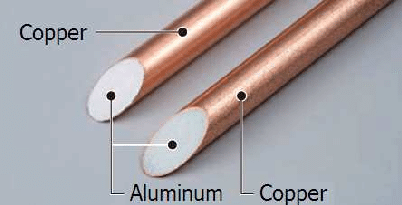
Copper-clad aluminum wire conforms to ASTM B566-04a standard, using an electrical-grade aluminum core as the base material and an outer layer of oxygen-free copper as the outer coating, forming a permanent bimetallic composite conductor through metallurgical bonding. The standard specifies four classes: Class 10A (10% soft copper by volume), Class 15A (15% soft copper by volume), Class 10H (10% hard copper by volume), and Class 15H (15% hard copper by volume).
The thickness of the copper layer is determined by the copper content. A copper layer with a 10% volume ratio is thinner, while a copper layer with a 15% volume ratio is thicker. The copper layer and the aluminum core are metallurgically bonded, resulting in high bonding strength and strong resistance to delamination. Delamination will not occur due to bending or stretching during winding manufacturing.
The density of copper-clad aluminum wire is approximately 3.63 to 4.05 grams per cubic centimeter, falling between 2.70 for pure aluminum and 8.96 for pure copper. The volume resistivity of 15A copper-clad aluminum wire is approximately 2.65 × 10⁻⁸ ohm-meters, and its conductivity is approximately 65% IACS; the volume resistivity of 10A copper-clad aluminum wire is approximately 2.74 × 10⁻⁸ ohm-meters, and its conductivity is approximately 63% IACS.
2.3 Core Differences
Pure copper wire is a monometallic homogeneous material, while copper-clad aluminum wire is a bimetallic composite structure. The two differ systematically in key indicators such as density, conductivity, mechanical strength, and cost, which determines their respective application scenarios.
3 Electrical Performance Comparison
3.1 DC Conductivity
Pure copper has a DC conductivity of 100% IACS. Copper-clad aluminum wire, because the copper layer only occupies 10% or 15% of the cross-section, has a significantly lower DC conductivity than pure copper. Class 15A copper-clad aluminum wire has approximately 65% IACS, and Class 10A approximately 63% IACS. That is, for the same cross-sectional area, the DC resistance of copper-clad aluminum wire is approximately 1.54 to 1.59 times that of pure copper.
For the same resistance requirements, the cross-sectional area of copper-clad aluminum wire needs to be 1.54 to 1.59 times larger than that of pure copper. This relationship is the core trade-off factor in the selection of copper-clad aluminum wire in transformer winding design.
3.2 AC Conductivity and Skin Effect
Pure copper is significantly affected by the skin effect under high-frequency AC, causing current to concentrate on the conductor surface. Copper-clad aluminum wire, with its outer layer of oxygen-free copper and inner layer of aluminum, experiences the skin effect at frequencies above 5 MHz, causing current to concentrate entirely in the copper layer. As a result, the AC conductivity of copper-clad aluminum wire is close to that of pure copper.
This characteristic gives copper-clad aluminum wire unique advantages in high-frequency, radio frequency, and induction heating applications. In the 50-60 Hz power frequency range, the difference in AC conductivity between copper-clad aluminum wire and pure copper is small; in the mid-frequency range above 1 kHz, the relative advantage of copper-clad aluminum wire begins to emerge; and in the high-frequency range above 5 MHz, the high-frequency conductivity of copper-clad aluminum wire is essentially equivalent to that of pure copper.
3.3 Current Carrying Capacity and Temperature Rise
For the same cross-sectional area, the current carrying capacity of copper-clad aluminum wire is approximately 65% to 75% of that of pure copper. This means that to achieve the same temperature rise, the current carrying capacity of copper-clad aluminum wire needs to be compensated for by increasing the cross-sectional area. For the same weight, the current carrying capacity of copper-clad aluminum wire is slightly lower than that of pure copper, but the difference is significantly smaller than in scenarios with the same cross-sectional area.
The temperature rise of the transformer winding is related to multiple factors, including conductor resistance loss, heat dissipation conditions, and insulation class. Due to its higher resistance, copper-clad aluminum wire experiences approximately 1.5 to 1.6 times more copper loss under the same current, resulting in a corresponding increase in winding temperature rise of 8 to 15 K. This temperature rise difference needs to be compensated for in winding design by optimizing cooling design or reducing current density.
3.4 Summary of Electrical Performance Comparison
Pure copper exhibits significantly superior electrical performance compared to copper-clad aluminum wire in DC and power frequency applications. Copper-clad aluminum wire possesses unique advantages in high-frequency applications above 5 MHz, making it a preferred option for high-frequency transformers. Transformer design requires a comprehensive selection of conductor materials based on parameters such as operating frequency, current density, efficiency requirements, and temperature rise limits.
4 Comparison of Mechanical Properties
4.1 Tensile Strength and Elongation
Pure copper T2 has a tensile strength of approximately 200 to 250 MPa and an elongation of 30% to 50%. TU1 oxygen-free copper has a tensile strength of approximately 200 to 230 MPa and an elongation of 35% to 50%. Pure copper has good plasticity and can withstand winding processes with large deformations.
According to ASTM B566-04a standard, copper-clad aluminum wire has the following tensile strengths: Class 10A (soft state) has a tensile strength of not less than 110 MPa and an elongation of not less than 18%; Class 15A (soft state) has a tensile strength of not less than 130 MPa and an elongation of not less than 18%; and Class 10H (hard state) has a tensile strength of not less than 175 MPa and an elongation of not less than 1.5%. The tensile strength of copper-clad aluminum wire is lower than that of pure copper, and while its elongation is acceptable in the soft state, it decreases significantly in the hard state.
Transformer windings must withstand tensile, bending, and torsional stresses during manufacturing. The high ductility of pure copper gives it an advantage in complex winding processes such as large-size rectangular windings and continuously transposed windings. While copper-clad aluminum wire meets the requirements in standard winding processes, special processes are needed to ensure performance under extreme deformation conditions.
4.2 Density and Weight
Pure copper has a density of 8.89 to 8.96 grams per cubic centimeter. Copper-clad aluminum wire, Class 10A, has a density of approximately 3.63 grams per cubic centimeter, and Class 15A approximately 4.05 grams per cubic centimeter. Copper-clad aluminum wire weighs approximately 41% to 45% of pure copper.
Weight advantage is the core selling point of copper-clad aluminum wire in transformer applications. In large-size equipment such as power transformers and distribution transformers, winding weight accounts for 30% to 50% of the total transformer weight; using copper-clad aluminum wire can significantly reduce the overall transformer weight. In weight-sensitive scenarios such as automotive transformers, portable transformers, and aerospace transformers, copper-clad aluminum wire has irreplaceable advantages.
4.3 Bending performance and fatigue life
Pure copper has excellent bending properties and can withstand repeated bending of mandrel diameters from 1d to 5d without damage. Copper-clad aluminum wire, with its outer copper layer and inner aluminum layer, exhibits slightly lower bending performance than pure copper due to the coordinated deformation of the copper and aluminum layers during bending, but it still meets the manufacturing requirements of transformer windings.
The vibration fatigue resistance of copper-clad aluminum wire may decrease during long-term operation due to minor defects in the metallurgical bonding at the copper-aluminum interface. In frequent vibration scenarios, accelerated vibration testing is necessary to verify the winding reliability.
4.4 Summary of Mechanical Properties
Pure copper generally outperforms copper-clad aluminum wire in mechanical properties such as tensile strength, elongation, bending performance, and fatigue life. Copper-clad aluminum wire has significant advantages in density and weight, making it the preferred choice for weight-sensitive applications.
5 Comparison of Thermal Properties
5.1 Thermal Conductivity
Pure copper has a thermal conductivity of approximately 397 watts per meter per Kelvin, making it one of the best thermally conductive metallic materials. Copper-clad aluminum wire, due to its thinner copper layer, has thermal conductivity between that of copper and aluminum. Class 15A copper-clad aluminum wire has an equivalent thermal conductivity of approximately 200 to 240 watts per meter per Kelvin, while Class 10A has approximately 180 to 220 watts per meter per Kelvin.
The thermal conductivity of the winding affects its heat dissipation and temperature rise. The high thermal conductivity of pure copper helps to quickly transfer heat from the winding to the heat dissipation channels. The thermal conductivity of copper-clad aluminum wire is about 50% to 60% of that of pure copper, resulting in a slightly higher winding temperature rise under the same heat dissipation conditions.
5.2 Coefficient of Thermal Expansion
The coefficient of linear expansion of pure copper is approximately 17 × 10⁻⁶ per Kelvin. Due to its copper-aluminum bimetallic structure, the equivalent coefficient of linear expansion of copper-clad aluminum wire is between that of copper and aluminum, approximately 19 to 22 × 10⁻⁶ per Kelvin. The coefficient of thermal expansion of copper-clad aluminum wire is slightly higher than that of pure copper; therefore, the impact of thermomechanical stress on the windings needs to be considered in scenarios involving frequent thermal cycling.
5.3 Short-circuit electrodynamic withstand
The transformer winding withstands short-circuit electrodynamic forces tens of times its rated current during a short circuit. These forces are proportional to the square of the current. Copper-clad aluminum wire, due to its higher DC resistance, experiences higher copper losses and a faster temperature rise under the same short-circuit current. The impact of these short-circuit electrodynamic forces on the mechanical deformation of the winding is roughly equivalent for both copper conductors and copper-clad aluminum wires; however, the mechanical stability of copper-clad aluminum wire windings after a short circuit needs to be verified through testing.
6 Comparison of Process and Cost
6.1 Manufacturing Process
The manufacturing process for pure copper conductors is mature, including processes such as melting and casting, continuous casting and rolling, stretching, annealing, enamel coating, and curing. The enamel coating process for pure copper conductors is mature and can achieve high-speed continuous production.
The manufacturing process of copper-clad aluminum wire includes aluminum core preparation, copper cladding, metallurgical bonding, stretching, annealing, and enamel coating. Copper cladding is a key process, and common methods include electroplating, co-extrusion, and hydrostatic extrusion. ASTM B566-04a specifies a metallurgical bond between copper and aluminum, characterized by high bond strength and strong resistance to delamination. The stretching process of copper-clad aluminum wire requires special control to prevent copper layer breakage.
6.2 enamel coating Coating
Both pure copper conductors and copper-clad aluminum wires can be coated with various enamel coatings. The enamel coating system specified in NEMA MW 1000-2018 is suitable for two types of conductors: polyurethane UEW 130 to 180 degrees Celsius, polyester PEW 155 degrees Celsius, polyester imide EIW 180 degrees Celsius, and polyamide-imide AIW 220 degrees Celsius. The copper layer on the surface of copper-clad aluminum wire gives it excellent solderability, allowing for the use of polyurethane solder enamel coatings.
The enamel coating process for copper-clad aluminum wire is basically the same as that for pure copper, and the enamel coating has good adhesion. However, the risk of electrochemical corrosion at the copper-aluminum interface needs to be considered during long-term operation of copper-clad aluminum wire.
6.3 Welding and Connection
The welding process for pure copper conductors is mature, and various techniques such as tin soldering, silver soldering, laser welding, and resistance welding can be used. Pure copper welded joints have high mechanical strength and stable electrical properties.
Copper-clad aluminum wire, with its outer layer of oxygen-free copper, can be welded using the same process as pure copper, exhibiting excellent weldability. However, when connecting copper-clad aluminum wire to copper terminals, the risk of electrochemical corrosion due to direct copper-aluminum contact must be considered. It is recommended to use a copper-aluminum transition joint or tin plating.
6.4 Cost Comparison
The price of pure copper materials is significantly affected by international copper prices. In 2026, the price of copper in the bulk market was estimated at approximately US$9,000 to US$10,000 per ton. The cost of copper-clad aluminum wire is significantly lower due to the high proportion of aluminum in the core. The cost of Class 10A copper-clad aluminum wire is approximately 35% to 45% of that of pure copper, and that of Class 15A is approximately 45% to 55% of that of pure copper.
Taking into account material costs, processing costs, transportation costs, and structural cost savings resulting from the reduction in the total weight of the transformer, the overall cost of copper-clad aluminum wire transformers can be reduced by 15% to 30% compared to pure copper transformers.
7 Comparison of Application Scenarios
7.1 Application of pure copper transformer
Pure copper transformers dominate in the following scenarios: high-voltage power, large-scale power transformers with voltage levels of 110 kV and above; high-efficiency power supplies, high-efficiency transformers in power frequency or medium frequency scenarios; high-reliability transformers, in scenarios with stringent reliability requirements such as nuclear power, military, and medical applications; and high-current transformers, in high-current industrial applications such as electrolysis, electroplating, and electric furnaces.
7.2 Application of Copper-Clad Aluminum transformer
Copper-clad aluminum transformers offer advantages in the following scenarios: power distribution (10-35 kV), where weight reduction leads to significant savings in transportation and installation costs; high-frequency transformers (1 kHz and above), including high-frequency electronics and induction heating; automotive and portable transformers, suitable for weight-sensitive applications such as new energy vehicles, rail transportation, and aerospace; low-frequency audio transformers, used for audio signal transmission; and mid-to-low-end electronic transformers, suitable for cost-sensitive applications such as consumer electronics and home appliances.
7.3 Application Selection Principles
Application selection should be based on a comprehensive evaluation of multiple dimensions, including operating frequency, efficiency requirements, weight constraints, cost budget, and reliability requirements. Pure copper and copper-clad aluminum wire each have their advantages in transformer windings; engineers should select the most suitable conductor material based on specific operating conditions.
8 Key Points for Selection and Evaluation
The selection of transformer winding conductor materials should be comprehensively evaluated from six dimensions: operating frequency, efficiency requirements, weight constraints, cost budget, reliability requirements, and expected lifespan.
In terms of operating frequency, pure copper has better electrical performance than copper-clad aluminum wire in the 50 to 60 Hz power frequency scenario, so pure copper should be the preferred choice; in the 1 to 100 kHz mid-frequency scenario, the performance difference between the two narrows, and the choice can be made based on a combination of weight and cost; in the 5 MHz and above high-frequency scenario, the high-frequency performance of copper-clad aluminum wire is close to that of pure copper, so it can be the preferred option.
In terms of efficiency requirements, high-efficiency transformers should prioritize pure copper to avoid efficiency drops due to increased copper losses; for medium-efficiency transformers, copper-clad aluminum wire can be used, sacrificing efficiency for cost savings.
Regarding weight constraints, copper-clad aluminum wire should be given priority in weight-sensitive applications such as automotive, aerospace, and portable devices; pure copper can be given priority in weight-insensitive applications such as stationary power transformers and power distribution transformers.
In terms of cost budget, copper-clad aluminum wire can be given priority in cost-sensitive scenarios such as consumer electronics, home appliances, and low-end industrial transformers; pure copper should be given priority in cost-insensitive scenarios such as high-end medical, military, and nuclear power.
In terms of reliability requirements, pure copper should be preferred for high reliability scenarios to avoid the risk of electrochemical corrosion at the copper-aluminum interface during long-term operation of copper-clad aluminum wire; copper-clad aluminum wire can be used for scenarios with medium reliability requirements.
In terms of lifespan expectation, pure copper should be the preferred choice for long-life transformers with a lifespan of 30 years or more; copper-clad aluminum wire can be used for medium-life transformers with a lifespan of 10 to 20 years; and copper-clad aluminum wire is the economical choice for short-life equipment with a lifespan of 5 to 10 years.
In terms of testing and verification, regardless of whether pure copper or copper-clad aluminum wire is used, the supplier should be able to provide type test reports that comply with standards such as ASTM B566, NEMA MW 1000, and IEC 60317, and have specific test data for dielectric breakdown voltage, thermal level, mechanical flexibility, and accelerated thermal aging.
9 Engineering Evolution Trends
Copper conductors and copper-clad aluminum wires are showing a complementary and coexisting development trend in transformer windings. Pure copper conductors maintain a dominant position in high-voltage power, high-efficiency power supply, and high-reliability applications. Copper-clad aluminum wires continue to see increased usage in power distribution, high-frequency applications, and automotive and portable applications.
In future development, pure copper conductors will evolve towards higher purity, higher conductivity, and higher mechanical properties, with new materials such as oxygen-free copper and single-crystal copper being gradually promoted. Copper-clad aluminum wires, on the other hand, will evolve towards a higher copper content, more stable metallurgical bonding, and better high-frequency performance. The proportion of 15A-class copper-clad aluminum wires in high-frequency transformers is expected to further increase.
Emerging applications such as 800-volt high-voltage platform drive for new energy vehicles, traction for rail transit, voltage boosting for offshore wind power, and special applications in aerospace will provide new application space and development opportunities for copper-clad aluminum wire and pure copper conductor.
10 Conclusion
Copper conductors and copper-clad aluminum wires each have their own technical advantages and application scenarios in transformer windings. Copper conductors, using pure copper as the current-carrying medium, have high conductivity, good mechanical properties, reliable welding, and long lifespan, making them the traditional first choice for power transformers, power supply transformers, and high-frequency transformers. Copper-clad aluminum wires, with electrical-grade aluminum as the core and oxygen-free copper as the outer layer, are lightweight, low-cost, and offer high-frequency performance close to that of pure copper, making them a preferred solution for power distribution transformers, high-frequency transformers, and automotive and portable transformers.
Selection decisions should be based on a comprehensive evaluation across multiple dimensions, including operating frequency, efficiency requirements, weight constraints, cost budget, reliability requirements, and expected lifespan. Pure copper is the preferred choice for applications requiring high power frequency, high efficiency, high reliability, and long lifespan; copper-clad aluminum wire can be used for medium frequency, weight-sensitive, cost-sensitive, and medium lifespan applications. With the development of strategic emerging industries such as new energy, rail transportation, and aerospace, copper conductors and copper-clad aluminum wires will complement and integrate with each other in more scenarios, jointly supporting the continued development of fields such as power electronics and energy conversion.
Contact Information:
- E-mail: office@cnlpzz.com
- WhatsApp: 0086-19337889070
- Zhengzhou LP Industry Co., Ltd.