


Solid-State Battery (SSB) is the next-generation battery technology — the electrolyte shifts from liquid organic to solid (sulfide / oxide / polymer), and the anode shifts from graphite to lithium metal (theoretical capacity 3860 mAh/g, 10× that of graphite, doubling the energy density to 400–500 Wh/kg, theoretical 1000 Wh/kg). Global 8 leading brands including QuantumScape / Solid Power / Samsung SDI / Toyota / CATL / ProLogium have invested over USD 10 billion in R&D. Copper foil plays five major roles in solid-state batteries: anode current collector (lithium metal substrate), anode-free current collector, tab copper foil, Cu-Al transition, and encapsulation copper foil (housing / pouch). 6–10 μm ultra-thin copper foil + carbon / nickel surface treatment + ultra-low roughness Ra ≤ 0.5 μm — these are the biggest differences from liquid Li-ion copper foil (8–12 μm). Below, we clarify the specifications of copper foil for solid-state batteries based on the latest 2025–2026 data.
I. Three Mainstream Technology Routes for Solid-State Batteries
- **Sulfide Route** — The mainstream commercialization route, with major investments from QuantumScape / Samsung SDI / Toyota / CATL / Solid Power. Representative materials include Li₆PS₅Cl / Li₁₀GeP₂S₁₂ (LGPS), with conductivity of 10⁻²–10⁻³ S/cm (close to liquid electrolyte). Challenges: moisture-sensitive (reacts with water to produce H₂S), inert atmosphere processing required, and high risk of lithium dendrite penetration.
- **Oxide Route** — The stable solution, with major investments from ProLogium / WeLion / QuantumScape (partial). Representative materials include LLZO (Li₇La₃Zr₂O₁₂) / LATP (Li₁₊ₓAlₓTi₂₋ₓ(PO₄)₃), with conductivity of 10⁻³–10⁻⁴ S/cm. Challenges: ceramic brittleness, large interface impedance, and high-temperature sintering required (800–1000°C).
- **Polymer Route** — The flexibility solution, with major investments from Bolloré / CATL Polymer / Factorial Energy. Representative materials include PEO / PVDF-HFP, with conductivity of 10⁻⁴–10⁻⁵ S/cm. Challenges: poor room-temperature performance, requires 60–80°C operation, and high mass production cost.
Impact on copper foil: the sulfide route requires carbon or nickel plating on copper foil (to suppress lithium dendrite + improve interface contact); the oxide route requires copper foil + oxide electrolyte co-sintering (interface fusion); the polymer route requires flexible copper foil + composite interface layer.
II. Five Major Application Scenarios for Solid-State Batteries
- **EV Electric Vehicles (500–800 km range)** — The mainstream application, single vehicle 50–100 kWh, 400–500 Wh/kg energy density (1.5–2× that of liquid Li-ion), 8–15 minute fast charging. Representatives: Toyota / Volkswagen (Squab Battery) / NIO 150 kWh semi-solid battery pack.
- **eVTOL Flying Cars / Electric Aircraft** — High energy density + safety, single vehicle 200–500 kWh, 500+ Wh/kg, zero ignition / explosion (solid electrolyte is non-flammable). Representatives: Joby Aviation / Archer / EHang / XPeng AeroHT.
- **ESS Energy Storage Stations** — High safety + long cycle life, single system 1–10 MWh, >10,000 cycles (2× that of liquid), zero thermal runaway. Representatives: NGK / BYD魔方 / CATL EnerC.
- **Consumer Electronics** (wearables / smartphones) — Miniaturization + high energy density, single device 1–20 Wh, 500 Wh/kg, flexible and bendable. Representatives: Apple (patents) / Samsung / ProLogium pouch.
- **Robotics / Drones / Defense** — High energy density + wide temperature range, single unit 0.5–50 kWh, 400–500 Wh/kg, -40°C ~ 80°C operation. Representatives: Boston Dynamics / DJI / Tesla Optimus.
III. Five Major Applications of Copper Foil in Solid-State Batteries
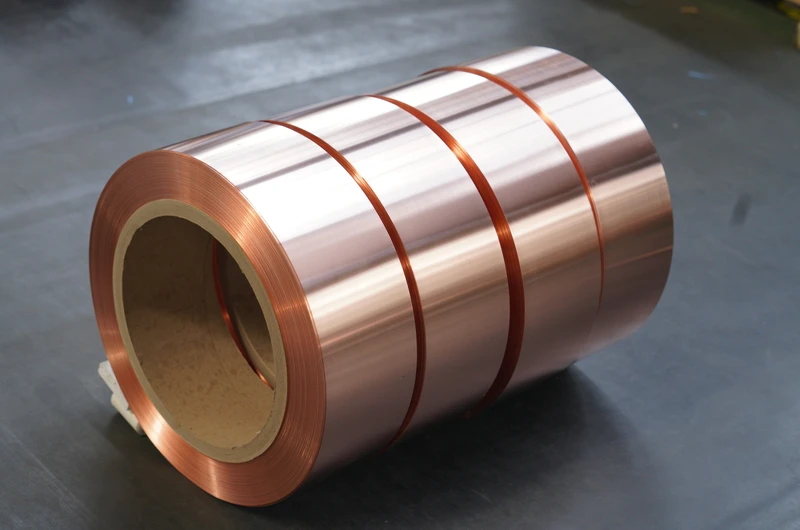
- **Anode Current Collector** — Lithium metal anode deposition substrate, thickness 6–10 μm × width 300–600 mm, alloy C11000 / C10100, carbon plating (carbon coating) — to suppress lithium dendrite + improve interface contact + reduce interface impedance. Key indicators: ultra-low roughness Ra ≤ 0.5 μm (vs. liquid Li-ion Ra 1.5–3.0 μm); tensile ≥ 294 MPa; elongation ≥ 5%.
- **Anode-free Current Collector** — The latest frontier direction, lithium metal directly deposited on copper foil (no traditional anode material), thickness 6–10 μm, alloy C10100 / 4N high-purity copper, silver / carbon / nickel plating; interface modification layer 50–200 nm (Au / Ag / Sn). Key indicators: energy density 30–50% higher than traditional Li-ion; challenges: lithium deposition uniformity + cycle life.
- **Tab Copper Foil** — Continuing the mature solution from liquid Li-ion, thickness 0.1–0.5 mm, alloy C11000 / C10100, nickel plating; contact resistance ≤ 0.1 mΩ. Mainstream forms: single-layer / multi-layer laminated tab.
- **Cu-Al Transition Copper Foil** — Specifically for prismatic aluminum case solid-state batteries, thickness 0.2–0.5 mm, alloy C11000 + 1060 industrial pure aluminum, nickel plating + ultrasonic welding; contact resistance ≤ 0.05 mΩ.
- **Encapsulation Copper Foil** (housing / pouch) — For pouch solid-state battery encapsulation, thickness 0.05–0.2 mm, alloy C11000 / T2 copper, nickel / tin plating; blocks oxygen + blocks moisture (especially critical for sulfide electrolyte).
IV. Key Specifications and Typical Values
| Category | Thickness (μm) | Alloy | Surface Treatment | Typical Application | Key Indicator |
|---|---|---|---|---|---|
| SSB Anode Current Collector | 6–10 | C11000 / C10100 | Carbon / Nickel Plating | Lithium Metal Anode | Ra ≤ 0.5 μm |
| Anode-free Current Collector | 6–10 | C10100 / High-Purity Cu | Silver / Carbon Plating | Direct Li Deposition | Interface Layer 50–200 nm |
| Tab Copper Foil | 100–500 | C11000 / C10100 | Nickel Plating | Li-ion Tab | Contact Resistance ≤ 0.1 mΩ |
| Cu-Al Transition | 200–500 | C11000 + 1060 | Nickel Plating | SSB Prismatic | Contact Resistance ≤ 0.05 mΩ |
| Encapsulation Copper Foil | 50–200 | C11000 / T2 | Nickel / Tin Plating | Pouch Encapsulation | Oxygen + Moisture Barrier |
Key figures: mainstream SSB copper foil thickness 6–10 μm (vs. liquid Li-ion 8–12 μm); ultra-low roughness Ra ≤ 0.5 μm is the core SSB requirement (vs. liquid Li-ion Ra 1.5–3.0 μm); carbon plating (carbon coating) is the mainstream SSB surface treatment (suppresses lithium dendrite + improves interface); tensile ≥ 294 MPa (typical TOB-C08 value); 99.9% purity is the basic requirement. ASTM B566 (battery copper foil international standard), UL 2580 (EV battery safety), IEC 62660 (power battery performance), GB 38031 (Chinese power battery safety), GB/T 5231 (wrought copper and copper alloy), IATF 16949 (automotive quality management), and RoHS / REACH (environmental) are the main reference standards.
V. Market Size and Growth
Comparing four independent data sources side by side:
| Data Source | 2024–2025 | 2030–2035 | CAGR |
|---|---|---|---|
| LinkedIn (Global Li-ion Anode Material) | 2024 = USD 4.5 Billion | 2033 = USD 11.55 Billion | 12.5% |
| Data Bridge (Lithium Metal Anode) | Commercialization accelerating, Gigafactory investment | — | — |
| Factorial / German Research (Energy Density) | 250 Wh/kg (Liquid) | 500 Wh/kg (SSB) | Doubling |
Taken together, the global SSB market in 2024–2025 was approximately 50 GWh / USD 3–8 billion, growing to 500 GWh / USD 20–80 billion by 2030, with all four institutions showing strong momentum (CAGR 30%–45%+). The 36Kr industry scope (global SSB installed capacity): 50 → 500 GWh (CAGR 45%+), representing the Chinese mainstream forecast; LinkedIn (Li-ion anode material): USD 4.5 → 11.55 billion (CAGR 12.5%), covering liquid + solid-state.
SSB copper foil demand estimation: each 50–100 kWh BEV uses 5–15 kg of copper foil (vs. liquid Li-ion 40–180 kg), with global 500 GWh installation (2030) × 30 kg/vehicle × 0.5 = 750,000 tons per year of SSB copper foil (about 1/3 of liquid Li-ion), corresponding to a market size of USD 0.5–1.0 billion (C11000 average price USD 60–120/kg). SSB copper foil unit price is 30–50% higher than liquid Li-ion (ultra-thin + carbon coating + ultra-low roughness premium).
VI. Competitive Landscape and Applications
- **QuantumScape (USA)** — Oxide + lithium metal, partnering with Volkswagen, 100% silicon anode + anode-free dual route, trial production in 2025 / mass production in 2026.
- **Solid Power (USA)** — Sulfide + lithium metal, partnering with BMW / Ford, silicon anode + lithium metal dual route, trial production in 2026.
- **Samsung SDI (Korea)** — Sulfide route, mass production in 2027, energy density 400–500 Wh/kg.
- **Toyota / Idemitsu Kosan (Japan)** — Sulfide route, mass production in 2027–2028, range 1000 km, 10-minute fast charging.
- **CATL (China)** — Sulfide + condensed battery (semi-solid), mass production in 2027, Qilin condensed range 1000 km.
- **BYD (China)** — Oxide route, semi-solid battery already in small-batch production, all-solid-state trial production in 2027.
- **NIO 150 kWh Semi-Solid Battery Pack** — Supplied by WeLion, 360 Wh/kg, mass production in 2024 (ET7 vehicle).
- **ProLogium (Taiwan, China)** — Oxide route, pouch solid-state battery mass production, 5–20 GWh production line.
VII. Procurement Notes
1. **Identify the copper grade clearly**: C11000 ETP (Cu ≥ 99.9%) is the mainstream for SSB copper foil; C10100 4N is used for anode-free + high-end cells.
2. **Thickness selection**: 6–10 μm is mainstream for SSB (vs. liquid Li-ion 8–12 μm); thickness tolerance ≤ ±0.5 μm.
3. **Surface roughness**: Ra ≤ 0.5 μm is the hard requirement for SSB (vs. liquid Li-ion Ra 1.5–3.0 μm); single-side Rz ≤ 2.0 μm.
4. **Surface treatment**: Carbon plating (carbon coating) is the mainstream solution to suppress lithium dendrite; nickel plating suits Cu-Al transition; silver / gold plating is used for anode-free.
5. **Mechanical properties**: Tensile ≥ 294 MPa (typical TOB-C08 value), elongation ≥ 5%; high stress uniformity (to avoid uneven lithium deposition).
6. **Interface modification**: Carbon coating thickness 50–200 nm (carbon content 95%+); excellent lithiophilicity (lithium wetting angle ≤ 30°).
7. **Inspection items**: Thickness tolerance, surface roughness (Ra), resistivity (≤ 1.72 × 10⁻⁸ Ω·m), tensile strength, elongation, plating adhesion (≥ 3.4 N), surface wetting angle (≤ 30°), salt spray test (≥ 96h), flame retardant (UL94 V-0), thermal cycling (-40°C ~ 85°C, 500 cycles), RoHS 6 items.
8. **Certifications and compliance**: ASTM B566 (battery copper foil); UL 2580 (EV battery safety); IEC 62660 (power battery performance); GB 38031 (Chinese power battery); IATF 16949 (automotive quality management); RoHS / REACH (environmental).
Final Thoughts
When selecting copper foil for solid-state batteries, the key is to remember “five major roles + 6–10 μm ultra-thin + carbon plating + ultra-low roughness” — these are the biggest differences from liquid Li-ion copper foil (8–12 μm + nickel plating / no coating). Global SSB installed capacity will reach approximately 500 GWh by 2030 (CAGR 45%+); the SSB copper foil market demand will reach USD 0.5–1.0 billion (2030). Lithium metal anode + anode-free + sulfide electrolyte are the three major technology breakthroughs, and carbon-coated copper foil + ultra-low roughness copper foil are the new supply chain growth drivers for SSB.
If you are evaluating solid-state battery copper foil suppliers (anode current collector / anode-free current collector / tab copper foil / Cu-Al transition / encapsulation copper foil), please contact Zhengzhou LP Industry Co., Ltd. Email: office@cnlpzz.com, WhatsApp: 0086-19337889070. We offer 6–10 μm C11000 / C10100 ultra-thin copper foil + full-process surface treatment (carbon / nickel / silver plating), with Ra ≤ 0.5 μm ultra-low roughness, tensile ≥ 294 MPa, and carbon coating layer 50–200 nm. Customized specifications and OEM processing are supported. ASTM B566 / UL 2580 / IEC 62660 / GB 38031 / IATF 16949 compliance support is available.