


Solenoid valves are the “switch” of fluid control systems — hydraulic systems, pneumatic systems, medical equipment, automotive transmissions, and home appliance water inlets all depend on them. Their core is the copper coil winding: electricity generates a magnetic field that drives the valve core to open or close. This winding demands high-frequency switching (10+ times per second), high-temperature resistance (oil temperature 120°C+), and long service life (DC 24V continuous operation for 1000+ hours). Below, we clarify the specifications of copper foil for solenoid valves based on the latest 2025–2026 market data.
I. Four Mainstream Types of Solenoid Valves
- **Direct-Acting Solenoid Valve** — The electromagnetic force directly drives the valve core, suitable for small-caliber (DN 1–10 mm), with fast response (< 10 ms), commonly used in medical equipment and precision control. Representatives: Burkert 6213 series, SMC VX21 series.
- **Pilot-Operated Solenoid Valve** — The electromagnetic force drives the pilot valve, while the media pressure drives the main valve, suitable for large-caliber (DN 15–300 mm), accounting for 56% of the global market (Future Market Insights 2026). Representatives: Danfoss EV220B, Bosch Rexroth 4WE6 series.
- **Proportional Solenoid Valve** — The output flow is proportional to the input current, high-end control, commonly used in CNC hydraulics and robot pneumatic grippers. Representatives: Bosch Rexroth 4WREE, Festo VPPM series.
- **Servo-Proportional Solenoid Valve** — With position feedback, the highest precision (±0.5%), commonly used in injection molding machines and rolling mills. Representatives: Moog D633/D634 series, Atos DLHZO series.
Impact on copper foil: Direct-acting and small-caliber pilot-operated types use round enameled copper wire (diameter 0.05–0.5 mm); proportional valves and servo-proportional valves use rectangular flat copper coils (thickness 0.5–2.0 mm), emphasizing high-density slot fill.
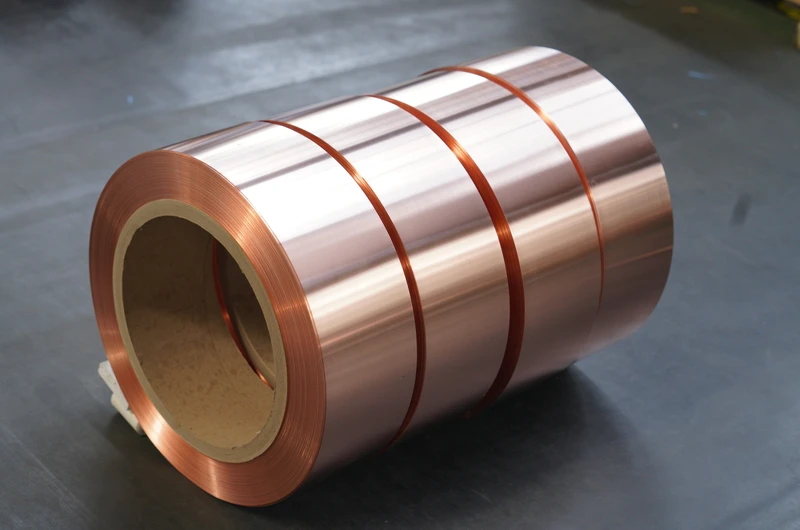
II. Three Main Applications of Copper Foil in Solenoid Valves
- **Coil Skeleton Winding** — Mainstream solution. Round enameled copper wire with diameter 0.05–0.5 mm wound on a PBT/PA66 skeleton, with 3UEW / PEW / UEW enamel coating (heat resistance 130–180°C).
- **Flat Copper Coil (Rectangular Coil)** — High-end proportional valve solution. Flat copper foil with thickness 0.5–2.0 mm × width 3–8 mm, slot fill 30–40% higher than round wire, with better heat dissipation. Representative: Bosch Rexroth 4WREE proportional valve coil.
- **Terminal Block / Lead Wire (Litz Wire / Terminal)** — Coil terminals connecting to the external power supply. T2 copper foil thickness 0.3–0.8 mm, or Litz multi-strand wire (reducing high-frequency skin effect).
III. Key Specifications and Typical Values
| Category | Diameter/Thickness (mm) | Width (mm) | Purity | Enamel Type | Thermal Class |
|---|---|---|---|---|---|
| Pilot-Operated Medium Valve (Hydraulic) | Ø 0.10–0.30 | — | C11000 (≥ 99.9%) | PEW | Class H (180°C) |
| Pilot-Operated Large Valve (Oil Line) | Ø 0.20–0.50 | — | C11000 (≥ 99.9%) | PEW | Class H (180°C) |
| Proportional Valve Flat Coil | Thickness 0.5–2.0 | 3–8 | C11000 (≥ 99.9%) | PI | Class N (200°C) |
| Servo-Proportional Valve Coil | Thickness 1.0–2.5 | 4–10 | C11000 / C10100 | PI | Class N (200°C) |
| Terminal Block / Litz Lead Wire | Thickness 0.3–0.8 | 5–15 | C11000 (≥ 99.9%) | Tin / Nickel Plating | — |
Key figures: Ø 0.05–0.5 mm is the mainstream for round enameled copper wire (solenoid valve skeleton winding); thickness 0.5–2.0 mm is the mainstream for rectangular flat coils (proportional valves); purity ≥ 99.9% (C11000) is the industrial standard (solenoid valves do not require 4N copper; only servo motors do); PI / PEW enamel (180–200°C) is the mainstream for high-frequency switching. IEC 60317-11 / IEC 60317-20 (round enameled copper wire) and IEC 60317-29 (rectangular copper magnet wire) are the main reference standards.
IV. Market Size and Growth
Comparing four independent data sources side by side:
| Data Source | 2024–2025 (USD Billion) | 2030–2036 (USD Billion) | CAGR |
|---|---|---|---|
| Reports and Data | 2025 = 6.84 | 2035 = 11.27 | 4.8% |
| Future Market Insights | 2025 = 4.90 | 2036 = 7.95 | 4.5% |
| Intel Market Research | 2024 = 4.44 | 2032 = 5.77 | 3.9% |
Taken together, the global solenoid valve market was USD 4.44–6.84 billion in 2024–2025, growing to USD 5.77–11.27 billion by 2030–2036, with a CAGR of 3.9%–4.96% (consistent across four major institutions). Pilot-operated solenoid valves account for 56% of the global market (Future Market Insights 2026), making them the largest segment.
Copper foil demand estimation: Based on copper usage of 50–200 g per pilot-operated solenoid valve, the global annual demand is 500 million to 1.5 billion solenoid valves (estimated by 2030 market), corresponding to a global annual demand for solenoid valve copper foil of 250,000–750,000 tons, with a market size of USD 1.8–5.0 billion (including processing).
V. Competitive Landscape and Applications
- **Bosch Rexroth (Germany)**: 4WE6 / 4WREE series hydraulic solenoid valves, global hydraulic leader, with copper usage of 100–300 g per proportional valve.
- **Festo (Germany)**: VPPM proportional valve + VX21 direct-acting series, global pneumatic leader.
- **Parker (USA)**: D1VW / D3W series proportional valves, global fluid control leader.
- **Danfoss (Denmark)**: EV220B pilot-operated series, industrial control leader.
- **SMC (Japan)**: VX21 / VP544 series, global #2 in pneumatics.
- **Norgren (UK)**: VS18 / 8550 series, global major pneumatic brand.
- **Emerson (USA)**: ASCO series, global process control leader (explosion-proof valves).
- **Hengli Hydraulics (China)**: InLine Hydraulic series, China’s hydraulic leader.
VI. Procurement Notes
1. **Identify the enamel type clearly**: 3UEW (130°C) / PEW (180°C) / PI (200°C) — select by thermal class. High-frequency switching or oil temperature 120°C+ must use PEW or PI.
2. **Round enameled wire diameter tolerance**: In the range Ø 0.05–0.50 mm, tolerance ≤ ±0.005 mm, otherwise the winding density will be affected.
3. **Flat coil edge quality**: Thickness 0.5–2.0 mm, edges must be burr-free (burr height ≤ 0.02 mm), otherwise the enamel will be pierced and short circuits will occur.
4. **Tensile strength / elongation**: Tensile strength ≥ 220 MPa, elongation ≥ 35% (to ensure winding does not crack).
5. **Inspection items**: Diameter/thickness tolerance, tensile strength (≥ 220 MPa), elongation (≥ 35%), resistivity (≤ 1.724 × 10⁻⁸ Ω·m), dielectric breakdown (≥ 3,543 V/mm), enamel adhesion (≥ 3.4 N).
6. **Certifications and compliance**: IEC 60317-11 / IEC 60317-20 (round enameled copper wire); IEC 60317-29 (rectangular copper magnet wire); GB/T 6109 (Chinese enameled copper wire standard); UL 1446 (insulation system); ATEX / IECEx (explosion-proof certification, required for chemical / oil & gas applications); RoHS / REACH (environmental).
Final Thoughts
When selecting copper foil for solenoid valves, the key is to remember “high-frequency switching + high-temperature resistance + long service life” — these are the biggest differences from motor windings. The global solenoid valve market was USD 4.44–6.84 billion in 2025, with a CAGR of 3.9%–4.96%, and pilot-operated valves account for 56%. For copper foil suppliers, each solenoid valve uses 50–300 g of copper, and global 500 million to 1.5 billion units per year correspond to 250,000–750,000 tons per year of copper foil demand — a stable, growing mid-sized B2B market.
If you are evaluating solenoid valve copper foil suppliers (round enameled wire skeleton / rectangular flat coil / Litz lead wire), please contact Zhengzhou LP Industry Co., Ltd. Email: office@cnlpzz.com, WhatsApp: 0086-19337889070. We offer C11000 copper foil + 3UEW/PEW/PI enamel processing, with Hairpin bending burr height ≤ 0.02 mm, and support customized specifications and OEM processing. ATEX / IECEx explosion-proof certification support is available.