

Introduction
A servo reactor (Servo Reactor) is one of the core passive components in servo drive systems, widely used in CNC machine tools, industrial robots, automated production lines, and other high-precision motion control fields. As the key conductive material for servo reactor windings, copper foil selection directly determines the electrical performance, operational efficiency, and reliability of the reactor. This article provides a systematic technical explanation of key parameters, selection criteria, and industrial applications for copper foil used in servo reactors, serving as a professional reference for engineers and procurement personnel.
1. Working Principles of Servo Reactors and Copper Foil Requirements
1.1 Basic Principles
Servo reactors perform three major functions in circuits: filtering, current limiting, and power factor correction. In servo systems with PWM modulation frequencies ranging from several kHz to tens of kHz, reactors effectively reduce motor temperature rise and drive system failure rates by suppressing high-order harmonics and ripple currents.
1.2 Skin Effect and Advantages of Copper Foil
When AC current frequency increases, current tends to flow along the conductor surface—a phenomenon known as the skin effect. Under high-frequency conditions, the effective conductive cross-sectional area of round conductors decreases significantly, leading to increased equivalent resistance and higher losses.
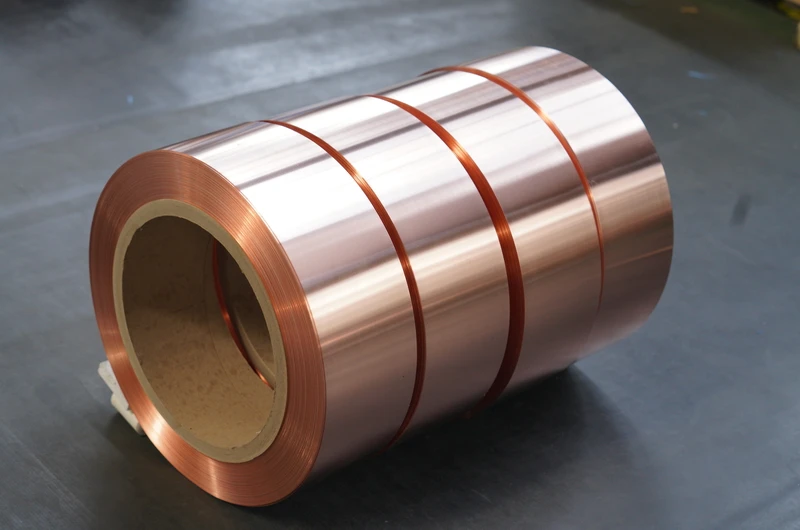
As a flat conductor, copper foil offers significant advantages over round wires: larger surface area effectively utilizes the skin effect to reduce high-frequency resistance; the flat structure provides greater heat dissipation area and higher thermal conductivity; its flexible formability makes it suitable for precision coil winding with higher fill factors; and the thin profile design effectively reduces high-frequency eddy current losses.
1.3 Typical Application Scenarios
Typical applications of copper foil in servo reactors include: servo drive output filter reactors (PWM harmonic suppression), servo motor stator/rotor windings (high-density coil formation), energy feedback system reactors (high-power IGBT/SiC switching circuit filtering), and robot joint servo reactors (compact high-power-density design).
2. Key Specifications and Technical Requirements
2.1 Thickness Selection
Copper foil thickness is the primary parameter affecting reactor performance and should be selected based on power rating:
| Application | Recommended Thickness | Key Characteristics |
|---|---|---|
| Small-power servo reactors | 0.05–0.10mm | High flexibility, precision coils |
| Medium-power servo reactors | 0.10–0.20mm | Balanced conductivity and mechanical strength |
| Large-power servo reactors | 0.20–0.50mm | High current capacity, excellent heat dissipation |
Within allowable ranges, thinner copper foil is preferred as it improves coil fill factor and power density.
2.2 Width and Tolerance
Copper foil width is determined by reactor slot design and turn requirements. Standard widths include 15mm, 20mm, 30mm, 50mm, and 80mm, with custom widths available up to 120mm and above. Width tolerance is typically controlled within ±0.1mm to ensure precise matching with coil slot dimensions.
2.3 Purity and Conductivity
Purity is the core factor affecting copper foil’s electrical conductivity and thermal stability:
| Purity Grade | Corresponding Grade | Conductivity | Typical Applications |
|---|---|---|---|
| 99.9% | T2 / C11000 | ≥98% IACS | General industrial applications |
| 99.95% | C10100 / C10200 | ≥99% IACS | High-performance servo systems |
| 99.99% | C10300 / OFHC | ≥101% IACS | Precision medical, aerospace |
2.4 Annealing State Selection
| State | Tensile Strength | Elongation | Application |
|---|---|---|---|
| Hard H04 | 300–380 MPa | 3–8% | Fixed high-current reactors |
| Half-hard H02 | 250–300 MPa | 8–15% | General-purpose reactors |
| Soft O | 200–260 MPa | 20–40% | Precision winding, bending forming |
2.5 Surface Quality Requirements
Surface roughness (Ra) should be ≤0.8μm, with ≤0.4μm recommended for high-frequency applications to reduce eddy current losses. Surfaces should be free from cracks, folds, inclusions, and other defects. Light oxidation is normal and does not affect performance; severe oxidation requires special treatment before use.
3. Temperature Resistance and Thermal Adaptability
3.1 Effect of Temperature on Copper Foil Performance
Servo reactor operating environments are complex, and copper foil properties change with temperature:
- Room temperature to 80°C: Stable performance with no significant changes
- 80–120°C: Mechanical properties begin to decline; heat-resistant grades required
- 120–180°C: Soft copper foil may experience recrystallization softening
- Above 180°C: Special high-temperature-resistant copper foil or cladding solutions required
3.2 Temperature Resistance Classification (Reference IEC 60172)
| Insulation Class | Max Operating Temperature | Copper Foil Recommendation |
|---|---|---|
| Class B | 130°C | Standard soft copper foil |
| Class F | 155°C | Soft copper foil + heat-resistant insulation |
| Class H | 180°C | Half-hard/hard copper foil |
| Class C | Above 200°C | Special custom copper foil |
3.3 Temperature Selection Calculation Method
For practical selection, use this formula: Design Temperature = Ambient Temperature + Temperature Rise + Safety Margin (20°C). Example: 55°C ambient + 65°C rise + 20°C margin = 140°C design temperature, corresponding to Class F insulation.
4. Insulation Treatment Solutions
4.1 Enameled Copper Foil
Applying insulation varnish to the copper foil surface is the most common treatment:
| Varnish Type | Temperature Rating | Dielectric Strength | Application |
|---|---|---|---|
| Polyurethane varnish (UEW) | 120–130°C | 100–150 kV/mm | Low-voltage servo reactors |
| Polyesterimide varnish (EIW) | 155°C | 120–180 kV/mm | Medium-voltage servo reactors |
| Polyamide-imide varnish (AIW) | 200°C | 150–200 kV/mm | High-performance servo systems |
4.2 Insulation Paper/Film Lamination
Polyester film (PET) with thickness of 0.025–0.188mm can be laminated with copper foil. NOMEX paper, an aromatic polyamide insulation paper, offers excellent heat resistance up to 200°C and above. The lamination approach applies insulation to both sides of the copper foil, suitable for high-voltage applications.
4.3 Epoxy Resin Impregnation
Coils are impregnated with epoxy resin and cured after winding, offering excellent sealing, high mechanical strength, and strong weather resistance. This solution is widely used in rail transit and new energy vehicle reactors operating in harsh conditions.
5. Industrial Applications and Selection Recommendations
5.1 Typical Application Fields
Industrial robot joint servo reactors focus on high power density and vibration resistance. CNC machine tool spindle drive filter reactors require low loss and high stability. Wind power converter reactors must meet high-power and salt-fog resistance requirements. Semiconductor equipment precision positioning system reactors have stringent requirements for noise control and positioning accuracy.
5.2 Common Problems and Solutions
Severe coil heating is mainly caused by increased resistance due to skin effect—select thinner copper foil and increase parallel turns to improve. Insufficient fill factor requires custom width and optimized turn arrangement. High-temperature performance degradation should be addressed by upgrading insulation class to H or C grade. Insufficient mechanical strength can be resolved by switching to half-hard or hard copper foil.
6. Supplier Selection Criteria
When selecting suppliers, key areas to evaluate include:
Quality management system certifications serve as the foundation—ISO9001, ISO14001, and ISO45001 triple system certifications, along with UL, REACH, and RoHS product certifications, are basic requirements. Technical capabilities should confirm custom design support, availability of full or random inspection reports, and traceable material certificates. Delivery capabilities typically require monthly capacity of 100+ tons, sample delivery within 3–7 working days, and mass production delivery within 15–30 working days.
7. Product Specifications Summary
| Parameter | Specification Range |
|---|---|
| Thickness | 0.03mm – 0.50mm |
| Width | 2mm – 120mm |
| Purity | 99.9% – 99.99% |
| State | Soft / Half-hard / Hard |
| Temperature Range | -40°C – +220°C |
| Standards | IEC / GB / JIS / NEMA |
8. Technical Support and Contact
For detailed product specifications, samples, or technical selection support, please contact Zhengzhou LP Industry Co., Ltd. With 30 years of expertise in electromagnetic wire exports, our 60-mu manufacturing base holds ISO triple system certification and SGS audit approval, with products exported to over 50 countries and regions worldwide.
- Email: office@cnlpzz.com
- Phone/WhatsApp: 0086-19337889070
- Key Products: Enameled copper (aluminum) round wire, Enameled copper (aluminum) flat wire, Copper foil, Aluminum foil
This document provides professional guidance for copper foil selection in servo reactor applications. For specific projects, please consult with technical professionals based on actual operating conditions.