


Copper Foil for Series Reactor Winding
Introduction
Series reactors are important reactive power compensation and harmonic control devices in power systems, widely used in power factor correction, harmonic suppression, and current limiting protection. The core component of a series reactor is the winding coil, and copper foil, as the main material of the winding, directly affects the reactor’s operating efficiency and reliability due to its electrical and mechanical properties.
This article systematically describes the technical characteristics, selection points, and typical applications of copper foil used in series reactor windings, providing a reference for engineering selection.
I. Basic Principles and Structure of Series Reactors
1.1 Working Principle of Series Reactors
Series reactors achieve impedance to alternating current by connecting an inductive element in series in the circuit. Its inductive reactance XL = 2πfL, where f is the frequency and L is the inductance.
Depending on their function, series reactors are mainly divided into three types: current-limiting reactors, filter reactors, and shunt reactors.
1.2 Structural Types of Series Reactors
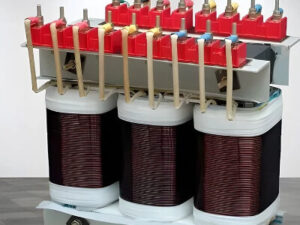
Air-core Reactors: Employ an air-core coil structure, offering good linearity and eliminating magnetic saturation issues. Suitable for high-current, high-voltage applications.
Iron-core Reactors: Include an iron core within the coil to enhance inductance. Small size and low loss, but with a risk of magnetic saturation.
Semi-iron-core Reactors: Between air-core and iron-core reactors, balancing linearity and efficiency.
1.3 The Role of Windings in Reactors
The reactor windings need to withstand:
- Thermal effects when rated current passes through
- Electrodynamic impacts during short circuits
- Mechanical vibrations during long-term operation
II. Advantages of Copper Foil in Reactor Windings
2.1 Basic Characteristics of Copper Foil
| Performance Indicators | Copper Foil Parameters |
|---|---|
| Conductivity | ≥58 MS/m |
| Tensile Strength | 200-260 MPa |
| Elongation | 20-40% |
| Hardness | 40-80 HB |
2.2 Advantages of Copper Foil Windings
Excellent Heat Dissipation Performance: The flat shape of copper foil increases the heat dissipation surface area, effectively reducing winding temperature rise.
Low Skin Effect: In high-frequency harmonic environments, copper foil exhibits a lower skin effect than round wire, resulting in more uniform current distribution.
High Fill Factor: Copper foil can achieve a higher copper fill factor in the core window, improving material utilization.
Good Mechanical Strength: Copper foil has better rigidity than round wire and strong resistance to short-circuit electrodynamic forces.
2.3 Comparison with Other Materials
| Material | Advantages | Disadvantages |
|---|---|---|
| Copper Foil | Good heat dissipation, high fill factor | More difficult to process |
| Aluminum Foil | Lightweight, low cost | Lower conductivity |
| Round Copper Wire | Mature processing | Low fill factor |
III. Technical Requirements for Copper Foil for Series Reactors
3.1 Conductivity Requirements
For high-power reactors, it is recommended to use oxygen-free or low-oxygen copper materials, with a conductivity of not less than 58 MS/m.
3.2 Thickness and Width Selection
Current Density: Typically, a current density range of 2-4 A/mm² is selected.
Mechanical Strength: The greater the thickness, the higher the mechanical strength and the stronger the short-circuit resistance.
The width of the copper foil should match the core window size to maximize utilization.
3.3 Surface Treatment Requirements
Deburring: To avoid electric field concentration leading to partial discharge.
Insulating Coating: Painting or wrapping with insulating paper can be selected.
Anti-oxidation Treatment: To prevent oxidation of the copper surface from affecting contact resistance.
IV. Typical Applications of Copper Foil Windings
4.1 Power Factor Correction Reactors
In reactive power compensation systems, series reactors are used in conjunction with capacitor banks.
Copper Foil Selection: Typically uses a thickness of 0.5-1.5mm, with the width determined according to the current rating.
4.2 Harmonic Filtering Reactors
Harmonic filtering reactors are used to filter out specific harmonic currents in the power grid.
Copper Foil Selection: It is recommended to use thin copper foil in multiple layers to reduce high-frequency impedance.
4.3 Current-Limiting Reactors
Current-limiting reactors are connected in series in the circuit to limit the system’s short-circuit current level.
Copper Foil Selection: Thicker copper foil is required to enhance mechanical strength. High conductivity copper materials should be selected.
V. Selection Technical Guidelines
| Voltage Rating | Recommended Copper Foil Thickness | Insulation Method |
|---|---|---|
| 400V | 0.5-1.0mm | Enameled or Insulating Paper |
| 690V | 1.0-1.5mm | Insulating Paper |
| 10kV | 1.5-2.5mm | Insulating Paper + Insulating Sleeve |
| 35kV | 2.0-3.0mm | Oil Paper Insulation |
5.2 Current Rating and Copper Foil Cross-Section
Calculation formula: Cross-sectional area A = I/(J×K)
Where I is the rated current, J is the current density, and K is the window fill factor.
5.3 Insulation Class Selection
Class F insulation (155°C): Suitable for general industrial environments.
Class H insulation (180°C): Suitable for high-temperature environments or high-load conditions.
VI. Manufacturing Process Key Points
6.1 Winding Process
- Winding tension control: Excessive tension may cause deformation, insufficient tension will result in loose windings
- Inter-turn insulation: Insulating strips or insulating paper should be placed between copper foils
- End treatment: The ends of the windings need to be reinforced with insulation
6.2 Welding and Connection
High-current reactor windings require multiple copper foils connected in parallel. Silver soldering or argon arc welding should be used.
6.3 Quality Inspection
- DC Resistance Measurement
- Insulation Resistance Test
- Withstand Voltage Test
- Partial Discharge Test
VII. Typical Application Cases
Case 1: Harmonic Mitigation in 10kV Distribution System
Solution: Install series resonant filter reactors with 3 sets of single-tuned filters.
Copper Foil Selection: 1.5mm thick copper foil, 120mm wide, insulation class F.
Application Effect: Harmonic current content decreased from 18% to below 5%, power factor increased to 0.95.
Case 2: Current-Limiting Reactor for Photovoltaic Grid-Connected System
Solution: Configure incoming line reactors to limit current harmonics.
Copper Foil Selection: 2.0mm thick copper foil with insulating paper and sleeves.
Application Results: Meets IEEE 519 harmonic limit requirements.
Case 3: Reactive Power Compensation for Rail Transit
Solution: Configure SVC with thyristor-controlled reactor.
Copper Foil Selection: 1.0mm thin copper foil multi-layer winding.
Application Results: Power factor reaches 0.98, harmonic content meets standards.
VIII. Common Technical Questions
Q1: Why use copper foil instead of round wire in series reactors?
Copper foil has a higher fill factor, better heat dissipation, and lower skin effect, making it ideal for high-current and harmonic-carrying applications.
Q2: How to control the temperature rise of copper foil windings?
Select high conductivity copper materials, design proper heat dissipation structure (oil/air cooling), control current density, and ensure unobstructed heat conduction paths.
Q3: What are the surface insulation treatment methods for copper foil?
Insulating varnish coating, cable paper wrapping, polyester film wrapping, and oxidation treatment.
Q4: What precautions should be taken during reactor operation?
Regular inspections: winding appearance, insulation condition, connection tightness, and temperature rise.
Conclusion
Copper foil, as an ideal material for series reactor windings, plays an important role in reactive power compensation, harmonic mitigation, and current limiting protection due to its excellent conductivity, heat dissipation, and mechanical properties.
Our company specializes in manufacturing copper foil for reactors and provides selection consultation and technical support services.
Contact Information
Email: office@cnlpzz.com
WhatsApp: 0086-19337889070
This article was prepared by Zhengzhou LP Industry Co., Ltd., specializing in the research and manufacturing of electrical wires and special conductors for thirty years.