


Introduction
Relay contacts are key components in electrical control elements such as relays, contactors, and switches, responsible for connecting and disconnecting circuits. Their core functions are to establish reliable current paths in the energized state and achieve complete circuit isolation in the de-energized state. The performance of relay contacts directly determines the reliability, lifespan, and safety of electrical control systems.
According to different application scenarios, relay contacts can be classified into the following categories: weak-current signal contacts (used in communication and control circuits), medium-power contacts (used in household appliances and industrial control), high-power contacts (used in motor control and power distribution systems), and special-purpose contacts (such as automotive relays, high-voltage relays, railway relays, etc.). Different applications have different requirements for contact material conductivity, arc resistance, weld resistance, mechanical strength, and corrosion resistance.
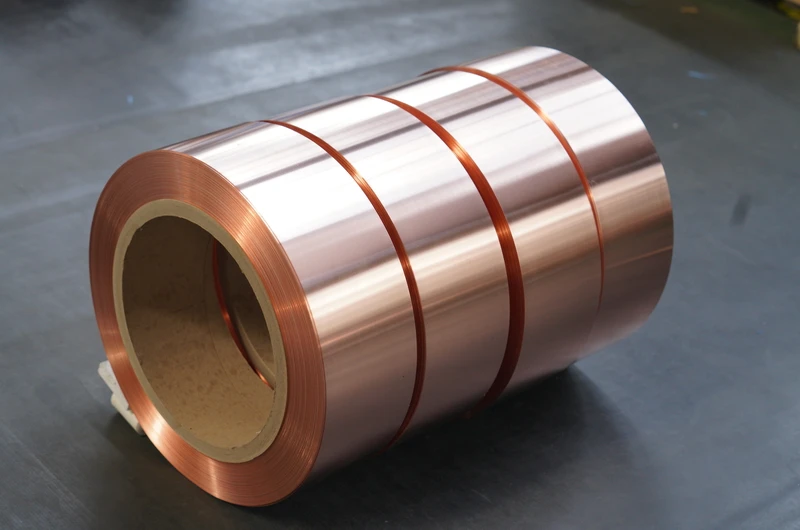
As an important auxiliary material in relay contact systems, copper foil has wide applications in composite contacts, contact carriers, spring materials, electrode leads, and other components. This article systematically explains key parameters, selection criteria, and industrial applications for copper foil used in relay contacts, serving as a professional reference for relay manufacturers and procurement personnel.
1. Relay Contact Structure and Copper Foil Role
1.1 Basic Structure of Relay Contacts
The relay contact system typically consists of the following components:
Moving contact and stationary contact: The core components directly responsible for connecting/disconnecting circuit functions, made of high-conductivity materials such as silver alloys (silver tin oxide, silver zinc oxide, silver nickel), silver cadmium oxide, or pure silver.
Contact spring: The elastic element connecting the contact with the coil circuit, requiring good conductivity and elasticity. Copper and copper alloys are the main materials for springs.
Contact base/carrier: Structural component used to fix and support the contact, with some using copper foil as base material.
Electrode lead: The lead-out terminal used to connect the contact to external circuits, with copper and copper alloys as the main materials.
1.2 Typical Applications of Copper Foil in Relay Contacts
Copper foil applications in relay contact systems mainly include:
Composite contact base: Silver alloy contacts are usually combined with copper base through roll bonding or welding, with copper foil serving as the support and conductive base material.
Contact spring material: Used for small relay shrapnel and spring components, requiring high elasticity and high conductivity.
Electroplating base: Electroplate copper layer on relay housings and shielding components to improve conductivity and electromagnetic shielding.
Thermal management: In high-power relays, copper foil is used for heat dissipation and heat equalization.
Contact plating base: Some relay contact terminals use copper as base, with tin, silver, or gold plating on the surface.
1.3 Main Failure Modes of Relay Contacts
Understanding contact failure modes helps understand the importance of copper foil selection:
Arc erosion: Arcs generated during contact breaking cause material evaporation, transfer, and oxidation.
Welding: Local melting welding caused by excessive current or high contact resistance when contacts close.
Contact resistance increase: Surface oxidation and contamination lead to poor contact.
Mechanical wear: Mechanical wear and fatigue caused by repeated opening and closing.
Corrosion failure: Chemical corrosion caused by environmental media (moisture, sulfides, chlorides).
As a base material, copper foil needs to balance conductivity, thermal conductivity, mechanical strength, and processing performance to ensure overall reliability of the contact system.
1.4 Differences Between Relay Copper Foil and Traditional Copper Foil
Copper foil used for relay contacts differs significantly from traditional transformer copper foil and capacitor copper foil: Relay contact copper foil has a wider thickness range (30μm – 500μm), mainly in soft/half-hard state, with key performance focused on elasticity, conductivity, and strength, usually requiring silver or tin plating on the surface. In contrast, transformer copper foil focuses on winding performance (10μm – 100μm, hard state), while capacitor copper foil focuses on ESR and ripple carrying (6μm – 100μm, hard state).
2. Key Specifications and Technical Requirements
2.1 Copper Foil Purity
Copper foil purity directly affects the conductivity and reliability of relay contact systems.
T2 pure copper (99.9%): The most commonly used industrial pure copper, conductivity approximately 98% IACS, suitable for most relay contact base applications.
TU1 oxygen-free copper (99.97%): Extremely low impurity content, conductivity above 101% IACS, suitable for high-end relays and high-reliability applications.
TP1/TP2 phosphorus deoxidized copper (99.9%): Contains a small amount of phosphorus (0.015%–0.04%), has good weldability and processability, widely used in relay springs and electrode leads.
Impurity effects: Impurities such as iron, sulfur, and oxygen will reduce copper foil conductivity and may affect welding performance. Low melting point impurities such as lead and bismuth may cause thermal brittleness in high temperature environments.
2.2 Thickness Selection
Copper foil thickness needs to be selected according to relay type and application scenario.
Thin copper foil (30μm–100μm): Used for small relay springs, signal relay contact carriers.
Medium-thick copper foil (100μm–200μm): Used for general-purpose relays, automotive relay contact bases and springs.
Thick copper foil (200μm–500μm): Used for high-power contactors, motor control relay main contact bases.
Ultra-thick copper foil (above 500μm): Used for high-current circuit breakers and heavy-duty contactors in industrial power distribution systems.
Selection advice: Contact base copper foil thickness needs to match contact size and current level. The general rule of thumb is that the ratio of copper foil thickness to contact diameter is approximately 1:3 to 1:5.
2.3 Width and Dimensions
Copper foil width is determined according to the relay contact component design.
Standard width range: Usually between 5mm and 100mm, customizable according to contact size.
Width precision: Copper foil width tolerance should be controlled within ±0.05mm to ensure assembly accuracy.
Slitting quality: Edges should be neat and burr-free, avoiding debris or damage to other components during assembly.
2.4 Annealing State
Copper foil annealing state significantly affects relay performance.
Soft state copper foil (O state): Highest conductivity, good elongation (≥35%), but lower strength. Suitable for complex-shaped springs requiring deep drawing and bending.
Half-hard state copper foil (H02/H04): Moderate strength (tensile strength 250–320MPa), elongation 15%–25%, suitable for spring applications requiring certain elasticity.
Hard state copper foil (H06/H08): High strength (tensile strength 350–400MPa), elongation 3%–8%, suitable for applications requiring high strength and wear resistance.
Selection advice: Relay springs mostly use half-hard or hard state copper foil to ensure lasting elasticity and mechanical stability. Contact bases can use soft state copper foil for subsequent processing.
2.5 Mechanical Properties
Relay contact copper foil has strict requirements for mechanical properties:
Tensile strength: Spring copper foil usually requires tensile strength 250–400MPa.
Elongation: Soft state copper foil elongation ≥35%, hard state copper foil elongation 3%–8%.
Elastic modulus: Approximately 110–130GPa, affecting spring elasticity and deformation recovery capability.
Fatigue life: Springs need to maintain elasticity under repeated operation, usually requiring over 1 million mechanical cycles.
2.6 Surface Quality Requirements
Relay contacts have strict requirements for copper foil surface quality:
Surface roughness: Ra is usually required between 0.4μm and 0.8μm. Excessive roughness affects electroplating or welding quality; overly smooth may affect the bonding strength of composite contacts.
Thickness uniformity: Copper foil thickness tolerance should be controlled within ±3%; for high-precision contact carriers, it is recommended to control within ±2%.
Surface cleanliness: Copper foil surface should be free from oil contamination, oxide film, dust, and other impurities. Microscopic contaminants may cause poor contact or welding defects.
Surface defects: Copper foil surface should be free from scratches, dents, pinholes, inclusions, and other defects.
3. Surface Treatment and Composite
3.1 Plating Treatment
Relay copper foil commonly uses the following surface treatments:
Silver plating (Ag): Plating silver on copper foil surface can significantly improve conductivity, oxidation resistance, and weldability. Silver plating thickness is usually 1μm–5μm, suitable for high-reliability relays.
Tin plating (Sn): Provides good weldability at lower cost. Tin plating thickness is usually 3μm–10μm, suitable for mid-to-low end relays.
Nickel plating (Ni): As base layer or functional plating, provides wear and corrosion resistance. Nickel plating thickness is usually 1μm–3μm.
Gold plating (Au): Used for high-end signal relays, gold plating thickness is usually 0.1μm–0.5μm, providing excellent oxidation resistance and low contact resistance.
Chemical polishing/electrolytic polishing: Improve copper foil surface finish, providing good base for subsequent plating.
3.2 Composite Contacts
Silver alloy contacts are often used in combination with copper foil:
Roll bonding: Combine silver alloy with copper foil through cold rolling process, with high bonding strength and low interface resistance.
Explosive welding: Through explosive shock wave, silver alloy and copper foil are metallurgically combined, suitable for large-area composite.
Welding composite: Solder silver alloy onto copper foil through brazing, suitable for local composite.
The bonding strength of composite contacts directly affects relay lifespan and reliability.
3.3 Insulation Treatment
Some relay copper foil requires insulation treatment:
Polyester film composite: Copper foil and PET film are laminated to form flexible copper foil (FCCL), used for flexible circuits and flat relays.
Epoxy coating: Apply epoxy resin on copper foil surface to provide insulation and moisture protection.
Anodic oxidation: Form copper oxide layer on copper foil surface through electrochemical methods to provide insulation.
4. Insulation Class and Temperature Management
4.1 Effect of Temperature on Relays
Relay operating temperature affects multiple aspects of the contact system:
Contact resistance: When temperature rises, metal conductivity decreases and contact resistance increases.
Spring elasticity: High temperature will reduce the elastic modulus of copper and copper alloys, affecting spring performance.
Insulation material: High temperature accelerates aging of insulation materials, affecting the overall insulation performance of the relay.
Plating stability: High temperature may accelerate silver layer oxidation and diffusion, affecting contact reliability.
4.2 Insulation Class and Selection
| Insulation Class | Max Operating Temperature | Applicable Relay Type | Copper Foil Selection |
|---|---|---|---|
| Class A | 105°C | General household appliance relays | TP2 phosphorus deoxidized copper + tin plating |
| Class E | 120°C | Industrial control relays | T2 pure copper + silver plating |
| Class B | 130°C | Standard automotive relays | T2 pure copper + silver/tin plating |
| Class F | 155°C | High temperature industrial relays | TU1 oxygen-free copper + silver plating |
| Class H | 180°C | High temperature automotive/railway relays | TU1 oxygen-free copper + silver plating + nickel base layer |
| Class C | Above 200°C | Special high temperature relays | TU1 oxygen-free copper + gold/rhodium plating |
4.3 Contact Material Temperature Characteristics
Common relay contact materials and their temperature characteristics include: pure silver (Ag) melting point 961°C, maximum operating temperature 200°C, mainly used for weak-current signal relays; silver tin oxide (AgSnO₂) and silver zinc oxide (AgZnO) melting point 961°C, maximum operating temperature 350°C, mainstream materials for medium-high power relays; silver nickel (AgNi) maximum operating temperature 300°C, used for medium-power relays; silver cadmium oxide (AgCdO) maximum operating temperature 350°C; silver tungsten (AgW) melting point 961°C, maximum operating temperature up to 800°C, the preferred choice for high-voltage high-current relays.
5. Industrial Applications and Selection Recommendations
5.1 Household Appliance Field
Household appliances are an important application market for relays.
Air conditioner/refrigerator relays: Compressor and fan control relays, working current 10A–30A. Recommended: AgSnO₂ contacts + T2 pure copper base + tin plating.
Washing machines/dishwashers: Motor control and water level control relays. Recommended: AgNi contacts + half-hard state copper foil.
Microwave ovens/ovens: Relays used in high temperature environments. Recommended: AgSnO₂ contacts + TU1 oxygen-free copper base + silver plating.
5.2 Automotive Electronics Field
Automotive relays have extremely high requirements for reliability and environmental adaptability.
Starter relays: High-current relays (100A–300A) controlling starter motors. Recommended: AgSnO₂ or AgW contacts + thick copper foil (above 200μm) + Class F or H insulation.
Light relays: Medium-power relays controlling headlights and turn signals. Recommended: AgSnO₂ contacts + T2 pure copper base.
Signal relays: Low-power relays for ECU and sensors. Recommended: AgNi contacts + half-hard state copper foil + gold plating.
BMS relays: High-voltage relays in battery management systems (400V/800V platform). Recommended: AgW or AgCu contacts + thick copper foil + vacuum arc extinguishing chamber.
5.3 Industrial Control Field
Industrial relays are fundamental components of industrial automation.
Contactors: Contactors for motor start/stop, working current 9A–800A. Recommended: AgSnO₂ contacts + thick copper foil base + Class F insulation.
Intermediate relays: Intermediate relays for control circuits. Recommended: AgNi contacts + medium-thick copper foil.
Safety relays: High-reliability relays for safety control circuits. Recommended: forced-guided contact structure + high-reliability copper foil material.
5.4 Communication and Signal Field
Communication relays require low contact resistance and high reliability.
Signal relays: Small relays for communication equipment. Recommended: AgAu alloy or gold-plated contacts + TU1 oxygen-free copper + surface gold plating.
High-frequency relays: Coaxial relays for RF switching, frequency up to several GHz. Recommended: high-conductivity copper alloy + precision machining.
Reed relays: Sealed relays using magnetic reed switches. Recommended: high-elasticity copper alloy springs + rhodium or gold plating.
5.5 Common Selection Problems and Solutions
Contact welding: Check if contact material matches current level; confirm copper foil conductivity and heat dissipation design; consider using AgSnO₂ contacts with better welding resistance.
Excessive contact resistance: Check copper foil surface cleanliness; confirm surface plating integrity; consider using highly conductive silver or gold plating.
Spring elasticity decay: Check if copper foil annealing state is appropriate; confirm if operating temperature exceeds spring usage temperature; consider using copper alloys with better elasticity (such as beryllium bronze, tin bronze).
Severe contact arc erosion: Check contact breaking speed; confirm arc extinguishing design; consider using arc-resistant AgW or AgC contact materials.
Plating peeling or corrosion: Check copper foil surface pretreatment quality; confirm plating process; consider adding nickel base layer to improve bonding strength and corrosion resistance.
6. Supplier Selection and Quality Control
6.1 Quality Certifications
ISO9001 quality management system certification is the basic requirement. IATF16949 certification is necessary for automotive relay applications. UL, VDE, TUV, CQC and other safety certifications are necessary for export relays. RoHS, REACH environmental certifications are necessary for overseas markets.
6.2 Technical Capability Evaluation
Custom drawing capability: Whether copper foil with specific thickness, width, and mechanical properties can be customized according to customer drawings. Whether sample development cycle is reasonable (typically 5–10 working days).
Process quality control: Whether key control capabilities such as thickness testing, mechanical performance testing, surface quality testing, and purity testing are available. Whether on-site supervision and third-party testing are supported.
Electroplating capability: Whether mature electroplating processes are available, especially for key surface treatments such as silver plating, gold plating, and nickel plating.
Composite capability: Whether composite processes of silver alloy and copper foil are available (roll bonding, explosive welding, etc.).
6.3 Production Capacity and Delivery
Stable production capacity is the guarantee for long-term supply. It is recommended to select suppliers with monthly production capacity above 100 tons and complete quality control systems. Quick response capability and flexible delivery arrangements are also important considerations.
7. Product Specifications Summary
| Parameter | Specification Range |
|---|---|
| Copper Foil Purity | 99.9% – 99.97% |
| Thickness | 30μm – 500μm |
| Width | 5mm – 100mm |
| State | Soft / Half-hard / Hard |
| Tensile Strength | 220MPa – 400MPa |
| Elongation | 3% – 40% |
| Surface Treatment | Silver plating / Tin plating / Nickel plating / Gold plating / Bare copper |
| Standards | IEC / GB / JIS / ASTM |
8. Technical Support and Contact
For detailed product specifications, samples, or technical selection support, please contact Zhengzhou LP Industry Co., Ltd. With years of expertise in electronic copper materials exports, our copper foil products are widely used in relay contacts, composite contacts, spring materials, power electronics, and other fields.
- Email: office@cnlpzz.com
- Phone/WhatsApp: 0086-19337889070
- Key Products: Copper foil, Relay contact copper foil, Composite contact materials, Spring materials
This document provides professional guidance for copper foil selection in relay contact applications. For specific projects, please consult with technical professionals based on actual operating conditions.