

Introduction
Excitation coils are core components in synchronous generators, MRI equipment, solenoid valves, and other equipment. Their main function is to generate a stable magnetic field to drive normal equipment operation. As an important part of generators, the excitation system directly determines the generator’s voltage regulation accuracy, operational stability, and efficiency level.
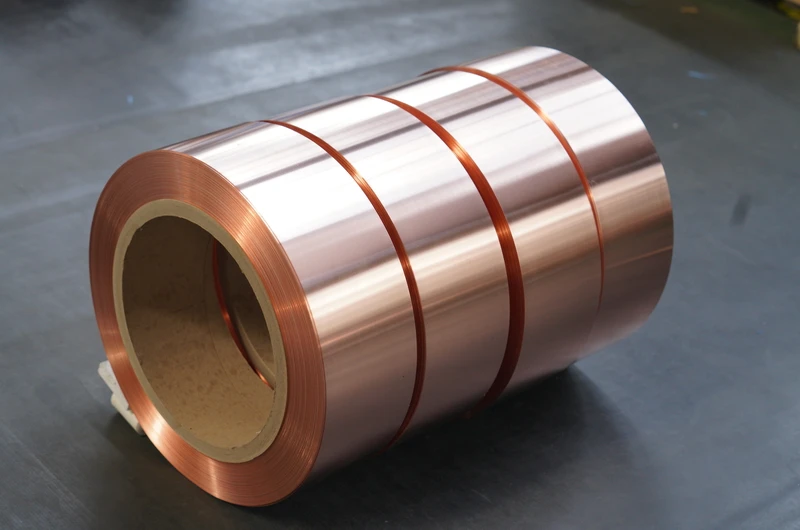
With excellent electrical conductivity, thermal management capability, and reliable insulation solutions, copper foil has become the ideal material for excitation coil manufacturing. Compared to traditional round wire winding, copper foil coils offer higher fill factor, better thermal conductivity, and more precise magnetic field distribution characteristics.
This article systematically explains key parameters, selection criteria, and industrial applications for copper foil used in excitation coils, serving as a professional reference for engineers and procurement personnel.
1. Working Principles and Application Fields of Excitation Coils
1.1 Working Principles of Excitation Coils
Excitation coils work based on the principle of electromagnetic induction. When direct current flows through the winding, it generates a constant magnetic field around the iron core. The magnetic field strength is proportional to the product of excitation current and number of winding turns. For synchronous generators, the rotor excitation winding receives direct current to generate a magnetic field; when the rotor rotates, the stator winding cuts the magnetic lines of force, inducing alternating voltage.
Main functions of the excitation system include: establishing initial voltage (establishing a magnetic field when the generator starts to generate electricity), regulating voltage (adjusting excitation current according to load changes to maintain stable output voltage), regulating reactive power (controlling generator reactive power output through excitation), and improving system stability (enhancing power system transient stability).
The performance of excitation coils directly affects the generator’s output voltage quality, efficiency, and service life. Therefore, excitation coil design and material selection are crucial.
1.2 Main Types of Excitation Coils
According to application scenarios and structural characteristics, excitation coils can be classified as follows:
Rotating excitation coils (rotor excitation windings): Used in the rotor part of synchronous generators, rotating at high speed with the rotor. Rotating excitation needs to withstand enormous centrifugal force, so mechanical strength requirements for copper foil are high. Copper foil should be selected in hard or half-hard state, with reliable fixing methods to prevent loosening during high-speed rotation.
Stationary excitation coils (stator excitation windings): Used in the stator part of certain special motors, stationary during operation. These coils have higher thermal dissipation requirements, needing soft copper foil with good thermal conductivity, combined with effective thermal dissipation measures.
Magnetic Resonance Imaging (MRI) excitation coils: Used for superconducting magnet excitation in medical MRI equipment. These applications require extremely uniform magnetic fields, with copper foil needing extremely high dimensional accuracy and surface quality.
Solenoid valve excitation coils: Used in various industrial solenoid valves, driving valve core movement through electromagnetic force. These applications have smaller power but require fast response; copper foil typically uses thin specifications.
1.3 Advantages of Copper Foil for Excitation Coils
Copper foil offers the following significant advantages over traditional round wire in excitation coil applications:
Higher fill factor: As a flat conductor, copper foil occupies less space at the same cross-sectional area, significantly improving coil fill factor and increasing effective conductive area.
Better thermal conductivity: The flat structure of copper foil has larger contact area with cooling medium, facilitating rapid heat dissipation and reducing coil temperature rise.
More uniform magnetic field distribution: The flat shape of copper foil optimizes coil magnetic field distribution and improves magnetic field uniformity.
Better mechanical strength: Copper foil coils have integral structure, better able to withstand centrifugal force in high-speed rotation applications.
Easier automated production: Copper foil can be processed using precision automatic winding equipment, improving production efficiency and product quality consistency.
2. Key Specifications and Technical Requirements
2.1 Thickness Selection
Copper foil thickness is the core parameter determining excitation coil current-carrying capacity and temperature rise characteristics.
Thin copper foil (0.05–0.15mm): Suitable for small-power excitation coils or precision solenoid valves, flexible winding, suitable for complex shape design. MRI coils typically use 0.05–0.10mm thin copper foil to obtain precise magnetic field distribution.
Medium copper foil (0.15–0.30mm): Suitable for medium-power industrial excitation applications, such as stationary excitation windings of ordinary synchronous generators. This thickness range balances conductivity and mechanical processability.
Thick copper foil (0.30–0.50mm and above): Suitable for large-power rotating excitation coils, such as rotor excitation windings of large hydraulic generators and turbine generators. Thick copper foil has large cross-sectional area, capable of carrying thousands of amperes of high current.
Selection advice: Excitation current typically ranges from tens to thousands of amperes; required cross-sectional area needs to be calculated based on design current, then copper foil thickness determined. Rotating excitation also needs to consider the impact of centrifugal force on copper foil mechanical strength.
2.2 Width and Dimensions
Copper foil width directly affects coil end dimensions and fill factor.
Standard width specifications: 10mm, 15mm, 20mm, 30mm, 50mm, 80mm, 100mm, etc., with custom wider or narrower specifications available.
Width selection principle: Width should match the iron core slot width, ensuring copper foil fits flat into the slot. Width too large causes installation difficulty; width too small increases end dimensions and leakage reactance.
Special-shaped copper foil: Step copper foil, bent copper foil, etc. can be customized according to drawings to optimize end shape, reducing end leakage reactance and heat generation.
2.3 Purity and Conductivity
Excitation coils have high requirements for electrical conductivity; copper foil purity directly affects coil efficiency.
T2 pure copper (99.9%): Conductivity approximately 98% IACS, the most commonly used industrial pure copper, suitable for the vast majority of excitation coil applications, best cost-effectiveness.
Oxygen-free copper (OFHC, 99.99%): Conductivity can reach above 101% IACS, with extremely low impurity content, suitable for high-efficiency applications such as precision medical equipment and MRI.
Pure copper and phosphorus deoxidized copper: Phosphorus deoxidized copper (C12200 etc.) has fewer impurities under phosphorus deoxidation, suitable for excitation coils requiring brazing processing.
Selection advice: General industrial excitation applications can use T2 pure copper; for high-efficiency or high-temperature environments, oxygen-free copper can be considered.
2.4 Annealing State Selection
Copper foil annealing state needs comprehensive consideration based on processing technology and usage conditions.
Hard state copper foil (H04/H06): Tensile strength 300–380MPa, elongation 3–8%. Hard state copper foil has strong shape-holding ability and is not easily deformed, the preferred choice for rotating excitation coils. High-speed rotating rotor excitation windings must use hard or half-hard copper foil to withstand centrifugal force.
Soft state copper foil (O): Tensile strength 200–260MPa, elongation 20–40%. Soft state copper foil is soft and easy to bend, suitable for stationary excitation coils requiring complex shapes or post-bending processing.
Half-hard state copper foil (H02/H04): Performance between the two, the most widely applicable state.
Selection advice: Rotating excitation selects hard or half-hard state; stationary excitation can select soft or half-hard state; select soft state for complex bending shapes.
2.5 Surface Quality Requirements
Excitation coils have extremely high requirements for insulation reliability, making copper foil surface quality crucial.
Surface roughness: Ra≤0.8μm, ≤0.4μm recommended for high-precision applications. Smooth surface facilitates uniform insulation varnish film adhesion and improves insulation reliability.
Surface defects: Cracks, folds, inclusions, oil contamination, and other defects are strictly prohibited. These defects may cause local electric field concentration and lead to insulation breakdown.
Thickness uniformity: Copper foil thickness tolerance should be controlled within ±5%, ensuring consistent coil resistance and uniform magnetic field distribution.
Residual stress: Hard state copper foil may have rolling residual stress; for precision applications, stress relief annealing treatment is recommended.
3. Insulation Class and Temperature Resistance Selection
3.1 Effect of Temperature on Excitation Coils
Excitation coil operating temperature directly affects its efficiency and service life. For every 10°C increase in temperature, copper’s resistance increases by approximately 4%, while insulation material aging also accelerates.
Main sources of excitation coil temperature rise include: I²R loss heat generated when current flows through windings, iron loss heat generated by core magnetization, and external ambient temperature influence.
For rotating excitation coils, since they are in a high-speed rotating sealed environment with poor thermal dissipation conditions, temperature rise control is particularly important. Rotor excitation windings of large generators typically use forced air cooling or hydrogen cooling to control temperature rise.
3.2 Insulation Class and Selection
| Insulation Class | Max Operating Temperature | Application Scenarios | Copper Foil Selection |
|---|---|---|---|
| Class B | 130°C | General industrial generators | Soft/half-hard + polyester insulation |
| Class F | 155°C | Applications with higher temperature rise | Half-hard + polyesterimide insulation |
| Class H | 180°C | High-power or high-temperature environments | Hard + polyamide-imide insulation |
Selection calculation: Design Temperature = Ambient Temperature + Temperature Rise + Safety Margin (20°C). For example: 45°C ambient + 80°C rise + 20°C margin = 145°C design temperature, should select Class F insulation.
3.3 Insulation Treatment Solutions
Enameled copper foil: Polyester varnish (PEW) with 130°C temperature resistance and best cost-effectiveness, suitable for Class B insulation stationary excitation. Polyesterimide varnish (EIW) with 155°C temperature resistance, suitable for Class F insulation various excitation coils. Polyamide-imide varnish (AIW) with 200°C temperature resistance, suitable for Class H insulation or rotating excitation and other harsh environments.
Insulation paper/film lamination: NOMEX paper lamination offers high temperature resistance and excellent electrical performance, suitable for high-voltage or high-temperature excitation applications. Polyester film lamination improves dielectric strength, suitable for medium voltage applications.
Overall impregnation: Epoxy resin impregnation after curing offers excellent sealing, high mechanical strength, and strong weather resistance, the standard treatment solution for rotating excitation coils. VPI (Vacuum Pressure Impregnation) process can obtain more uniform insulation layer.
4. Industrial Applications and Selection Recommendations
4.1 Synchronous Generator Excitation
The excitation system of synchronous generators is a core component, directly affecting generator performance and grid stability.
Large hydraulic generators (such as giant hydraulic generators at Three Gorges Dam): Rotor excitation current can reach thousands of amperes, requiring 0.3–0.5mm or even thicker copper foil. Rotational speed is relatively low (approximately 75–150 rpm), but centrifugal force is enormous; copper foil must have sufficient mechanical strength. Recommended: hard state T2 copper foil with Class H insulation and epoxy impregnation solution.
Turbine generators (gas turbine/steam turbine driven): Rotational speed up to 3000 rpm (2-pole) or 1500 rpm (4-pole), extremely high mechanical strength requirements for rotor excitation windings. Recommended: specially reinforced hard state copper foil, combined with high-strength insulation system and reliable rotor fixing structure.
Medium and small synchronous generators: Power from hundreds to tens of thousands of kilowatts, medium rotational speed, excitation current from hundreds to thousands of amperes. Recommended: half-hard copper foil with Class F insulation, overall vacuum impregnation process can be used.
4.2 MRI Excitation Coils
Superconducting magnets in MRI equipment operate at extremely low temperatures (liquid helium temperature 4.2K or lower superconducting state); their excitation coil design and requirements are fundamentally different from conventional excitation.
Copper foil purity requirements are extremely high; oxygen-free copper must be used to ensure superconducting stability. Dimensional accuracy requirements are extremely high, ensuring magnetic field uniformity. Surface quality requirements are stringent; any微小 defects may affect magnetic field quality. Typically uses thin copper foil multi-turn winding; windings require special reinforcement treatment.
4.3 Solenoid Valve Excitation Coils
Solenoid valves are fundamental components in industrial automation control systems; excitation coils are their core components.
Industrial general solenoid valves: Power from several watts to tens of watts, coils are usually small, selecting 0.05–0.15mm thin copper foil. Commonly use Class B or F insulation, overall impregnation treatment.
High-pressure hydraulic solenoid valves: High working pressure, severe vibration, need mechanically strong copper foil and reinforcement structure. Recommended: hard state copper foil with high-strength insulation system.
Explosion-proof solenoid valves: Used in flammable and explosive environments, with extremely high safety and reliability requirements. Both copper foil and insulation need high-performance specifications, and must pass strict explosion-proof certification tests.
4.4 Common Selection Problems and Solutions
Excessive coil temperature rise: Check if copper foil thickness and cross-sectional area meet current-carrying requirements; check if thermal dissipation design is reasonable (whether air/water/oil cooling is adequate); confirm if insulation class matches ambient temperature and temperature rise.
Rotating excitation loosening or deformation: Confirm copper foil state is correct (must use hard or half-hard state); check winding tension is appropriate; verify fixing method is secure; consider using adhesive fixing or NOMEX binding tape reinforcement.
Cracking in high-frequency vibration environments: Check if insulation class and treatment method meet vibration requirements; consider using softer insulation materials (such as polyurethane) to improve bending resistance; add vibration reduction measures in structural design.
Insulation breakdown issues: Check copper foil surface quality for defects; confirm insulation varnish film thickness is uniform; verify insulation class meets working voltage requirements; check impregnation process is adequate.
5. Supplier Selection and Quality Control
5.1 Quality Certifications
Excitation coils are key components related to equipment safe operation; supplier quality certifications are crucial.
ISO9001 quality management system certification is the basic requirement. UL certification is an important reference for entering North American markets or exporting high-end equipment. IEC and GB standard compliance certification are basic requirements for industrial applications. For large generator matching, supplier qualification review by the main engine manufacturer is usually also required.
5.2 Technical Capability Evaluation
Custom drawing capability: Whether copper foil thickness, width, and tolerance range can meet design requirements. Whether sample development cycle is reasonable (typically 5–10 working days). Whether material certificates and inspection reports are complete and traceable.
Process quality control: Whether key control methods such as hardness testing, thickness testing, and surface quality testing are available. Whether on-site supervision and process inspection are supported.
5.3 Production Capacity and Delivery
Stable production capacity is the guarantee for long-term supply. It is recommended to select suppliers with monthly production capacity above 100 tons. For large generator matching projects, supplier project experience and batch supply capability also need to be evaluated.
6. Product Specifications Summary
| Parameter | Specification Range |
|---|---|
| Thickness | 0.05mm – 0.50mm |
| Width | 5mm – 150mm |
| Purity | 99.9% – 99.99% |
| State | Soft / Half-hard / Hard |
| Conductivity | 98% – 101% IACS |
| Temperature Range | -40°C – +220°C |
| Standards | IEC / GB / JIS / NEMA |
7. Technical Support and Contact
For detailed product specifications, samples, or technical selection support, please contact Zhengzhou LP Industry Co., Ltd. With 30 years of expertise in electromagnetic wire exports, our copper foil products are widely used in synchronous generators, MRI equipment, solenoid valves, and other high-end equipment fields.
- Email: office@cnlpzz.com
- Phone/WhatsApp: 0086-19337889070
- Key Products: Enameled copper (aluminum) round wire, Enameled copper (aluminum) flat wire, Copper foil, Aluminum foil
This document provides professional guidance for copper foil selection in excitation coil applications. For specific projects, please consult with technical professionals based on actual operating conditions.