Copper Clad Aluminum Winding Wire Explained – A Complete Guide
I. Introduction: Copper-clad aluminum winding wire – “the choice for weight reduction and cost reduction” of modern motors
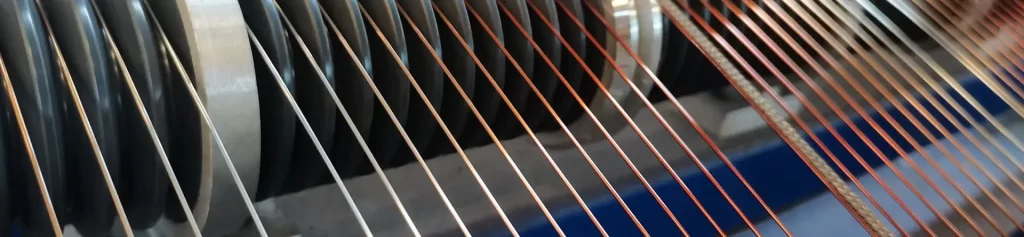
Copper Clad Aluminum Winding Wire (CCA Winding Wire) is a composite conductor with aluminum as the core material, the outer layer metallurgically bonded copper layer, and the surface is coated with insulating paint film. It plays an increasingly important role in 50/60 Hz motors and high-frequency windings.
1.1 Industry background: High copper prices drive demand for copper-clad aluminum
The London Metal Exchange copper price in 2024 is about $9,000-10,000/ton, while the aluminum price is only about $2,200-2,600/ton. The price of copper is 4-5 times the price of aluminum. Copper-clad aluminum winding wire can save 50-60% of copper usage and reduce weight by 30-40%, making it the first choice for cost reduction and efficiency improvement.
1.2 The core value of copper-clad aluminum winding wire
Core Values
Physical Basis
Engineering Significance
Lightweight
Aluminum density 2.7 vs copper 8.96 g/cm³
Motor/transformer weight reduction 30-40%
Copper Saving
Copper only accounts for 10-30% of the volume
Copper consumption is reduced by 70-90%
Low cost
Low aluminum price and low consumption
Total cost reduced by 30-50%
High frequency excellence
Skin effect + Leeds process
High frequency performance is close to pure copper
1.3 Copper-clad aluminum winding wire vs pure copper winding wire: essential differences
Dimensions
Pure copper winding wire
Copper-clad aluminum winding wire
Density
8.96 g/cm³
3.6-4.0 g/cm³
DC resistivity
1.724 μΩ·cm
2.7-2.8 μΩ·cm
100 kHz AC resistance
1.0×
1.02×
Weldability
Excellent
Medium (requires special process)
Tensile strength
220-300 MPa
100-150 MPa
Price
High
Medium (Save 30-50%)
II. Core structure and manufacturing of copper-clad aluminum winding wire
Take 1,000 kg of wire as an example (2024 prices):
Materials
Weight
Copper usage
Total cost
Savings
Pure Copper
1,000 kg
1,000 kg
$9,500
Baseline
Copper Clad Aluminum (Copper 15%)
425 kg
64 kg
$3,200
-66%
Copper Clad Aluminum (Copper 20%)
450 kg
90 kg
$3,800
-60%
Copper Clad Aluminum (Copper 25%)
480 kg
120 kg
$4,500
-53%
IV. International standards for copper-clad aluminum winding wires
4.1 ASTM B566 – Master Standard for Copper Clad Aluminum Wire
ASTM B566 is the core international standard for copper-clad aluminum wire:
Project
Required Content
Range
Round copper-clad aluminum wire, diameter 0.10-8.00 mm
Copper volume ratio
10-30%
Copper Purity
> 99.9%
Aluminum Purity
> 99.7%
Resistivity
2.7-2.8 μΩ·cm
Tensile strength
100-150 MPa
Elongation
> 15%
Interface bonding strength
> 50 MPa
Surface quality
Defect-free and smooth
4.2 ASTM B566 Critical Tests
Testing
Methods
Qualification criteria
Resistivity
Four-terminal method
2.7-2.8 μΩ·cm
Tensile strength
Tensile testing machine
> 100 MPa
Elongation
Gauge length 200mm
> 15%
Copper thickness
Metallographic section
0.05-0.30 mm
Interface Bonding
Peel Test
> 50 MPa
Bend test
90°/180° bend
No delamination
Salt spray test
5% NaCl, 96 h
No corrosion
4.3 IEC 60317 series (paint film part)
Copper-clad aluminum enameled winding wire is suitable for IEC 60317 series:
Standard number
Paint film type
Temperature grade
Applicable
IEC 60317-0-1
General requirements
All
Basics
IEC 60317-15
PEI Enameled Aluminum Wire
180°C
High Frequency
IEC 60317-20
PAI Enameled Copper Wire
200°C
High End
IEC 60317-25
PAI Enameled Aluminum Wire
200°C
High End
IEC 60317-26
PAI enamelled round copper wire
220°C
High end
IEC 60317-42
Corona resistant PEI
180°C
Variable frequency
IEC 60317-56
Corona Resistant PI
220°C
High Voltage
4.4 GB/T 5584 Chinese National Standard
Standard number
Name
Applicable
GB/T 5584.1-2009
Bare copper-clad aluminum round wire
Before enameling
GB/T 5584.2-2009
Enameled copper-clad aluminum round wire
After enameling
GB/T 6109.1-2008
Universal enameled round wire
Universal paint film
GB/T 23312.1-2009
Enameled aluminum round wire
Pure aluminum enameled
4.5 JIS Standards and Certification
V. Detailed explanation of key performance indicators
5.1 Conductive properties
Performance
Pure copper
Copper-clad aluminum (25%)
Difference analysis
DC Resistivity
1.724 μΩ·cm
2.7-2.8 μΩ·cm
+57% (key difference)
20 kHz AC resistance
1.0×
1.05×
Close to
100 kHz AC resistance
1.0×
1.02×
Almost the same
1 MHz AC resistance
1.0×
1.01×
Almost the same
10 MHz AC resistance
1.0×
1.00×
Identical
Key point: In the > 20 kHzfrequency band, due to theskin effect, the AC current is concentrated in the copper layer of the conductor (skin depth formula: δ = √(ρ/(πfμ))), and the high-frequency performance of copper-clad aluminum and pure copper is almost the same.
5.2 Skin depth calculation
Skin depth of copper at different frequencies:
Frequency
Skin depth (μm)
Minimum required copper thickness
50 Hz
9,300
Not applicable (skin depth is much larger than wire radius)
1 kHz
2,100
Much smaller than the wire radius
10 kHz
660
Smaller than most wire radii
100 kHz
210
Much smaller than the wire radius
1 MHz
66
Much smaller than the wire radius
10 MHz
21
Close to copper thickness
5.2 Skin depth calculation
Skin depth of copper at different frequencies:
Frequency
Skin depth (μm)
Minimum required copper thickness
50 Hz
9,300
Not applicable (skin depth is much larger than wire radius)
1 kHz
2,100
Much smaller than the wire radius
10 kHz
660
Smaller than most wire radii
100 kHz
210
Much smaller than the wire radius
1 MHz
66
Much smaller than the wire radius
10 MHz
21
Close to copper thickness
Conclusion: Above 100 kHz, the high frequency performance of copper-clad aluminum (copper thickness 50-300 μm) is almost the same as that of pure copper.
5.3 Mechanical properties
Performance
Pure copper winding wire
Copper-clad aluminum winding wire
Impact
Tensile strength (MPa)
220-300
100-150
Winding tension reduced by 20-30%
Elongation (%)
30-40
15-25
Reduced number of bends
Elastic modulus (GPa)
110-120
70-85
Large elastic deformation
Hardness (HV)
50-100
30-50
Easily scratched
Bending performance
Excellent
Moderate
Bending radius increased by 50%
5.4 Paint film adhesion performance
Paint film type
Pure copper substrate
Copper-clad aluminum substrate
Improvement method
PE (polyester)
Excellent
Good
Use primer with coupling agent
PEI (Polyesterimide)
Excellent
Good
Use primer with coupling agent
PAI (polyamideimide)
Excellent
Good
Use primer with coupling agent
PI (polyimide)
Excellent
Good
Use primer containing coupling agent
PU (polyurethane)
Excellent
Good
Use primer containing coupling agent
Key Point: The adhesion between the copper-clad aluminum substrate and the paint film is slightly lower than that of pure copper, but it can reach a level close to pure copper through special primer(containing silane coupling agent, titanate coupling agent).
5.5 Temperature resistance
Paint film grade
Pure copper winding wire
Copper-clad aluminum winding wire
Differences
Class 130 (B)
130°C
130°C
Same
Class 155 (F)
155°C
155°C
Same
Class 180 (H)
180°C
180°C
Same
Class 200 (R)
200°C
200°C
Same
Class 220 (N)
220°C
220°C
Same
Class 240 (C)
240°C
240°C
Same
5.6 Long-term reliability
Test
Condition
Pure Copper
Copper Clad Aluminum
Remarks
Heat Aging
200°C, 1,000 h
Excellent
Good
PI Paint Film
Humid heat aging
85°C/85%RH, 1,000 h
Excellent
Good
–
Hot and cold cycle
-40°C ↔ 150°C, 100 times
Excellent
Good
The interface may be slightly cracked
Vibration fatigue
10-500 Hz, 10⁷ times
Excellent
Moderate
Interface fatigue
Long-term thermal diffusion
250°C, 5,000 h
Excellent
Moderate
Interfacial intermetallic compounds
VI. 5 typical application cases
6.1 Application 1: High frequency transformer
6.1.1 Application background
High frequency transformer in switching power supplies (SMPS), operating frequency 20-500 kHz.
6.1.2 Selection Guide
Parameters
Recommended values
Specifications
AWG 22-38 (0.40-0.08 mm)
Paint film
PEI / PAI (180-200°C)
Copper volume ratio
15-25%
Paint film grade
Grade 1-2
6.1.3 Typical cases
A 240 W laptop power adapter has a main transformer operating frequency of 100 kHz and uses AWG 30 copper-clad aluminum enameled wire (copper volume ratio 20%). Compared with the pure copper solution, the weight is reduced by 45%, the cost is reduced by 50%, and the efficiency remains above 92%.
6.2 Application 2: UPS uninterruptible power supply
6.2.1 Application background
Inverters, rectifiers, transformers in UPS, operating frequency 20-100 kHz.
6.2.2 Typical cases
A 10 kVA online UPS uses copper-clad aluminum enameled wire to wind the power transformer and high-frequency inductor. The weight of the entire machine is reduced from 80 kg to 50 kg, the efficiency remains above 95%, and the material cost is reduced by 40%.
6.3 Application 3: Inverter air conditioning compressor
6.3.1 Application background
Inverter air conditioner compressor motor, powered by inverter, voltage 100-300 V, frequency 50-200 Hz.
6.3.2 Typical cases
The winding of a 1.5 HP inverter air conditioner compressor is made of copper-clad aluminum enameled wire (copper volume ratio 25%). The weight of the whole machine is reduced by 15%, energy saving is 5%, and the service life is maintained for more than 10 years.
6.4 Application 4: Electric vehicle motor controller
6.4.1 Application background
Boost inductor, filter inductor, resonant inductor in EV motor controller, operating frequency 10-100 kHz.
6.4.2 Typical cases
A 150 kW electric vehicle motor controller uses copper-clad aluminum enameled Litz wire to wind a boost inductor with a frequency of 50 kHz. The power density is increased by 30% and the cost is reduced by 25%.
6.5 Application 5: Solar Photovoltaic Inverter
6.5.1 Application background
High-frequency transformer and output filter inductor in photovoltaic inverter, operating frequency 16-100 kHz.
6.5.2 Typical cases
A 10 kW string photovoltaic inverter uses copper-clad aluminum enameled wire to wind a high-frequency transformer. The weight of the entire machine is reduced by 30%, the cost is reduced by 35%, and the efficiency remains above 97%.
VII. Five core selection project suggestions
7.1 Suggestion 1: Decide on material selection based on frequency
Operating frequency
Recommended materials
Reasons
50/60 Hz power frequency
Pure copper
Large DC resistance, obvious disadvantages
400 Hz IF
Pure copper or copper-clad aluminum
Close performance, cost considerations
1-20 kHz low intermediate frequency
Pure copper or copper-clad aluminum
Close performance
20-100 kHz
Copper-clad aluminum(advantage range)
Optimal performance/cost
100 kHz-1 MHz
Copper Clad Aluminum Litz Wire
High frequency performance is almost the same as pure copper
> 1 MHz
Copper-clad aluminum with silver plating
Very shallow skin depth, silver plating improves performance
7.2 Recommendation 2: Select copper volume ratio based on power density
Power density (W/cm²)
Recommended copper volume ratio
< 1
10-15%
1-5
15-20%
5-10
20-25%
> 10
25-30%
7.3 Recommendation 3: Choose paint film according to temperature grade
Temperature level
Recommended paint film
Film thickness
Class 130 (130°C)
PE
Grade 1-2
Class 155 (155°C)
PEI
Grade 1-2
Class 180 (180°C)
PEI
Grade 2
Class 200 (200°C)
PAI
Grade 2
Class 220 (220°C)
PAI / PI
Grade 2-3
Class 240 (240°C)
PI
Grade 3
7.4 Recommendation 4: Consider welding and joining processes
VIII. Manufacturing process and quality control of copper-clad aluminum winding wire
8.1 Copper-clad aluminum wire blank manufacturing
8.1.1 Cladding welding process
Process
Critical Control Points
Aluminum rod preparation
Purity > 99.7%, diameter tolerance ±0.05 mm
Copper strip preparation
Purity > 99.9%, thickness 0.10-0.50 mm
Surface cleaning
Oil stain and oxide film removal (alkaline cleaning + pickling)
Heating
300-400°C, argon protection
Copper strip coating
Spiral coating angle 45-60°
Welding
TIG/laser welding, welding speed 5-10 m/min
Multi-pass drawing
Total compression ratio 80-95%
Annealing
350-450°C, 1-2 hours
Surface treatment
Pickling, fluxing
8.1.2 Key Performance Indicators
Indicators
Standards
Test methods
Copper volume ratio
15-25%
Metallographic section + image analysis
Interface bonding strength
> 50 MPa
Peel test/shear test
Resistivity
2.7-2.8 μΩ·cm
Four-terminal method
Diameter deviation
±0.01 mm
Laser diameter measurement
Copper thickness
0.05-0.30 mm
Metallographic section
Tensile strength
> 100 MPa
Tensile testing machine
Elongation
> 15%
Gauge length 200 mm
Surface roughness
Ra < 1.6 μm
Roughness meter
8.2 Paint film coating process
8.2.1 Process flow
Process
Pure Copper
Copper Clad Aluminum
Surface Preparation
Annealing + Cleaning
Annealing + Cleaning + Primer
Primer application
Usually omitted
Required(contains coupling agent)
Main paint application
4-12 coats
6-12 coats
Baking temperature
350-450°C
330-420°C (avoid interface diffusion)
Baking time
10-30 s/lane
12-35 s/lane
Paint film thickness
Grade 1/2/3
Grade 1/2/3
Line speed
50-200 m/min
40-180 m/min
8.2.2 Design of paint passes
Paint film grade
Number of paint coats
Paint film thickness
Grade 1
4-6 lanes
18-30 μm
Grade 2
6-8 lanes
30-50 μm
Grade 3
Lane 8-10
50-80 μm
Grade 4
Lanes 10-12
> 80 μm
8.2.3 Key process differences
The process differences between copper-clad aluminum enameled wire and pure copper enameled wire:
Difference item
Pure copper
Copper clad aluminum
Reason
Primer
Usually none
Required
Improves adhesion
Baking temperature
Higher
Lower
Prevent interface diffusion
Baking time
Shorter
Longer
Paint film fully cured
Paint liquid formula
Standard
Adjust curing agent
Adapt to copper-clad aluminum substrate
8.3 Quality Control Testing
8.3.1 Online Test
Test items
Sampling ratio
Qualification criteria
Appearance
100%
No defects
Diameter
100%
Deviation ±0.01 mm
Resistance
100%
Within specified value
Paint film thickness
100%
Grade regulations
Paint film continuity (pinholes)
100%
< 5 pieces/30m
8.3.2 Batch inspection
Test items
Standards
Qualification criteria
Breakdown voltage
IEC 60851-5
> Specified values
Flexibility (coiling)
IEC 60851-3
No cracking
Adhesion
IEC 60851-3
No peeling
Paint film thickness
IEC 60851-2
Grade regulations
Copper thickness
ASTM B566
Within specified value
Interface bonding
ASTM B566
> 50 MPa
Tensile Strength
ASTM B566
> 100 MPa
Elongation
ASTM B566
> 15%
IX. Limitations of copper-clad aluminum winding wires
9.1 Limitation 1: High DC resistance
The DC resistance of copper-clad aluminum winding wire is 40-65% higher than that of pure copper, which means:
-Not applicable for DC applications(battery, bus, electrolytic)
-Not applicable to power frequency transformers(50/60 Hz full cross-section conductive)
-Not applicable for high power low frequency motors(>100 kW, 50/60 Hz)
9.2 Limitation 2: Poor mechanical properties
Performance
Pure Copper
Copper Clad Aluminum
Impact
Tensile strength
220-300 MPa
100-150 MPa
Winding tension limit
Bending performance
Excellent
Moderate
Increased bending radius
Hardness
High
Low
Easy to scratch
Elastic modulus
High
Low
Easy to deform
9.3 Limitation 3: Difficulty in welding
Ordinary soldering iron: difficult (oxide layer on aluminum surface)
Interface diffusion: Intermetallic compounds (CuAl₂, Cu₉Al₄) are formed at the copper-aluminum interface at high temperatures
Vibration fatigue: The fatigue life of the copper-aluminum interface is lower than that of pure copper
Thermal cycling: The interface may delaminate under repeated thermal cycling
Galvanic corrosion: Copper-aluminum forms galvanic corrosion in a hot and humid environment
9.5 Limitation 5: Cost Balance Point
Copper price (USD/ton)
Cost advantage of copper-clad aluminum
> 10,000
Significant (saving > 50%)
8,000-10,000
Significant (30-50% savings)
6,000-8,000
General (save 20-30%)
< 6,000
Not significant (savings < 20%)
X. FAQ: Frequently asked questions about copper-clad aluminum winding wires
10.1 Can copper-clad aluminum winding wire completely replace pure copper?A: It cannot be completely replaced, but it is the best choice in certain scenarios:
High frequency above 20 kHz: replaceable, performance close to pure copper
Power frequency (50/60 Hz): cannot be replaced, large DC resistance
High power (>100 kW): cannot be replaced, high loss
10.2 What are the skin effect advantages of copper-clad aluminum?
Answer: In high-frequency applications, the current is concentrated in the copper layer:
Skin depth ~210 μm at 100 kHz
Skin depth ~66 μm at 1 MHz
Skin depth ~21 μm at 10 MHz
Copper clad aluminum copper skin thickness 50-300 μm > high frequency skin depth
Conclusion: Above 20 kHz, the high-frequency performance of copper-clad aluminum and pure copper is almost the same
10.3 What is the service life of copper-clad aluminum winding wire?
Paint film
200°C life
180°C life
PE
1,000-2,000 h
5,000-10,000 h
PEI
3,000-5,000 h
15,000-20,000 h
PAI
8,000-12,000 h
25,000-40,000 h
PI
10,000-20,000 h
30,000-50,000 h
Note: The interface of copper-clad aluminum winding wire may diffuse under long-term high temperature. The recommended operating temperature is < 180°C.
10.4 How to weld copper-clad aluminum?
Welding method
Applicability
Remarks
Ordinary soldering iron
Not recommended
The aluminum oxide layer is difficult to remove
Ultrasonic welding
Highly recommended
The most reliable
Laser welding
Recommended
Precise control
Crimping
Recommended
Lowest Cost
Wrapping
Laboratory
Not suitable for mass production
Argon arc welding
Available
Shielding gas required
10.5 Is copper-clad aluminum winding wire safe?A: Products that meet standards are safe:
ASTM B566 certified
Certified according to IEC 60317
Passed GB/T 5584 certification
Certified to UL 1446
Passed CCC certification
XI. Future Trend: Development of Copper-clad Aluminum Winding Wire Technology
11.1 Trend 1: Higher copper volume ratio
Current mainstream: 15-25% copper volume ratio
Future direction: 25-40% copper volume ratio
Meaning: Higher copper ratio = better conductivity + closer to pure copper performance
11.2 Trend 2: Nano coating technology
Nano-coating (Ni, Ag, Au) on the copper surface improves corrosion resistance
Nano fillers (SiO₂, TiO₂, Al₂O₃) are added to the paint film to improve temperature resistance
Interface nanolayer control (Zr, Ti diffusion barrier layer)
11.3 Trend 3: New energy drive
New energy vehicles: OBC, DC-DC, motor controller
Energy Storage: Inductors and transformers of battery management systems
Photovoltaic: inverter, step-up transformer
Wind power: converters, filters
11.4 Trend 4: Expansion of high-frequency applications
5G/6G communication base station
Satellite communications
Radar system
Wireless charging
millimeter wave
11.5 Trend 5: Smart Manufacturing
Online defect detection (vision + AI)
Digital twin
Full process traceability
Intelligent quality control
XII. Conclusion: Copper-clad aluminum winding wire is a “cost balancer” for high-frequency lightweighting.
As a key material for high-frequency lightweight applications in the 21st century, copper-clad aluminum winding wire plays an irreplaceable role in switching power supplies, UPS, new energy vehicles, 5G communications, photovoltaic inverters, wireless charging and other fields.
Core Value:
– Lightweight: 30-60% lighter than pure copper
– Copper Saving: Copper consumption reduced by 70-90%
– Low cost: 30-50% cheaper than pure copper
– High Frequency Excellence: High frequency performance is close to that of pure copper
Selection Principles:
– Power frequency, high power → pure copper
– Medium frequency and high frequency above 20 kHz → Copper-clad aluminum (best advantage range)
– High frequency above 100 kHz → Copper-clad aluminum Litz wire
LP Winding Wireprovides a full range of copper-clad aluminum winding wire products, specifications AWG 8-44 (0.08-3.20 mm), copper volume ratio 10-30%, paint film covers the full range of PE/PEI/PAI/PI, all products are certified by ASTM B566, IEC 60317, UL, VDE, TÜV, CCC.
XIII. Appendix: Key Parameters Cheat Sheet
13.1 Quick check on copper volume ratio
Copper volume ratio
Conductivity (% IACS)
Density (g/cm³)
Applicable frequency
Typical applications
10%
50-55%
3.0-3.2
> 100 kHz
High frequency small signal coil
15%
58-62%
3.2-3.4
> 50 kHz
High frequency transformer
20%
62-66%
3.4-3.6
> 20 kHz
Switching power supply
25%
66-70%
3.6-3.8
> 10 kHz
General high frequency
30%
70-72%
3.8-4.0
Power frequency-high frequency
High-end applications
13.2 Quick check on paint film selection
Paint Film
Temperature Rating
Weldability
Cost
Typical Applications
PE
130°C
Solderable
Low
General Motors
PEI
180°C
Difficult to solder
Medium
High frequency transformer
PAI
200°C
Solderable
Medium to high
High end high frequency
PI
220°C
Difficult to weld
High
High temperature and high frequency
PU
155°C
Easy to solder
Medium
Coils, electronic components
13.3 Quick check on diameter specifications
AWG
Diameter (mm)
Cross-sectional area (mm²)
Typical applications
16
1.290
1.310
Medium frequency transformer
18
1.024
0.823
Medium frequency transformer
20
0.813
0.519
High frequency transformer
22
0.644
0.326
High frequency transformer
24
0.511
0.205
High frequency transformer
26
0.405
0.129
High frequency inductor
28
0.321
0.081
High frequency inductor
30
0.255
0.051
High frequency coil
32
0.202
0.032
Communication Coil
34
0.160
0.020
Communication Coil
36
0.127
0.013
Tiny coil
38
0.101
0.008
Tiny coil
40
0.080
0.005
Tiny Coil
13.4 Selection process
1.Determine the operating frequency: Determine whether copper-clad aluminum is suitable
2. Determine power density: Determine copper volume ratio
3. Determine the temperature level: Determine the paint film
4. Determine voltage level: Determine paint film thickness
5. Determine mechanical requirements: Determine specifications
6. Determine the connection method: Determine the welding process
7. Verify Reliability: Require suppliers to provide test reports
8. Certification standards: UL / VDE / TÜV / CCC
9. Select suppliers: quality, capacity, service, cases
Conductivity Reference Standard (Pure Copper = 100% IACS)
Skin Effect
Skin Effect
–
The phenomenon in which high-frequency current is concentrated on the surface of a conductor
Skin Depth
Skin Depth
δ
The depth at which the current density decays to 1/e of the surface
Proximity Effect
–
The phenomenon that adjacent conductors affect current distribution
Litz Wire
Litz Wire
–
Multi-strand insulated thin wires are twisted to suppress the skin effect
Cladding Welding
Cladding Welding
–
Welding process of copper strip clad aluminum core
Roll Bonding
Roll Bonding
–
Copper and aluminum plate roll bonding process
Continuous Extrusion
Continuous Extrusion
–
Aluminum extrusion + copper tube coating process
Interface Bonding
–
Metallurgical bonding force of copper-aluminum interface
Intermetallic Compound
IMC
A brittle phase formed at the copper-aluminum interface at high temperatures
Coupling Agent
Coupling Agent
–
Chemicals that improve the adhesion between the paint film and the substrate
Primer
–
First coat to enhance adhesion
Switching power supply
Switch Mode Power Supply
SMPS
High frequency switch mode power supply
Uninterruptible Power Supply
Uninterruptible Power Supply
UPS
Emergency Power Supply System
On-Board Charger
On-Board Charger
OBC
Electric vehicle on-board charger
5G AAU
5G Active Antenna Unit
AAU
5G base station active antenna unit
Film Grade
Film Grade
–
Paint film thickness grade specified by IEC 60317
Temperature Class
Thermal Class
–
Rated operating temperature of winding wire
XV. LP Winding Wire Company Introduction
LP Winding Wire is an international enterprise specializing in the research and development, production and sales of high-performance winding wires. Its main products include pure copper enameled wire, pure aluminum enameled wire, copper-clad aluminum winding wire, copper-clad aluminum enameled Litz wire, enameled flat wire, paper-covered wire, glass fiber winding wire, etc.
Core Advantages:
– Complete product certifications: UL, VDE, TÜV, CCC, CSA fully covered
– Production Capacity Scale: Annual production capacity 50,000 tons
– Copper-clad aluminum winding wire: copper volume ratio 10-30%, specification AWG 8-44
– Application areas: high-frequency transformers, UPS, new energy vehicles, 5G communications, photovoltaic inverters, wireless charging
– Core Technology: high frequency application, lightweight, low cost, reliability
– Service Commitment: technical consulting, sample testing, customized development, global logistics
XVI. Practical suggestions and misunderstandings for engineers
16.1 3 common misunderstandings when selecting a model
Myth 1: Use copper-clad aluminum for DC applicationsDC applications (battery, solar bus, power frequency transformer) should use pure copper, copper-clad aluminum has high DC resistance and will increase power loss.Myth 2: The higher the copper volume ratio, the betterThe higher the copper volume ratio, the closer the performance is to pure copper, but the cost is also higher. The optimal copper volume ratio should be selected based on actual needs (usually 20-25% is the most cost-effective).Misunderstanding 3: Ignoring the difficulty of weldingCopper-clad aluminum is difficult to weld and requires special processes. Wiring methods (crimping, wrap-around, ultrasonic welding) should be considered during the design phase.
16.2 3 key points of manufacturing process
1.Primer must be used: special primer containing coupling agent to ensure the adhesion of the paint film
2. Baking temperature control: Slightly lower than pure copper enameled wire (330-420°C vs 350-450°C) to prevent copper-aluminum interface diffusion
3. Interface bonding strength: must > 50 MPa
16.3 3 major precautions in use
Winding tension: It is recommended to reduce it by 20-30% compared with pure copper
Bending radius: It is recommended to be 50% larger than that of pure copper
Avoid sharp bends: The copper-aluminum interface is prone to delamination under sharp bends.
16.4 Troubleshooting and troubleshooting
Troubleshooting
Possible causes
Solutions
DC resistance is high
Copper volume ratio is low, length is too long
Check specifications, thicken copper volume ratio
The paint film peels off
Insufficient primer and improper baking
Check the primer and adjust the process
High frequency heating
Skin effect, proximity effect
Using Litz wire
Poor welding
Oxide layer, insufficient flux
Use special flux, ultrasonic welding
Early failure
Interface diffusion, excessive temperature
Lower operating temperature, choose PI paint film
16.5 Gap with international counterparts
Compared with the top international brands (Elektrisola, Rubadue, Pack Feind), the main differences between China’s copper-clad aluminum winding wires are:
– Stability for high-end applications
– Process precision for mass production
– Long-term reliability data accumulation
Leading companies such as LP Winding Wire have gradually narrowed the gap with international brands through continuous research and development.
XVII. Summary and Outlook
As a key material for high-frequency lightweight applications, copper-clad aluminum winding wire plays an irreplaceable role in switching power supplies, UPS, new energy vehicles, 5G communications, photovoltaic inverters, wireless charging and other fields. With the rapid development of new energy vehicles, 5G/6G communications, photovoltaic energy storage, and wireless charging, the market demand and technical requirements for copper-clad aluminum winding wires continue to increase.
Future Development Direction:
– Higher copper volume ratio: 30-40% copper volume ratio, performance closer to pure copper
– Nano Interface Control: Prevent copper-aluminum diffusion through nanolayers
– High frequency application expansion: Support 5G/6G communications, satellite Internet
– New energy drive: OBC, photovoltaic inverter, energy storage
– Intelligent Manufacturing: Online defect detection, full-process traceability
LP Winding Wire is willing to work with global high-frequency application manufacturers to jointly promote the progress and innovation of copper-clad aluminum winding wire technology and contribute to global energy transformation and digital development.
Send Message
Get a tailored quote—fill out the request form and enjoy exclusive discounts!