

1 Introduction
Copper-clad aluminum wire and pure aluminum wire are two important non-pure copper conductor materials used in transformers, inductors, and motor windings. Pure aluminum wire uses electrical-grade aluminum alloy as the current-carrying medium and is the traditional non-copper conductor choice for power transformers, distribution transformers, and inductor windings. Copper-clad aluminum wire, or CCA for short, uses an electrical-grade aluminum core as the base material and is covered with an oxygen-free copper outer layer, forming a bimetallic composite conductor through metallurgical bonding. It combines the lightweight properties of pure aluminum with the surface weldability of pure copper.
Based on standards such as ASTM B566-04a, NEMA MW 1000-2018, and IEC 60317 series, this article systematically compares the engineering applications of copper-clad aluminum wire and pure aluminum wire in transformer windings from seven dimensions: material composition, electrical performance, mechanical properties, thermal properties, connection process, corrosion resistance, application scenarios, and selection evaluation. This provides a systematic selection reference for winding wire engineers and purchasers.
2 Comparison of Material Composition
2.1 Material Composition of Pure Aluminum Wire
Pure aluminum wire conforms to standards such as NEMA MW 1000-2018 and ASTM B230, using electrical-grade aluminum alloy as raw material. A common grade is 1350 aluminum alloy, which is industrial pure aluminum with a purity of not less than 99.5%. 1350 aluminum alloy has an aluminum content of not less than 99.50% and a conductivity of not less than 61% IACS, making it the mainstream material for aluminum wire used in transformer windings.
Pure aluminum wire is manufactured through continuous casting and rolling, stretching, annealing, and insulation coating. Aluminum wire used for windings is typically enameled aluminum (round wire) or enameled aluminum (flat wire), with enameled coating grades according to NEMA MW 1000-2018, including polyester imide (EIW 180°C) and polyamide imide (AIW 220°C). Enameled aluminum wire has a mature application base in transformers, inductors, and motor windings.
Pure aluminum has a density of approximately 2.70 grams per cubic centimeter and a volume resistivity of approximately 2.82 × 10⁻⁸ ohmmeters, making it one of the lowest density and lightest conductor materials among commercially available conductive materials.
2.2 Material Composition of Copper-Clad Aluminum Wire
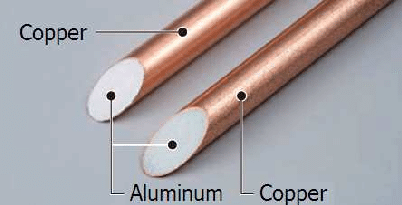
Copper-clad aluminum wire conforms to ASTM B566-04a standard, using an electrical-grade aluminum core as the base material and an outer layer of oxygen-free copper as the outer coating, forming a permanent bimetallic composite conductor through metallurgical bonding. The standard specifies four classes: Class 10A (10% soft copper by volume), Class 15A (15% soft copper by volume), Class 10H (10% hard copper by volume), and Class 15H (15% hard copper by volume).
The thickness of the copper layer is determined by the copper content. A copper layer with a 10% volume ratio is thinner, while a copper layer with a 15% volume ratio is thicker. The copper layer and the aluminum core are metallurgically bonded, resulting in high bonding strength and strong resistance to delamination. Delamination will not occur due to bending or stretching during winding manufacturing.
Copper-clad aluminum wire can be coated with various enamel coatings. According to ECCAW specifications, common enamel coatings include modified polyester and solderable polyurethane. Enamel coating grades range from 130 to 220 degrees Celsius (thermal class). The density of copper-clad aluminum wire is approximately 3.63 to 4.05 grams per cubic centimeter, between 2.70 for pure aluminum and 8.96 for pure copper.
2.3 Core Differences
Pure aluminum wire is a monometallic homogeneous material, while copper-clad aluminum wire is a bimetallic composite structure. The two exhibit systematic differences in core indicators such as surface condition, chemical stability, and weldability, which determine their respective application scenarios. Due to the outer copper cladding, copper-clad aluminum wire is significantly superior to pure aluminum wire in terms of weldability and surface stability.
3 Electrical Performance Comparison
3.1 DC Conductivity
Pure aluminum 1350 has a DC conductivity of 61% IACS and a volume resistivity of approximately 2.82 × 10⁻⁸ ohmmeters. Copper-clad aluminum wire, because the copper layer occupies only 10% or 15% of the cross-section, has a significantly higher DC conductivity than pure aluminum. Class 15A copper-clad aluminum wire has approximately 65% IACS and a volume resistivity of approximately 2.65 × 10⁻⁸ ohmmeters; Class 10A copper-clad aluminum wire has approximately 63% IACS and a volume resistivity of approximately 2.74 × 10⁻⁸ ohmmeters.
For the same cross-sectional area, the DC resistance of Class 15A copper-clad aluminum wire is approximately 0.94 times that of pure aluminum, and that of Class 10A copper-clad aluminum wire is approximately 0.97 times that of pure aluminum. This relationship is a core trade-off factor in the selection of copper-clad aluminum wire in transformer winding design.
3.2 AC Conductivity and Skin Effect
Pure aluminum is significantly affected by the skin effect under high-frequency AC conditions. Aluminum has a greater skin depth than copper, with a current penetration depth approximately 1.4 times that of copper. Therefore, pure aluminum has a slightly better relative advantage over pure copper at high frequencies. However, the high-frequency conductivity of pure aluminum is still lower than that of copper-based materials.
Copper-clad aluminum wire, with its outer layer of oxygen-free copper and inner layer of aluminum, exhibits a skin effect at high frequencies above 5 MHz, causing current to concentrate entirely in the copper layer. This results in AC conductivity properties close to those of pure copper. Copper-clad aluminum wire combines the lightweight advantages of an aluminum core with the skin effect of copper at high frequencies, making it a preferred choice for high-frequency transformers.
3.3 Current Carrying Capacity and Temperature Rise
For the same cross-sectional area, the current carrying capacity of copper-clad aluminum wire is approximately 1.06 to 1.10 times that of pure aluminum. Pure aluminum has higher resistive losses, resulting in higher copper losses and a correspondingly higher winding temperature rise for the same current.
The temperature rise of a transformer winding is related to multiple factors, including conductor resistance loss, heat dissipation conditions, and insulation class. Pure aluminum windings, due to their higher resistance, experience a greater temperature rise under the same current. This temperature difference needs to be compensated for in winding design by optimizing cooling design, increasing cross-sectional area, or reducing current density.
3.4 Summary of Electrical Performance Comparison
Copper-clad aluminum wire exhibits superior electrical performance compared to pure aluminum in both DC and high-frequency applications. Pure aluminum offers advantages in weight and cost, making it a traditional choice for weight- and cost-sensitive applications. Copper-clad aluminum wire, on the other hand, significantly improves electrical performance and connection processes while maintaining a weight advantage, representing an upgrade solution for aluminum windings.
4 Comparison of Mechanical Properties
4.1 Tensile Strength and Elongation
Pure aluminum 1350 has a tensile strength of approximately 60 to 95 MPa in its soft state and an elongation of 20% to 30%. Pure aluminum has excellent plasticity and can withstand winding processes with large deformations, but its tensile strength is relatively low, requiring increased cross-sectional area compensation under high mechanical stress conditions.
According to ASTM B566-04a standard, copper-clad aluminum wire has the following tensile strengths: Class 10A (soft state) has a tensile strength of not less than 110 MPa and an elongation of not less than 18%; Class 15A (soft state) has a tensile strength of not less than 130 MPa and an elongation of not less than 18%; and Class 10H (hard state) has a tensile strength of not less than 175 MPa and an elongation of not less than 1.5%. The tensile strength of copper-clad aluminum wire is significantly higher than that of pure aluminum, while its elongation in the soft state is close to that of pure aluminum.
Transformer windings must withstand tensile, bending, and torsional stresses during manufacturing. The high tensile strength of copper-clad aluminum wire gives it an advantage in complex winding processes such as large-size rectangular windings and continuously transposed windings. The low tensile strength of pure aluminum in large transformer windings requires compensation through increasing the cross-sectional area or adding winding support structures.
4.2 Density and Weight
Pure aluminum has a density of 2.70 grams per cubic centimeter, making it the lightest commercially available conductive material. Copper-clad aluminum wire, Class 10A, has a density of approximately 3.63 grams per cubic centimeter, and Class 15A approximately 4.05 grams per cubic centimeter. Copper-clad aluminum wire weighs approximately 1.34 to 1.50 times that of pure aluminum, but is significantly lighter than pure copper.
Weight advantage is the core selling point of pure aluminum and copper-clad aluminum wire in transformer applications. In large-size equipment such as power transformers and distribution transformers, winding weight accounts for 30% to 50% of the total transformer weight; using aluminum-based conductors can significantly reduce the overall transformer weight. In weight-sensitive applications such as automotive transformers, portable transformers, and aerospace transformers, aluminum-based conductors have irreplaceable advantages.
4.3 Bending performance and fatigue life
Pure aluminum exhibits excellent bending properties, capable of withstanding repeated bending of mandrel diameters ranging from 1d to 5d without damage. However, pure aluminum is prone to fatigue cracking under long-term vibration conditions, especially in hardened aluminum wires.
Copper-clad aluminum wire, with its outer copper layer and inner aluminum layer, exhibits coordinated deformation between the copper and aluminum layers during bending. While its bending performance is slightly lower than pure aluminum, it is significantly better than pure copper. Furthermore, copper-clad aluminum wire demonstrates superior vibration fatigue resistance compared to pure aluminum, as the increased strength of the copper layer and the stability of the metallurgical bond reduce the rate of interfacial crack propagation.
4.4 Summary of Mechanical Properties
Copper-clad aluminum wire generally outperforms pure aluminum in mechanical properties such as tensile strength, elongation, and fatigue resistance. Pure aluminum has advantages in density, plasticity, and low-temperature formability. Both are significantly lighter than pure copper and are the two main choices for aluminum winding applications.
5 Comparison of Thermal Properties
5.1 Thermal Conductivity
Pure aluminum 1350 has a thermal conductivity of approximately 230 watts per meter per Kelvin, making it the second most thermally conductive metal after copper and silver. Aluminum’s high thermal conductivity facilitates heat dissipation from the windings, which is one of the advantages of aluminum windings.
Copper-clad aluminum wire, due to its thinner copper layer, has an equivalent thermal conductivity between that of aluminum and copper. Class 15A copper-clad aluminum wire has an equivalent thermal conductivity of approximately 200 to 240 watts per meter per Kelvin, while Class 10A has approximately 180 to 220 watts per meter per Kelvin. The thermal conductivity of copper-clad aluminum wire is close to that of pure aluminum, resulting in no significant difference in heat dissipation during winding.
5.2 Coefficient of Thermal Expansion
The coefficient of linear expansion of pure aluminum 1350 is approximately 23 × 10⁻⁶ per Kelvin. The coefficient of thermal expansion of pure aluminum is significantly higher than that of copper, which is approximately 17 × 10⁻⁶ per Kelvin, making it prone to thermomechanical stress at the connection points with copper terminals and copper windings.
The equivalent linear expansion coefficient of copper-clad aluminum wire is between that of copper and aluminum, approximately 19 to 22 × 10⁻⁶ per Kelvin. The thermal expansion coefficient of copper-clad aluminum wire is closer to that of copper, resulting in lower thermomechanical stress at the connection points with copper terminals and windings, and superior thermal cycling stability compared to pure aluminum.
5.3 Short-circuit electrodynamic withstand
The transformer winding withstands short-circuit electrodynamic forces tens of times its rated current during a short circuit. These forces are proportional to the square of the current. Pure aluminum windings, due to their higher DC resistance, experience higher copper losses and faster temperature rise under the same short-circuit current. The impact of these short-circuit electrodynamic forces on the mechanical deformation of the winding is roughly equivalent in both copper-clad aluminum and pure aluminum winding scenarios; however, copper-clad aluminum windings exhibit superior mechanical stability after a short circuit due to their higher tensile strength.
6 Comparison of Connection Processes
6.1 Welding Performance
Pure aluminum welding is a core challenge in aluminum winding applications. A dense alumina film rapidly forms on the aluminum surface in air, with a melting point of approximately 2050 degrees Celsius, far exceeding the natural melting point of aluminum (660 degrees Celsius). This alumina film hinders welding fusion, leading to unstable joint quality and a high rate of incomplete welds. Aluminum welding requires specialized processes such as brazing, energy storage welding, friction welding, and inert gas shielded welding, resulting in high costs and poor repeatability.
Copper-clad aluminum wire, with its oxygen-free outer layer, can be welded using the same processes as pure copper. No oxide layer forms on the copper surface, hindering welding, resulting in excellent weldability. Mature processes such as tin soldering, silver soldering, laser welding, and resistance welding can be employed. The high strength and stable electrical properties of the welded joints in copper-clad aluminum wire are core advantages in transformer applications.
6.2 Terminal Connection
Direct connection between pure aluminum wire and copper terminals poses a risk of electrochemical corrosion. In humid environments, aluminum and copper form a galvanic corrosion cell, accelerating aluminum corrosion and leading to increased contact resistance, temperature rise, and ultimately, failure at the connection point. Pure aluminum-copper connections require the use of copper-aluminum transition joints, tin-plated copper terminals, and specialized antioxidants.
Because copper-clad aluminum wire has a copper surface, there is no risk of electrochemical corrosion when connected to copper terminals, allowing for direct connection. The terminal connection reliability of copper-clad aluminum wire is significantly superior to that of pure aluminum, representing a significant engineering value in aluminum winding upgrade solutions.
6.3 Crimping and Wrapping
Crimping pure aluminum wire requires a large crimping force to ensure contact area, but excessive crimping force can easily lead to deformation and mechanical damage of the aluminum wire. Pure aluminum crimped joints are also prone to loosening due to aluminum creep during long-term operation.
The crimping process for copper-clad aluminum wire is similar to that for pure copper, resulting in moderate crimping strength and stable joints. The high strength and elasticity of the copper layer ensure that the crimped joint maintains stable contact pressure during long-term operation.
7 Corrosion Resistance Comparison
7.1 Chemical Corrosion
Pure aluminum forms a dense aluminum oxide film on its surface in the atmosphere, which protects the inner aluminum layer, thus giving it good corrosion resistance in atmospheric environments. However, pure aluminum corrodes rapidly in corrosive media such as acids, alkalis, and salt spray, especially in marine environments containing chloride ions.
The copper layer in copper-clad aluminum wire will slowly oxidize in the atmosphere to form copper oxide or cuprous oxide, but the oxide layer has little impact on the conductor performance. Copper-clad aluminum wire has better corrosion resistance than pure aluminum in corrosive media because the chemical stability of the copper layer is significantly higher than that of aluminum.
7.2 Electrochemical Corrosion
When pure aluminum comes into contact with dissimilar metals such as copper and stainless steel in humid environments, it forms galvanic corrosion cells, accelerating the corrosion of the aluminum. This is a key reliability challenge for the application of aluminum windings in transformers.
The risk of electrochemical corrosion of copper-clad aluminum wire is significantly reduced. The copper layer provides compatibility with copper terminals, and the aluminum core is isolated from the outside environment by the copper layer, avoiding the risk of electrochemical corrosion of pure aluminum in humid environments.
7.3 Long-term operational stability
The long-term operational stability of pure aluminum windings is affected by multiple factors, including the quality of the copper-aluminum transition joint, the stability of the alumina film, and electrochemical corrosion in humid environments. During long-term operation, aluminum windings require periodic monitoring of key indicators such as connection point temperature rise and contact resistance.
The long-term operational stability of copper-clad aluminum wire windings is significantly better than that of pure aluminum. The chemical and mechanical stability of the copper layer ensures the long-term reliability of the windings in transformer, oil-immersion, and humid environments.
8 Comparison of Application Scenarios
8.1 Application of Pure Aluminum Wire
Pure aluminum wire dominates in the following scenarios: power distribution windings, large aluminum windings for 10 to 35 kV power distribution scenarios; inductor windings, low-frequency power inductors and filter windings; motor windings, low-voltage small motors and induction motor rotors; and mid-to-low-end electronics, such as consumer electronics and home appliances, in cost-sensitive scenarios.
8.2 Application of Copper-Clad Aluminum Wire
Copper-clad aluminum wire has advantages in the following scenarios: high-frequency transformers, high-frequency electronic transformers and induction heating transformers with operating frequencies above 5 MHz; high-reliability aluminum winding transformers, transformers requiring weldability, corrosion resistance, and long lifespan; special transformers for weight-sensitive scenarios such as new energy vehicles, rail transportation, and aerospace; and mid-to-high-end electronic transformers, scenarios with high requirements for connection reliability.
8.3 Application Selection Principles
Application selection should be based on a comprehensive evaluation across multiple dimensions, including welding requirements, corrosion resistance requirements, reliability requirements, weight constraints, cost budget, and electrical performance requirements. Copper-clad aluminum wire, while maintaining the lightweight advantages of pure aluminum, significantly improves connection processes and corrosion resistance, making it an upgrade solution for aluminum windings.
9 Key Points for Selection and Evaluation
The selection of transformer winding conductor materials should be comprehensively evaluated from six dimensions: electrical performance, connection process, reliability requirements, weight constraints, cost budget, and expected lifespan.
In terms of electrical performance, copper-clad aluminum wire has better conductivity than pure aluminum in DC and power frequency scenarios, but the difference is within 6%; copper-clad aluminum wire has significant advantages in high frequency scenarios above 5 MHz and should be given priority.
In terms of connection technology, copper-clad aluminum wire should be given priority in scenarios that require convenient welding, reliable terminal connection, and resistance to electrochemical corrosion; pure aluminum can be used in cost-sensitive scenarios where special welding processes can be adopted.
In terms of reliability requirements, copper-clad aluminum wire or pure copper should be given priority in long-life, high-reliability scenarios such as nuclear power, medical, and aerospace; pure aluminum can be used in scenarios with medium reliability requirements such as power distribution transformers and household appliances.
In terms of weight constraints, pure aluminum or copper-clad aluminum wires should be given priority in weight-sensitive applications such as automotive, portable, and aerospace applications; pure aluminum can be given priority in weight-insensitive applications such as stationary power transformers and power distribution transformers to reduce costs.
In terms of cost budget, pure aluminum can be given priority in cost-sensitive scenarios such as consumer electronics, home appliances, and low-end industrial transformers; copper-clad aluminum wire or pure copper should be given priority in cost-insensitive scenarios such as high-end medical and military applications.
In terms of lifespan expectation, copper-clad aluminum wire or pure copper should be given priority for long-life transformers with a lifespan of more than 30 years to avoid the risk of electrochemical corrosion of pure aluminum during long-term operation; pure aluminum can be used for medium-life transformers with a lifespan of 10 to 20 years; pure aluminum is the economical choice for short-life equipment with a lifespan of 5 to 10 years.
In terms of testing and verification, regardless of whether copper-clad aluminum wire or pure aluminum is used, the supplier should be able to provide type test reports that comply with standards such as ASTM B566, NEMA MW 1000, and IEC 60317, and have specific test data for dielectric breakdown voltage, thermal level, mechanical flexibility, accelerated thermal aging, and salt spray corrosion.
10 Engineering Evolution Trends
Pure aluminum and copper-clad aluminum wire are showing a complementary and coexisting development trend in transformer windings. Pure aluminum windings maintain a dominant position in cost-sensitive applications such as power distribution transformers, low-voltage inductors, and low-end electronic transformers. Copper-clad aluminum wire, on the other hand, continues to increase its application share in high-frequency transformers, high-reliability transformers, automotive, and aerospace applications.
In future development, pure aluminum windings will evolve towards higher purity, higher conductivity, and higher mechanical properties, while new materials such as oxygen-free aluminum and low-resistance aluminum alloys will be gradually promoted. Copper-clad aluminum wires will evolve towards a higher copper content, more stable metallurgical bonding, and better high-frequency performance, and the proportion of 15A class copper-clad aluminum wires in high-frequency transformers is expected to further increase.
Emerging applications such as 800-volt high-voltage platform drive for new energy vehicles, traction for rail transit, voltage boosting for offshore wind power, and special applications in aerospace will provide new application space and development opportunities for copper-clad aluminum wire and pure aluminum windings.
11 Conclusion
Copper-clad aluminum wire and pure aluminum wire each have their own technical advantages and application scenarios in transformer windings. Pure aluminum wire uses electrical-grade aluminum alloy as the current-carrying medium, making it the lightest and lowest-cost option, and is the traditional choice for power distribution transformers, low-voltage inductors, and cost-sensitive applications. Copper-clad aluminum wire uses an electrical-grade aluminum core as the base material and an outer layer of oxygen-free copper as the cladding, combining the lightweight of pure aluminum with the weldability and corrosion resistance of pure copper, making it an upgraded solution for aluminum windings.
Selection decisions should be based on a comprehensive evaluation across multiple dimensions, including electrical performance, connection technology, reliability requirements, weight constraints, cost budget, and expected lifespan. Copper-clad aluminum wire offers significant advantages in weldability, corrosion resistance, and long lifespan applications, making it a high-end choice for aluminum windings. Pure aluminum, on the other hand, offers advantages in cost, weight, and low-end applications, making it a fundamental choice for aluminum windings. With the development of strategic emerging industries such as new energy, rail transportation, and aerospace, copper-clad aluminum wire and pure aluminum windings will complement and integrate in more scenarios, jointly supporting the continued development of fields such as power electronics and energy conversion.
Contact information: E-mail office@cnlpzz.com, WhatsApp 0086-19337889070, Zhengzhou LP Industry Co., Ltd.
Contact Information:
- E-mail: office@cnlpzz.com
- WhatsApp: 0086-19337889070
- Zhengzhou LP Industry Co., Ltd.