

Motor wire length requirements on compressors. Successful refrigeration and air conditioning systems rely on compressors. There are considerable differences for motor wire on various compressor types.
A compressor the same the scroll, the piston, or the centrifugal operates on a different principle, a different motor, and we have entirely different wiring requirements.
What else do we need to know today you may ask? How about motor wire for various types of compressor.
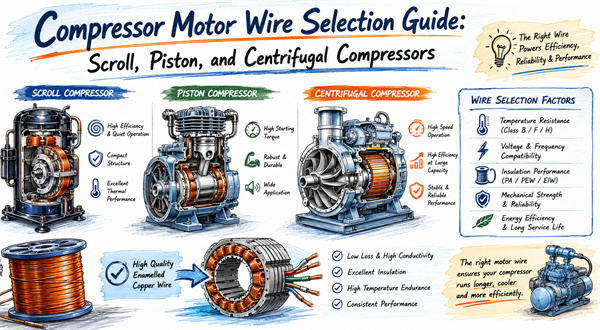
Compressor Classification Overview
Positive Displacement Compressors:
- Piston Compressor—traditional type, reciprocating motion
- Scroll Compressor—current mainstream, smooth operation
- Screw Compressor—industrial applications, high power
Velocity Compressors:
- Centrifugal Compressor—the heart of large central air conditioning
- Axial Compressor—large industrial projects
Scroll Compressor Motor Wire
Scroll compressors are the absolute mainstream in residential and light commercial air conditioning.
Operating Characteristics:
- Power Range: 1-50kW (residential and light commercial)
- Operating Features: Two scroll plates move relative to each other, low vibration, low noise
- Typical Applications: Residential air conditioning, VRF systems, small commercial air conditioning
Wire Selection Recommendations:
| Power Range | Conductor Material | Insulation Class | Recommended Spec |
|---|---|---|---|
| 1-3kW | Copper wire | E/B Class | 0.5-1.0mm |
| 3-10kW | Copper wire | B/F Class | 1.0-1.5mm |
| 10-20kW | Copper/Aluminum wire | F Class | 1.5-2.0mm |
Inverter Trend: Current-driven scroll compressors require corona-resistant wire for high-frequency pulse voltage resistance.
Aluminum Wire Applications: Entry-level scroll compressors widely use enameled aluminum wire—cost reduced by 20-30%, weight reduced by 30%.
Piston Compressor Motor Wire
Piston compressors are a traditional type still widely used in industrial and refrigeration applications.
Operating Characteristics:
- Power Range: 0.5-500kW (extremely wide range)
- Operating Features: Reciprocating motion, significant vibration
- Typical Applications: Industrial refrigeration, cold storage, large cold chain
Wire Selection Recommendations:
| Power Range | Conductor Material | Insulation Class | Recommended Spec |
|---|---|---|---|
| <1kW | Copper wire | E Class | 0.3-0.5mm |
| 1-10kW | Copper wire | B/F Class | 0.5-1.5mm |
| 10-50kW | Copper/Aluminum wire | F Class | 1.5-2.5mm |
| 50kW+ | Copper/Aluminum busbar | F/H Class | Custom specs |
Harsh Operating Environment: High vibration, impact loads, oil contamination—wire must have excellent coating adhesion and mechanical properties.
Centrifugal Compressor Motor Wire
Centrifugal compressors are the “heart” of large central air conditioning systems, with extremely high power.
Operating Characteristics:
- Power Range: 100-3000kW (even larger)
- Operating Features: High-speed rotation, smooth operation
- Typical Applications: Large commercial building air conditioning, industrial cooling, data centers
Wire Selection Recommendations:
| Power Range | Conductor Material | Insulation Class | Recommended Spec |
|---|---|---|---|
| 100-500kW | Copper/Aluminum busbar | F Class | Custom flat wire |
| 500-1500kW | Copper/Aluminum busbar | H Class | Custom flat wire |
| 1500kW+ | Copper busbar | H/C Class | Special specs |
Flat Wire is Mainstream: High-power centrifugal compressors widely use flat wire or rectangular busbars—large cross-section, excellent heat dissipation, suitable for large-scale automated production.
Special Wire Types:
- Fiber glass covered wire—for harsh industrial environments
- Transposed conductors—for ultra-large compressors, reducing skin effect
Screw Compressor Motor Wire
Screw compressors are widely used in industrial applications, especially for high-power scenarios.
Operating Characteristics:
- Power Range: 20-1000kW
- Operating Features: Twin-screw meshing, continuous operation
- Typical Applications: Industrial compressed air, process refrigeration, marine
Wire Selection Recommendations:
| Power Range | Conductor Material | Insulation Class | Recommended Spec |
|---|---|---|---|
| 20-100kW | Copper/Aluminum wire | F Class | 1.5-3.0mm |
| 100-300kW | Flat wire | F/H Class | Custom specs |
| 300kW+ | Copper/Aluminum busbar | H Class | Special specs |
Oil-Cooled Environment: Screw compressors typically use oil-flooded cooling—wire insulation must be oil-resistant.
Rotary Compressor Motor Wire
Rotary compressors (including rolling piston and swing types) are widely used in room air conditioners and small commercial air conditioning.
Operating Characteristics:
- Power Range: 0.5-10kW
- Operating Features: Rotating motion, simple structure
- Typical Applications: Room air conditioners (RAC), small commercial air conditioning
Wire Selection Recommendations:
| Power Range | Conductor Material | Insulation Class | Recommended Spec |
|---|---|---|---|
| 0.5-2kW | Copper wire | E/B Class | 0.3-0.8mm |
| 2-5kW | Copper wire | B/F Class | 0.8-1.2mm |
| 5-10kW | Copper/Aluminum wire | F Class | 1.2-1.8mm |
High Inverter Penetration: Rotary compressors are extensively used in inverter air conditioners—require corona-resistant wire, F Class insulation is mainstream.
Aluminum Wire is Widely Used: Entry-level products extensively use aluminum wire—strong cost competitiveness, reliability meeting residential needs.
Compressor Wire Selection Summary Table
| Compressor Type | Power Range | Recommended Wire | Insulation Class | Special Requirements |
|---|---|---|---|---|
| Scroll | 1-50kW | Round copper/aluminum wire | E/F Class | Inverter, corona-resistant |
| Piston | 0.5-500kW | Round/flat wire, busbar | E/B/F Class | Vibration-resistant |
| Centrifugal | 100-3000kW | Flat wire, busbar | F/H/C Class | High temperature resistant |
| Screw | 20-1000kW | Round/flat wire, busbar | F/H Class | Oil-resistant |
| Rotary | 0.5-10kW | Round copper/aluminum wire | E/B/F Class | Inverter, corona-resistant |
Development Trends for Different Compressor Types
Inverter Trend: Whichever compressor type is used, inverterization is the main direction, which the high-frequency pulse resistance, corona resistance and higher insulation class need.
Expansion of aluminum wire: more types of compressors are taking aluminum wire billowing to lower level of scroll compressor, rotary compressor as main part.
Trends in High-Temperature Insulation: H Class insulation use is on the rise, in some markets C Class insulation is entering certain areas.
Common Misconceptions in Compressor Wire Selection
Myth 1: All wires are the same for all compressors.
Varieties of compressor types operate under very different conditions of operation application specific selection is essential.
Myth 2: Aluminum wire is sub-standard in comparison to Copperwire
However, in certain specialized applications, the full benefits of the aluminum wire become even more apparent.
Myth 3: Greater number of insulation class is always preferred.
High insul. Class more expensive must match actual (operating conditions).
Myth 4: Forgetting inverter specifications
Completely different inverter compressor wire requirements to those of fixed speed.
Myth 5. Being price-oriented and not paying attention to quality The compressor is a very robust product and the quality of the wire directly influences the life of the compressor.
Summary
Different types of compressors have different requirements for motor wire:
- Scroll Compressors: Residential and light commercial mainstream, high inverterization, require corona-resistant wire
- Piston Compressors: Wide industrial applications, wide power range, require vibration-resistant wire
- Centrifugal Compressors: Large projects, require flat wire and high-temperature insulation
- Screw Compressors: Industrial mainstream, require oil-resistant wire
- Rotary Compressors: Residential main force, aluminum wire widely used