

Introduction
The engineering value of ECCA wire (Enameled Copper Clad Aluminum Wire, Enameled Copper Clad Aluminum Wire) not only depends on the copper layer proportion, interface bonding quality, and electrical conductivity of the copper-clad aluminum (CCA) conductor, but also depends on the coating material system covering the surface of the CCA conductor. The coating material is the core element that distinguishes ECCA wire from bare CCA wire. It is a key engineering barrier to ensure that ECCA wire achieves electrical insulation, mechanical protection, chemical protection, and heat-resistant stability during winding processing, embedding slot insulation, and long-term operation. Understanding the system classification, key performance, special matching of paint film and CCA conductor, composite coating and self-adhesive layer design, coating process and quality control, failure modes and selection decisions of ECCA wire coating materials has important practical guidance significance for ECCA wire manufacturers, paint liquid suppliers, motor manufacturers, home appliance manufacturers, transformer manufacturers, and winding wire selection engineers.
ECCA wire is a typical composite conductor enameled wire in the enameled wire product lineage. The core of its engineering is the double-layer structure of “copper-clad aluminum (CCA) conductor + paint film coating”. CCA conductors provide conductive channels and basic mechanical strength, and the paint film coating provides multiple functions such as electrical insulation, mechanical protection, chemical protection, and thermal stability. The matching of the paint film coating and the CCA conductor is the key to the ECCA line engineering application: the copper cladding provides an adhesion basis for the paint film, the difference in thermal expansion coefficients between the aluminum core and the copper cladding needs to be balanced by the paint film design, and the flexibility, adhesion, and curing process of the paint film must be optimized for the CCA conductor characteristics.
ECCA wire coating materials are a special subdivision in enameled wire coating engineering. From the perspective of material systems, ECCA line coatings involve more than 10 material systems such as polyester paint (PE), polyurethane paint (PU/UEW), polyesterimide paint (PEI), polyamideimide paint (PAI), polyimide paint (PI), self-adhesive paint, hot-melt paint, and composite coatings. From a functional level, ECCA wire coatings include basic insulation layer, mechanical protection layer, chemical protection layer, self-adhesive layer, lubricating layer, shielding layer, flame retardant layer, etc. From the perspective of engineering applications, ECCA wire coatings must meet the full-cycle engineering requirements for winding processing (high tension, compression, friction), embedded slot insulation (high temperature, high mechanical stress), and long-term operation (thermal aging, electrical aging, chemical aging, mechanical vibration).
The engineering connotation of Coating Materials Used in ECCA Wire can be systematically elaborated from twelve dimensions including the basics of ECCA wire coating materials, seven basic paint film systems, composite coatings and double-coating designs, self-adhesive wires and hot-melt paints, special matching of paint films and CCA conductors, coating processes and curing engineering, performance parameters and quality standards, failure modes and diagnosis, selection decision matrix, certification systems and standards, suppliers and manufacturing capabilities, future trends and innovation directions. This article provides a systematic engineering reference for ECCA wire manufacturers, paint liquid suppliers, motor manufacturers, home appliance manufacturers, transformer manufacturers, winding wire selection engineers, and procurement engineers.
ECCA Wire Coating Material Basics
Engineering Positioning of ECCA Line Coating Materials
ECCA wire coating material is an organic insulating coating covering the surface of CCA conductors, which undertakes multiple engineering functions such as electrical insulation, mechanical protection, chemical protection, thermal stability, welding compatibility, and self-adhesion. Compared with pure copper enameled wire and pure aluminum enameled wire, ECCA wire coating materials have the following special engineering considerations:
Copper Cladding Surface Characteristics: The outermost layer of the CCA conductor is the copper layer, which provides an adhesion basis for the paint film. The surface energy, oxidation tendency and weldability of copper directly affect the adhesion and curing process of the paint film. The surface of the copper cladding should be kept clean, dry, and free of oxide layers to ensure the wettability and adhesion of the paint film during the coating process.
Difference in thermal expansion coefficient between aluminum core and copper cladding: The thermal expansion coefficient of aluminum (≈23×10⁻⁶/°C) is larger than that of copper (≈17×10⁻⁶/°C). The dimensional changes of the copper layer and the aluminum core of CCA conductors are inconsistent under temperature cycles. The paint film must have sufficient flexibility and fatigue life to withstand the interfacial stress under long-term temperature cycles to avoid cracking of the paint film or loss of adhesion.
Copper cladding thickness limit: The copper cladding thickness of CCA conductors is usually 10%-40%. For some thin copper layer designs (≤15%), the mechanical stress at the painting mold needs to be precisely controlled to avoid micro-damage to the copper cladding during the coating process. The paint formulation needs to be optimized for CCA conductors to ensure adhesion of the paint film to the surface of the thin copper layer.
Hydrolysis sensitivity of the aluminum core: The hydrolysis tendency of the aluminum core of the CCA conductor in moisture, acid and alkali environments needs to be suppressed by the shielding performance of the paint film. The hydrolytic stability, wet and heat aging performance, and chemical resistance of the paint film are key indicators of ECCA line coating materials.
Key performance dimensions of coating materials
The key performance dimensions of ECCA wire coating materials cover five categories: electrical properties, mechanical properties, thermal properties, chemical properties, and processing properties:
Electrical properties: Breakdown Voltage, Dielectric Strength, Volume Resistivity, Dielectric Constant, Dissipation Factor tanδ, Corona Resistance, Partial Discharge Resistance.
Mechanical properties: Coating Adhesion, Flexibility, Tensile Strength, Elongation, Abrasion Resistance, Impact Resistance, Cut-Through Resistance, Spring Back Angle.
Thermal properties: Thermal Class / Temperature Class, Thermal Shock Resistance, Thermal Aging Life, Softening Breakdown Temperature, Thermal Decomposition Temperature, Temperature Index.
Chemical properties: Chemical Resistance, Humidity Resistance, Salt Spray Resistance, Refrigerant Resistance, Oil Resistance, Hydrolysis Resistance, Solvent Resistance.
Processing performance: Solderability, Self-Bonding, Lubricity, Winding Performance, Insertion Performance, Storage Stability, Curing Speed.
Standard system for coating materials
ECCA wire coating materials follow international and domestic multi-layer standard systems:
IEC 60317 Series: Enameled wire product standards, stipulating key technical indicators such as conductor specifications, paint film thickness, electrical properties, mechanical properties, and thermal properties of ECCA wires. IEC 60317-0-1 is the general requirement, and IEC 60317-13/14/15 is the specific paint film system product standard.
IEC 60851 Series: Enameled wire test method standard, stipulating test methods such as breakdown voltage test, thermal shock test, abrasion resistance test, paint film continuity test, adhesion test, etc.
NEMA MW 1000: North American enameled wire standard system, including MW 35 (PEI), MW 36 (PAI), MW 73 (PEI/PAI composite), MW 76 (PEI self-lubricating) and other specific paint film system standards.
GB/T 7095: China’s national standard is equivalent to the IEC 60317 series, which stipulates enameled wire product standards.
GB/T 4074: Chinese national standards are equivalent to the IEC 60851 series and stipulate test methods for enameled wires.
UL 1446: Insulation system standard, stipulating system-level evaluation methods for enameled wires in insulation systems such as motors and transformers.
JIS C 3003: Japanese Industrial Standard, stipulates the conductor specifications, paint film thickness, and electrical properties of enameled wires.
Detailed explanation of 7 basic paint film systems
Polyester paint (PE/Polyester)
Chemical basis of polyester paint: Polyester paint is a polymer compound formed by the polycondensation reaction of polyethylene terephthalate (PET) or its derivatives and polyols (ethylene glycol, glycerol, neopentyl glycol, etc.). Polyester paint film has excellent flexibility, adhesion, and electrical insulation properties, and is the most basic paint film system for ECCA lines.
Temperature resistance class of polyester paint: PEW 130 paint film (Polyester Enamelled Wire, Class 130) specified in IEC 60317-3, long-term operating temperature 130°C, short-term overload temperature 155°C.
Application of polyester paint on ECCA lines:
- Household appliance motors (electric fan motors, washing machine drain pumps, range hood motors)
- Small electronic transformers (toy motors, electric toothbrush vibration motors)
- Low voltage coil (relay coil, solenoid valve coil)
- Cost-sensitive lightweight applications
Performance boundaries of polyester paint:
- The upper limit of temperature resistance is 130°C, which cannot meet applications above Class H (180°C).
- Medium resistance to chemical media, not suitable for oil immersion and refrigerant environments
- The paint film has low hardness and medium wear resistance
- Poor welding performance, the paint film needs to be removed in advance
Special considerations for polyester paint on CCA conductors: The copper cladding surface should be clean, dry, and free of oxide layers, and the paint viscosity needs to be adjusted for the thin copper layer of the CCA conductor. The polyester paint has good adhesion to the surface of the copper layer, but there is no direct contact with the interface with the aluminum core (the paint film only covers the outer surface of the copper layer).
Polyurethane paint (PU/UEW/Polyurethane)
Chemical basis of polyurethane paint: Polyurethane paint is a polymer compound formed by the polycondensation reaction of blocked isocyanate (Blocked Isocyanate) and polyol (polyester polyol, polyether polyol). Polyurethane paint film has weldability, high frequency performance, flexibility and is the key film system for ECCA lines.
Temperature resistance grade of polyurethane paint:
- UEW 130 (Polyurethane Enamelled Wire, Class 130): Long-term operating temperature 130°C
- UEW 155 (Modified Polyurethane, Class 155): Long-term operating temperature 155°C
- Self-adhesive polyurethane paint: hot melt temperature 180-200°C
Application of polyurethane paint on ECCA lines:
- High frequency transformers (switching power supply transformers, electronic transformers)
- Instrument coils (magnetic heads, sensor coils)
- Small relays, timer coils
- Communication equipment coils
- Self-adhesive coils (speaker voice coil, vibration motor coil)
Core characteristics of polyurethane paint:
- **Solderability**: Polyurethane paint film can be soldered directly at 375°C soldering iron temperature without prior removal of the paint film. This property gives polyurethane paint significant advantages in applications such as small electronic transformers and relay coils that require a large number of welded joints.
- **High frequency performance**: The polyurethane paint film has a low dielectric loss tangent (tanδ) and is suitable for high frequency applications.
- **Flexibility**: The elongation rate of polyurethane paint film is high (≥30%), which is suitable for thin wires (≤0.1mm) and high-stretch windings.
- **Moisture and Heat Resistance**: The polyurethane paint film has medium resistance to moisture and heat, and requires a moisture-proof design in high-humidity environments.
Modification system of polyurethane paint:
- **Modified Polyester Polyurethane**: Increased temperature resistance to 155°C, retaining solderability.
- **Self-Bonding Polyurethane**: Self-bonding layer (epoxy or polyvinyl butyral) for self-bonding coils.
- **Solderable Polyesterimide (PEI)**: Solderable polyesterimide paint, welding temperature can reach above 450°C, with both solderability and temperature resistance.
Polyesterimide paint (PEI / Polyesterimide)
Chemical basis of polyesterimide paint: Polyesterimide paint is a polymer compound formed by the polycondensation reaction of polyester polyol and imine compound (trimellitic anhydride or maleic anhydride). Polyester-imide paint film combines the flexibility of polyester paint with the high-temperature stability of imine rings. It is the mid-to-high-end paint film system of the ECCA line.
Temperature resistance grade of polyesterimide paint:
- PEI 180 (Polyesterimide Enamelled Wire, Class H): long-term operating temperature 180°C
- Short-term overload temperature 200°C
- Thermal life: ≥20,000 hours at 180°C, ≥40,000 hours at 155°C
Application of polyesterimide paint on ECCA lines:
- Industrial motors (compressor motors, pump motors, fan motors)
- Medium and high voltage motors (≥380V industrial motors)
- Dry-type transformers (control transformers, lighting transformers)
- Fluorescent lamp ballasts
- Motors that frequently start and stop (textile machinery, lifting equipment motors)
Core characteristics of polyesterimide paint:
- **Temperature resistance**: The polyesterimide paint film maintains stable performance at a long-term operating temperature of 180°C, and its thermal shock performance is better than that of pure polyester paint.
- **Mechanical properties**: The flexibility, adhesion and wear resistance of the paint film are better than polyurethane paint and polyester paint.
- **Chemical Properties**: Chemical media resistance and oil resistance are better than pure polyester paint, but lower than polyamide-imide paint.
- **Electrical properties**: Dielectric strength and breakdown voltage are better than pure polyester paint.
- **Cost**: Between pure polyester and polyamide-imide, it is the most cost-effective mid-to-high-end paint film system.
THEIC modified polyesterimide paint (TPEI): Polyesterimide paint modified with THEIC (Tris(2-Hydroxyethyl) Isocyanurate, trishydroxyethyl isocyanurate) is a high-end PEI system with excellent heat resistance, mechanical properties, electrical properties and chemical properties. TPEI paint film maintains stable performance under long-term operating temperature of 180°C and is the mainstream paint film system for high-end applications in ECCA lines.
Polyamide-Imide paint (PAI / Polyamide-Imide)
Chemical basis of polyamide-imide paint: Polyamide-imide paint is a polymer compound formed by the polycondensation reaction of trimellitic anhydride (TMA) and aromatic diamines (such as diaminodiphenylmethane, MDA). The molecular structure of polyamide-imide paint film contains both amide bonds (flexible) and imide rings (rigid). It is a high-end system with the best comprehensive performance among enameled wire paint film systems.
Temperature resistance grade of polyamideimide paint:
- PAI 200 (Polyamide-Imide Enamelled Wire, Class 200): Long-term operating temperature 200°C
- Short term overload temperature 220-230°C
- Thermal life: ≥10,000 hours at 200°C, ≥40,000 hours at 180°C
Application of polyamideimide paint on ECCA lines:
- Electric vehicle drive motors (drive motors, auxiliary motors)
- Refrigeration compressors (refrigerator compressors, air conditioning compressors)
- Dry-type transformers (high-frequency transformers, wind power transformers)
- Industrial high-end motors (servo motors, precision motors)
- Aerospace coils
- Special applications (nuclear magnetic resonance, new energy)
Core characteristics of polyamide-imide paint:
- **Ultra-high temperature stability**: The polyamide-imide paint film maintains stable performance at a long-term operating temperature of 200°C, with a thermal decomposition temperature ≥400°C.
- **Super wear resistance**: The wear resistance of polyamide-imide paint film is better than other paint film systems, and it is the first choice for high-speed winding.
- **Super chemical resistance**: The polyamide-imide paint film has excellent resistance to refrigerants (R134a, R410A, R1234yf), transformer oil, silicone oil, ester oil, and ketone solvents.
- **Super mechanical properties**: Tensile strength, elongation, cut resistance, and rebound angle are superior to other paint film systems.
- **Super Electrical Properties**: Dielectric strength (≥8kV), breakdown voltage, and volume resistivity are superior to other paint film systems.
- **Cost**: Polyamide-imide paint is one of the most expensive systems among enameled wire paint systems.
The special value of polyamide-imide paint in the ECCA line: The window (slot) space of the electric vehicle drive motor is limited, and the lightweight advantage of the ECCA line is significant. The 200°C temperature resistance and super wear resistance of the polyamide-imide paint film meet the harsh working conditions of high speed, high torque and vibration of the drive motor. The refrigerant resistance of the polyamide-imide paint film meets the requirements of the closed oil-immersed environment of refrigeration compressors.
Polyimide paint (PI / Polyimide)
Chemical basis of polyimide paint: Polyimide paint is a polymer compound formed by the condensation polymerization and imidization reaction of pyromellitic dianhydride (PMDA) and aromatic diamines (such as diaminodiphenyl ether, ODA). Polyimide paint film is the system with the highest temperature resistance among enameled wire paint film systems.
Temperature resistance rating of polyimide paint:
- PI 220 (Polyimide Enamelled Wire, Class 220): Long-term operating temperature 220°C
- Short-term overload temperature 250°C
- Thermal life: ≥20,000 hours at 220°C
Application of polyimide paint on ECCA lines:
- Aerospace (aerospace generators, satellite coils, rocket thruster coils)
- Harsh industries (nuclear power equipment, military equipment, high-speed rail traction motors)
- High-end electronics (high-frequency power supply, military communications)
- Extreme working conditions (-65°C ~ 220°C temperature cycle)
Core characteristics of polyimide paint:
- **Ultra-ultra-high temperature stability**: The polyimide paint film maintains stable performance at a long-term operating temperature of 220°C, with a thermal decomposition temperature ≥500°C.
- **Ultra-wide temperature range**: The polyimide paint film remains flexible in the range of -65°C ~ 220°C and does not become brittle at low temperatures.
- **Radiation Resistance**: The polyimide paint film has excellent resistance to gamma rays, electron beams, and neutron radiation.
- **Chemically Inert**: Polyimide paint films have excellent resistance to almost all chemical media.
- **Brittleness**: The flexibility and elongation of the polyimide paint film are lower than those of the PAI paint film and need to be improved through plasticization or composite modification.
- **Adhesion**: The polyimide paint film has poor adhesion to the substrate and needs to be matched with a primer.
- **Cost**: Polyimide paint is the most expensive system among the enameled wire paint film systems.
Special considerations for polyimide paint on ECCA lines: The brittleness of the polyimide paint film needs to be matched by a primer (PEI primer) to enhance adhesion. Pure ECPI lines are rarely used in ECCA lines, and PEI/PI composite coatings or PI self-lubricating modified systems are mostly used.
Composite coating (Dual Coat)
Engineering significance of composite coating: It is difficult for a single paint film system to meet all engineering requirements at the same time. Composite coating (Dual Coat / Overcoat) combines the advantages of the two paint film systems through a double-layer structure of base layer (Base Coat) + surface layer (Top Coat), and is the mainstream design for high-end applications of ECCA lines.
PEI/PAI composite coating (PEI Base + PAI Overcoat):
- **Base Layer (PEI)**: Temperature resistant to 180°C, good mechanical properties, moderate cost.
- **Surface layer (PAI)**: Temperature resistance 200°C, super wear-resistant, super chemical resistance.
- **Comprehensive performance**: Temperature resistance of 200°C (PAI dominant), mechanical properties (PEI contribution), cost between pure PEI and pure PAI.
- **Applications**: Electric vehicle drive motors, servo motors, refrigeration compressors, wind power transformers.
PEI/PI composite coating:
- **Base layer (PEI)**: Temperature resistant 180°C, good adhesion.
- **Surface Layer (PI)**: Temperature resistance 220°C, super chemical resistance, super radiation resistance.
- **Applications**: aerospace, military industry, high-speed rail traction motors.
PE/PAI composite coating:
- **Basic layer (PE)**: low cost, good flexibility.
- **Surface Layer (PAI)**: Ultra wear-resistant, ultra-chemical resistant.
- **Application**: Upgraded versions of industrial and low-end motors and home appliances.
International standards for composite coatings:
- IEC 60317-13: PEI/PAI composite coating (Polyester or Polyesterimide Overcoated with Polyamide-Imide), Class 200.
- IEC 60317-15: PEI/PAI self-lubricating composite coating (Polyesterimide Overcoated with Polyamide-Imide, with Bonding Layer).
- IEC 60317-25: PE/PAI composite coating (Polyester Overcoated with Polyamide-Imide), Class 200.
- IEC 60317-42: PEI/PAI refrigerant-resistant composite coating (Polyesterimide Overcoated with Polyamide-Imide, Refrigerant Resistant).
- NEMA MW 73: PEI/PAI composite coating (Polyesterimide Overcoated with Polyamide-Imide).
The engineering value of composite coatings in ECCA lines: Composite coatings are the mainstream solution for high-end applications of ECCA lines. PEI/PAI composite coatings have significant advantages in harsh working conditions such as electric vehicle drive motors, refrigeration compressors, and wind power transformers. ECCA wire + PEI/PAI composite coating is the golden combination of “lightweight + high temperature resistance + high wear resistance”.
###Self-Bonding Layer
Engineering significance of self-adhesive layer: Self-Bonding Wire is a hot-melt or chemical adhesive layer coated on top of the base paint film. The coil is bonded and formed through heating or solvent activation without the need for a skeleton or impregnation process. Self-adhesive wire is widely used in speaker voice coils, vibration motor coils, air core coils, instrument coils, and sensor coils.
Self-adhesive layer material system:
- **Epoxy Self-Bonding**: Based on bisphenol A epoxy resin and curing agent, bonding temperature 180-200°C, bonding time 30-60 minutes.
- **Polyvinyl butyral self-bonding (PVB Self-Bonding)**: Based on polyvinyl butyral resin, solvent activated (ethanol, isopropyl alcohol), bonding temperature 150-180°C.
- **Polyamide Self-Bonding**: Based on copolyamide resin, bonding temperature 200-220°C.
- **Modified Epoxy Self-Bonding**: Based on epoxy-phenolic or epoxy-polyurethane modification, bonding temperature 180-200°C.
- **Acrylic Self-Bonding**: Based on thermoplastic acrylic resin, bonding temperature 120-150°C.
Application of self-adhesive layer on ECCA line:
- Speaker voice coil (Voice Coil): Self-adhesive wire ensures that the voice coil remains structurally stable in the magnetic field.
- Vibration Motor: Self-adhesive wire ensures that the vibration motor coil does not loosen under high-frequency vibration.
- Air Core Coil: Self-adhesive wire realizes a self-supporting structure without a skeleton coil.
- Instrument Coil: Self-adhesive wire ensures the dimensional stability of precision instrument coils.
- Sensor Coil: Self-adhesive wire ensures long-term reliability of the sensor coil.
Matching of self-adhesive layer and base paint film:
- **PE + self-adhesive layer**: low-cost self-adhesive wire, suitable for low-end speakers and toy motors.
- **UEW + self-adhesive layer**: weldable + self-adhesive, suitable for electronic transformers and relay coils.
- **PEI + self-adhesive layer**: temperature resistant 180°C + self-adhesive, suitable for mid-to-high-end audio equipment.
- **PAI + self-adhesive layer**: temperature resistant 200°C + self-adhesive, suitable for high-end audio and automotive sensors.
Engineering Challenges of Self-Adhesive Wire:
- The curing or activation process of the self-adhesive layer needs to be precisely controlled to avoid conflict with the curing process of the base paint film.
- The storage stability of the self-adhesive layer (avoid pre-curing at room temperature) needs to be ensured through formula design.
- The adhesive strength (shear strength, peel strength) of the self-adhesive layer needs to match the application requirements.
- The chemical medium resistance and heat resistance of the self-adhesive layer must meet long-term operation requirements.
Modified paint film and special coating
Self-Lubricating Enamel: Self-lubricating paint film adds solid lubricants (wax, polytetrafluoroethylene micropowder, molybdenum disulfide) or liquid lubricants (silicone oil, ester oil) to the outer layer of the basic paint film to reduce the friction coefficient of the paint film surface and improve high-speed winding performance. The international standards for self-lubricating paint films are IEC 60317-15 (PEI self-lubricating) and NEMA MW 76 (PEI self-lubricating). The applications of self-lubricating paint films on ECCA wires are mainly high-speed winding (≥3,000 RPM) and precision winding.
Flame Retardant Enamel: Flame retardant paint film adds flame retardants (halogen series, phosphorus series, nitrogen series, inorganic flame retardants) to the basic paint film to improve the flame retardant performance of the paint film. The international standards for flame retardant paint films are UL 1446 (system level flame retardant) and IEC 60317-50. The applications of flame retardant paint films on ECCA lines are mainly household appliances, rail transit, and new energy vehicles.
Corona Resistant Enamel: Corona-resistant paint film adds nanoscale inorganic fillers (silicon oxide, aluminum oxide, titanium oxide) to the base paint film to improve the corona-resistant performance of the paint film. The applications of corona-resistant paint films on ECCA lines are mainly high-voltage motors, wind turbines, and rail transit traction motors. The international standard for corona-resistant paint films is IEC 60317-56 (corona-resistant enameled wire).
Partial Discharge Resistant Enamel: Partial Discharge Resistant Enamel adds special nano-fillers or organic modifiers to the base paint film to improve the partial discharge resistance of the paint film. The applications of partial discharge resistant paint films on ECCA lines are mainly variable frequency motor drive systems and rail transit traction motors.
Oil Resistant Enamel: Oil Resistant Enamel adds an oil-resistant modifier to the base paint film to improve the paint film’s resistance to transformer oil, mineral oil, and synthetic oil. The main applications of paint-resistant films on ECCA lines are oil-immersed transformers and oil-immersed reactors.
Refrigerant Resistant Enamel: The refrigerant-resistant paint film is optimized on the basis of PAI paint film and has excellent resistance to refrigerants such as R134a, R410A, and R1234yf. The international standard for refrigerant-resistant paint films is IEC 60317-42. The applications of refrigerant-resistant paint films on ECCA lines are mainly refrigerator compressors and air-conditioning compressors.
##Special matching of paint film to CCA conductors
Wettability of paint film on copper cladding surface
The outermost layer of the CCA conductor is the copper layer, which provides the base for the paint film to adhere to. The surface energy and wettability of copper (≈1.5 J/m²) are better than those of aluminum (≈1.0 J/m²), and the wettability of the paint film on the surface of the copper layer is better than that of the aluminum layer. The paint film coating process must ensure that the paint liquid is fully wetted, evenly spread, and tightly adhered to the surface of the copper layer.
Copper layer surface treatment process:
- **Mechanical Polishing**: Remove the oxide layer, defects, and foreign matter on the surface of the copper layer through physical methods.
- **Chemical Cleaning**: Remove oil stains and oxide layers on the surface of the copper layer through pickling and alkali cleaning processes.
- **Electrochemical Polishing**: Improve the surface finish of the copper layer through electrochemical methods.
- **Plasma treatment**: Improve the wettability of the copper layer surface through plasma treatment.
- **Primer pretreatment**: Apply an extremely thin layer (≤1 μm) of primer on the surface of the copper layer to improve the adhesion of the paint film.
Suppression of surface oxidation of copper layer: The copper layer slowly oxidizes (Cu → Cu₂O → CuO) at room temperature, and the oxide layer (CuO) affects the adhesion of the paint film. The thickness of the oxide layer on the surface of the copper layer before paint film coating should be controlled within the range of ≤50 nm. The coating process should avoid long-term exposure of the copper layer before coating, and the environmental humidity and temperature of the coating process should be strictly controlled.
Copper cladding thickness ratio matches paint film:
- Copper cladding ratio 10-15%: Thin copper layer design, paint film coating requires precise control of mechanical stress to avoid damage to the copper layer.
- Copper cladding ratio 15-25%: Standard copper layer design, the paint film coating process has good tolerance.
- Copper cladding ratio 25-40%: thick copper layer design, improved paint film adhesion, and stable coating process.
- Copper cladding ratio ≥40%: high copper layer design (close to pure copper), and the paint film coating process is consistent with that of pure copper enameled wire.
Paint film compensates for the difference in thermal expansion coefficients of copper and aluminum
The aluminum core and copper cladding of CCA conductors exhibit inconsistent dimensional changes under temperature cycling. The thermal expansion coefficient of aluminum (≈23×10⁻⁶/°C) is greater than that of copper (≈17×10⁻⁶/°C). When the temperature of the CCA conductor increases, the expansion of the aluminum core is greater than that of the copper layer, causing the copper layer to bear tensile stress and the aluminum core to bear compressive stress. The paint film must have sufficient flexibility and fatigue life to withstand the interfacial stress under long-term temperature cycles.
Temperature Cycle Stress Analysis:
- Temperature cycling range: -40°C ~ 180°C (typical industrial applications)
- Number of temperature cycles: ≥1,000 times (typical industrial life)
- Strain level: 1-3% (depending on copper cladding ratio and temperature cycle range)
- Stress concentration: edges of copper-aluminum interface and changes in paint film thickness
Paint film flexibility design:
- **Elongation rate of basic paint film**: ≥30% (Class 130-155), ≥25% (Class 180), ≥20% (Class 200-220).
- **Glass transition temperature (Tg) of the paint film**: Tg should be 20-30°C lower than the long-term working temperature of the paint film to ensure that the paint film remains highly elastic at the working temperature.
- **Elastic modulus of paint film**: The elastic modulus should be moderate (1-3 GPa). Excessive elastic modulus will cause the paint film to crack under temperature cycles.
- **Fatigue life of paint film**: ≥10⁶ temperature cycles (typical industrial requirements).
Temperature Cycle Test Standard:
- IEC 60851-6: Heat Shock Test, the paint film is bent 1 circle in diameter at a temperature of 130-200°C, and the paint film does not crack.
- IEC 60851-6: Softening breakdown test (Cut-Through Test), the paint film is subjected to a load of 1 N at a temperature of 200-300°C, and the paint film does not break down.
- GB/T 4074.6: Chinese national standard is equivalent to IEC 60851-6.
Paint film shields aluminum core from hydrolysis
The aluminum core of the CCA conductor will undergo a hydrolysis reaction (Al + 3H₂O → Al(OH)₃ + 3/2 H₂) in the presence of moisture. The hydrolysis product (Al(OH)₃) affects the adhesion and electrical insulation properties of the paint film. The hydrolytic stability and moist heat aging performance of the paint film are key indicators of ECCA line coating materials.
Hydrolysis Mechanism:
- Moisture penetrates into the interface between the paint film and the copper layer through microscopic defects, pinholes, and thickness changes in the paint film.
- Moisture comes into contact with the aluminum core on the surface of the copper layer, triggering the hydrolysis reaction of the aluminum core.
- Hydrolysis products (Al(OH)₃, H₂) accumulate at the interface, leading to bubbling, delamination, and decreased adhesion of the paint film.
- Long-term hydrolysis causes the electrical insulation performance of the paint film to decrease and the breakdown voltage to decrease.
Design of paint film hydrolytic stability:
- **Denseness of the paint film**: Reduce pinholes and microscopic defects, and improve the moisture shielding performance of the paint film.
- **Hydrophobicity of the paint film**: Reduce the water absorption of the paint film (≤0.5% for Class 180+).
- **Chemical bond stability of the paint film**: The ester bonds, amide bonds, and imide bonds of the paint film should be resistant to hydrolysis.
- **Paint film thickness**: Appropriately increase the paint film thickness (≥30 μm) to extend the moisture penetration path.
- **Interlayer structure of paint film**: The moisture shielding performance of a double-coat design is better than that of a single coating.
Damp and Heat Aging Test Standard:
- IEC 60851-5: Hydrolysis Resistance Test, the paint film will not crack for 1,000 hours in an environment of 90% RH and 60°C.
- IEC 60851-5: Humidity Resistance Test, the breakdown voltage of the paint film does not decrease for 96 hours in an environment of 90-95% RH and 40°C.
- GB/T 4074.5: Chinese national standard is equivalent to IEC 60851-5.
Compatibility of paint film with copper-aluminum intermetallic compound (IMC)
The copper-aluminum interface forms intermetallic compounds (IMC) under long-term high temperatures. Common IMCs include CuAl₂, Cu₉Al₄, Cu₃Al, etc. IMC is a brittle phase that affects the mechanical properties, electrical properties, and long-term reliability of CCA conductors. The curing temperature of the paint film application (300-500°C) may accelerate the formation of IMC.
Effect of IMC on paint film:
- The formation of IMC is accompanied by volume changes in the copper layer and aluminum core, resulting in changes in the surface morphology of the copper layer and affecting the adhesion of the paint film.
- The brittleness of IMC may cause micro-cracks in the copper layer during the paint film coating process, affecting the continuity of the paint film.
- The resistance of IMC is higher than that of the copper layer, and an excessively thick IMC layer affects the conductive performance of the ECCA line.
Control of IMC by paint film coating process:
- **Curing temperature control**: The curing temperature should be as low as possible while ensuring the curing of the paint film. The recommended curing temperature is ≤450°C.
- **Curing time control**: The curing time should be optimized according to the curing temperature and paint film thickness to avoid over-curing.
- **Rapid Curing Process**: Rapid curing processes such as UV curing and electron beam curing can reduce the exposure time of the copper-aluminum interface to high temperatures.
- **Copper cladding thickness control**: The copper cladding thickness ratio should be appropriate (≥15%) to ensure that the formation of IMC does not affect the integrity of the copper layer.
Coating process and curing engineering
Basics of coating process
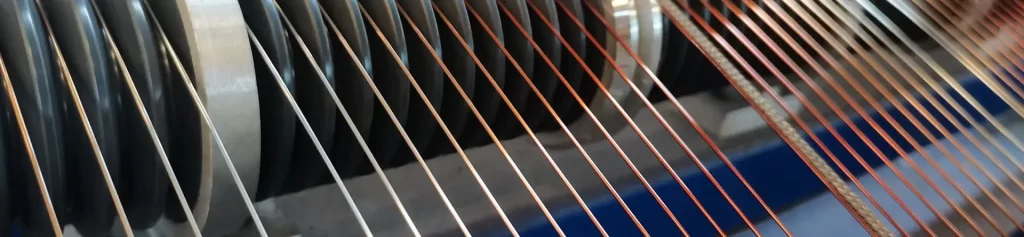
The coating process of ECCA wire is similar to that of pure copper enameled wire, mainly using die coating method. The key steps of the coating process include conductor pretreatment, paint liquid preparation, painting mold, baking and curing, and wire take-up and packaging.
Coating process:
1. Conductor pre-treatment: CCA conductors undergo mechanical polishing, chemical cleaning, plasma treatment and other processes to ensure that the surface of the copper layer is clean, dry and free of oxide layers.
2. Paint liquid preparation: Prepare the paint liquid according to the paint film system (PE/PU/PEI/PAI/PI), and strictly control the viscosity, solid content, and temperature of the paint liquid.
3. Painting Mold: The paint liquid is evenly coated on the surface of the CCA conductor through the die (Die), and the size of the die matches the thickness of the paint film.
4. Baking Curing: The CCA conductor coated with paint liquid enters the baking oven (Oven), and the paint liquid solidifies at high temperature to form a paint film.
5. Cyclic coating: Repeat coating and curing 2-10 times according to the paint film thickness grade (Grade 1/2/3) and composite coating design.
6. Wire take-up and packaging: The cured ECCA wire is taken up by the take-up machine, packaged and stored in the warehouse.
Key parameters of coating process:
- **Paint liquid viscosity**: 50-500 mPa·s (depending on the paint film system and coating method)
- **Solid content of paint liquid**: 15-35% (depending on the paint film system)
- **Painting speed**: 10-100 m/min (depending on conductor diameter and paint film thickness)
- **Baking temperature**: 300-500°C (depending on the paint film system)
- **Baking time**: 10-60 seconds (depends on baking temperature and paint film thickness)
- **Ambient Humidity**: ≤60% RH (coating area)
- **Ambient temperature**: 20-30°C (coating area)
###Special Considerations for Coating Processes
Differences between the coating process of CCA conductors and pure copper enameled wires:
- The mechanical stress of ECCA wires with thin copper cladding (≤15%) at the painted mold needs to be precisely controlled to avoid micro-damage to the copper layer.
- The paint solution formula needs to be optimized for the copper layer surface of the CCA conductor to improve the adhesion of the paint film.
- The coating speed should be adjusted according to the mechanical properties of the CCA conductor to avoid conductor breakage.
- The baking temperature and time should be optimized based on the copper-aluminum interface stability of the CCA conductor to avoid excessive rapid formation of IMC.
Evolution of copper-aluminum interface in coating process:
- **Room Temperature Coating**: Copper-aluminum interface is stable, IMC formation is slow.
- **Low-temperature baking (≤300°C)**: The copper-aluminum interface is stable and IMC is formed very slowly.
- **Medium temperature baking (300-450°C)**: IMC formation is accelerated and baking time should be controlled.
- **High temperature baking (≥450°C)**: IMC formation is significant and should be avoided or rapid curing should be used.
Composite coating coating process
The coating process of composite coating (double coating) requires surface layer coating after the base layer coating is completed. The two coating processes need to be coordinated to ensure the interlayer bonding between the base layer and the surface layer.
Key processes for composite coating application:
- **Base layer curing**: The base layer needs to be fully cured after coating (usually 80-90% curing degree) to avoid solvent erosion during surface layer coating.
- **Surface layer coating**: The surface layer is coated on the surface of the base layer, and the coating process parameters are similar to those of the base layer.
- **Composite Curing**: The final curing after surface layer coating should consider the coordinated curing of the base layer and surface layer.
- **Interlayer bonding force**: The interlayer bonding force between the base layer and the surface layer should be ensured through formula design, chemical bond matching, mechanical fitting, etc.
Frequently Asked Questions about Composite Coating Application Process:
- **Interlayer delamination**: Delamination between the base layer and the surface layer. Common reasons are excessive curing of the base layer or solvent erosion of the surface layer.
- **Uneven paint film thickness**: The thickness of the base layer and the surface layer is uneven. The common reason is that the coating process parameters are unstable.
- **Paint film defects**: bubbles, pinholes, and inclusions between layers. Common causes are improper control of the coating environment (humidity, cleanliness).
Self-adhesive wire coating process
The coating process of the self-adhesive line is to apply the self-adhesive layer after the basic paint film is completed. The coating process of the self-adhesive layer needs to be carried out at low temperature (≤200°C) to avoid pre-curing of the self-adhesive layer during the coating process.
Key processes for self-adhesive layer coating:
- **Preparation of self-adhesive layer paint**: The viscosity and solid content of the self-adhesive layer paint liquid need to be adjusted according to the type of self-adhesive layer (epoxy/PVB/polyamide).
- **Coating temperature**: The coating temperature of the self-adhesive layer should be controlled at 100-200°C to avoid pre-curing of the self-adhesive layer.
- **Coating Speed**: The coating speed of the self-adhesive layer should be appropriately reduced (≤30 m/min) to ensure that the self-adhesive layer is evenly coated.
- **Storage Stability**: ECCA self-adhesive threads coated with self-adhesive layer should be stored in a dry environment at low temperature (≤25°C) for a storage period of ≤6 months.
Key Controls of Curing Process
Cure Temperature Curve:
- **Preheating zone**: 80-150°C, evaporates the paint solvent.
- **Main Curing Zone**: 300-450°C, paint film cross-linking reaction.
- **Post-curing zone**: 200-300°C, the paint film is completely cured.
- **Cooling Zone**: ≤100°C, the paint film is cooled and finalized.
Curing oven design:
- **Vertical Curing Oven**: The ECCA line passes vertically through the curing oven, and the coating process is stable, suitable for large-sized ECCA lines.
- **Horizontal Curing Oven**: The ECCA line passes through the curing oven horizontally, suitable for small size ECCA lines.
- **Catalytic Hot Air Curing Oven (CAT)**: Uses catalytic burner for heating, uniform curing temperature, suitable for high-end ECCA lines.
- **Electric Heating Curing Oven**: Uses electric heating elements for heating, and the curing temperature is precisely controlled. It is suitable for mid-to-high-end ECCA lines.
Key Controls of Curing Process:
- **Cure Temperature Uniformity**: Temperature uniformity within the curing oven ±5°C.
- **Cure Atmosphere**: hot air circulation, oxygen content 21% (to avoid oxidation).
- **Curing time**: Optimized based on paint film thickness, baking temperature, and paint film system.
- **Solvent Emission**: Solvent emissions from the curing oven should comply with environmental regulations (VOC emission standards).
Performance parameters and quality standards
Paint film thickness grade
ECCA line paint film thickness grades follow international standards (IEC 60317, NEMA MW 1000, GB/T 7095):
Grade 1 (thin film): Increased film thickness by 0.06-0.09 mm (depending on wire diameter), suitable for low voltage ECCA line applications.
Grade 2 (medium film): Increased film thickness by 0.09-0.13 mm (depending on wire diameter), suitable for general purpose ECCA wire applications.
Grade 3 (thick paint film): The paint film thickness increases by 0.13-0.18 mm (depending on the wire diameter), suitable for ECCA line applications with high voltage and severe working conditions.
Relationship between paint film thickness and breakdown voltage:
- Grade 1 paint film: breakdown voltage ≥2.5 kV
- Grade 2 paint film: breakdown voltage ≥4.0 kV
- Grade 3 paint film: breakdown voltage ≥6.0 kV
Breakdown voltage and dielectric strength
The breakdown voltage of the ECCA line paint film is closely related to the paint film thickness, paint film system, and paint film uniformity.
Breakdown voltage test standard:
- IEC 60851-5: Breakdown Voltage Test, apply AC voltage between the conductor and the paint film surface electrode, and measure the breakdown voltage.
- GB/T 4074.5: Chinese national standard is equivalent to IEC 60851-5.
- ASTM D3032: American Society for Testing and Materials standard.
Typical breakdown voltage value:
- PE 130/Grade 1: ≥2.5 kV
- PE 130/Grade 2: ≥4.0 kV
- PE 130/Grade 3: ≥6.0 kV
- PEI 180/Grade 2: ≥5.0 kV
- PAI 200/Grade 2: ≥6.0 kV
- PEI/PAI / Grade 2: ≥6.5 kV
- PAI/PI/Grade 2: ≥7.0 kV
Paint film continuity (pinhole test)
The continuity of the ECCA line paint film is characterized by the Pin Hole Test / Continuity Test. The number of pinholes per meter of paint film is a key indicator of paint film quality.
Pinhole Test Standard:
- IEC 60851-5: Paint film continuity test, paint film under 30V DC voltage, count the number of pinholes per meter of paint film.
- ASTM D3032: American Society for Testing and Materials standard.
Typical number of pinholes:
- Grade 1 paint film: ≤5 pinholes/30m
- Grade 2 paint film: ≤3 pinholes/30m
- Grade 3 paint film: ≤1 pinhole/30m
Wear resistance
The abrasion resistance of the ECCA line paint film is characterized by the Unidirectional Scrape Test and the Reciprocating Scrape Test.
Abrasion resistance test standards:
- IEC 60851-3: Unidirectional Scrape Test, measuring the number of times the paint film is worn under a load of 0.4-1.6 N.
- NEMA MW 1000: Reciprocating Scrape Test, which measures the number of reciprocating scrapes of a paint film under a load of 0.2-1.0 N.
Typical wear times:
- PE 130 / Grade 2: ≥50 times (0.55 N load)
- UEW 130 / Grade 2: ≥40 times (0.55 N load)
- PEI 180 / Grade 2: ≥100 times (0.55 N load)
- PAI 200 / Grade 2: ≥150 times (0.55 N load)
- PEI/PAI / Grade 2: ≥130 times (0.55 N load)
Adhesion test
The adhesion of ECCA thread paint film is characterized by tensile test (Mandrel Test), snap test (Snap Test), and peel test (Peel Test).
Adhesion Test Standard:
- IEC 60851-3: Snap Test, the paint film is pulled sharply on a rod with a diameter of 1 circle, and the paint film does not crack.
- IEC 60851-3: Tensile test (Mandrel Test), the paint film is stretched on rods of different diameters, and the paint film does not crack.
- GB/T 4074.3: Chinese national standard is equivalent to IEC 60851-3.
Typical adhesion test results:
- Class 130-155: 1 circle diameter rod will not crack under sudden pull.
- Class 180: 2-turn diameter rod will not crack under sudden pull.
- Class 200-220: 3-turn diameter rod will not crack under sudden pull.
Thermal shock and softening breakdown
The thermal shock and softening breakdown properties of ECCA line paint films are characterized by the Heat Shock Test and Cut-Through Test.
Thermal Shock Test Standard:
- IEC 60851-6: Thermal shock test, the paint film is baked at the specified temperature (130-200°C) for 30 minutes and then bent on a 1-turn diameter rod. The film does not crack.
- Typical thermal shock temperatures: Class 130 = 155°C, Class 155 = 180°C, Class 180 = 200°C, Class 200 = 220°C, Class 220 = 240°C.
Softening breakdown test standard:
- IEC 60851-6: Softening breakdown test, the paint film is subjected to a load of 1 N at a temperature of 200-300°C, and the paint film does not break down.
- Typical softening breakdown temperatures: Class 130 = 200°C, Class 155 = 250°C, Class 180 = 300°C, Class 200 = 350°C, Class 220 = 400°C.
Chemical media resistance
The chemical resistance of the ECEA line paint film is characterized by the Chemical Resistance Test.
Chemical reagent test standards:
- IEC 60851-4: Chemical reagent resistance test, the paint film is soaked in specified chemical reagents (transformer oil, silicone oil, ester oil, ketone solvent, alcohol solvent) for 24 hours. The paint film does not become sticky, does not fall off, and the breakdown voltage does not decrease.
- Typical test reagents: transformer oil (100°C, 24h), R134a refrigerant (50°C, 24h), ethanol (20°C, 24h), acetone (20°C, 24h).
Failure Modes and Diagnostics
Paint film cracking
Failure Phenomenon: Visible cracks, cracks, and network cracks appear in the ECCA wire paint film during manufacturing, storage, winding processing, embedding, and long-term operation.
Cause of failure:
- Insufficient flexibility of the paint film (elongation and tensile strength are not up to standard)
- Over-curing of the paint film (excessive cross-linking leads to embrittlement of the paint film)
- Insufficient curing of the paint film (insufficient cross-linking leads to softening of the paint film)
- Coefficient of thermal expansion of paint film and CCA conductor does not match
- Fatigue aging of paint films under temperature cycles
- Swelling and degradation of paint film in chemical media
- Mechanical damage to the paint film during winding processing
Failure Diagnosis:
- Visual inspection: Observe the crack distribution on the surface of the paint film under a magnifying glass (10-50 times).
- Microscopic examination: Observe the depth of cracks in the cross-section of the paint film under a metallographic microscope (100-500 times).
- Adhesion test: sudden pull test, tensile test, peel test of paint film.
- Thermal shock test: Thermal shock test of paint film at specified temperature.
- Paint film thickness test: paint film thickness distribution, uneven thickness is prone to cracking.
Failure Prevention:
- Choose a paint film system with suitable flexibility (PE/UEW has better flexibility than PAI/PI)
- Optimize the curing process (avoid over- or under-curing)
- Choose a paint film system with a matching thermal expansion coefficient
- Optimize winding processing technology (reduce mechanical stress)
- Optimize the embedding process (reduce thermal stress)
Paint film bubbling
Failure Phenomenon: There are bulges, blisters, and bulges on the surface of the ECCA line paint film.
Cause of failure:
- Moisture and solvent residues under the paint film (improper coating process)
- Poor interface between the paint film and the CCA conductor (oxidation and contamination of the copper layer)
- Decomposition of paint film at high temperatures (curing temperature too high)
- Hydrolysis of paint film in hot and humid environment
- Swelling of paint film in chemical media
Failure Diagnosis:
- Visual inspection: The surface of the paint film is convex and blistered.
- Cross-sectional analysis: Observe the location of bubbles in the cross-section of the paint film (inside the paint film/paint film-conductor interface).
- Humid heat aging test: The paint film is exposed to 90% RH and 60°C for 1,000 hours, and the bubbling is observed.
- Adhesion test: Adhesion test at blisters.
Failure Prevention:
- Optimize the coating process (reduce moisture and solvent residues)
- Optimize the surface treatment of the copper layer (ensure clean, dry and non-oxidized)
- Optimize the curing process (avoid excessive curing temperature)
- Choose a paint film system with superior moisture and heat resistance (PEI/PAI is better than PE)
- Choose a paint film system with excellent resistance to chemical media
Paint film delamination
Failure Phenomenon: Separation, peeling, and delamination occur between the ECCA wire paint film and the CCA conductor.
Cause of failure:
- Insufficient adhesion between the paint film and the CCA conductor (surface contamination and oxidation of the copper layer)
- Insufficient curing of the paint film (not fully cross-linked)
- Degradation of paint film in chemical media (moisture, acid, alkali, solvent)
- Interfacial stress of paint film under temperature cycle
- Thermal aging of paint film during long-term operation
Failure Diagnosis:
- Visual inspection: location and distribution of paint film peeling.
- Peel test: peel strength of paint film (Peel Strength).
- Tensile test: Tensile adhesion of paint film (Mandrel Test).
- Humid heat aging test: changes in the adhesion of the paint film in a humid and hot environment.
- Cross-sectional analysis: microstructure of the paint film-conductor interface.
Failure Prevention:
- Optimize surface treatment of copper layer (mechanical polishing + chemical cleaning)
- Optimize the paint formula (improve the adhesion between the paint film and the copper layer)
- Optimize the curing process (ensure the paint film is fully cross-linked)
- Choose a paint film system with superior adhesion (PEI is better than PI)
- Optimize storage conditions (avoid improper humidity and temperature)
Paint film breakdown
Failure Phenomenon: The ECCA wire paint film breaks down under high voltage and loses its insulation performance.
Cause of failure:
- Insufficient paint film thickness (paint film thickness is lower than the design value)
- Paint film defects (pinholes, bubbles, inclusions)
- Aging of paint film in long-term operation (thermal aging, electrical aging, chemical aging)
- Breakdown of the paint film under overvoltage (voltage stress exceeds the dielectric strength of the paint film)
- Breakdown of paint film under mechanical damage (winding processing, embedded damage)
Failure Diagnosis:
- Breakdown voltage test: Measure the breakdown voltage of the paint film.
- Pinhole test: Check the continuity of the paint film.
- Paint film thickness test: Measure the thickness distribution of the paint film.
- Microscopic analysis: microscopic defects and pinhole distribution of the paint film.
- Aging analysis: accelerated aging test of paint film (thermal aging, electrical aging).
Failure Prevention:
- Make sure the paint film thickness meets the design requirements (Grade 1/2/3)
- Optimize coating process (reduce pinholes, bubbles, inclusions)
- Choose a paint film system with superior aging resistance (PEI/PAI is better than PE)
- Optimize application design (avoid overvoltage, overload)
- Optimize winding processing and embedding process (avoid mechanical damage)
Paint film discoloration
Failure phenomenon: ECCA line paint film changes color (yellowing, browning, whitening) during manufacturing, storage, and long-term operation.
Cause of failure:
- Oxidation of paint films at high temperatures (coating, curing, operation)
- Aging of paint films under UV light (storage, outdoor applications)
- Discoloration of paint film in chemical media
- Chemical reaction between paint film and CCA conductor (ion diffusion of copper layer, aluminum core)
- The batches of paint films are inconsistent (raw materials and process fluctuations)
Failure Diagnosis:
- Visual inspection: Distribution of color changes in the paint film.
- Color difference test: Color difference (ΔE) measurement of the paint film.
- UV aging test: Aging test of paint film under UV light.
- Chemical analysis: changes in the chemical composition of the paint film (FTIR, DSC).
Failure Prevention:
- Optimize the curing process (avoid excessive curing temperature)
- Optimize storage conditions (avoid UV light, humidity, improper temperature)
- Choose a paint film system with excellent UV resistance
- Choose a paint film system with excellent resistance to chemical media
- Strengthen paint film batch consistency control
Selection decision matrix
Paint film system vs application scenario
| Application scenarios | Recommended paint film system | Recommended temperature resistance level | Recommended copper cladding ratio | Recommended paint film thickness |
|---|---|---|---|---|
| Home Appliance Motors | PEW/UEW | Class 130-155 | 10-15% | Grade 1-2 |
| Power Tool Motors | UEW/PEI | Class 155-180 | 15-20% | Grade 2 |
| Industrial Motors | PEI | Class 180 | 15-25% | Grade 2-3 |
| Electric vehicle drive motor | PEI/PAI | Class 200 | 25-40% | Grade 2-3 |
| Refrigeration Compressor | PAI | Class 200 | 15-25% | Grade 2 |
| Wind Turbine | PEI/PAI | Class 200 | 25-40% | Grade 3 |
| Dry-type transformer | PEI | Class 180 | 10-15% | Grade 1-2 |
| High frequency transformer | UEW | Class 130-155 | 10-15% | Grade 1-2 |
| High voltage motor | PEI/PAI | Class 200 | 25-40% | Grade 3 |
| Aerospace Coils | PI | Class 220 | 25-40% | Grade 2-3 |
| Self-adhesive coil (speaker) | UEW + self-adhesive layer | Class 130-155 | 10-15% | Grade 1-2 |
| High Speed Winding | PEI + Self-lubricating | Class 180 | 15-25% | Grade 2-3 |
| Corona-resistant motor | Corona-resistant paint film | Class 180-200 | 25-40% | Grade 3 |
| Flame retardant home appliances | Flame retardant paint film | Class 130-155 | 10-15% | Grade 2 |
Paint film system vs performance parameters
| Paint film system | Temperature resistance level | Breakdown voltage | Wear resistance | Tensile strength | Chemical resistance | Cost |
|---|---|---|---|---|---|---|
| PE | Class 130 | Medium | Medium | Medium | Low | Low |
| UEW | Class 130-155 | Medium | Medium | Medium | Medium | Low |
| PEI | Class 180 | High | High | High | Medium High | Medium |
| PAI | Class 200 | High | High | High | High | High |
| PI | Class 220 | High | Medium High | Medium High | Extra High | Extra High |
| PEI/PAI | Class 200 | High | Extra High | High | High | Medium High |
| PEI/PI | Class 220 | High | High | High | Extra High | High |
Paint film system vs coating process
| Paint film system | Number of coatings | Curing temperature | Curing time | Coating speed | Coating difficulty |
|---|---|---|---|---|---|
| PE | 3-5 times | 300-400°C | 30-60s | 20-50 m/min | Low |
| UEW | 3-5 times | 300-400°C | 30-60s | 20-50 m/min | Low |
| PEI | 4-6 times | 350-450°C | 30-60s | 15-40 m/min | Medium |
| PAI | 5-8 times | 400-500°C | 30-90s | 10-30 m/min | High |
| PI | 5-8 times | 400-500°C | 30-90s | 10-30 m/min | Ultra high |
| PEI/PAI | 8-12 times | 350-450°C | 30-90s | 10-30 m/min | High |
| PEI/PI | 8-12 times | 350-500°C | 30-90s | 10-30 m/min | Ultra high |
Certification system and standards
International Certification
UL Certified (Underwriters Laboratories):
- UL 1446: Insulation system standard, system-level evaluation of enameled wires in insulation systems such as motors and transformers.
- UL 1581: Standard for wires and cables, electrical performance, mechanical performance, and thermal performance testing of enameled wires.
- UL 758: Wiring Standard, Application of Enameled Wire in Electrical Wiring.
IEC Certification (International Electrotechnical Commission):
- IEC 60317: Enameled wire product standard.
- IEC 60851: Standard for test methods of enameled wires.
- IEC 60085: Rating of thermal resistance class of electrical insulation.
RoHS Certification (EU Restriction of Hazardous Substances):
- RoHS 2.0 (2011/65/EU): Restricts 10 substances including lead, mercury, cadmium, hexavalent chromium, polybrominated biphenyls, and polybrominated diphenyl ethers.
- RoHS 3.0 (2015/863/EU): Added 4 phthalates (DEHP, BBP, DBP, DIBP).
REACH Certification (Registration, Evaluation, Authorization and Restriction of Chemicals in the European Union):
- REACH SVHC (Substances of Very High Concern): Restricts 240+ hazardous substances.
- REACH Appendix 17: Restricting the production, marketing, and use of specific hazardous substances.
CQC Certification (China Quality Certification Center):
- CQC certification: China voluntary product certification, electrical performance, mechanical performance, and thermal performance testing of enameled wire.
- CQC mark certification: safety certification for enameled wire.
GB/T certification (Chinese national standard):
- GB/T 7095: Enameled wire product standard.
- GB/T 4074: Standard for test methods of enameled wires.
- GB 4706.1: General safety requirements for household and similar electrical appliances.
Application field certification
Automotive Applications:
- IATF 16949: Quality management system certification for the automotive industry.
- ISO 9001: Quality management system certification.
- ISO 14001: Environmental Management System Certification.
- ISO 6722: Standard for 60V and 600V single-core cables for road vehicles (application of enameled wire in automotive windings).
Aerospace Applications:
- AS9100: Aerospace Quality Management System Certification.
- MIL-W-22759: Military cable standard (application of enameled wire in military cables).
- DO-160: Environmental Conditions and Test Procedures (Applications of Enameled Wires in Avionics).
Medical Device Applications:
- ISO 13485: Medical device quality management system certification.
- FDA certification: Registration certification of medical devices in the US market.
New energy vehicle applications:
- ISO 19453: Road vehicles Environmental testing of electrical/electronic components (Application of ECCA wire in electric vehicles).
- ISO 6722: Standard for 60V and 600V single-core cables for road vehicles.
- QC/T 1037: Enameled copper-clad aluminum wire standard for electric vehicles (China automotive industry standard).
Suppliers and Manufacturing Capabilities
International Paint Liquid Supplier
Elantas (Beck Group):
- Headquarters: Germany
- Paint liquid system: PE, UEW, PEI, PAI, PI, composite coating, self-adhesive layer
-Application fields: home appliances, motors, transformers, electric vehicles
- Advantages: Comprehensive paint liquid system, global supply chain, technical support
Von Roll (Von Roll Holding AG):
- Headquarters: Switzerland
- Paint liquid system: PE, PEI, PAI, PI, composite coating, flame retardant paint film
- Application areas: electrical insulation, motors, transformers, railways
- Advantages: high-end paint liquid systems, railway and aerospace applications
Haysite Reinforced Plastics (Haysite):
- Headquarters: United States
- Paint liquid system: PEI, PAI, composite coating
-Application fields: industrial motors, transformers
- Advantages: North American market coverage, industrial applications
Suplet:
- Headquarters: Suzhou, China
- Paint liquid system: PE, UEW, PEI, PAI, composite coating, self-adhesive layer
-Application fields: home appliances, motors, transformers, electric vehicles
- Advantages: Comprehensive paint liquid system, Chinese market coverage, cost advantage
Elantas China:
- Headquarters: Shanghai, China
- Paint liquid system: synchronized with Elantas Germany
- Application areas: electrical insulation, motors, transformers
- Advantages: localized services, technical support
International ECCA Wire Manufacturer
Superior Essex (USA):
- ECCA wire products: enameled copper-clad aluminum wire, self-adhesive wire, composite coating
-Application fields: electric vehicles, home appliances, transformers
- Advantages: North American market leader, dedicated ECCA line for electric vehicle drive motors
Hitachi Metals (Japan):
- ECCA wire products: enameled copper-clad aluminum wire, composite coating, self-lubricating
-Application fields: high-end motors, transformers, electric vehicles
- Advantages: high-end ECCA line, strict quality control
Furukawa Electric (Japan):
- ECCA wire products: enameled copper-clad aluminum wire, composite coating
- Application areas: motors, transformers, home appliances
- Advantages: Japan’s market-leading, stable quality
Tongling Jingda (Copley Tia) (China):
- ECCA wire products: enameled copper-clad aluminum wire, composite coating
- Application areas: home appliances, motors, transformers
- Advantages: China’s market leadership, large-scale production
Guocheng (China):
- ECCA wire products: enameled copper-clad aluminum wire, composite coating
- Application areas: home appliances, motors, transformers
- Advantages: Chinese market, cost advantage
Luxshare (China):
- ECCA wire products: enameled copper-clad aluminum wire, composite coating
- Application areas: motors, transformers
- Advantages: Chinese market, new energy vehicle applications
Supplier comparison of key paint film products
| Paint Film Systems | Main Suppliers | Application Areas | Price Range |
|---|---|---|---|
| PE 130 | Subote, Elantas, Furukawa | Home appliances, toys | Low |
| UEW 130/155 | Subbot, Elantas, Superior Essex | High frequency transformers, relays | Low and medium |
| PEI 180 | Elantas, Von Roll, Hitachi | Industrial Motors, Transformers | Medium |
| PAI 200 | Elantas, Von Roll, Haysite | Electric vehicles, refrigeration compressors | High |
| PI 220 | Von Roll, Hitachi, Mitsui | Aerospace, military industry | Ultra high |
| PEI/PAI 200 | Elantas, Von Roll, Superior Essex | Electric vehicles, high-end motors | Medium to high |
| Self-adhesive layer | Subote, Elantas, Draka | Self-adhesive coils, speakers | Medium |
Future trends and innovation directions
High performance
Ultra-high temperature paint film: Develop paint film systems with temperature resistance levels of 240°C, 250°C, and 260°C to meet the application needs of next-generation aerospace, nuclear power, and high-speed rail traction motors.
Super wear-resistant paint film: Develop a paint film system with a wear resistance of ≥500 times (0.55 N load) to meet the application requirements of ultra-high-speed winding (≥5,000 RPM).
Super chemical-resistant paint film: Develop resistance to new refrigerants (R1234yf, R1234ze) and new transformer oils (vegetable oils, synthetic esters).
Ultra-low loss paint film: Develop a paint film system with dielectric loss angle tangent (tanδ) ≤0.01 to meet the application needs of high-frequency transformers (≥100 kHz).
Environmental protection
Water-based paint: Develop a water-based paint system to replace solvent-based paint, reduce VOC emissions, and comply with environmental regulations.
Solvent-Free Paint: Developed 100% solids solvent-free paint with zero VOC emissions.
Bio-based paint liquid: Develop a paint liquid system based on bio-based raw materials (vegetable oil, starch, cellulose) to reduce carbon footprint.
Recyclable paint liquid: Develop a recyclable and reusable paint liquid system to reduce production costs.
Intelligent
Online paint film thickness monitoring: Develop an online paint film thickness monitoring system based on laser, optics, and capacitance to achieve 100% real-time monitoring of paint film thickness.
Online paint film continuity monitoring: Develop an online paint film pinhole detection system based on optics and electricity to achieve 100% real-time monitoring of paint film continuity.
AI Paint Film Quality Control: Develop a paint film quality control system based on machine learning and deep learning to improve the consistency of paint film quality.
Digital twin paint film coating process: Develop a paint film coating process simulation system based on digital twin (Digital Twin) to optimize the coating process parameters.
Compounding
Multi-functional composite paint film: Develop a composite paint film system with multiple functions such as temperature resistance, wear resistance, chemical resistance, flame retardancy, electrical conductivity, and thermal conductivity.
Nano composite paint film: Develop a composite paint film system based on nanomaterials (carbon nanotubes, graphene, nano-oxide) to improve the electrical, mechanical and thermal properties of the paint film.
Self-healing paint film: Develop a paint film system with self-healing ability. After the paint film is damaged, it can automatically repair through heating, light, and chemical activation.
Ultra-thin paint film: Develop an ultra-thin paint film system with a thickness of ≤10 μm to reduce the volume of the paint film and increase the copper content while ensuring insulation performance.
ECCA line specialization
Special paint film for ECCA wire: Based on the particularity of ECCA wire (copper-aluminum interface, aluminum core hydrolysis, difference in thermal expansion coefficient), a special paint film system for ECCA wire was developed.
ECCA wire + self-adhesive layer: Develop a dedicated self-adhesive layer for ECCA wire to enhance the application of ECCA wire in self-adhesive coils (speakers, vibration motors).
ECCA thread + flame retardant: Develop a special flame-retardant paint film for ECCA thread to improve the flame-retardant performance of ECCA thread in new energy vehicles and home appliances.
ECCA wire + corona resistance: Develop a corona-resistant paint film specifically for ECCA wire to enhance the application of ECCA wire in high-voltage motors and wind turbines.
Summary
Coating materials for ECCA wires are a special subdivision in enameled wire coating engineering. They are a key engineering barrier for ECCA wires to achieve electrical insulation, mechanical protection, chemical protection, and thermal stability. This article systematically explains the engineering connotation of ECCA wire coating materials from twelve dimensions: the basics of ECCA wire coating materials, seven basic paint film systems, composite coatings and double-coating designs, self-adhesive wires and hot-melt paint, special matching of paint films and CCA conductors, coating processes and curing engineering, performance parameters and quality standards, failure modes and diagnosis, selection decision matrix, certification systems and standards, suppliers and manufacturing capabilities, future trends and innovation directions.
The core selection principle of ECCA line coating materials is based on the comprehensive trade-off of the six dimensions of electrical performance, mechanical performance, thermal performance, chemical performance, processing performance and cost based on the application scenario. PEW/UEW 130-155 paint film + 10-15% copper cladding ratio is recommended for household appliance motors; PEI 180 paint film + 15-25% copper cladding ratio is recommended for industrial motors; PEI/PAI 200 composite coating + 25-40% copper cladding ratio is recommended for electric vehicle drive motors; PAI 200 paint film + 15-25% is recommended for refrigeration compressors Copper cladding ratio; aerospace coils recommend PI 220 paint film + 25-40% copper cladding ratio.
The future trend of coating materials for ECCA lines covers high performance (ultra-high temperature paint film, super wear-resistant paint film, ultra-chemical resistant paint film), environmental protection (water-based paint liquid, solvent-free paint liquid, bio-based paint liquid), intelligence (online monitoring, AI quality control), composite (multifunctional composite paint film, nano-composite paint film, self-healing paint film), ECCA line specialization (ECCA line special paint film, ECCA line + self-adhesive layer, ECCA line + Flame retardant, ECCA wire + corona resistance) five major directions.
ECCA wire manufacturers should continue to optimize the matching coating process between paint films and CCA conductors, improve paint film coating quality, strengthen quality control levels, and provide higher-performance, more reliable, and more cost-competitive ECCA wire products for home appliance manufacturers, motor manufacturers, transformer manufacturers, and electric vehicle drive motor manufacturers. Paint liquid suppliers should continue to innovate paint film system materials, expand paint film application areas, improve the environmental performance of paint liquids, and provide comprehensive paint liquid solutions for ECCA line manufacturers.
ECCA line coating materials are key elements for ECCA line engineering applications. Its engineering connotation covers eight engineering dimensions: material system, coating process, performance parameters, failure modes, selection decisions, certification standards, supplier ecology, and future trends. A systematic understanding of the engineering connotation of coating materials for ECCA lines is the engineering basis for ECCA line manufacturers, paint liquid suppliers, motor manufacturers, home appliance manufacturers, and transformer manufacturers to realize the design and application of high-performance, high-reliability ECCA line products.