


Introduction
Class 180 H Grade High-Temperature Industrial Enameled Copper Wire is a core topic in the winding wire manufacturing industry and the motor and electrical equipment industry, specifically concerning H-grade high-temperature industrial enameled round wire (as distinct from flat wire). Class 180 (H Grade) is a key temperature rating defined by the International Electrotechnical Commission (IEC), indicating that the enameled wire can operate continuously at temperatures up to 180°C. It serves as a representative winding material for high-temperature industrial motors, new-energy vehicle traction motors, wind turbine generators, traction motors, and high-voltage industrial motors. Understanding the paint film chemical system, thermal endurance mechanism, performance characteristics, typical industrial application areas, compliance standard systems—including IEC 60317, NEMA MW 1000, ASTM B566, UL 1446, and IATF 16949—and selection and procurement considerations for H-grade industrial enameled round wire is of significant practical importance for design and procurement engineers at industrial motor manufacturers, traction motor manufacturers, new-energy vehicle drive motor manufacturers, wind turbine generator manufacturers, high-temperature transformer manufacturers, and specialty motor manufacturers.
Class H industrial enameled round wire is the core material for high-temperature industrial windings, serving as a critical engineering bridge between conventional polyester enameled wire (Class 130) and high-temperature polyamide-imide enameled wire (Class 220). The balanced thermal endurance, mechanical properties, dielectric properties, and cost characteristics of Class H industrial enameled round wire make it the preferred winding material for most high-temperature industrial motors.
The engineering implications of Class 180 H Grade High-Temperature Industrial Enameled Copper Wire are systematically elaborated across eight dimensions: standardization and fundamental understanding of the H thermal class rating; chemical composition of H-class insulation coatings; temperature-resistance mechanism of H-class enameled round wire; performance characteristics of H-class enameled round wire; typical industrial applications of H-class enameled round wire; compliance standards for H-class enameled round wire; selection and procurement considerations for H-class enameled round wire; and manufacturing processes and quality control for H-class enameled round wire. This article serves as a systematic engineering reference for design and procurement engineers at industrial motor manufacturers, traction motor manufacturers, new-energy vehicle traction motor manufacturers, wind turbine generator manufacturers, high-temperature transformer manufacturers, and specialty motor manufacturers.
Standardization and Fundamental Understanding of Class H Thermal Rating
Temperature Rating Standardization System
The International Electrotechnical Commission (IEC) temperature class system is the core standard framework for evaluating the thermal endurance performance of magnet wire. Temperature classes are defined based on the thermal aging life of magnet wire under long-term operating temperatures relative to design life requirements, and are categorized into multiple classes per IEC 60085, IEC 60216, and UL 1446. Class 180 (Class H) falls within the mid-to-high range of temperature classes, with a long-term operating temperature of up to 180 °C, representing the principal temperature class for high-temperature industrial magnet wire.
Selection of the temperature class is a core aspect of motor design; the chosen temperature class of the magnet wire directly affects the motor’s power density, operating temperature, design life, and reliability level. Class 180 (Class H) is the standard temperature class for windings in high-temperature industrial motors.
Application Positioning of Class H Temperature Rating
The application positioning of Class H temperature rating in motor design is based on the temperature–life relationship curve. The designed service life of Class H enameled wire at a continuous operating temperature of 180 °C typically exceeds tens of thousands of hours, significantly longer than that of Class B (130 °C) and Class F (155 °C) enameled wires. Class H enameled wire is suitable for high-temperature applications such as industrial motors, new-energy vehicle traction motors, wind turbine generators, and traction motors.
The Class H temperature rating is closely related to the overall design of the motor insulation system. The motor insulation system encompasses multiple insulating materials—including magnet wire insulation, slot insulation, phase-to-phase insulation, impregnating varnish, and binding tapes—all of which must collectively meet the motor’s specified temperature rating requirement. For a Class H insulation system, all insulating materials must possess Class H thermal endurance; as a core component of the insulation system, the magnet wire must comply with the Class H temperature rating requirement.
Performance Differences Between Class H and Conventional Enameled Wires
Class H magnet wire offers significant advantages over conventional Class B (130°C) and Class F (155°C) magnet wire in thermal endurance, mechanical properties, dielectric properties, and chemical resistance. Compared with Class N (200°C) and Class R (220°C) magnet wire, Class H magnet wire provides advantages in cost, processability, and application scope. The balance between thermal endurance and cost makes Class H magnet wire the preferred grade for high-temperature industrial motors.

Class H Enamel Chemical System
Polyester-imide Enamel System
Polyesterimide (PEI) enamel is the core enamel system for Class H magnet wire. The PEI enamel system is a hybrid of polyester and polyimide resins, combining the high adhesion and high flexibility of polyester enamels with the exceptional thermal resistance of polyimide enamels. Through molecular design, the PEI enamel system balances flexibility and thermal resistance, making it the representative enamel system for Class H magnet wire.
The chemical structure of polyester-imide enamel combines ester groups (for flexibility) and imide rings (for thermal resistance). The ester groups impart excellent flexibility and adhesion to the enamel film, while the imide rings confer outstanding thermal resistance and chemical stability. Polyester-imide enamel exhibits excellent adhesion to copper conductor surfaces and is the standard enamel system for Class H round magnet wire.
Modified Polyester Enamel System
Modified polyester enamel is another key enamel system for Class H magnet wire. By incorporating heat-resistant functional groups—such as aromatic rings and imide rings—into the polyester molecular backbone, modified polyester enamel achieves enhanced thermal resistance, meeting the Class H temperature rating. Compared with standard polyester enamel, modified polyester enamel offers superior thermal performance; compared with polyester-imide enamel, it provides lower cost, making it a high-value-for-money preferred enamel system for Class H round magnet wire.
Composite Coating Film System
Composite Coating is a premium enamel system for Class H magnet wire. The Composite Coating enamel features a dual-layer or multi-layer structure, with distinct enamel systems used for the outer and inner layers to leverage the advantageous properties of each. Common Composite Coating systems include polyester-imide/polyamide-imide and polyester-imide/polyimide. By integrating the benefits of different enamel systems, Composite Coating achieves the upper temperature limit of Class H, making it the preferred enamel system for premium Class H round magnet wire.
Basis for Selection of Insulation Chemical System
Selection of the enamel chemical system shall be based on a comprehensive evaluation of temperature resistance requirements, mechanical requirements, dielectric requirements, and cost requirements for the intended application. Polyester-imide enamel systems are the standard choice for Class H round magnet wire. Modified polyester enamel systems offer a high cost-performance ratio. Composite coating enamel systems represent the premium option. Enamel chemical system selection must also consider compatibility with impregnating varnishes, slot insulation, and other insulating materials.
Thermal Resistance Mechanism of Class H Enameled Round Wire
Fundamentals of Thermal Aging Mechanism
The temperature resistance mechanism of Class H enameled round wire is based on the optimized design of the enamel coating’s thermal stability and thermal aging life. Under prolonged high-temperature conditions, the enamel coating undergoes chemical changes such as thermal oxidation, thermal decomposition, and thermal crosslinking reactions, resulting in degradation or crosslinking of the molecular chain structure of the enamel coating and a progressive decline in its dielectric properties, mechanical properties, and adhesion performance.
Thermal aging follows the Arrhenius kinetic model, whereby higher temperatures accelerate the thermal aging rate. The temperature resistance mechanism of Class H enameled round wire is based on optimization of the thermal stability of the enamel chemical system, achieved through molecular design to enhance the enamel film’s thermal decomposition temperature, thermal oxidation resistance, and thermal crosslinking resistance. The key design objective of Class H enamel films is to retard thermal aging and extend the service life of the enamel film.
Key Design Elements of Thermal Class Mechanism
Design considerations for H-class enamel film thermal resistance encompass three dimensions: molecular structure design, additive system design, and curing process design. Molecular structure design enhances the thermal stability of the enamel film by incorporating heat-resistant functional groups—such as aromatic rings and imide rings—and constitutes the core element of H-class enamel film design. Additive system design improves the comprehensive thermal resistance performance of the enamel film through the incorporation of functional additives—including thermal stabilizers and antioxidants. Curing process design optimizes curing parameters—such as curing temperature, curing time, and curing atmosphere—to achieve full crosslinking of the enamel film and thereby enhance its thermal resistance performance.
Temperature Resistance Life Prediction and Accelerated Aging Testing
The temperature endurance life prediction of Class H enameled round wire is based on the Arrhenius kinetic model, extrapolating the maximum operating temperature at standard life from accelerated aging tests. Accelerated aging tests are typically conducted at multiple temperature points above the designed operating temperature, with periodic evaluation of key coating properties such as dielectric strength and mechanical performance; the coating life at the designed operating temperature is then extrapolated using the Arrhenius model.
Performance Characteristics of Class H Enameled Round Wire
Dielectric and Mechanical Performance Characteristics
Class H enameled round wire exhibits excellent dielectric properties. The enamel film possesses high dielectric strength, enabling it to withstand medium- to high-voltage operating conditions. The dielectric loss tangent (tan δ) of the enamel film remains at a low level, ensuring high operational efficiency of motors or transformers. These dielectric performance characteristics make Class H enameled round wire suitable for applications in high-voltage motors and medium- to high-voltage transformers.
Class H enameled round wire exhibits excellent mechanical properties. The enamel coating demonstrates superior adhesion to the copper conductor, and possesses good cut-through resistance, abrasion resistance, and impact resistance. The flexibility of the enamel coating meets the requirements of winding, coil insertion, and shaping processes. These mechanical characteristics of Class H enameled round wire make it suitable for high-efficiency production processes such as high-speed winding, automated coil insertion, and precision shaping.
Thermal and Chemical Performance Characteristics
Class H round enameled wire exhibits outstanding thermal performance. The enamel coating is rated Class 180 (Class H), with a long-term operating temperature of up to 180 °C. The enamel coating features a high softening breakdown temperature and remains resistant to softening, deformation, or flow at elevated temperatures. The enamel coating demonstrates excellent thermal shock resistance, remaining free from cracking or delamination under rapid temperature changes.
Class H enameled round wire exhibits excellent chemical resistance. The enamel coating demonstrates high resistance to most chemical media, including transformer oil, insulating varnish, refrigerants, and cleaning agents. Its resistance to damp heat, salt spray, and chemical corrosion complies with the chemical environment requirements of industrial motors. These chemical performance characteristics make Class H enameled round wire suitable for applications such as chemical-duty motors, marine motors, and oil-immersed transformers.
Typical Industrial Applications of Class H Enameled Round Wire
Application in New Energy Vehicle Traction Motors
The new-energy vehicle (NEV) traction motor is the core application field for Class H enameled round wire. NEV traction motors operate at elevated temperatures (peak temperatures up to 180°C–200°C), require high power density, high efficiency, and long-term reliability. Class H enameled round wire—featuring a Class 180 temperature rating, high dielectric performance, and high mechanical strength—is the preferred material for NEV traction motors. The rapid development of the NEV industry is driving rapid growth in demand for Class H enameled round wire.
Wind Turbine Applications
Wind turbines—particularly large onshore and offshore wind turbines—operate at elevated temperatures under harsh conditions and demand exceptionally high long-term reliability (design life exceeding 20 years). The high-humidity, salt-fog environment of offshore wind turbines imposes stringent weathering resistance requirements on winding insulation; H-class enamel coatings meet these rigorous offshore wind power requirements with respect to humidity-heat resistance and salt-fog resistance.
Applications in Traction Motors and Industrial High-Voltage Motors
Traction motors for rail transit (metro vehicles, light rail vehicles, mainline locomotives, and urban rail transit vehicles) impose stringent requirements on winding insulation regarding temperature class, mechanical strength, vibration resistance, and long-term reliability. Traction motors operate at elevated temperatures (peak temperatures up to 180°C) and endure frequent start-stop cycles, overload conditions, and vibration. Class 180 enameled round wire—offering high mechanical strength and long-term reliability—is the preferred winding material for traction motors.
Industrial high-voltage motors (medium- to large-size industrial motors, high-voltage motors) operate at elevated temperatures and impose stringent insulation requirements. Class H enameled round wire is compatible with various winding configurations of industrial high-voltage motors; its dielectric strength meets insulation requirements, its mechanical strength satisfies winding processing requirements, and its long-term reliability fulfills the design service life requirements of industrial motors.
Special Motors and Harsh Industrial Applications
Special-purpose motors—including explosion-proof motors, chemical industry motors, marine motors, mining motors, nuclear power motors, naval ship motors, and aerospace motors—impose stringent requirements on winding insulation regarding temperature resistance, mechanical strength, chemical resistance, long-term reliability, and flame retardancy. Class H enameled round wire, owing to its superior comprehensive performance, serves as a critical winding material for special-purpose motors and demanding industrial applications.
Class H Enameled Round Wire Compliance Standards
IEC International Standards
The IEC 60317 series standards are the primary international standards governing enamel coating thickness and product classification for magnet wire, including product standards for Class H enameled round wire (e.g., IEC 60317-8 and other standards specific to Class H enameled round wire). The IEC 60851 series standards specify test methods for magnet wire, defining test procedures for key parameters of Class H enameled round wire—including coating thickness, dielectric strength, coating continuity, and thermal aging. IEC 60085 specifies thermal classification of electrical insulation systems. IEC 60216 specifies test methods for determining the thermal endurance of electrical insulating materials. Compliance with IEC standards constitutes the fundamental requirement for Class H enamelled round wire to access international markets.
NEMA and UL Standards
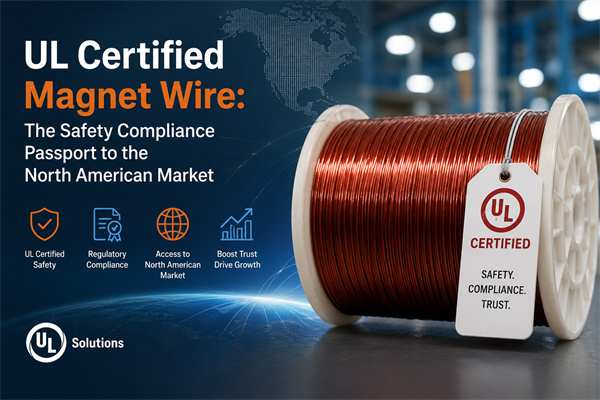
The NEMA MW 1000 series standards constitute the North American enameled wire standard system and include specific specifications for Class H enameled round wire. NEMA MW 35-C is a key standard for Class H enameled round wire, specifying critical technical parameters such as conductor dimensions, enamel coating thickness, electrical properties, and mechanical properties. UL 1446 is the standard for motor insulation systems and imposes specific requirements on the performance of enameled wire coatings in conjunction with the overall motor insulation system. UL certification is an essential safety certification for Class H enameled round wire entering the North American market.
Chinese National Standards
The GB/T 7095 series standards are the Chinese national standards for magnet wire, specifying the requirements for Class H enamelled round wire. The GB/T 4074 series standards define test methods for enamelled wire. The GB/T 11026 series standards specify test methods for thermal endurance of electrical insulating materials. Compliance with Chinese national standards is a fundamental requirement for Class H enamelled round wire entering the Chinese market.
Selection and Procurement Considerations for Class H Enamelled Round Wire
Basic Selection Principles
The fundamental principle for selecting Class H enamelled round wire is a comprehensive trade-off based on multiple dimensions, including motor design requirements, application-specific characteristics, performance requirements, and cost constraints. Motor design requirements constitute the primary basis for selecting Class H enamelled round wire. Application-specific characteristics must account for special operating conditions—such as exposure to chemical media, temperature, and vibration—that impose specific demands on the enamelled round wire.
Performance requirements are central to product selection, including dielectric properties (dielectric strength, dielectric loss, insulation resistance), mechanical properties (film adhesion, tensile strength, bendability, film flexibility), thermal properties (temperature class, thermal shock resistance, softening breakdown), and chemical properties (chemical resistance, humidity/heat resistance, salt spray resistance). Cost constraints define the practical boundary for selection; H-class enameled round wire incurs a significant cost increase compared to B-class and F-class enameled round wire.
Selection Recommendations for Different Application Scenarios
Selection requirements for Class H enameled round wire used in new-energy vehicle traction motors include Class 180 temperature rating, high fill factor, excellent dielectric properties, high mechanical strength, and high efficiency; Class H polyester-imide enameled round wire is commonly selected. For wind turbine generators, Class H polyester-imide enameled round wire is preferred, paired with highly weather-resistant impregnating varnish and insulation materials. Traction motors commonly employ Class H polyester-imide enameled round wire or composite-coated enameled round wire. Industrial high-voltage motors commonly utilize Class H polyester-imide enameled round wire, with film thickness grades matched to voltage class requirements.
Procurement Considerations
Procurement considerations for Class H enamelled round wire include manufacturer qualifications, product technical specifications, quality control level, supply capability, cost, and service. Manufacturer qualifications form the foundation of procurement and encompass quality management system certifications (e.g., ISO 9001, IATF 16949), product certifications (e.g., UL, VDE, CCC), industry experience, and customer reputation. Product technical specifications constitute the core of procurement and include conductor specifications, enamel coating specifications, electrical properties, mechanical properties, thermal properties, chemical properties, and compliance with standards (e.g., IEC 60317, NEMA MW 1000, ASTM B566, UL 1446).
Manufacturing Process and Quality Control of Class H Enamelled Round Wire
Key Manufacturing Process Technologies
Key manufacturing process technologies for Class H enameled round wire encompass conductor drawing, conductor annealing, enamel coating, enamel curing, and winding/packaging. Conductor drawing is based on the principle of round wire drawing, progressively reducing the diameter to the target dimension through multiple passes through drawing dies. Conductor annealing employs a continuous annealing process to restore the conductor’s ductility and electrical conductivity.
The enamel coating is applied using the die-coating method, where excess varnish is scraped off by a precision-sized coating die to form a wet enamel film of uniform thickness. Enamel curing is performed in a high-temperature curing furnace, with curing temperature, curing time, and curing atmosphere being critical process parameters. The curing temperature for Class H enamel is typically high, requiring precise control of the curing process.
Quality Control Key Points and Manufacturing Process Development Trends
Quality control of Class H enameled round wire encompasses three dimensions: raw material quality control, in-process manufacturing quality control, and finished product quality inspection. Raw material quality control includes incoming inspection of conductor raw materials (e.g., copper rod) and insulation enamel raw materials (e.g., polyester-imide enamel). In-process manufacturing quality control covers critical quality control points across key operations including conductor drawing, conductor annealing, enamel coating application, and enamel curing. Finished product quality inspection includes visual appearance, dimensional, electrical, mechanical, chemical, and thermal performance testing. Finished product quality inspection of Class H enameled round wire shall comply with applicable standards including IEC 60317, IEC 60851, NEMA MW 1000, and GB/T 7095.
Development trends in H-class enameled round wire manufacturing encompass intelligent manufacturing, green manufacturing, and high-end manufacturing. Intelligent manufacturing includes automated production lines, robotic applications, and intelligent inspection systems. Green manufacturing includes the use of clean energy, energy-saving production processes, waste minimization, and low-VOC enamel formulations. High-end manufacturing includes product upgrading (specialized enamel systems, customized specifications), technological upgrading (high-precision enameling dies, high-precision online inspection), and brand upgrading.
Conclusion
The engineering implications of Class 180 H Grade High-Temperature Industrial Enameled Copper Wire encompass eight core engineering dimensions: standardization and fundamental understanding of the Class 180 H thermal class; chemical systems of H-class enamel coatings; thermal endurance mechanisms of H-class enameled round wire; performance characteristics of H-class enameled round wire; typical industrial applications of H-class enameled round wire; compliance standards for H-class enameled round wire; selection and procurement considerations for H-class enameled round wire; and manufacturing processes and quality control for H-class enameled round wire.
Class 180 (Class H) is the standard temperature rating for high-temperature industrial motors; Class H enameled round wire offers a balanced combination of thermal endurance, mechanical properties, dielectric properties, and chemical resistance, making it the preferred winding material for high-temperature industrial motor applications such as new-energy vehicles, wind power generation, traction systems, and industrial high-voltage motors. The engineering value of Class H enameled round wire has been extensively validated through practical engineering applications.
With the continuous development of high-temperature industrial sectors—including new-energy vehicles, wind power, and rail transit—the application prospects for Class H enameled round wire will continue to expand. Class H enameled round wire manufacturers should continuously optimize the varnish chemical system, deepen manufacturing process innovation, and enhance quality control capabilities to supply high-temperature industrial motor manufacturers with higher-performance, more reliable, and more cost-competitive Class H enameled round wire products.