


Enameled wire (also known as magnet wire or winding wire) serves as the critical insulated conductor material for all electromagnetic devices—including transformers, motors, inductors, relays, electromagnets, induction heating systems, new-energy vehicle traction motors, home appliances, aerospace systems, rail transit, 5G/6G communications, and AI servers. Supplier selection for enameled wire directly determines project quality, schedule adherence, cost efficiency, and long-term reliability. Enamel wire procurement differs fundamentally from general industrial raw material procurement: although enamel wire accounts for only 5–15% of total equipment cost, quality defects can trigger failure costs up to 10–100× the equipment’s selling price (including recalls, repairs, warranty claims, and reputational damage).
Moreover, requirements vary significantly across applications: household motors demand cost-optimized solutions; wind turbines require 20-year weather resistance; new-energy vehicles mandate IATF 16949 compliance and 15-year service life; aerospace applications necessitate AS9100 certification and PPAP validation; and repair spare parts require immediate availability. Supplier selection is therefore an inherently project-driven engineering decision, requiring systematic alignment with the project’s industry sector, scale, lifecycle stage, quality requirements, regulatory compliance needs, timeline, and budget. The global enameled wire supplier landscape comprises four categories: international brands (Essex, Elektrisola, Superior Essex, Furukawa, Sumitomo, LS Cable, Rea Magnet Wire), large Chinese manufacturers (Tongling Jingda, Xianfeng Holding, Great Wall Electric, Foshan Weilai, Dongguan Zhuangrui), mid-sized specialized Chinese suppliers (Suzhou Donghu, Changzhou Jinyi, Jiaxing Dingbao, Shanghai Yiheng), small custom manufacturers (regional factories, workshop-style producers), and traders/importers (Alibaba, Made-in-China platform vendors, Hong Kong trading companies). Each category exhibits distinct strengths and weaknesses regarding production capacity, technical capability, quality management systems, pricing, and responsiveness.
This document systematically addresses: how project type influences supplier selection; supplier matching methodologies by project classification; alignment between project scale and supplier tier; core supplier evaluation dimensions (quality management system, production capacity, technical support, regulatory compliance, pricing, geographic location); detailed analysis of certification frameworks (ISO 9001, IATF 16949, UL 1446, AS9100, RoHS, REACH); on-site audit checkpoints; incoming material inspection SOPs; contract clause design; alternate supplier strategy; risk assessment matrix; and supplier management across the project lifecycle—providing project managers, procurement engineers, quality control engineers, and R&D engineers with a practical, project-centric, data-supported methodology for enameled wire supplier selection.
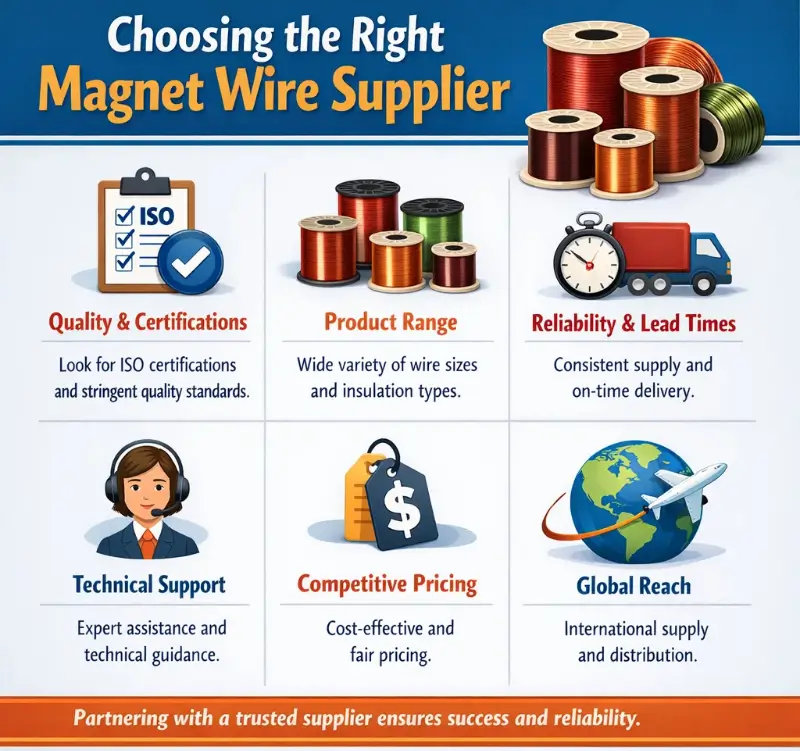
Fundamental Logic of Supplier Selection from a Project Perspective
Why Supplier Selection Is a Project-Level Decision
Enamel wire supplier selection is not a simple “price-versus-quality” comparison but rather a comprehensive decision spanning the entire project lifecycle:
Differences Across Project Phases:
- R&D Phase: Low-volume, multi-specification orders, intensive technical support required → Select small- or mid-sized suppliers with strong technical capabilities and rapid response.
- Pilot Production Phase: Sample validation and process finalization → Select mid-sized suppliers capable of fast prototyping.
- Mass Production Phase: High-volume, stable supply, zero-defect requirement, cost optimization → Select large-scale suppliers with ample capacity and proven quality consistency.
- Aftermarket/Repair Phase: Substitute materials, emergency delivery → Select suppliers maintaining ready stock or offering rapid response.
Differences Across Industries:
- Home Appliances: Cost sensitivity, UL certification, high capacity → Mid-sized specialized manufacturers.
- New-Energy Vehicles: IATF 16949, PPAP, long-term reliability → Large branded suppliers.
- Aerospace: AS9100, MSDS, 100% full inspection → International branded suppliers.
- Wind Power/Photovoltaics: Weather resistance, UV resistance, salt fog resistance → Large specialized suppliers.
- Transformers/Reactors: UL 1446 system certification, high-temperature endurance → International branded suppliers.
- Aftermarket Repair: Substitute materials, just-in-time delivery → Traders, small suppliers.
Alignment Between Project Scale and Supplier Tier
| Project Scale | Annual Purchase Volume | Supplier Type | Typical Procurement Model |
|---|---|---|---|
| Low Volume (R&D, Repair) | < 500 kg | Small custom manufacturers, traders | Single-order basis |
| Medium Volume (Home Appliances, Small Motors) | 500 kg – 50 t | Mid-sized specialized manufacturers | Annual framework agreement |
| High Volume (Major Appliance OEMs, Automotive) | 50 t – 500 t | Mid-to-large specialized manufacturers, large branded suppliers | Long-term strategic partnership |
| Very High Volume (Automotive OEMs, Wind Power) | > 500 t | Large branded suppliers, international brands | Global procurement agreement |
Supplier Switching Costs Across the Project Lifecycle
Switching suppliers is not merely “finding a new vendor” but entails:
- Re-certification: Under UL/CSA/IATF regimes, supplier switching requires full re-validation.
- PPAP/Sample Validation: 12–24 months for automotive applications.
- Production Line Adjustment: Rewinding machine parameter recalibration, welding process requalification.
- Inventory Management: Dual inventory during transition period.
- Qualification Documentation: Updating qualified supplier lists for 500–1,000 specifications.
Core Principle: Supplier selection must begin at project initiation, not after bid award.
Supplier Selection by Project Type
Type 1: Home Appliances and Small Motors
Project Characteristics:
- Annual purchase volume: 100 t – 1,000 t
- Primary specifications: Enameled round copper wire, 0.20–1.00 mm diameter, Class F/H thermal rating
- Key requirements: Low cost, stable supply, UL certification
- Failure cost: Low (low appliance repair cost)
Recommended Supplier Types:
- First choice: Mid-sized specialized manufacturers (optimal cost-performance ratio)
- Second choice: Large branded suppliers (assured stability)
- Avoid: Workshop-style manufacturers (high quality variability)
Representative Suppliers (Reference Only):
- China: Tongling Jingda, Foshan Weilai, Xianfeng Holding, Great Wall Electric
- International brands: Essex, Elektrisola
Key Evaluation Criteria:
- UL certification covering Classes H/F/B/C
- Monthly production capacity: 100–500 t
- On-Time Delivery (OTD) rate: ≥ 95%
- Defect rate (PPM): < 500
Typical Price Range:
- Class F enameled round copper wire: ¥60–¥120/kg (varies by specification and volume)
- Class H: ¥80–¥150/kg
Type 2: New-Energy Vehicle Traction Motors
Project Characteristics:
- Annual purchase volume: 1,000 t – 10,000 t (including main and auxiliary drives)
- Primary specifications: Flat wire, Litz wire, Class H thermal rating
- Key requirements: IATF 16949, PPAP, VDA 6.3, long-term reliability, 15-year service life
- Failure cost: Extremely high (recalls may reach ¥1–¥10 billion)
Recommended Supplier Types:
- First choice: Large specialized branded suppliers (IATF 16949 + proven PPAP experience)
- Second choice: International brands (VDA 6.3 audit passed)
- Avoid: Suppliers certified solely to ISO 9001
Representative Suppliers:
- International: Essex, Elektrisola, Rea Magnet Wire
- China: Xianfeng Holding (joint venture), Tongling Jingda (automotive-grade)
- Korea: LS Cable, LS EV Motor Wire
Key Evaluation Criteria:
- Valid IATF 16949 certificate
- PPAP submission capability (Level 3–5)
- VDA 6.3 process audit results
- OEM automotive customers (Tesla, BYD, Volkswagen, BMW, etc.)
- Failure Analysis (FA) experience (case studies with FA reports)
- Annual procurement contract value
Critical Performance Requirements:
- Dielectric breakdown voltage: ≥ 6 kV
- Thermal class: Class H or Class C
- Corona resistance (where applicable)
- PDIV (Partial Discharge Inception Voltage): ≥ 1,000 V
Type 3: Aerospace and Defense
Project Characteristics:
- Annual purchase volume: 1–100 t
- Primary specifications: High-temperature enameled wire (polyimide [PI], polyetherimide [PEI], ceramic-filled), specialty alloys
- Key requirements: AS9100, MSDS, 100% full inspection, full traceability
- Failure cost: Extremely high (life-critical applications)
Recommended Supplier Types:
- First choice: International branded suppliers (AS9100 + aerospace-specific system experience)
- Second choice: Large Chinese state-owned enterprises (military qualification)
- Avoid: Small suppliers primarily serving civilian markets
Representative Suppliers:
- International: Magnet Wire Inc., Essex Aerospace, Elektrisola Aerofil
- China: Chinalco, Zhengzhou Cable, Shanghai Fujikura, Hunan Cable
Key Evaluation Criteria:
- AS9100 certification
- Military production license
- MSDS, RoHS, REACH
- 100% full inspection capability
- Full-batch traceability
- Failure analysis laboratory
- Export control compliance (EAR/ITAR)
Type 4: Transformers and Reactors
Project characteristics:
- Annual procurement volume: 500 t – 5,000 t
- Primary specifications: Enamelled round copper wire (0.50–5.00 mm), paper-covered wire, Class H/C
- Key requirements: UL 1446 system certification, high-temperature resistance
- Failure cost: High (transformer failure = grid failure)
Recommended supplier types:
- Preferred: International brands (extensive UL 1446 system experience)
- Secondary: Mid-sized UL-certified manufacturers
- Avoid: Small manufacturers without UL certification
Representative suppliers:
- International: Essex, Elektrisola, Rea Magnet Wire
- China: Tongling Jingda, Changcheng Electric
Key evaluation criteria:
- UL 1446 system certification
- Insulation system temperature index (130/155/180/200/220)
- Scale production capability for Class H/C enamelled wire
- Long-term reliability data
Type 5: Wind Power and Photovoltaics
Project characteristics:
- Annual procurement volume: 500 t – 5,000 t (wind turbines), 100–500 t (photovoltaics)
- Primary specifications: Class H/C, large cross-sections (2.5–8.0 mm²), weather resistance
- Key requirements: 20-year service life, UV resistance, salt fog resistance, vibration resistance
- Failure cost: High (difficult maintenance)
Recommended supplier types:
- Preferred: Large specialized manufacturers with new energy experience
- Secondary: Transformer-grade suppliers (sufficient thermal class capability)
- Avoid: Household appliance-grade suppliers (insufficient weather resistance)
Representative suppliers:
- International: Essex, Elektrisola, Rea Magnet Wire
- China: Tongling Jingda, Foshan Weilai
Key evaluation criteria:
- Customer case references for wind power/photovoltaic projects
- Weathering test reports (UV, salt fog, damp heat cycling)
- Long-term reliability data (10+ years)
- Vibration fatigue resistance performance
Type 6: Motor Repair Market
Project characteristics:
- Procurement mode: Spare parts, repair materials
- Primary specifications: Conventional sizes (0.50–2.00 mm)
- Key requirements: Stock availability, interchangeability of substitute materials, rapid delivery
- Failure cost: Low
Recommended supplier types:
- Preferred: Distributors (stock-based supply)
- Secondary: Small custom manufacturers
- Optional: Mid-sized manufacturers (for urgent orders)
Representative channels:
- Industrial distributors (Grainger, Mouser, Digi-Key)
- Specialized enamelled wire traders
- E-commerce platforms
Type 7: Consumer Electronics and Small Transformers
Project characteristics:
- Annual procurement volume: 10–200 t
- Primary specifications: Ultra-fine enamelled wire (0.05–0.30 mm)
- Key requirements: High consistency, precision coating, UL certification
- Failure cost: Medium
Recommended supplier types:
- Preferred: Ultra-fine enamelled wire specialists
- Secondary: Comprehensive manufacturers with dedicated ultra-fine wire product lines
- Avoid: Manufacturers primarily producing heavy-gauge wire
Representative suppliers:
- International: Elektrisola (ultra-fine wire specialist), SWR (fine wire specialist)
- China: Dongguan Zhuanrui, Suzhou Fine Wire Co., Ltd.
Key evaluation criteria:
- Production experience in ultra-fine enamelled wire
- Coating precision
- Consistency data (CV < 2%)
Core Supplier Evaluation Dimensions
Regardless of project type, enamelled wire suppliers must be systematically evaluated across the following six dimensions:
Dimension 1: Quality Management System
Baseline certifications:
| Certification | Applicability | Project Requirement |
|---|---|---|
| ISO 9001 | Basic quality management | Mandatory for all projects |
| IATF 16949 | Automotive | Mandatory for automotive projects |
| AS9100 | Aerospace | Mandatory for aerospace projects |
| ISO 14001 | Environmental management | Required for export projects and EU customers |
| ISO 45001 | Occupational health & safety | Required for large-scale projects |
| ISO/IEC 17025 | Testing laboratory | Required for large-scale projects; mandatory for in-house testing |
| UL Recognized | Insulation systems | Mandatory for North American transformers/motors |
| UL 1446 | Insulation system certification | Mandatory for transformers |
| RoHS | Restriction of hazardous substances | Mandatory for EU market |
| REACH | Chemical substances | Mandatory for EU market |
Audit depth:
- Remote audit (Desk Audit): Document review
- On-site audit: Factory visit
- Second-party audit: Customer-conducted audit
- Third-party audit: Certification body audit
Recommended audit bodies:
- SGS, TÜV, Bureau Veritas (BV), Intertek, DNV, UL (UL is the primary issuing body for UL 1446)
Dimension 2: Production Capacity and Supply Capability
Evaluation items:
- Monthly capacity: Ability to meet peak demand
- Equipment count: Number of enamelling machines, number of enamel tanks
- Capacity expansion capability: Ability to scale up during project ramp-up
- Inventory level: Stock of standard specifications
- Logistics network: Coverage of project locations
Capacity assessment methodology:
- Request capacity data (by specification)
- Calculate peak order demand
- Simulate supply disruption scenarios
- Conduct on-site capacity verification
- Review peer industry customer references
Dimension 3: Technical Support Services
Evaluation items:
- Number and experience of application engineers
- Sample lead time
- New-specification development capability
- Failure analysis capability
- Customer support response time
Technical capability grading:
| Level | Capability | Representative |
|---|---|---|
| A-level | Full range of specifications and applications; strong failure analysis capability | International brands, comprehensive large-scale manufacturers |
| B-level | Major specifications and applications | Large Chinese specialized manufacturers |
| C-level | Specific specifications and applications | Mid-sized specialized manufacturers |
| D-level | General-purpose specifications and applications | Small manufacturers, distributors |
Dimension 4: Regulatory Compliance
Compliance requirements:
- Export controls: EAR/ITAR (if supplying U.S. customers)
- REACH/RoHS: EU market
- Conflict Minerals: Tungsten, tantalum, tin, gold (if supplying U.S.-listed customers)
- EU Battery Regulation: New energy vehicles
- REACH SVHC: Substances of Very High Concern
- POPs: Persistent Organic Pollutants
- Carbon footprint/Carbon Border Adjustment Mechanism (CBAM): EU
Compliance documentation:
- REACH test report
- RoHS test report
- MSDS
- Conflict minerals declaration
- Carbon footprint report
Dimension 5: Pricing and Commercial Terms
Pricing evaluation:
- Price transparency: Clear quotation sheet
- Price volatility mechanism: Raw material linkage clause
- Payment terms: Net 30/60/90 days
- Credit line: Ability to extend credit
- Volume discounts: Bulk pricing
Cost breakdown:
- Enamelled wire unit price
- Freight charges (FOB/CIF)
- Tariffs and import duties
- Testing fees (e.g., third-party)
- Warehousing fees
- Duties (for imported goods)
Price risk mitigation:
- Long-term agreements (1–3 years)
- Price linkage clauses (copper price + processing fee)
- Hedging strategies
- Multi-source strategy
Dimension 6: Geographic Location and Logistics
Evaluation items:
- Factory location
- Warehouse network
- Transit time
- Customs facilitation
- Emergency response time
Regional advantages:
- East China (Suzhou, Wuxi, Shanghai): Industrial cluster
- South China (Foshan, Dongguan): Consumer electronics hub
- North China (Tianjin, Hebei): Northern market access
- Southeast Asia (Vietnam, Thailand): Re-export to U.S.
- Europe (Germany, Italy): Localized supply
Geographic risks:
- Natural disasters (earthquakes, floods)
- Political risk
- Trade friction (tariffs)
- Logistics disruptions (pandemics, strikes)
Certification System Details
ISO 9001: Fundamental Quality Management System
Purpose: The world’s most widely adopted foundational quality management certification
Evaluation points:
- Certificate validity
- Accreditation status of audit body (IAF-accredited)
- Historical audit reports
- Status of nonconformity closure
- Internal audit and management review records
Value for enamelled wire projects:
- Serves as the “entry-level certification” for all projects
- Absence renders collaboration virtually impossible
IATF 16949: Automotive Quality Management System
Purpose: Mandatory certification for the automotive supply chain
- Certificate status (Valid/Suspended/Revoked)
- Audit frequency (Once per year)
- OEM customer approval
- Application of the Five Core Tools:
- APQP (Advanced Product Quality Planning)
- PPAP (Production Part Approval Process)
- FMEA (Failure Mode and Effects Analysis)
- SPC (Statistical Process Control)
- MSA (Measurement Systems Analysis)
- CSR (Customer-Specific Requirements)
Value to magnet wire projects:
- Mandatory: New energy vehicles, conventional automotive motors, commercial vehicles
- Missing: Inability to enter mainstream automotive OEM supply chains
AS9100: Aerospace Quality Management System
Purpose: Mandatory certification for the aerospace industry
Assessment criteria:
– Certificate status
– Nadcap special process certification (e.g., heat treatment, surface treatment)
– Aerospace customer approval
– Configuration management
– FAI (First Article Inspection)
Value to magnet wire projects:
– Mandatory: Aerospace and defense programs
– Critical: Defense supply license
UL 1446: Insulation System Certification
Purpose: Mandatory certification for transformer insulation systems in North America
Assessment criteria:
– System certification documentation (OBJS2 file number)
– Covered temperature classes (130–240°C)
– Coverage of magnet wire + impregnating varnish + insulation material combinations
– Whether each combination requires separate certification
Value to magnet wire projects:
– Mandatory: Transformers for the North American market
– Critical: A “premium qualification” for magnet wire manufacturers
RoHS and REACH
RoHS 2011/65/EU:
– Restricts lead, mercury, cadmium, hexavalent chromium, PBB, PBDE, etc.
– Thresholds: 1000 ppm (Cd: 100 ppm)
– Test reports: Third-party laboratories (e.g., SGS)
REACH (EC) No 1907/2006:
– Registration, Evaluation, Authorization, and Restriction of Chemicals
– SVHC (Substances of Very High Concern) candidate list (updated annually)
– Test reports + declaration
Value to magnet wire projects:
– Mandatory: EU market (appliances, consumer electronics, transformers)
– Missing: Products barred from entering the EU market
Supplier On-Site Audit Key Points
Audit Process
- Pre-audit preparation:
– Audit checklist (based on project type)
– Historical audit reports
– Data collection (capacity, complaints, customers) - On-site audit (1–2 days):
– Executive interviews
– Document review
– Shop floor walkthrough
– Equipment inspection
– Laboratory assessment
– Nonconformance recording - Post-audit actions:
– Audit report issuance
– Nonconformance closure
– Follow-up improvement verification
– Final evaluation
Quality Management System Audit (Based on ISO 9001)
Audit criteria:
– Quality manual and procedure documents
– Internal audits and management reviews
– Document control
– Record control
– Nonconforming product control
– Corrective and preventive actions
– Customer complaint handling
Production Process Audit (Based on VDA 6.3 or IATF/VDA 6.3)
P1–P7 Audit:
| Phase | Audit Criteria |
|---|---|
| P1 Project Management | Project planning, resources, risk management |
| P2 Product Development | APQP, design verification |
| P3 Process Development | Process design, parameter determination |
| P4 Process Implementation | Production capability, SPC implementation |
| P5 Supplier Management | Purchased part management |
| P6 Production | Shop-floor processes, 5S, equipment |
| P7 Customer Support | Service, complaint handling |
Application to magnet wire projects:
– Automotive projects: Full P1–P7 audit
– General industrial projects: Focus on P4–P6
– Critical audit items: Enameling machine parameter control, varnish management, baking profile
Laboratory Capability Audit
Test Equipment Audit:
– Dielectric breakdown voltage tester
– Insulation resistance tester
– Diameter/polymer coating thickness measuring instrument
– Pinhole detector
– Thermal shock test equipment
– High-temperature aging oven
– Elongation tester
– Microscope
Test Method Audit:
– Compliance with IEC 60851 / GB/T 4074
– Compliance with ASTM D1676
– Compliance with UL 1446 system requirements
– Test frequency and sampling plan
Engineering Questionnaire Example (Magnet Wire Project Specific)
| No. | Question | Expected Response |
|---|---|---|
| 1 | Number and specifications of enameling machines? | >2 units, covering 0.10–3.00 mm |
| 2 | How is varnish managed? | Closed-loop management + viscosity control |
| 3 | Number of enamel application passes? | 4–8 passes (per specification) |
| 4 | Baking temperature? | 350–450°C (per enamel type) |
| 5 | Online inspection capability? | 100% online pinhole detection + offline dielectric breakdown testing |
| 6 | Incoming bare copper wire control? | Copper content, elongation, surface finish |
| 7 | Varnish procurement source? | Direct purchase (not recycled) |
| 8 | Finished goods outgoing inspection? | AQL 0.4–1.0 (per specification) |
| 9 | Nonconforming product disposition? | Segregation + review + corrective action |
| 10 | Customer complaint response time? | <24 h confirmation, <7 days FA report |
Incoming Material Inspection SOP
Purpose of Inspection
- Verify conformance of magnet wire to purchase specifications
- Prevent nonconforming material from entering production
- Continuously monitor supplier quality performance
- Provide data for supplier evaluation
Inspection Basis
Core Reference Standards:
– GB/T 4074 series
– IEC 60851 series
– ASTM D1676
– NEMA MW 1000
– Internal company standards (stricter than above)
Inspection Items
Visual Inspection:
– Surface smoothness (no contaminants or particles)
– Color uniformity
– Absence of scratches or indentations
– Absence of enamel lumps or bubbles
– No exposed conductor
Dimensional Inspection:
| Item | Tool | Frequency |
|---|---|---|
| Conductor diameter | Micrometer (0.001 mm resolution) | 5 points per lot |
| Enamel coating thickness | Microscope with micrometer eyepiece | 3 points per lot |
| Overall diameter | Micrometer | 5 points per lot |
| Eccentricity | Microscope | 3 points per lot |
Electrical Properties:
– Dielectric breakdown voltage (twist method or steel ball method)
– Insulation resistance
– Pinhole count (voltage method)
Mechanical Properties:
– Elongation
– Springback angle
– Flexibility (mandrel winding)
– Enamel adhesion (rapid pull test)
– Enamel abrasion resistance (abrasion test)
Thermal Properties:
– Thermal shock resistance (300°C / 1 h / 1× mandrel)
– Softening breakdown (per specification)
– Weight loss (optional)
Sampling Plan (GB/T 2828.1)
Normal Inspection, Single Sampling, Level I:
| Lot Size N | Sample Size n | AQL 0.4 | AQL 1.0 | AQL 2.5 |
|---|---|---|---|---|
| 26–50 | 8 | 1/2 | 2/3 | 3/4 |
| 51–90 | 13 | 1/2 | 2/3 | 3/4 |
| 91–150 | 20 | 1/2 | 3/4 | 5/6 |
| 151–280 | 32 | 2/3 | 3/4 | 6/7 |
| 281–500 | 50 | 3/4 | 5/6 | 7/8 |
| 501–1200 | 80 | 5/6 | 7/8 | 10/11 |
Decision Rule:
– Accept if number of conforming units ≤ Ac
– Reject if number of conforming units ≥ Re
Inspection Equipment Calibration
Key Calibration Items:
– Micrometer: Monthly calibration
– Dielectric breakdown voltage tester: Quarterly calibration
– Insulation resistance tester: Quarterly calibration
– Micrometer eyepiece: Monthly calibration
– Temperature controllers: Semi-annual calibration
Inspection Records
Record Content:
– Supplier name and batch number
– Specification and batch number
– Incoming quantity and sample size
– Test data (for each parameter)
– Disposition result (Accept/Reject)
– Inspector name and date
– Nonconforming material disposition
Nonconforming Material Handling
- Segregation: Physical segregation + identification labeling
- Review: Joint technical, quality, and procurement review
- Disposition: Return to supplier / sorting / downgrading / scrap
- Feedback: SCAR (Supplier Corrective Action Request)
- Follow-up: Verification of corrective action effectiveness
Contract Clause Design
Core Procurement Clauses for Magnet Wire
| Clause Category | Key Content | Project Significance |
|---|---|---|
| Technical Specifications | Detailed specifications (type, diameter, enamel coating, Class) | Basis for acceptance |
| Quality Standards | Referenced to IEC 60851 / GB/T 4074 + internal standards | Prevent substandard quality |
| Acceptance Methods | GB/T 2828.1 + AQL | Scientific sampling inspection |
| Pricing Terms | FOB/CIF/DDP | Clarify responsibilities |
| Payment Terms | 30/60/90 days | Cash flow management |
| Delivery Terms | Order confirmation, minimum order quantity (MOQ) | Flexible supply capability |
| Quality Warranty | 12–24 months | Post-sale liability |
| Confidentiality Clause | Technical specifications, pricing | Protect trade secrets |
| Dispute Resolution | Arbitration / venue of litigation | Risk allocation |
| Liability Cap | Amount of breach | Risk control |
| Force Majeure | Definition, notification, consequences | Extreme events |
| Environmental Compliance | RoHS/REACH declaration | Regulatory compliance |
Detailed Pricing Terms
FOB (Free On Board):
– Seller bears costs up to loading port
– Buyer bears ocean freight, insurance, and customs duties
– Suitable for standard sea shipments
CIF (Cost, Insurance, and Freight):
– Seller bears ocean freight to destination port
– Seller arranges insurance
– Suitable for large-volume imports
DDP (Delivered Duty Paid):
– Seller bears all costs to buyer’s warehouse, including customs duties
– Lowest risk for buyer, but highest price
EXW (Ex Works):
– Buyer bears all transportation costs
– Lowest price
Price Adjustment Clause
Base Adjustment Formula:
New Price = (Spot Copper Price − Base Copper Price) × 0.85 × Copper Consumption per Unit + Base Processing Fee
Key Parameters:
– Copper Consumption: Copper content per kilogram of magnet wire (typical range: 1.020–1.030 kg)
– Hedging Ratio: 80–90% (to avoid full hedging)
– Adjustment Cycle: Monthly or quarterly
– Benchmark Price: LME/SHFE price at contract signing
Breach of Contract Clause
Key Scenarios:
– Quality issues: Return + rework + compensation
– Delivery delay: Liquidated damages (5–15% of contract value)
– Quantity discrepancy: Shortage replenishment + discount on excess
– Specification nonconformance: Return or negotiated discount
– Intellectual property infringement: Liability assignment
Confidentiality Clause
Protected Information:
– Specifications, pricing, purchase volumes
– Project plans, technical parameters
– Customer information, application fields
Confidentiality Period: 5–10 years
Alternate Supplier Strategy and Risk Management
Risk Categories
| Risk Category | Description | Potential Consequence |
|---|---|---|
| Single-Supplier Dependency | Full reliance on one supplier | Supply disruption = production halt |
| Capacity Bottleneck | Insufficient supply during project ramp-up | Delivery delays |
| Compliance Risk | Supplier noncompliance | Product recall / market withdrawal |
| Price Volatility | Sharp raw material price fluctuations | Uncontrolled cost escalation |
| Quality Incident | Major quality failure | Recall / scrap |
| Financial Risk | Supplier bankruptcy | Loss of supplier |
| Geopolitical Risk | Trade wars, export controls | Tariff imposition / supply cutoff |
| Natural Disasters | Earthquakes, floods, typhoons | Production interruption |
| Pandemic/Public Health Events | Factory shutdowns | Supply interruption |
Single-Supplier Risk Assessment
Risk Scoring Model:
| Risk | Score | Mitigation Measure |
|---|---|---|
| Exclusive supply of critical specifications | 5 | Develop alternate suppliers |
| Primary supplier share > 80% | 4 | Dual-sourcing strategy |
| Qualification/transition cycle > 6 months | 4 | Pre-qualify backups |
| Geographic concentration (domestic only / overseas only) | 3 | Multi-regional sourcing |
| High financial risk | 3 | Financial due diligence |
| No qualified alternate supplier pool | 3 | Accelerate supplier development |
Multi-Sourcing Strategy
Application Tiers:
– Core Specifications: 2–3 qualified suppliers; primary 60–80%, backup 20–40%
– Critical Specifications: ≥3 suppliers
– General Specifications: 1–2 suppliers
– Low-volume / Custom Specifications: 1 supplier
Primary/Backup Allocation Principles:
– Primary supplier: 60–80% of orders
– Backup #1: 20–30% of orders
– Backup #2: 5–10% of orders (to maintain activation)
Alternate Supplier Activation
Activation Methods:
– Annual sample validation (small-batch supply)
– Quarterly sample validation
– Annual audit + test data review
– Framework agreement with no volume commitment
Activation Cost: Alternate suppliers typically incur 1–5% of total cost (additional audit, trial runs)
Inventory Strategy
Safety Stock Levels:
– Standard specifications: 1–2 months’ usage
– Critical specifications: 3–6 months’ usage
– Strategic specifications: 6–12 months’ usage
– Process-specific enamel types (customer-exclusive): ≥12 months
Inventory Models:
– Owned inventory (JIT): High inventory carrying cost
– Vendor-managed inventory (VMI): Moderate cost
– Third-party warehousing: Moderate cost
– Zero-inventory (JIT): High risk
Supplier Management Across Project Lifecycle
Phase 1: Project Initiation (RFQ Stage)
Key Tasks:
– Prepare procurement specification sheet
– Identify candidate suppliers (5–10 companies)
– Issue RFQ (Request for Quotation)
– Evaluate quotations (technical + commercial)
– Conduct on-site audits (2–3 shortlisted suppliers)
Key Milestones:
– RFQ issuance: Within 2 weeks after project initiation
– Quotation submission deadline: 4 weeks
– Evaluation completion: 6 weeks
– Supplier selection: 8 weeks
Phase 2: Sample Validation
Key Tasks:
– Sample provision per specification
– Testing per GB/T 4074 + IEC 60851
– Pilot-line validation
– Process parameter optimization
– Customer / system-level approval
Sample Quantities:
– 1.00 mm enameled round copper wire: 50 kg
– Rectangular (flat) wire: 20–30 kg
– Ultra-fine wire: 5–10 kg
Phase 3: PPAP / Small-Batch Validation
Automotive Projects:
– PPAP levels 3–5 (per customer requirement)
– Submitted samples: 30–300 pieces (per specification)
– Test coverage: Dimensions, performance, reliability
– Timeline: 3–6 months
– Customer sign-off required
General Industrial Projects:
– Small-batch validation: 100–1000 kg
– Test coverage: Key performance indicators
– Timeline: 1–3 months
Phase 4: Mass Production Launch
Key Tasks:
– First production order (PQG – Production Quality Gate)
– Process capability study (Cpk)
– Gage R&R (Gauge Repeatability & Reproducibility) study
– Process freeze (parameter finalization)
– Formal mass production commencement
Initial Order Ramp-Up:
– Months 1–3: 50% of monthly demand
– Months 4–6: 80% of monthly demand
– Months 7–12: 100% of monthly demand
Phase 5: Stable Mass Production
Key Tasks:
– Continuous monitoring (key metrics)
– Quarterly audits (1–2 times annually)
– Annual supplier evaluation
– Continuous improvement initiatives (Lean, Six Sigma)
– Alternate supplier management
Core Monitoring Metrics:
– Incoming defect rate (PPM)
– On-time delivery (OTD)
– Price variation
– Number of complaints
– Number of improvement projects
Phase 6: Project Termination / End-of-Life (EOL)
Key Tasks:
– Final order placement
– Obsolete inventory clearance
– Data archiving
– Relationship summary
– Post-mortem report
EOL Risks:
– Spare parts demand (≥10 years)
– Permanent retention of alternate suppliers
– Full traceability of historical data
Common Issues and Best Practices
Issue 1: Price-First Mentality
Phenomenon: Procurement decisions based solely on price, ignoring quality and reliability
Risks:
– Short-term savings offset by long-term failures
– Recall costs may reach 10× project profit
– Project delay costs
Best Practices:
– Adopt Total Cost of Ownership (TCO) mindset
– Weighted evaluation (price 30% + quality 40% + service 30%)
– Target optimal value, not lowest price
Issue 2: Certification = Quality
Phenomenon: Equating certification with guaranteed quality
Risks:
– Certificates may be forged
– Certificate scope may be incomplete
– Certificate may not match project requirements
Best Practices:
– Verify certificate authenticity (direct verification with certifying body)
– Confirm scope coverage (product + manufacturing site)
– Mandatory on-site audit
– Second-party audit
Issue 3: Single-Point Supplier
Phenomenon: Single-source supply for core specifications
Risks:
– Production halt upon supply interruption
– Weak bargaining power
Best Practices:
– Maintain 2–3 suppliers for critical specifications
– Regularly activate alternate suppliers
– Implement inventory strategy (1–3 months)
Issue 4: Inadequate Contract Terms
Phenomenon: Simplified contract terms lacking technical details
Risks:
– Disputes during acceptance
– Difficulty in breach-of-contract claims
Best Practices:
– Attach Technical Specification Document as a contractual appendix
– Specify acceptance methods (e.g., AQL, sampling plans)
– Quantify liability for breach of contract
Issue 5: Neglect of Geopolitical Risk
Phenomenon: Failure to assess supplier geopolitical risk
Risks:
– Impact of trade wars
– Increased tariffs
– Export controls
Best Practices:
– Adopt multi-regional sourcing strategy
– Dual-source critical specifications domestically and internationally
– Monitor policy developments continuously
Issue 6: Lack of Long-Term Collaboration
Phenomenon: Annual re-tendering and frequent supplier switching
Risks:
– High switching costs
– Loss of accumulated technical knowledge
Best Practices:
– Establish long-term strategic partnerships (3–5 years)
– Collaborate on continuous improvement initiatives
– Implement price linkage mechanisms instead of annual price reductions
Summary
Magnet wire (enameled wire) supplier selection is a project-driven systems engineering process, requiring systematic evaluation based on project type, scale, industry, and lifecycle. This document comprehensively outlines the fundamental logic of supplier selection from a project perspective (differentiation by project phase/industry/scale), supplier selection by project type (appliances/automotive/aerospace/transformers/wind power/maintenance/consumer electronics), core supplier evaluation dimensions (quality management system/capacity/technology/compliance/price/geographic location), detailed certification frameworks (ISO 9001/IATF 16949/AS9100/UL 1446/RoHS/REACH), key points for on-site supplier audits (VDA 6.3 + engineering issue checklist), standard operating procedures (SOP) for incoming material inspection (per GB/T 2828.1), contract clause design (technical specifications + acceptance criteria + pricing + breach liability + confidentiality), alternate supplier strategy (risk assessment + multi-sourcing + inventory), supplier management across the project lifecycle (six-phase management), and common issues with best practices (TCO mindset + certificate verification + multi-sourcing + long-term collaboration).
Core Methodology:
– Initiate at Project Kick-off: Supplier selection must commence at project initiation
– Project-Based Alignment: Match supplier types to specific project requirements
– Six-Dimensional Evaluation: Quality, capacity, technology, compliance, price, geographic location
– Certification + Audit + Performance: Certificates + on-site audit + proven track record
– Contractual Precision: Technical specifications + acceptance methodology + breach liability
– Multi-Sourcing Strategy: 2–3 suppliers for critical specifications
– Long-Term Partnership: Strategic suppliers + joint improvement collaboration
Core Recommendations:
– Prioritize optimal value-for-money over lowest price
– Never omit on-site audits
– Continuously activate alternate suppliers
– Favor long-term collaboration over frequent switching
– Combine risk assessment with multi-sourcing for dual-layer risk mitigation
– Continuously monitor geopolitical risks
As emerging applications—including new-energy vehicles, aerospace, AI data centers, wind power, photovoltaics, and 5G/6G communications—impose increasingly stringent requirements on magnet wire suppliers’ certification systems, technical capabilities, and global supply chain resilience, supplier selection is progressively shifting from “price-driven” to “strategy-driven.” Project managers and procurement engineers are advised to adopt an integrated mental framework: “project type → supplier type → evaluation dimensions → audit focus areas → contract clauses → long-term collaboration,” tailoring supplier strategies to actual project conditions.