

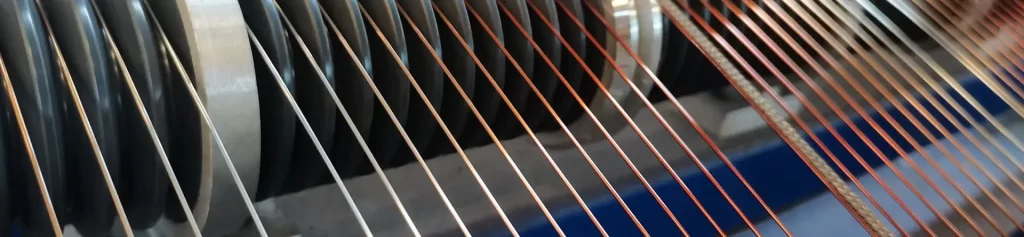
Enameled wire (also known as magnet wire or winding wire), a core conductor material for motors, transformers, inductors, relays, audio voice coils, power supplies, and telecommunications equipment, has long been dominated by pure copper. Copper-clad aluminum enameled wire (CCA magnet wire, ECCAW), a novel bimetallic composite enameled wire, features an aluminum core with low density (2.70 g/cm³, i.e., 30% that of copper) and a copper outer layer offering corrosion resistance, solderability, and high electrical conductivity (the copper layer serves as the solderable and connection interface).
Through metallurgical bonding or electroplating processes, permanent, continuous copper–aluminum interfacial bonding is achieved. CCA magnet wire has been progressively adopted in applications including audio voice coils (subwoofers, automotive audio systems), UPS power supplies, inductors, telecom power supplies, automotive electronics, specialty transformers, household appliance compressors, and RF antennas. This article systematically addresses: definition and structure of CCA enameled wire; core comparative analysis between CCA and pure copper enameled wire; physical parameter comparison (CCA vs. pure copper); electrical performance comparison; mechanical performance comparison; weight and cost comparison; soldering and connection processes; corrosion resistance and oxidation resistance; CCA enameled wire manufacturing processes; application scenario comparison (audio, UPS, telecom, transformers, home appliances); CCA selection criteria (decision boundaries between CCA and pure copper); CCA standards and certifications (ASTM B566, ASTM B258, UL); CCA failure modes and quality control; and future development trends of CCA versus pure copper enameled wire—providing a comprehensive technical selection and application comparison guide for audio engineers, UPS designers, telecom power supply engineers, enameled wire procurement specialists, and end-product manufacturers.
CCA Magnet Wire Definition and Structure
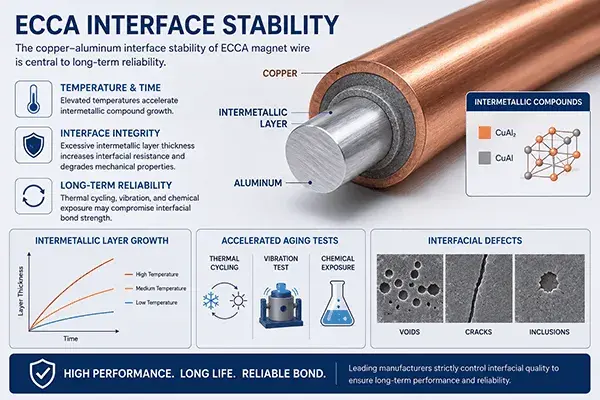
CCA magnet wire (Copper Clad Aluminum Magnet Wire) is a specialized enameled wire featuring a copper–aluminum bimetallic composite structure, integrating the respective advantages of the aluminum core and copper cladding.
CCA Definition
CCA magnet wire is:
- Conductor: copper–aluminum bimetallic composite
- Outer copper layer: provides electrical conductivity, solderability, and corrosion resistance
- Inner aluminum core: provides weight reduction and cost advantages
- Copper layer content: typically 10–40%
- Insulating enamel coating applied to surface (e.g., UEW, PEW, EIW, AIW)
- Applications: enameled wire coils, transformers, inductors, voice coils
Relationship among CCA, ECCA, and CCAW:
- CCA (Copper Clad Aluminum): Copper-clad aluminum
- ECCA / ECCAW (Enameled Copper Clad Aluminum Wire): Enamelled copper-clad aluminum wire
- Some brands refer to it as ECCA wire or copper-clad aluminum magnet wire
- All three terms are essentially identical; CCA is the generic abbreviation
Core Structure of CCA
Basic Structure:
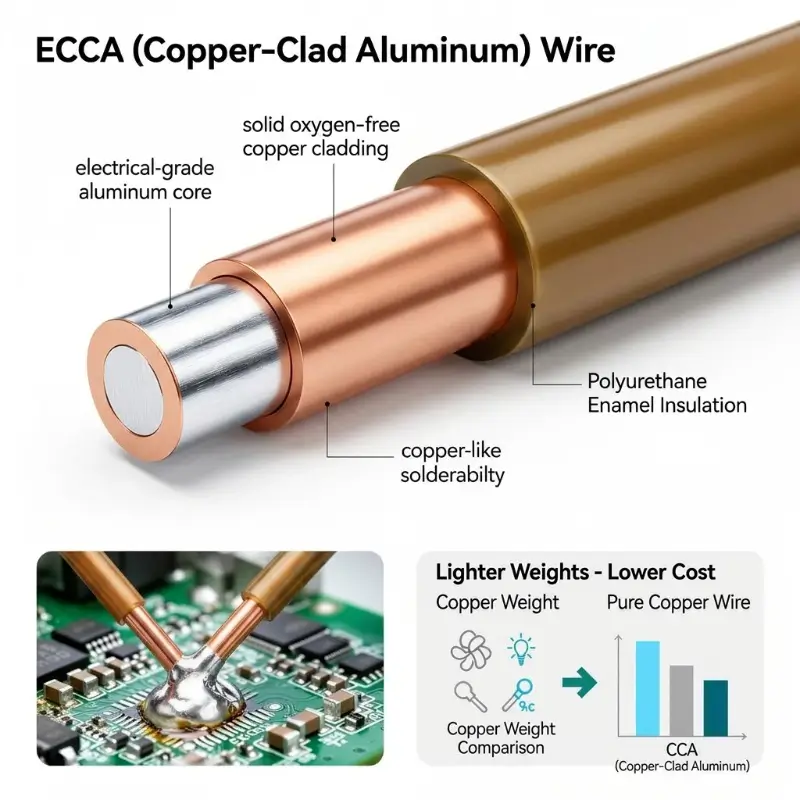
- Core: Aluminum core (electrical-grade aluminum, ≥99.5% purity)
- Outer layer: Copper layer (oxygen-free copper, ≥99.95% purity)
- Cu–Al bonding: Metallurgical bonding (continuous welding)
- Enamel coating: Standard magnet wire enamel coating
Structural Characteristics:
- Round cross-section (predominant)
- Uniform and continuous copper cladding
- Atomic-layer bonding between copper and aluminum
- No looseness or gaps
- Reliable performance after enamel coating
Differences from Conventional Aluminum Magnet Wire:
- Conventional aluminum magnet wire: pure aluminum conductor
- CCA: aluminum core + copper cladding
- CCA advantages: excellent solderability and reliable connectivity
- CCA disadvantages: higher cost than pure aluminum
CCA Standard Construction Types
According to ASTM B566:
- Class 10A (10% copper coating + annealed)
- Class 15A (15% copper coating + annealed)
- Class 10H (10% copper coating + hard-drawn)
- Class 15H (15% copper coating + hard-drawn)
By copper layer ratio:
- 10% copper: lowest cost
- 15% copper: mainstream (balanced performance)
- 20% copper: high conductivity requirement
- 25% copper: high-end applications
- 30% copper: special applications
- 40% copper: extremely rare scenarios
By enamel type:
- PEW (Polyester): Class B, 130 °C
- UEW (Polyurethane): Class B, 130 °C, solderable
- EIW (Polyester-imide): Class F, 155 °C
- AIW (Polyamide-imide): Class H, 180 °C
Physical Properties of CCA
CCA density (theoretical value):
- Pure copper: 8.96 g/cm³ (reference)
- 10% CCA: 4.10 g/cm³ (calculated)
- 15% CCA: 4.32 g/cm³ (calculated)
- 20% CCA: 4.54 g/cm³ (calculated)
- 30% CCA: 5.01 g/cm³ (calculated)
CCA Copper Layer Ratio and Performance Balance:
- Increased copper layer ratio → higher conductivity, better solderability, higher cost, higher weight
- Decreased copper layer ratio → lower weight, lower cost, poorer solderability
Marking of CCA Enamelled Wire
Marking Specifications:
- Type: CCA-AWG18-UEW155
- Description: Copper-clad aluminum (CCA) enameled wire, AWG 18 diameter, solderable polyurethane enamel coating, Class 155°C
- Alternate manufacturer designations: CCA / ECCA / ECCAW
- Copper layer classification: Class 10A / 15A / 10H / 15H
Typical Marking Example:
- ECCAW 0.5 mm Grade 1 UEW/155
- CCA AWG 24 UEW 130 Grade 2
- ECCA Wire 24 AWG 155 °C
Core Advantages of CCA
Weight Advantage (CCA Core Selling Point):
- Aluminum density: 2.70 g/cm³
- Copper density: 8.96 g/cm³
- CCA is 50–65% lighter than pure copper (based on copper layer ratio)
- Winding weight reduction: 30–50%
- Overall unit weight reduction: 5–15% (application-dependent)
Cost Advantage:
- Aluminum price: ¥18,000–¥22,000 per metric ton (2024)
- Copper price: ¥60,000–¥70,000 per metric ton (2024)
- CCA composite price: ¥35,000–¥45,000 per metric ton (depending on copper cladding ratio)
- 30–50% material cost savings after weight reduction
- Reduced transportation costs
- Minimal impact on processing costs
Connection Performance:
– Copper coating ensures solderability (comparable to pure copper)
– Compatible with copper terminals
– Conventional soldering processes applicable (380 °C solder)
– Mitigates issues associated with direct aluminum connections (aluminum surface oxidation, poor solderability of aluminum)
Electrical Conductivity Advantage:
- 10% CCA: approx. 63–65% IACS
- 15% CCA: approx. 67–69% IACS
- 20% CCA: approx. 70–72% IACS
- Improvement over bare aluminum (61% IACS)
- 60–72% of equivalent cross-sectional area copper
Limitations of CCA
Higher resistivity than pure copper:
- At the same cross-sectional area, the resistance of CCA is 1.5–1.6 times higher than that of pure copper.
- Cross-sectional area compensation: To achieve identical resistance, the wire diameter must be increased.
- Increased losses: Higher-frequency heating and resistive losses.
Low mechanical strength
- CCA Class 10A: 105–135 MPa
- Annealed pure copper: 220–260 MPa
- Hard-drawn pure copper: 300–380 MPa
- CCA tensile strength is lower than that of pure copper
Galvanic Corrosion between Copper and Aluminum:
- Galvanic coupling between copper and aluminum in humid environments
- Electrochemical corrosion
- Accelerated failure
- The enamel coating is the critical protective barrier
Recycling and Cost:
- Difficulty in separating copper and aluminum during recycling
- Lower value compared to pure copper
- Limited applicability in certain applications
Core Comparison Between CCA and Pure Copper Magnet Wire
CCA differs significantly from pure copper magnet wire across multiple dimensions.
Core Difference Comparison Table
| Dimension | Pure Copper Magnet Wire | Copper-Clad Aluminum (CCA) Magnet Wire |
|---|---|---|
| Conductor Material | Pure Copper (≥99.9%) | Copper-Clad Aluminum (10–40% copper cladding) |
| Density (g/cm³) | 8.96 | 4.10–5.01 |
| Conductivity (% IACS) | 100 | 63–72 |
| Weight per Unit Length | Baseline | Reduced by 50–65% |
| Unit Price (2024 CNY/ton) | 60,000–70,000 | 35,000–45,000 |
| Solderability | Excellent | Good (ensured by copper cladding) |
| Tensile Strength (Annealed) | 220–260 MPa | 105–135 MPa |
| Elongation | 30–40% | 20–30% |
| Corrosion Resistance | Excellent | Good (protected by copper cladding) |
| High-Frequency Performance | Excellent | Moderate |
| DC Power Loss | Baseline | Increased by 50–60% |
| Compatibility with Copper Terminals | Perfect | Good |
| Processing Difficulty | Standard | Moderate |
| Weight-Based Application Advantage | None | Significant |
| Cost-Based Application Advantage | None | Significant |
| Service Life | Extremely Long | Long (under standard operating conditions) |
| Recycling Value | High | Low |
Core Feature Comparison
CCA Application Scenarios:
- Weight-sensitive applications (mobile devices, automotive, portable equipment)
- Cost-sensitive applications (consumer electronics, low-end markets)
- General-purpose magnet wire windings (no requirement for ultimate performance)
- Medium- and low-frequency applications
- Magnet wire with large cross-sectional area
Advantages of Pure Copper Applications:
- High-performance motors
- High-frequency transformers
- Applications requiring high reliability and long service life
- High-temperature, harsh environments
- Precision instruments
Physical Parameter Comparison Between CCA and Pure Copper
Physical parameters are the core data for product selection.
Density and Weight Comparison
Density Comparison:
- Pure copper: 8.96 g/cm³
- Aluminum: 2.70 g/cm³
- CCA Class 10A: 4.10 g/cm³ (10% copper layer)
- CCA Class 15A: 4.32 g/cm³ (15% copper layer)
- CCA Class 20A: 4.54 g/cm³ (20% copper layer)
- CCA Class 30A: 5.01 g/cm³ (30% copper layer)
Weight Comparison (Same Length and Same Specification):
- Pure copper AWG 18: 7.32 g/m
- CCA Class 10A AWG 18: approx. 3.35 g/m
- CCA Class 15A AWG 18: approx. 3.53 g/m
- Weight reduction: approx. 50–55%
Electrical Parameter Comparison
DC Resistance at 20°C (Same Diameter):
Taking AWG 18 (diameter 1.024 mm) as an example:
- Pure copper: 20.95 Ω/km
- CCA Class 10A: approx. 32.5 Ω/km (55% higher)
- CCA Class 15A: approx. 30.8 Ω/km (47% higher)
- CCA Class 20A: approx. 29.5 Ω/km (41% higher)
- Bare aluminum: approx. 34.7 Ω/km (66% higher)
Same Resistance (Cross-Sectional Area Enlargement Compensation):
Required to achieve the same resistance as pure copper AWG 18:
- Pure copper: 1.024 mm (diameter)
- CCA Class 15A: approximately 1.245 mm (22% diameter increase)
- i.e., CCA requires approximately 1.5× cross-sectional area
Inductance and Skin Effect:
- CCA: Slightly lower inductance than pure copper due to the aluminum core.
- High-frequency CCA (>100 kHz): Due to the skin effect, current concentrates in the copper layer, resulting in performance approaching that of pure copper.
- Low-frequency CCA: Performance is slightly inferior to that of pure copper.
Mechanical Parameter Comparison
Tensile Strength:
- Pure copper, annealed (O): 220–260 MPa
- Pure copper, one-half hard (H14): 280–320 MPa
- Pure copper, hard (H18): 350–380 MPa
- CCA Class 10A (annealed): 105–135 MPa
- CCA Class 15A (annealed): 110–140 MPa
- CCA Class 10H (hard-drawn): 130–165 MPa
- CCA Class 15H (hard-drawn): 140–175 MPa
Elongation:
- Annealed copper: 30–40%
- CCA Class 10A: 20–30%
- CCA Class 15A: 18–28%
- Difference of approximately 10–15%
Flexibility:
- Pure copper: Excellent
- CCA: Good (windable)
- Bending radius: CCA slightly larger than pure copper
Springback:
– Pure copper: small spring-back angle
– CCA: slightly larger spring-back angle
– Winding tension requires adjustment
Enamel Coating Comparison
CCA and pure copper both employ the same enamel coating process:
Insulation Type (for CCA):
- UEW (polyurethane, solderable): 130 °C (Class B)
- PEW (polyester): 130 °C (Class B)
- EIW (polyester-imide): 155 °C (Class F)
- AIW (polyamide-imide): 180 °C (Class H)
Coating Process Comparison:
- CCA enamel coating process is identical to that of pure copper.
- Enamel application methods: groove coating, felt coating.
- Process challenge: aluminum core surface requires pre-coating for protection.
- Enamel adhesion: slightly lower than that of pure copper (due to aluminum surface tension).
Weight and Cost Comparison Between CCA and Pure Copper
Weight and cost are the core advantages of CCA.
Quantification of Weight Advantage
Winding Weight Reduction Calculation (Based on 1000 m of AWG 18):
- Pure copper weight: 7.32 kg/1000 m
- CCA Class 15A: 3.53 kg/1000 m
- Weight reduction: 3.79 kg/1000 m (approximately 52%)
Motor Winding Weight Reduction (Example: 500 m of Enamel-Coated Wire):
- Pure copper: 3.66 kg
- CCA Class 15A: 1.77 kg
- Weight reduction: 1.89 kg (approximately 52%)
Overall Weight Reduction:
– Small transformers (total weight: 10 kg): weight reduction of 0.5–1 kg
– Medium transformers (total weight: 50 kg): weight reduction of 2–3 kg
– Large transformers (total weight: 500 kg): weight reduction of 20–30 kg
– Mobile equipment (automotive, household appliances): reduced vibration and energy savings
Value of Weight Reduction:
- Automotive: Increased range (electric vehicles), improved fuel economy (internal combustion engine vehicles)
- Aerospace: Increased range, increased payload capacity
- Portable devices: Enhanced portability, extended battery life
- Transformers: Reduced structural cost
Quantification of Cost Advantages
Unit Price Comparison (2024):
- Pure copper: RMB 60,000–70,000 per metric ton
- CCA Class 15A: RMB 35,000–45,000 per metric ton
- Price differential: 35–45%
- Unit: RMB yuan per metric ton
Equivalent Cost Comparison (at Same Resistance):
To achieve the same resistance as pure copper AWG 18:
- Pure copper: 7.32 kg/1000 m, raw material cost approx. CNY 480/1000 m
- CCA Class 15A: 1.5× cross-sectional area, approx. 5.30 kg/1000 m, raw material cost approx. CNY 210/1000 m
- At equal resistance, CCA achieves approx. 56% cost savings
Total Cost Comparison:
- Material cost: CCA saves 30–56%
- Transportation cost: Weight reduction saves 30–50%
- Processing cost: Slightly higher (copper–aluminum bonding process)
- Total cost: Saves 20–40%
Cost Comparison of CCA vs. Other Alternative Solutions
Total Cost Comparison (Based on Equivalent Resistance):
| Alternative | Conductivity | Unit Weight | Unit Cost |
|---|---|---|---|
| Pure Copper | 100% IACS | 1.00 | 1.00 |
| CCA Class 10A | 63% IACS | 0.46 | 0.45 |
| CCA Class 15A | 67% IACS | 0.48 | 0.50 |
| CCA Class 20A | 70% IACS | 0.51 | 0.55 |
| Pure Aluminum | 61% IACS | 0.30 | 0.35 |
Note: Material relative quantity comparison based on resistance equivalence.
Welding and Connection Process Comparison Between CCA and Pure Copper
Welding and joining are key technical differentiators for CCA.
Solderability of CCA
CCA Welding Advantages:
- Outer copper layer is directly solderable
- Soldering process is similar to that of pure copper
- Soldering achieved at 380 °C dip-soldering (UEW enamel coating)
- Compatible with copper terminal connectors
- Compatible with PCB copper pads
CCA Welding Challenges:
- Excessive welding time: aluminum core melts after copper layer melts
- Welding temperature: avoid exceeding aluminum melting point (660°C)
- Flux: must be specifically formulated for copper–aluminum bonding
- Long-term reliability: aluminum core oxidation
Connection Methods for CCA
Cold crimping:
- Suitable for crimping both copper and aluminum
- Moderate crimping force
- Excellent long-term contact reliability
- Insulation coating must be stripped prior to crimping
Soldering:
- Soldering: 380 °C solder; CCA surface copper layer is solderable
- Welding temperature: < 400 °C (to prevent aluminum melting)
- Immediately clean flux after welding
Mechanical Connection:
– Screw terminals
– Plug-in terminals
– Suitable for large-size applications
Electrochemical Corrosion of CCA Connected to Copper Terminals
Galvanic Corrosion:
- Galvanic coupling of copper and aluminum in humid environments
- Electrode potential: Cu ≈ +0.35 V, Al ≈ −1.0 V
- Potential difference up to 1.35 V
- Formation of a galvanic cell, accelerating aluminum corrosion
Protective Measures:
- Insulation layer: CCA surface copper layer + enamel coating = dual-layer protection
- Tinning/silver plating: Tin layer applied beneath the enamel coating
- Sealing: Waterproof sealing at connection points
- Waterproof connectors: Prevent moisture ingress
Enamel Removal Method
CCA is similar to pure copper; enamel removal method:
- Mechanical insulation removal: sandpaper, scraper
- Chemical insulation removal: solvents (cresol, sulfuric acid)
- Thermal insulation removal: flame or heating
- Laser insulation removal: precision
- Wire is weldable after insulation removal
Corrosion Resistance and Anti-Oxidation Comparison Between CCA and Pure Copper
Oxidation resistance and corrosion resistance are critical performance attributes of magnet wire.
Oxidation Issue of Aluminum Conductors
Aluminum Oxidation Characteristics:
- A thin Al₂O₃ layer (4–10 nm) forms instantly on the aluminum surface.
- Al₂O₃ is dense and stable.
- It prevents further oxidation.
- However, this oxide layer is insulating and adversely affects electrical connections.
CCA Copper Layer Protection:
– Copper cladding protects the aluminum core from direct exposure to air
– The enamel coating provides additional protection
– With this dual-layer protection, the risk of aluminum core oxidation is low
Electrochemical Corrosion of CCA (Critical)
Galvanic Corrosion Mechanism:
- Formation of a galvanic cell between different metals in an electrolyte
- The metal with the more negative potential (Al) acts as the anode
- The metal with the more positive potential (Cu) acts as the cathode
- Accelerated dissolution (corrosion) of the anode
- No corrosion of the cathode
Galvanic Corrosion of Copper–Aluminum in CCA:
- Occurs upon insulation film damage
- Exacerbated by humid environments
- Initiates at the copper–aluminum interface
- Severely compromises long-term reliability
Protection Strategy:
- The enamel coating must be intact.
- The enamel coating thickness must be sufficient.
- Joints must be sealed.
- Prolonged exposure to moisture must be avoided.
Corrosion Resistance Comparison: CCA vs. Pure Copper
Corrosion Type Comparison:
- Atmospheric oxidation: CCA—good (copper layer protection); bare copper—excellent
- Electrochemical corrosion: CCA—poor (copper–aluminum galvanic couple); bare copper—excellent
- Stress corrosion: CCA—good; bare copper—medium
- Pitting corrosion: CCA—poor (aluminum core); bare copper—excellent
Long-term reliability:
– Standard environment: CCA good (15–20 years)
– Humid environment: CCA requires enhanced protection
– Marine environment: CCA not recommended
– High-temperature environment: CCA good
CCA Magnet Wire Manufacturing Process
Manufacturing of CCA magnet wire involves critical processes including cladding, enameling, and inspection.
Overall Manufacturing Process of CCA
Aluminum core casting → Copper cladding → Bonding (metallurgical welding) → Annealing → Surface treatment → Drawing → Enameling → Baking → Testing → Spooling → Packaging
Step 1: Aluminum Core Manufacturing
- Raw material: Electrical-grade aluminum rod (Φ8 mm)
- Aluminum content: ≥99.5%
- Tensile strength: 100–150 MPa
- Surface cleanliness: Oxide layer removed
Step 2: Copper Layer Cladding
Coating Method:
Method 1: Clad Welding (Mainstream):
- Copper tape wrapped around aluminum core
- Continuous tungsten inert gas (TIG) welding
- Welding temperature: 1100–1200 °C (copper welding)
- Forms a metallurgical bond
- Suitable for high-volume production
Method 2: Electroplating
- Pre-plated copper on aluminum core
- Electroless copper plating layer
- Controllable thickness
- Higher cost
Method 3: Composite Casting:
- Copper–aluminum composite casting
- Direct production of bimetallic rod
- Complex process
- Suitable for large cross-sections
Step 3: Drawing
- Multi-pass drawing
- Total reduction ratio: 50–95%
- Intermediate annealing: 300–400 °C
- Drawing lubrication: soap-based + oil
Step 4: Annealing
- Annealing temperature: 400–500 °C
- Annealing atmosphere: Nitrogen protection (oxidation prevention)
- Condition after annealing: O temper
- Tensile strength: 105–135 MPa
- Elongation: 20–30 %
Step 5: Enameling
Lacquering process is identical to that for pure copper:
- Groove coating: Standard
- Varnish viscosity: 0.5–2.0 Pa·s
- Number of coating passes: 5–10
- Baking temperature: 300–400 °C
- Baking time: 10–30 seconds per zone
Special Considerations for CCA Enameling:
- Prevent aluminum core oxidation from affecting enamel adhesion
- Clean prior to enameling
- The enamel coating must completely cover the copper layer
- Prevent surface contamination
Step 6: Inspection
- Diameter measurement: Online laser diameter measurement
- Enamel coating thickness: Online/offline
- Dielectric breakdown voltage: ≥100 V (Grade 1)
- Electrical resistance: Four-point probe method
- Coating integrity: Pinhole detection
CCA Application Scenarios
CCA magnet wire has been applied in multiple fields.
Audio Voice Coils (Subwoofer & Speaker)
Application Parameters:
- Power: 50–2000 W
- Frequency range: 20 Hz–2 kHz
- Voice coil diameter: Φ30–150 mm
- Wire gauge: AWG 24–32 (round or rectangular)
- Enamel coating: UEW, PEW
Advantages of CCA in Audio Applications:
- Voice coil weight reduction: 50% reduction
- Sensitivity improvement: Lightweight voice coil enhances transient response
- High-frequency response improvement
- Overall sound quality enhancement
- Heat dissipation: Aluminum core provides excellent thermal conductivity
Typical Applications:
- Automotive subwoofers
- Professional audio systems
- High-fidelity loudspeakers
- Home theater systems
UPS Power Supply
Application Parameters:
- Capacity: 1–500 kVA
- Frequency: 50/60 Hz
- Transformer windings
- Wire gauge: AWG 14–22
- Enamel coating: Class F (155 °C)
Advantages of CCA in UPS Applications:
– 30% reduction in transformer weight
– Reduction in overall equipment cost
– Energy savings (lower copper loss; reduced weight-related losses due to lower weight)
– Excellent heat dissipation
Telecom Power
Application Parameters:
- DC–DC converters
- Inductors
- High-frequency transformers
- Wire gauge: AWG 22–32
- Enamel coating: UEW, Class F
Advantages of CCA in Telecommunication Power Supplies:
- Skin effect compensation at high frequencies
- Overall weight reduction
- Cost reduction
- Excellent heat dissipation
Automotive Electronics
Application Parameters:
- Automotive ECU coils
- Sensor coils
- Ignition coils (partial)
- Wire gauge: AWG 24–36
- Enamel coating: Class B/F
Advantages of CCA in Automotive Applications:
– Weight reduction (for every 1 kg reduction in vehicle weight, fuel consumption decreases by 0.005 L/100 km)
– Extended driving range for electric vehicles
– Reduced cost
– Application in selected scenarios
Special Transformers
Application Parameters:
- Solar inverters
- LED drivers
- Small adapters
- Wire gauge: AWG 18–30
- Enamel coating: Class F/H
Advantages of CCA in Special Transformers:
– Lightweight
– Low cost
– Suitable for low-cost residential and commercial applications
RF Antennas and Inductors
Application Parameters:
- Receiving antenna
- RF inductor
- Frequency range: 1–100 MHz
- Wire gauge: AWG 22–32
- Enamel coating: UEW
Advantages of CCA in RF Antennas:
- Skin effect compensation at high frequencies
- Lightweight (aerospace antennas)
- Low cost
Consumer Electronics
Application Parameters:
- Small motors
- Fan motors
- Coils
- Insulation coating: UEW/B class
Application of CCA in Household Appliance Compressors:
- DC brushless compressor motor windings
- Applications: refrigerators, air conditioners
- Weight reduction to lower cost
Other Applications
Special Applications:
- Toy coils
- Educational experiments
- DIY audio applications
- Partial UPS backup applications
CCA Selection Decision (CCA vs Pure Copper)
Whether to select CCA depends on the specific application scenario.
Selection Decision Tree
Decision 1: Weight Sensitivity
- High (mobility, automotive, aerospace): CCA preferred
- Medium (portable UPS, household appliances): CCA acceptable
- Low (stationary equipment, industrial): Pure copper
Decision 2: Performance Requirements
- Low requirement: CCA acceptable
- Medium requirement: CCA with 15–20% copper coating
- High requirement: Pure copper
Decision 3: Frequency
- 50/60 Hz: Both pure copper and copper-clad aluminum (CCA) are suitable.
- 1 kHz–1 MHz: For high-frequency applications, CCA offers a slight advantage.
- ≥10 MHz: High-frequency skin effect; pure copper (limited copper layer thickness).
Decision 4: Lifetime Requirements
- 5–10 years: CCA acceptable
- 10–15 years: Standard CCA
- ≥15 years: Pure copper
- ≥20 years: Pure copper (mandatory)
Decision 5: Environment
– Standard indoor: CCA available
– High humidity, marine environments: Pure copper (copper is corrosion-resistant; aluminum core poses risk)
– High temperature: CCA suitable (Class H)
– Severe vibration: Pure copper
Decision 6: Cost
– Strict control: CCA
– Standards: All applicable
– Insensitive: Pure copper
Application Scenarios for CCA vs. Pure Copper
Scenarios Requiring Pure Copper:
- High-reliability, long-life motors
- High-frequency transformers (>1 MHz)
- High-temperature, high-voltage transformers
- High-precision instrumentation
- Critical medical equipment
- Aerospace core applications
- National defense and military applications
Application Scenarios for CCA (Copper-Clad Aluminum):
- Audio voice coils (quality advantage)
- Mid- to low-end UPS systems
- Household appliances
- RF antennas
- Certain automotive electronics
- Low-cost consumer electronics
- Certain telecommunications power supplies
CCA Selection Equivalent Table (Resistance-Equivalent)
| Application | Pure Copper Specification | CCA Equivalent Specification |
|---|---|---|
| Voice Coil | AWG 24 Cu | AWG 21 CCA |
| UPS Transformer | AWG 16 Cu | AWG 13 CCA |
| Telecom Power Supply | AWG 24 Cu | AWG 21 CCA |
| Automotive Electronics | AWG 28 Cu | AWG 25 CCA |
| Household Appliance Motor | AWG 26 Cu | AWG 23 CCA |
| RF Inductor | AWG 28 Cu | AWG 25 CCA |
Note: The CCA wire diameter is approximately 1.22 times larger than that of pure copper wire (for equivalent resistance).
Economic Analysis for Product Selection
Cost Break-Even Point:
- Magnet wire consumption <100 kg/year: Minimal cost difference; pure copper is recommended.
- 100–1000 kg/year: Selection depends on application requirements.
- ≥1000 kg/year: CCA offers significant cost savings; CCA is recommended.
Weight Critical Point:
- Single unit ≤1 kg: Pure copper preferred
- 1–10 kg: CCA advantages become evident
- ≥10 kg: CCA achieves significant weight reduction
CCA Standards and Certifications
U.S. Standards
ASTM B566:
- Title: Standard Specification for Copper-Clad Aluminum Wire
- Scope: Bare copper-clad aluminum round wire
- Classes: Class 10A / 15A / 10H / 15H
- Dimensions: Diameter 0.30–8.25 mm
ASTM B258:
- Title: Standard Specification for Standard Nominal Diameters and Cross-Sectional Areas of AWG Sizes of Solid Round Wires Used as Electrical Conductors
- Scope: AWG round wire
- Also applicable to CCA AWG magnet wire
International Standards
IEC 60317:
- IEC 60317-0-3: General requirements for aluminum-clad copper round enameled wire
- Equivalent to IEC standards in certain countries
- Test methods: IEC 60851 series
UL Certification:
- UL 1446: Electrical Insulation Systems for Motors
- UL 758: Appliance Wiring Material
- Some CCA magnet wire manufacturers are UL-certified
Chinese Standards
GB/T:
- GB/T 32503: Aluminum-clad copper enameled round wire (draft)
- Partially adopted from IEC 60317
Industry Standards:
– China Electrical Equipment Industry Association Standards
– Internal standards of certain enterprises
Japanese Standards
JIS C 3202:
- Enameled round copper wire (including CCA portion)
Other Standards
DIN (Germany):
- DIN 46435: Enamelled Round Wire (including CCA)
BS (United Kingdom):
- BS 6811: Enamelled Round Wire
CCA Failure Modes and Quality Control
Common Failure Modes
Failure 1: Electrochemical Corrosion (CCA-Specific):
- Cause: Enamel film damage + humidity
- Phenomenon: Interfacial corrosion, enamel film delamination
- Test: Accelerated damp heat aging
- Prevention: Intact enamel film + sealed connection
Failure 2: Insulation Film Adhesion to Copper Insufficient
- Cause: Inadequate copper surface cleaning prior to enameling
- Effect: Enamel film peeling, reduced dielectric breakdown voltage
- Detection: Tensile adhesion test
- Prevention: Copper surface cleaning prior to enameling
Failure 3: Delamination at the copper–aluminum interface
- Cause: Poor coating adhesion, thermal cycling
- Phenomenon: Abnormal increase in resistance, localized overheating
- Detection: Cross-sectional metallographic examination
- Prevention: Strict control of coating process
Failure 4: Pinholes in the Enamel Coating
- Cause: Enameling process issue
- Phenomenon: Decrease in insulation resistance
- Detection: In-line pinhole detection
- Prevention: Enameling process control
Failure 5: Fracture:
- Cause: Excessive bending, high tension
- Phenomenon: Open circuit
- Detection: Continuity test
- Prevention: Apply appropriate tension
Failure 6: Long-term oxidation (aluminum core)
- Cause: Long-term use, enamel aging
- Phenomenon: Increased resistance
- Detection: Resistance tracking
- Prevention: Intact enamel coating, periodic replacement
Quality Control System
Raw Material Quality Control:
- Aluminum rod: composition, purity
- Copper strip: composition, purity
- Enamel varnish: viscosity, solids content
Process Quality Control:
- Coating: soldering temperature, pressure
- Drawing: die size, tension
- Annealing: temperature, time
- Enameling: viscosity, temperature, thickness
- In-line inspection: diameter measurement, pinhole detection
Finished Product Quality Control:
- Dielectric breakdown voltage
- Electrical resistance
- Dimensional tolerance
- Copper layer thickness
- Enamel adhesion
- Tensile strength
Quality Assurance System:
- ISO 9001: Foundation
- IATF 16949: Automotive
- Customer Certification
Magnet wire engineers, designers, procurement personnel, and end-product manufacturers should systematically develop expertise in CCA (copper-clad aluminum) magnet wire applications through: (1) structured learning (CCA processing, CCA performance, copper and aluminum material characteristics); (2) supplier collaboration (CCA magnet wire manufacturers, copper and aluminum material suppliers); (3) application validation (electrical resistance, thermal performance, mechanical properties); (4) quality control (incoming material inspection, in-process control, finished product testing); and (5) technology tracking (new CCA processes, new applications, and new standards). This enables the provision of specialized magnet wire solutions supporting lightweighting, cost reduction, and efficiency enhancement for industries including audio equipment, UPS systems, telecommunications, automotive, and home appliances. Meanwhile, for high-frequency, high-reliability, and high-precision applications, pure copper magnet wire remains the preferred choice to ensure optimal balance among performance, service life, and cost.