


Last week, a customer who has designed motors for 20 years asked: it’s 2026. Can aluminum enameled wire actually be used? I replied: that question should not be “can it or not,” but “in what scenarios.” The answer is not yes or no, but a multi-dimensional decision table.
This answer surprised the customer, but he later used our decision framework to re-evaluate materials for 5 products, saving 18 percent of total cost. This is the value of a framework. It turns the vague “can it” into the specific “in which scenarios can it.”
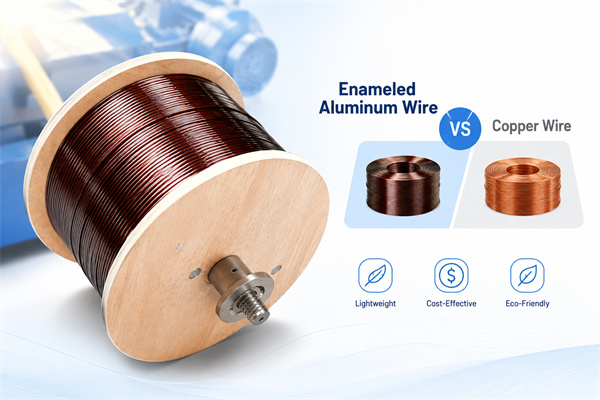
This article does not repeat the details of price, weight, and conductivity (these have been covered before). Today we focus on one thing: the decision framework for replacing copper with enameled aluminum wire. 7 judgment dimensions, 4 typical scenarios’ “can or cannot,” and 3 common misconceptions.
Decision Framework: 7 Judgment Dimensions
To determine whether enameled aluminum wire can replace copper wire, 7 dimensions must be examined simultaneously. If any dimension shows red, the entire replacement plan should be cautious.
Dimension 1: current carrying capacity requirement. Under equal current carrying capacity, the aluminum wire cross-sectional area needs to be enlarged by 1.64 times. If your product slot design is compact and cannot accommodate 1.64 times the cross-sectional area of aluminum wire, this dimension shows red.
Dimension 2: peak working temperature. Aluminum wire dissipates heat slower than copper wire (copper thermal conductivity 401 W/(m·K) versus aluminum 237 W/(m·K)). If the peak working temperature exceeds 180°C and lasts for a long time, this dimension shows red, requiring upgrade to 200°C class enamel.
Dimension 3: vibration conditions. Aluminum’s elastic modulus is only 56 percent of copper’s, with poor vibration resistance. If the product is subjected to long-term vibration above 5g (such as new energy vehicle drive motors, compressors), this dimension should be cautious, possibly requiring additional bundling and anti-vibration design.
Dimension 4: life requirement. Aluminum enameled wire has a slightly shorter life than copper at the same temperature class (aluminum oxide film thickening affects adhesion). If the product life requirement exceeds 25 years (such as power transformers), this dimension should be cautious.
Dimension 5: connection process. Aluminum wire cannot be directly crimped with copper terminals, as this will cause galvanic corrosion. Copper-aluminum transition joints, nickel-plated terminals, or ultrasonic welding must be used. If the product has small batch size and high modification cost, this dimension may not be cost-effective.
Dimension 6: economics. Copper-aluminum ratio of 3.5 times is the critical point. Above 3.5 times, aluminum replacing copper is economically strong. Below 3.5 times, copper replacing aluminum is economically strong. The current copper-aluminum ratio is 3.63 times, close to the critical point.
Dimension 7: industry conventions. Certain industries have mandatory material requirements (such as aviation, medical, military that must use copper). If the product is targeted at these industries, this dimension shows red. There is no room for negotiation.
Core judgment logic: among 7 dimensions, 5 green plus 2 yellow equals “can replace.” 4 green plus 3 yellow equals “replace cautiously.” 3 green plus 4 yellow equals “replacement not recommended.” Any 1 red means “cannot replace.”
4 Typical Scenarios’ “Can or Cannot” Judgment
Scenario One: Home Air Conditioner Outdoor Unit Motor (Can Replace)
The home air conditioner outdoor unit motor is a typical mature scenario for replacing copper enameled wire with aluminum enameled wire.
7-dimension check: 1. Current carrying capacity: low (0.5 to 3 A), 1.64 times cross-sectional area enlargement can fit in slot. 2. Working temperature: peak 110 to 130°C, standard 130°C enamel sufficient. 3. Vibration: motor body vibration 1 to 2g, acceptable. 4. Life requirement: 10 to 15 years, aluminum enameled wire can achieve. 5. Connection process: terminal crimping mainly, can be modified. 6. Economics: large batch, aluminum is 40 percent cheaper, strong economics. 7. Industry convention: aluminum replacement of copper in home appliance industry is mature.
Conclusion: all 7 dimensions are green, strongly recommended for replacement. The home appliance industry’s aluminum replacement of copper has been completed for over 20 years. Currently, the penetration rate of aluminum enameled wire in home air conditioners, washing machines, and range hoods exceeds 90 percent.
Scenario Two: Distribution Transformer Winding (Can Replace, With Limitations)
Distribution transformer windings (below 500 kVA) are moderately mature scenarios for replacing copper enameled wire with aluminum enameled wire.
7-dimension check: 1. Current carrying capacity: medium-low, cross-sectional area enlargement acceptable. 2. Working temperature: 130 to 150°C, Class H enamel sufficient. 3. Vibration: transformer body vibration 0.5 to 1g, very low. 4. Life requirement: 25 to 30 years, aluminum enameled wire under Class H can achieve (close to limit). 5. Connection process: many aluminum-copper lead wires inside transformer, connection process complex. 6. Economics: large copper volume in transformer, aluminum replacement saves 30 to 50 percent raw material cost. 7. Industry convention: IEC 60076 standard allows aluminum transformers.
Conclusion: 5 green plus 2 yellow (life, connection process), can replace but requires strict engineering management. In State Grid Corporation of China’s 2024 distribution transformer bidding, aluminum windings accounted for 35 percent, which has become the mainstream solution. However, aluminum replacement of copper in large power transformers (above 2,500 kVA) is still immature.
Scenario Three: EV Drive Motor (Partial Replacement, Flat Wire Scenario Special)
The replacement of copper with aluminum enameled wire in EV drive motors is the industry’s hottest topic.
7-dimension check: 1. Current carrying capacity: peak 300 to 600 A, requires large cross-sectional area, 1.64 times enlargement challenges slot. 2. Working temperature: peak 170 to 180°C, requires Class C enamel (200°C class). 3. Vibration: 3 to 5g, new energy vehicle specific scenario. 4. Life requirement: 8 to 10 years (200,000 to 300,000 km), aluminum enameled wire can achieve. 5. Connection process: hairpin welding process is mature but costly. 6. Economics: large copper volume per vehicle (10 to 15 kg), aluminum replacement saves 30 percent raw material cost. 7. Industry convention: Tesla, Lucid, Porsche high-end models have used it in batches.
Conclusion: 4 green plus 3 yellow, partial scenarios can be replaced (high-end hairpin motors), partial scenarios cannot (round wire winding motors). Currently, the aluminum replacement of copper in EV drive motors is mainly concentrated in high-end flat wire and hairpin motors. Traditional round wire winding motors still mainly use copper.
Scenario Four: Aviation Motor (Cannot Replace)
Aviation motors are a hard scenario where aluminum enameled wire cannot replace copper wire.
7-dimension check: 1. Current carrying capacity: high, cross-sectional area enlargement challenging. 2. Working temperature: peak 200 to 220°C, Class C or above enamel (enamel only). 3. Vibration: aviation grade 10 to 50g, aluminum vibration resistance insufficient. 4. Life requirement: aviation 20 to 30 years plus high reliability. 5. Connection process: aviation grade connection standards strict, aluminum connection cost extremely high. 6. Economics: aviation pursues lightweight, aluminum has advantages. 7. Industry convention: aviation standards mandate copper or special alloys.
Conclusion: 3 green plus 2 yellow plus 2 red (vibration, industry convention), cannot replace. Aviation, military, medical, and other industries have mandatory material requirements. Aluminum enameled wire cannot enter these markets.
3 Common Misconceptions
Misconception One: “Aluminum Is 70 Percent Cheaper, So Total Cost Is 70 Percent Cheaper”
Many customers’ first reaction is “aluminum is 70 percent cheaper, switching to aluminum must save 70 percent raw material cost.” This is wrong.
Under equal conductivity, the aluminum wire cross-sectional area is enlarged by 1.64 times, and the raw material cost is actually saved by 50 percent (not 70 percent). Considering incremental costs such as connection process modification, terminal replacement, and reliability verification, total cost savings are 20 to 35 percent (not 50 percent).
A more hidden cost: although aluminum enameled wire processing fees are 30 percent lower, enamel costs increase rather than decrease, because aluminum enameled wire requires thicker enamel to ensure adhesion (GB/T 6109 Grade 1 enamel plus 30 percent). This will eat into 5 to 8 percent of the cost advantage.
Misconception Two: “Aluminum Wire Is Lighter, So the Product Will Definitely Be Lighter”
Many customers switch to aluminum wire for “lightweight,” but weight reduction only works under “equal conductivity replacement.”
If the customer does not require equal conductivity and just uses a “similar slot size to fit aluminum wire,” the aluminum winding weight may actually exceed copper (because more aluminum is stuffed to fill the slot). This is common in engineering.
Scenarios where weight can actually be reduced: EV high-voltage wiring harnesses, transformer windings, home appliance motor windings. These scenarios have surplus space in the slot, so equal conductivity replacement works.
Scenarios where weight cannot be reduced: compact motors, high power density transformers. The slot is compact, and aluminum wire cross-sectional area cannot fit. Only copper can be used.
Misconception Three: “Aluminum Enameled Wire Technology Is Immature”
This misconception is now outdated. Aluminum enameled wire technology has fully matured in the three major scenarios of home appliances, transformers, and EVs.
Home appliances: over 30 years of application history, penetration rate above 90 percent. Transformers: over 20 years of application history, IEC 60076 standard support. EV drive motors: 5 to 8 years of application history, Tesla, Lucid, BYD have used it in batches.
Truly immature scenarios: aviation (will not mature within 25 years), high-voltage cables (high insulation requirements), medical equipment (industry standard restrictions). The claim of “immature technology” in other scenarios reflects supplier unprofessionalism.
Decision Tree: From Question to Conclusion
If you are evaluating whether to replace copper with enameled aluminum wire, follow this decision tree.
Step 1: Do industry standards mandate copper? Yes means cannot replace. No means continue.
Step 2: Does the product life requirement exceed 25 years? Yes means cautious replacement (requires Class H or above enamel plus strict engineering management). No means continue.
Step 3: Do vibration conditions exceed 5g? Yes means cautious replacement (requires additional anti-vibration design). No means continue.
Step 4: Is the copper-aluminum ratio above 3.5? No means replacement is not cost-effective. Yes means continue.
Step 5: Can the slot accommodate aluminum wire under equal conductivity replacement? No means cannot replace. Yes means continue.
Step 6: Can the batch exceed 5,000 kg per year? No means modification investment payback period is too long. Yes means recommend replacement.
Products that pass all 5 steps: recommend immediately starting the enameled aluminum wire replacement project. Products that fail any step: maintain the copper wire solution.