

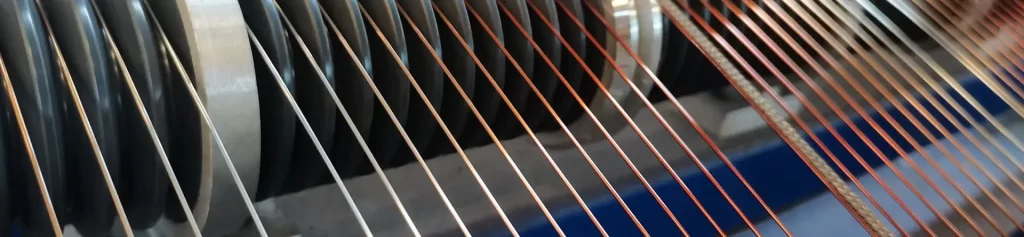
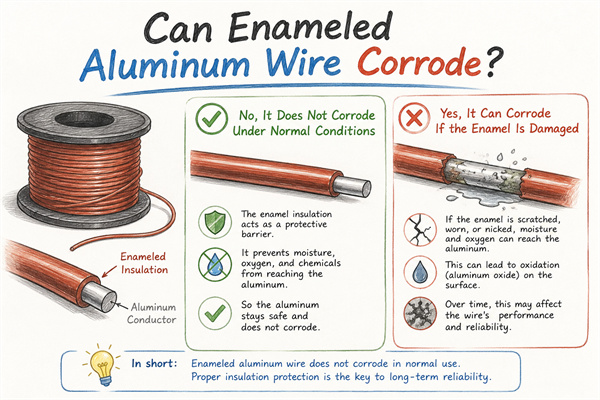
The short answer is: yes, it will corrode, but under certain conditions —in most normal usage scenarios, the corrosion risk of enameled aluminum wire is extremely low; in certain specific environments (such as salt spray, humidity, and chemical media), the corrosion risk increases significantly. Understanding the corrosion mechanisms, typical scenarios, and protection methods of enameled aluminum wire is crucial for the reliability design throughout the product’s entire lifecycle.
This article, starting from the principles of corrosion electrochemistry, systematically explains the four major corrosion mechanisms of enameled aluminum wire, compares five typical environments, and outlines three protection strategies. The standards covered in this article include ASTM B117 (salt spray test), ISO 9227 (artificial atmosphere corrosion test), IEC 60068-2-52 (cyclic salt spray test), and ASTM G85 (modified salt spray test).
I. Direct Answer: Yes, but with conditions
1.1 The essence of corrosion in enameled aluminum wire:
Aluminum is an active metal with a standard electrode potential of -1.66 V (relative to the standard hydrogen electrode, SHE), far lower than copper (+0.34 V) and iron (-0.44 V). This means that aluminum is thermodynamically very easy to oxidize—which is why aluminum can naturally form an Al₂O₃ protective film in the atmosphere.
The Al₂O₃ film is about 2-10 nm thick , dense, stable, and self-healing, which is the fundamental reason why aluminum “seems not to corrode” in various environments. The enameled aluminum wire’s enamel coating provides a second layer of protection for the aluminum substrate—mechanically isolating it from corrosive media such as moisture, oxygen, and chloride ions. The integrity of the enamel coating directly determines whether the aluminum substrate will corrode. When the enamel coating is intact, the aluminum substrate hardly corrodes; when the enamel coating has pinholes, scratches, or peeling, corrosion begins at the defective points.
1.2 Under what conditions does enameled aluminum wire not corrod
e? Enameled aluminum wire exhibits excellent corrosion resistance in the following scenarios: dry indoor environments (relative humidity < 60%), oil immersion (mineral oil/synthetic ester), inside sealed electrical equipment, inside household appliances (such as air conditioner compressor motors), and standard motor windings (Class F/H enamel coating + impregnation process). Under these scenarios, based on the damp heat test results of IEC 60068-2-78 standard, the enamel coating of the enameled aluminum wire can withstand 1,000 hours of aging at 85°C/85% RH, with an insulation resistance retention rate of not less than 80%.
1.3 Under what circumstances will enameled aluminum wire corrode?
The corrosion risk of enameled aluminum wire increases significantly in the following scenarios: salt spray environment (coastal, offshore, chemical zone), long-term humid environment (outdoor without protection, underground, underwater), chemical media environment (acid, alkali, salt solution), galvanic connection (direct aluminum-copper connection without protection), and mechanical damage (bending, scratching damage to the enameled coating). In these scenarios, the corrosion mechanism and protection methods for enameled aluminum wire need to be designed separately.
II. Four Corrosion Mechanisms of Enameled Aluminum Wire
2.1 Pitting Corrosion Pitting corrosion is the most common form of corrosion for enameled aluminum wire, occurring at pinholes or scratches in the enameled coating.
Its mechanism is: chloride ions (Cl⁻) penetrate the enameled coating defects, react with the aluminum matrix to form AlCl₃, which then hydrolyzes to generate Al(OH)₃ and HCl. HCl further corrodes the aluminum matrix. Pitting corrosion is characterized by its small diameter (0.1-1 mm), large depth (up to 10-50% of the metal thickness), and difficulty in being detected by the naked eye.
According to ASTM B117, enameled aluminum wire should show no visible pitting within 96 hours of a 5% NaCl salt spray test.
2.2 Crevice Corrosion Crevice corrosion occurs in the gaps between enamel coatings, between enamel coatings and conductors, and between winding layers.
The mechanism is as follows: oxygen is depleted within the gap, forming an oxygen-deficient zone; an oxygen-rich zone outside the gap forms an oxygen concentration cell; and aluminum inside the gap acts as the anode and is corroded. Crevice corrosion is particularly common in transformers and motor windings—interlayer insulation paper, insulating varnish, and winding binding tape can all form gaps. Micro-gaps in the windings should be minimized during design.
2.3 Galvanic Corrosion Galvanic corrosion is a typical form of corrosion in enameled aluminum wires when connected to dissimilar metals (such as aluminum-copper terminals and aluminum-steel bolts).
The mechanism is as follows: the standard electrode potential difference between aluminum and copper reaches 2.0 V (aluminum -0.86 V vs Cu -0.34 V, in a Cl⁻-containing environment), forming a strong galvanic cell, with aluminum acting as the anode and being accelerated in corrosion.
When the aluminum-copper area ratio is < 1 (copper area is larger than aluminum), the corrosion rate of aluminum can be accelerated by 10-100 times. Therefore, aluminum-copper connections must use copper-aluminum transition joints or anti-galvanic corrosion coatings.
2.4 Stress Corrosion Cracking (SCC) Stress corrosion cracking is a failure mode of enameled aluminum wires under the combined action of tensile stress and corrosive media.
The mechanism is as follows: tensile stress causes microcracks to form in the protective film (Al₂O₃) of the aluminum matrix. Corrosive media penetrate along the cracks, causing crack propagation until fracture. The characteristics of SCC are: brittle fracture morphology, dendritic or intergranular distribution of cracks. Aluminum is relatively sensitive to SCC—especially 2000 series and 7000 series aluminum alloys; however, 1000 series (pure aluminum) and 6000 series (aluminum-magnesium-silicon) have lower SCC sensitivity. Enamelled aluminum wire usually uses pure aluminum (1350-O state) as the matrix, and the SCC risk is relatively controllable.
III. The protective effect of enamel coating on the aluminum matrix
3.1 The protective mechanism of enamel coating
The enamel coating of enamelled aluminum wire protects the aluminum matrix through three mechanisms: mechanical barrier (isolation of water, oxygen, Cl⁻), chemical stability (resistance to acid, alkali and salt corrosion), and electrical insulation (prevention of electrolytic corrosion caused by leakage current). According to IEC 60317 standard, the thickness and quality of the enamel coating determine its protective capability—Grade 2 standard enamel coatings with a thickness of approximately 0.03-0.04 mm can withstand a breakdown voltage of 4,200 V and a 168-hour salt spray test.
3.2 Common Causes of Enamel Coating Failure Enamel coatings can
fail under the following conditions: mechanical damage (insufficient bending radius, scratches, impacts), thermal aging (long-term exposure to temperatures exceeding the Class level, leading to embrittlement), chemical corrosion (strong acids, strong alkalis, organic solvents), ultraviolet degradation (polyurethane enamel coatings are prone to powdering in outdoor applications), and corona discharge (partial discharge in high-voltage windings damages the enamel coating). Once pinholes or peeling occur in the enamel coating, corrosion begins at the defect and spreads to the surrounding area.
3.3 The Influence of Enamelled Coating Grade on Corrosion
Resistance Different enamel coating systems exhibit significant differences in corrosion resistance: Polyurethane enamel coating (UEW/130) – moderate chemical resistance, not resistant to strong acids and alkalis; Polyester enamel coating (PEW/155) – good chemical resistance, but moderate resistance to damp heat; Polyester imide enamel coating (EIW/180) – excellent chemical and damp heat resistance, the mainstream Class H enamel coating; Polyamide-imide coating (AIW/200) – best chemical resistance, abrasion resistance, and high temperature resistance, Class N. When designing enameled aluminum wires for corrosive environments, it is recommended to prioritize EIW/180 or AIW/200 enamel coating systems.
IV. Comparison of Five Typical Corrosion Environments
4.1 Atmospheric Environment
(Indoor/Outdoor) A dry indoor environment is the ideal working scenario for enameled aluminum wires.
According to ISO 9223 atmospheric corrosivity classification, in environments ranging from C1 (very low) to C2 (low), the expected service life of enameled aluminum wire can reach 20-30 years. For outdoor exposure environments, the enameled coating needs to be selected based on the atmospheric corrosivity level—C3 (medium) can use EIW/180, and C4 (high) should use AIW/200 with a coating + impregnation process. The outdoor atmosphere in coastal cities is typically C3-C4, while chemical industrial zones may reach C5 (very high).
4.2 Salt Spray Environment
(Coastal/Marine) Salt spray is the most challenging corrosive environment for enameled aluminum wire.
According to the neutral salt spray test (NSS) standards of ASTM B117 and ISO 9227, under conditions of 5% NaCl, 35°C, and pH 6.5-7.2, the tolerance time of Grade 2 enameled aluminum wire with an enameled coating is approximately 168-500 hours (depending on the enameled coating system). Grade 2 polyester imide enamel coating has a lifespan of approximately 168 hours, while AIW/200 coating can reach 500-1,000 hours. For offshore applications (such as offshore wind power and marine motors), AIW/200 enamel coating + vacuum pressure impregnation (VPI) process is recommended.
4.3 Humid and Hot Environments
(Tropical/Underground/Condensing) Humid and hot environments primarily affect the electrical performance and long-term reliability of enamel coatings.
According to IEC 60068-2-78, under 85°C/85% RH conditions, the humid and hot aging life of Class H enamel coatings is approximately 1,000-2,000 hours. The failure mode of enameled aluminum wire in humid and hot environments is typically: enamel coating absorbs water and expands → insulation resistance decreases → electrochemical corrosion → breakdown. When designing for tropical or underground applications, a temperature margin of 10-15°C should be reserved in the Class rating, and sealing and drainage designs should be strengthened.
4.4 Chemical Media Environment (Acid/Alkali/Salt)
The corrosiveness of chemical media to the enamel coating depends on the pH value and temperature of the medium. Strong acids (pH < 4) will dissolve the enamel coating and the Al₂O₃ protective film; strong alkalis (pH > 9) will dissolve Al₂O₃ but corrode the enamel coating more slowly; neutral salt solutions (NaCl, CaCl₂) mainly cause pitting corrosion. Enameled aluminum wires near battery factories, electroplating plants, and chemical equipment require special protection—usually using fluoroplastic or polyimide coatings (resistant to strong acids and alkalis) + stainless steel or titanium alloy shells.
4.5 Electrochemical Environment (Strray Current/Poor Grounding)
Electrochemical corrosion is a special form of corrosion of enameled aluminum wires in DC systems, frequency converter systems, and poor grounding scenarios. DC leakage current, frequency converter common-mode voltage, and stray currents in the grounding circuit can all cause electrolytic corrosion of enameled aluminum wires. A typical characteristic is that corrosion is distributed in a dendritic or radial pattern along the enamel coating defects.
When designing variable frequency motors, solar inverters, and new energy vehicle drive motors, it is essential to ensure good grounding, complete winding shielding, and the use of common-mode reactance or filtering devices.
V. Three-Layer Corrosion Protection Strategy
5.1 First Layer: Selection of Substrate Material
The substrate material for enameled aluminum wire should preferably be pure aluminum in the 1350-O state (annealed pure aluminum, conductivity 61% IACS, elongation ≥ 20%, low SCC susceptibility). Avoid using 2000 series (Al-Cu) and 7000 series (Al-Zn) aluminum alloys—these alloys have high strength but high SCC susceptibility and are not suitable as substrates for enameled wire. For special corrosive environments (such as seawater and soil), 5xxx series (Al-Mg) alloys can be considered—their corrosion resistance is superior to pure aluminum.
5.2 Second Layer: Enamelled Coating System and Thickness
The enamel coated coating system should be selected according to the corrosive environment: Class F (155°C) – PEW/155 – suitable for dry indoor environments; Class H (180°C) – EIW/180 – suitable for general industrial environments; Class N (200°C) – AIW/200 – suitable for salt spray, humid heat, and chemical media environments. The recommended enamel coated coating thickness is Grade 2 or higher – Grade 3 thickened enamel coated coating is recommended for corrosive environments (enamel coated coating thickness 0.05-0.08 mm, breakdown voltage ≥ 6,000 V). Impregnation processes (VPI vacuum pressure impregnation or drip impregnation) can form a secondary protective layer on the winding surface, further improving corrosion resistance.
5.3 The Third Line of Defense: Structural and System
Design Structural and system design is the “last line” of defense against corrosion, including: Sealing design—using an enclosure with an IP55 or higher protection rating for outdoor or humid environments; Drainage design—preventing condensation buildup on the windings; Ventilation design—reducing internal humidity (relative humidity < 60%); Cathodic protection—considering zinc sacrificial anode protection for large transformers or underground equipment; Electrical insulation—using copper-aluminum transition joints, double-layer heat shrink tubing, or insulating gaskets at aluminum-copper connections; Regular inspection—insulation resistance and appearance of enameled aluminum wire equipment that has been in operation for more than 5 years should be checked regularly.