


Introduction
Glass-fiber-covered magnet wire is a composite insulated wire formed by braiding or winding alkali-free E-glass fiber yarn over enameled round copper wire or enameled flat copper wire, followed by high-temperature impregnation and curing with silicone organic varnish or polyester-imide varnish. In typical industrial applications—including transformers, high-voltage motors, traction motors, explosion-proof motors, metallurgical and hoisting equipment, wind-power generators, rail transit traction systems, industrial heating devices, and auxiliary nuclear power motors—the operating temperature commonly ranges from 155 °C to 220 °C, accompanied by multiple stress factors such as vibration, oil mist, humidity, dust, chemical media, or radiation. The single-layer insulation of conventional enameled wire is insufficient to ensure long-term operational reliability under such conditions. The synergistic effect between the glass-fiber covering layer and the underlying enamel layer not only enhances mechanical strength and abrasion resistance but, more critically, significantly extends thermal life and improves dielectric stability at elevated temperatures beyond that achievable with plain enameled wire alone. A comprehensive understanding of “optimal” industrial-grade glass-fiber-covered magnet wire requires systematic evaluation across six dimensions: material system, thermal class rating, key performance parameters, manufacturing process, application-specific operating condition matching, and quality certification. This article unfolds progressively—from material fundamentals and thermal classification systems through performance specifications, process details, representative industrial applications, quality testing, and material selection guidelines—covering the full industrial spectrum, from dry-type transformers and traction motors to industrial heating equipment and new-energy systems, and referencing core standards including IEC 60851, IEC 60085, IEC 60216, NEMA MW 1000 series, ASTM D578, UL 1446, and GB/T 7672.
Fundamental Glass Fiber Material System
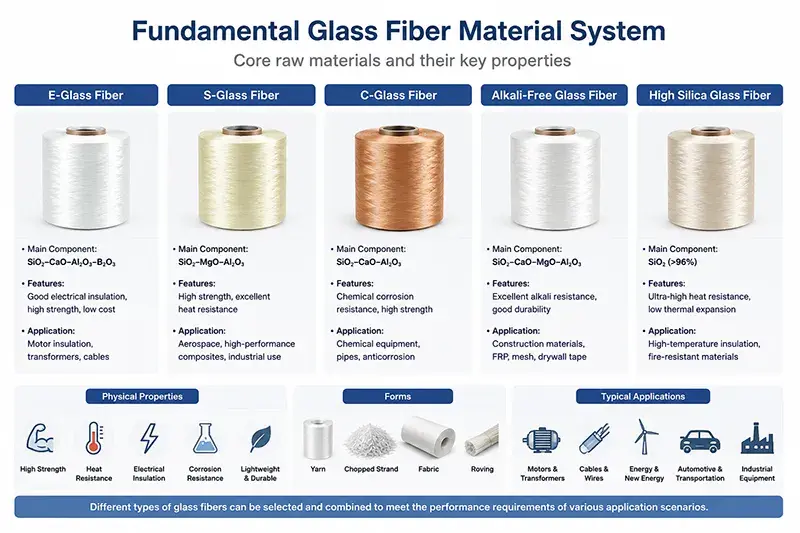
Chemical Composition and Dielectric Advantages of E-Glass Fiber
Industrial glass-fiber-covered magnet wire almost exclusively employs alkali-free E-glass fiber, with a typical chemical composition of approximately 54 % SiO₂, 15 % Al₂O₃, 17 % CaO, 4.5 % MgO, 8 % B₂O₃, and total Na₂O + K₂O content less than 1 %. The low alkali metal content is the defining characteristic distinguishing E-glass from conventional A-glass (C-glass): alkali metal ions migrating under electric field significantly degrade insulation resistance and dielectric strength. E-glass filament diameter is typically controlled between 6 μm and 9 μm; tensile strength of individual filaments reaches 3 000–5 000 MPa—5 to 8 times that of copper—conferring exceptional mechanical protection to the glass-fiber covering layer. Its dielectric strength is approximately 8–12 kV/mm; volume resistivity exceeds 10¹⁴ Ω·cm; dielectric constant at 1 MHz ranges from 6.2 to 6.6; and loss tangent (tanδ) is approximately 0.005–0.008—significantly lower than that of organic fiber materials.
Yarn Twist and Braiding Structure
Glass fiber exhibits high inherent brittleness and must be twisted into continuous yarns to enable braiding or winding. Twist level—defined as the number of twists per meter—is a critical parameter influencing the flexibility and mechanical strength of the covering layer. Low-twist yarns (30–60 twists/m) offer superior softness and conformability to enameled wire surfaces, suitable for fine round wires (AWG 28 to AWG 40); medium-twist yarns (80–120 twists/m) provide optimal dimensional stability and abrasion resistance and represent the mainstream choice for Class H 180 glass-fiber-covered magnet wire; high-twist yarns (150–200 twists/m) deliver enhanced tensile strength but reduced flexibility, commonly employed for tight wrapping of rectangular flat wire. Braiding density—i.e., the number of interlacing points per centimeter—is typically controlled within 8–16 interlacings/cm, determining covering layer thickness (typical range: 0.15–0.4 mm) and cut-through resistance.
Synergistic Mechanism of Impregnating Varnish and Primer Layer
The glass-fiber covering layer does not function independently but forms a three-layer composite insulation system together with the primer layer (enameled wire insulation) and outer impregnating varnish. The primer layer is typically a polyester (PEW), polyester-imide (EIW), or polyamide-imide (AIW) film, with thickness ranging from 30 μm to 80 μm, providing primary dielectric insulation; the glass-fiber covering layer delivers mechanical strength and abrasion resistance; the outer impregnating varnish is commonly silicone-based (Class H 180) or polyester-imide (Classes H 180 to N 200), which, after high-temperature baking (typical range: 180–220 ℃), fills interstitial voids among glass fibers, seals moisture pathways, and forms a continuous insulating matrix. Viscosity, solids content, curing temperature, and time of the impregnating varnish are key process parameters governing final performance of glass-fiber-covered magnet wire. This three-layer synergy enables the composite system to achieve thermal life exceeding 20 000 hours at 180 ℃—5 to 10 times that of single-layer enameled wire.
Temperature Rating System and Corresponding Industrial Applications
Class F 155 °C Glass-Film-Clad Wire
Class F 155 °C is the most widely applied temperature rating for industrial glass-film-clad wire, corresponding to Class F per IEC 60085 and MW 79-C in the NEMA MW 1000 series (double-glass-film-clad polyester enameled round copper wire). The base enamel is typically polyester or modified polyester, with outer impregnation using polyester or epoxy-modified varnish. This rating is primarily used in general-purpose industrial motors (Y2 and Y3 series), medium- and small-size dry-type transformers, reactors, and general-purpose relays. Class F glass-film-clad wire offers an optimal balance of cost-effectiveness and reliability, with unit-length pricing typically 70 % to 80 % of that for Class H products—making it the preferred choice for the majority of civilian industrial motors. Typical manufacturing standards include IEC 60851 and GB/T 7672.1.
Class H 180 °C Glass-Film-Clad Wire
Class H 180 °C represents the high-temperature tier for industrial glass-film-clad wire, corresponding to Class H per IEC 60085 and MW 82-C in the NEMA MW 1000 series (double-glass-film-clad polyester-imide enameled round copper wire). The base enamel is upgraded to polyester-imide (EIW), and the outer impregnating varnish is silicone organic resin (typical grades: Dow Corning DC 996 or Wacker Silicone Resin MK), delivering a thermal life exceeding 20,000 hours at 180 °C. Class H glass-film-clad wire is extensively employed in dry-type transformers (epoxy-cast or VPI processed, per NEMA MW 82-C), traction motors, metallurgical and hoisting motors, wind turbine generator windings, and end-turn insulation for high-voltage motors. It commands a premium of approximately 30 % over Class F products but significantly enhances thermal margin, enabling a 15 % to 25 % increase in motor power density.
Class N 200 °C and Class R 220 °C Glass-Film-Clad Wire
Class N 200 °C and Class R 220 °C represent higher-temperature tiers for industrial glass-film-clad wire, corresponding to MW 84-C (polyamide-imide base enamel + glass film + polyamide-imide impregnating varnish) or MW 86-C (polyimide base enamel + glass film + polyimide impregnating varnish) in the NEMA MW 1000 series. Base enamels are predominantly polyamide-imide (AIW) or polyimide (PIW), with outer impregnating varnishes based on polyamide-imide or polyimide systems. Class R glass-film-clad wire achieves a thermal life exceeding 20,000 hours at 220 °C and serves as the core insulation solution for nuclear auxiliary motors, steam turbine generators, high-speed rail traction transformers, military electrical equipment, and aerospace motor windings. Its price is typically 1.8 to 2.5 times that of Class H wire, deployed exclusively in applications demanding extreme temperature resistance or long-life commitments.
Arrhenius-Based Temperature Rating Conversion Logic
The temperature rating of industrial glass-film-clad wire is not merely a “maximum operating temperature”—rather, it constitutes a thermal life commitment derived from the Arrhenius model per IEC 60216. An empirical rule states that thermal life halves for every 8 K to 10 K rise in temperature. For example, an identical insulation system rated for 20,000 hours at 180 °C would be rated for approximately 10,000 hours at 190 °C and ~5,000 hours at 200 °C. Understanding this conversion relationship is critical for temperature-field verification in industrial motor design—transient peak temperature excursions do not cause immediate failure, yet cumulative thermal aging substantially reduces winding service life. In practice, industrial design mandates maintaining the winding hot-spot temperature at least 10 K below the rated temperature class to ensure adequate design safety margin.
Key Performance Indicator System
Dielectric Breakdown Voltage and Partial Discharge Performance
The dielectric breakdown voltage of industrial glass-fiber-covered magnet wire depends on the primer layer thickness, glass-fiber braid density, impregnating varnish fill quality, and synergistic interaction among the three layers. Typical values range from 5 kV to 15 kV (AC 50 Hz breakdown voltage, tested per IEC 60851-3), with Class F products exhibiting no breakdown at 1 kV, Class H products at 1.5 kV, and Class R products at 2 kV. Notably, the dielectric performance of glass-fiber-covered magnet wire is more prominently reflected in its pulse impulse resistance and partial discharge (PD) resistance—glass-fiber wrapping significantly reduces electric field concentration under inter-turn voltage stress, enabling windings to achieve 3–5× higher impulse lifetime under PWM inverter drive (dv/dt level: 10 kV/μs) compared to plain enameled wire. PDIV (Partial Discharge Inception Voltage) and PDEV (Partial Discharge Extinction Voltage) have become critical reference parameters for evaluating the high-frequency insulation capability of glass-fiber-covered magnet wire.
Mechanical Strength: Tensile, Flexibility, and Abrasion Resistance
The tensile strength of glass-fiber-covered magnet wire is primarily determined by the copper conductor (glass fiber serves only as auxiliary reinforcement), whereas flexibility and abrasion resistance are governed by the glass-fiber covering layer. Class F round glass-fiber-covered magnet wire (1.0 mm diameter) remains crack-free when bent at a radius of 10× the wire diameter; Class H and Class N products remain crack-free at a bending radius of 5× the wire diameter. Abrasion testing (IEC 60851-3 Clause 3) requires the glass-fiber covering layer to withstand ≥30 reciprocating scrapes under a 0.2 N load without exposing copper—a critical specification in dry-type transformer coil manufacturing and motor winding insertion processes. During coil insertion, enameled wire must endure multiple mechanical stresses including end-turn bending, slot-edge friction, and wedge pressure; the glass-fiber covering layer serves as the final barrier ensuring winding integrity.
Moisture, Chemical, and Flame Resistance
Moisture, oil mist, acidic/alkaline vapors, dust, and chemical media in industrial environments pose persistent threats to the long-term reliability of glass-fiber-covered magnet wire. E-glass fibers themselves exhibit excellent chemical stability—resistant to dilute acids, dilute alkalis, organic solvents, and transformer oil—yet undergo significant corrosion only in hydrofluoric acid, hot concentrated phosphoric acid, or strong alkalis (e.g., NaOH >5 %, >80 ℃). The impregnating varnish layer—particularly silicone-organic and polyimide varnishes—provides a hydrophobic barrier, enabling glass-fiber-covered magnet wire to maintain insulation resistance >10¹² Ω after 1,000 hours at 95 % relative humidity and 40 ℃. Regarding flame resistance, silicone-organic varnish-impregnated Class H glass-fiber-covered magnet wire achieves an oxygen index (LOI) ≥30 %, satisfying the Class H flame-retardant requirements specified in UL 1446 and IEC 60085; low-smoke zero-halogen (LSZH) impregnating varnishes further reduce fire smoke density and HCl emission—mandatory for confined-space applications such as rail transit, metro systems, and nuclear power plants.
Thermal Aging and Thermal Shock Resistance
Thermal aging tests (IEC 60216-1 and IEC 60851-3 Clause 6) subject glass-fiber-covered magnet wire samples to target temperatures (e.g., 200 ℃, 220 ℃, 240 ℃) in ovens, with periodic sampling for bend and breakdown voltage testing until performance failure occurs; failure time is recorded and extrapolated using the Arrhenius equation. Thermal shock testing requires samples to be rapidly heated from ambient temperature to a set temperature (e.g., 180 ℃), then immediately quenched in ice water, repeated cyclically without cracking. Industrial-grade glass-fiber-covered magnet wire typically must withstand ≥30 thermal shock cycles. Thermal shock resistance is a composite indicator of impregnating varnish flexibility and glass-fiber braid tension—low-quality products often suffer glass-fiber breakage and primer exposure after only 5–10 cycles due to excessively rigid impregnating varnish or overly tight braiding.
Geometric Specifications and Manufacturing Processes
Specification Systems for Round and Rectangular Wire
Industrial glass-filament-wrapped magnet wire is categorized by conductor geometry into round wire and rectangular (flat) wire. Round wire conforms to AWG (American Wire Gauge) or IEC 60228 standards, with diameters ranging from AWG 14 (1.63 mm) to AWG 38 (0.10 mm); AWG 18 to AWG 30 represents the primary specification range for industrial motors and transformers. Rectangular wire conforms to IEC 60317-29 and GB/T 7672.2, with typical widths of 2 to 12 mm and thicknesses of 0.8 to 4.5 mm; the width-to-thickness ratio is controlled between 2:1 and 12:1. Rectangular wire is the predominant form for large dry-type transformers and high-voltage motor windings. Glass-filament wrapping of rectangular wire is more challenging than that of round wire—requiring precise control of braiding angle, tension, and crossover density to prevent filament breakage or voids at sharp edges.
Single-Layer and Double-Layer Glass-Filament Braiding
Single-layer glass-filament braiding (MW 80-C / MW 81-C) is a cost-effective solution, featuring a wrap thickness of 0.15 to 0.25 mm, suitable for Class F and entry-level Class H industrial motors. Double-layer glass-filament braiding (MW 82-C / MW 83-C) employs two counter-rotating helical wraps (clockwise + counterclockwise), achieving a wrap thickness of 0.30 to 0.45 mm, delivering superior mechanical strength and dielectric withstand capability. It is the standard configuration for dry-type transformers rated above Class H 180, traction motors, and explosion-proof motors. A critical process parameter in double-layer braiding is tension balance between the counter-rotating yarns—tension deviation exceeding 10 % results in inconsistent wrap tightness, adversely affecting subsequent impregnation and coil insertion. Triple-layer and multi-layer braiding are employed only in specialized high-voltage applications (e.g., motor windings rated above 10 kV).
Vacuum Pressure Impregnation (VPI) and Dip-and-Bake Processes
Vacuum Pressure Impregnation (VPI) is one of the most critical manufacturing processes for industrial glass-filament-wrapped magnet wire. Its sequence comprises: pre-baking (moisture removal at 120 to 150 ℃) → vacuum degassing (≤ 50 Pa) → varnish injection (ensuring full coverage of all windings) → pressure impregnation (0.2 to 0.6 MPa, held for 30 to 60 minutes) → varnish drainage → curing bake (180 to 220 ℃ × 8 to 16 hours). The VPI process enables thorough penetration of impregnating varnish into the glass-filament braid layer, winding end gaps, and inter-turn spaces, forming a void-free, monolithic insulation system that significantly enhances dielectric strength, thermal conductivity, and moisture resistance. In contrast, the dip-and-bake process employs atmospheric-pressure impregnation and atmospheric-pressure baking; although simpler, it achieves only 60 % to 70 % void-fill efficiency and is suitable for Class F and entry-level Class H products.
Industrial Application I — Dry-Type Transformers
Epoxy-Cast Dry-Type Transformers
Epoxy-cast dry-type transformers represent one of the core applications for glass-filament-wrapped magnet wire rated at Class H 180 °C and above. Windings fabricated from glass-filament-wrapped rectangular wire are vacuum-impregnated with epoxy resin (typical grades: Huntsman LY 564 / Araldite CW 229) within molds; upon curing, this forms monolithic coils. The glass-filament wrapping serves multiple functions: enhancing mechanical strength of the coil (to withstand epoxy shrinkage stresses during curing and electromagnetic forces under sudden short-circuit conditions), elevating overall thermal class (synergistic effect between glass-filament Class H 180 °C and epoxy Class F 155 °C raises system rating to Class F), and improving thermal conductivity (the braided glass-filament structure combined with epoxy forms continuous thermal conduction pathways). Typical products include the SCB10, SCB11, and SCB12 series of epoxy-cast dry-type transformers, deployed in fire-sensitive environments such as high-rise buildings, hospitals, subways, and data centers.
VPI Dry-Type Transformers and Open-Type Dry-Type Transformers
VPI (Vacuum Pressure Impregnation) dry-type transformers employ the VPI process instead of epoxy casting, facilitating on-site maintenance and recyclability—making them suitable for large-capacity units (e.g., ≥10 MVA) and high-voltage applications (35 kV). Glass-filament-wrapped round or rectangular wire windings are impregnated via VPI with silicone-based or polyester-imide varnish, achieving an overall temperature rating of Class H 180 °C to Class N 200 °C. Open-type ventilated dry-type transformers (OVDTs) rely on natural convection cooling and are predominantly used in low-capacity applications (<1 MVA); Class F glass-filament-wrapped wire offers a cost-effective solution. Within the NEMA MW 1000 series, MW 80-C, MW 82-C, and MW 84-C correspond respectively to Classes F, H, and N temperature ratings, serving as the core insulation materials for both OVDTs and VPI dry-type transformers.
Industrial Applications II — Industrial Motors and Traction Motors
Explosion-Proof Motors and Metallurgical & Lifting Motors
Explosion-proof motors (Ex d IIB / Ex d IIC) require windings capable of maintaining intact insulation under extreme temperatures, as their enclosures must withstand internal explosion pressures. The standard solution is H 180-class double-glass-filament-wrapped wire (MW 82-C) combined with Vacuum Pressure Impregnation (VPI) processing: the glass filament wrapping prevents flame penetration through winding gaps (flame erosion time ≥ 12 s), while VPI varnish fills all air gaps to prevent explosive pressure leakage. Metallurgical and lifting motors (YZR and YZ series) operate under multiple stresses—including frequent start-stop cycles, overload conditions, vibration, and thermal shock—where H-class double-glass-filament-wrapped wire impregnated with silicone organic varnish extends winding service life by 3 to 5 times compared to conventional enameled wire.
Traction Motors and Rail Transit
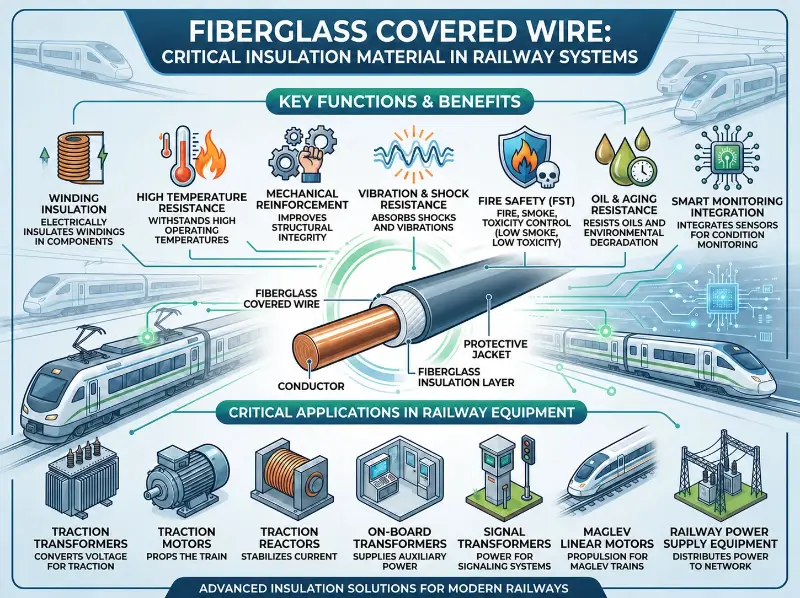
Railway, electric locomotive, and metro traction motors operate in high-temperature environments (peak winding temperature up to 200 ℃), experience intense vibration across the full frequency range (30–500 Hz), and undergo frequent start-stop cycles (over 100 times per day), demanding exceptional thermal cycling resistance and mechanical strength from windings. The mainstream solution employs H 180–N 200-class double-glass-filament-wrapped wire (MW 82-C / MW 84-C) impregnated with polyester-imide or polyamide-imide varnish. Major manufacturers—including CRRC, Bombardier, and Alstom—utilize glass-filament-wrapped rectangular wire combined with VPI processing for H 180-class high-voltage windings in traction transformers.
Wind Turbine Generators and Offshore Wind Power
Wind turbine generator winding insulation must withstand combined stresses including low-frequency vibration (blade rotation frequency: 0.1–1 Hz), thermal cycling (diurnal temperature variation: −20 to +50 ℃), and moisture/salt fog (offshore wind). H 180-class double-glass-filament-wrapped round wire combined with VPI processing is the mainstream solution for onshore wind power; N 200-class (MW 84-C) wire is applied in offshore wind and high-power-density machines (e.g., direct-drive permanent-magnet turbines rated at 8 MW or higher). The low coefficient of thermal expansion of the glass filament wrapping closely matches that of copper conductors, preventing insulation cracking during thermal cycling; the hydrophobicity of VPI varnish provides a salt-fog barrier, enabling offshore wind turbine winding lifetimes exceeding 20 years.
Industrial Application #3 — High-Voltage Motors and Power Generation Equipment
Stator Windings for Large High-Voltage Motors
Stator windings for large high-voltage motors rated at 6 kV, 10 kV, 13.8 kV, and 15 kV employ glass-fiber-covered rectangular wire combined with vacuum pressure impregnation (VPI) and global VPI processes—representing one of the highest-specification applications for industrial glass-covered magnet wire. The winding insulation system comprises turn-to-turn insulation (glass-fiber covering layer + impregnating varnish), main insulation (mica tape + impregnating varnish, thickness 3–5 mm), and end-winding fixation (glass-fiber cord binding + corona protection coating). The glass-fiber covering layer bears the full dielectric stress across turns—turn-to-turn peak voltage in a 10 kV motor may exceed 1,500 V, requiring the glass-fiber covering layer to withstand a 1.5 kV dielectric breakdown test without failure. Key governing standards include NEMA MW 1000 MW 82-C, IEC 60851, and IEC 60034-1.
Nuclear Power Auxiliary Motors and Turbine Generators
Motors for nuclear reactor coolant pumps, exciter motors for turbine generators, and auxiliary system motors in nuclear power plants must maintain operational integrity for 60 years under seismic loading (LOCA conditions), radiation exposure (cumulative γ-ray dose ≥100 kGy), and elevated temperatures (180–200 °C). R220-class (MW 86-C) glass-covered magnet wire combined with polyimide impregnating varnish is the sole solution qualified for nuclear certification per IEEE 323, IEEE 383, and RCC-M. The polyimide base coat (PIW) exhibits significantly superior radiation resistance compared to polyester-imide and polyamide-imide systems; meanwhile, the glass-fiber covering layer provides mechanical support under seismic loading, preventing structural damage to windings subjected to peak accelerations up to 0.5 g.
Industrial Application #4 — Industrial Electric Heating and High-Temperature Environments
Kilns, Induction Heating Coils, and Heat Treatment Equipment
Industrial resistance furnaces, medium-frequency induction furnaces, induction heating coils, and heat treatment fixtures operate at temperatures ranging from 200 °C to 400 °C, rendering conventional enameled wire completely nonfunctional. Glass-fiber-covered nickel-clad copper wire rated R 220 (MW 86-C) or higher—using nickel-based alloy conductors as substitutes—is the core material for this application. The glass-fiber covering provides not only dielectric isolation but also maintains mechanical integrity under prolonged exposure to temperatures above 220 °C—a capability unattainable by polyimide enamel coatings alone (which gradually carbonize above 250 °C). Impregnating varnishes are typically inorganic silica sols or mica tape combinations, enabling winding lifetimes exceeding 10,000 hours at 250 °C.
High-Temperature Motors and Military Electrical Systems
Propulsion motors for naval vessels, drive motors for tanks, military power generation units, and rocket launch site motors require windings capable of reliable operation across an extended temperature range of –50 °C to +200 °C, under severe vibration and shock (30 g), as well as fungal and salt fog exposure. GJB military standards (GJB 150, GJB 360A) mandate that windings pass 28 environmental tests. Double-glass-covered wires rated H 180 to N 200—impregnated with silicone-organic or polyimide varnish—are standard for military motors. The glass-fiber covering exhibits significantly superior resistance to fungus, salt fog, and humid heat compared to organic enamel coatings, enabling military motor service life exceeding 15 years in subtropical marine environments.
Industrial Applications – Part 5: New Energy and Rail Transit
Photovoltaic and Wind Power Inverter Reactors
Filter reactors and boost reactors inside photovoltaic grid-connected inverters and wind power converters operate at frequencies of 5–20 kHz, under high magnetic flux density and significant temperature rise, requiring windings with low high-frequency losses and high-temperature stability. The current mainstream solution is H 180-class glass-fiber-covered round wire (MW 82-C), combined with a high-frequency, low-loss enamel coating and Vacuum Pressure Impregnation (VPI) processing. Its dielectric loss (tanδ) is < 0.015 at 10 kHz—significantly superior to conventional enameled wire (tanδ = 0.025–0.035). Photovoltaic and wind power inverters operate for over 8,000 hours annually; the high-temperature aging resistance and harmonic current tolerance of glass-fiber-covered wire enable reactor service life exceeding 20 years.
Rail Transit Traction Transformers
High-speed rail, EMU (Electric Multiple Unit), and urban rail traction transformers (on-board) are subjected to multiple stresses: wide operating temperature range (−40 °C to +180 °C), severe vibration, high-frequency harmonic currents, and high voltage (25 kV, 35 kV). The complete insulation system for traction transformers comprises H 180-class glass-fiber-covered rectangular (flat) wire (MW 82-C), VPI-impregnated silicone organic varnish, and epoxy resin encapsulation. The glass-fiber covering provides turn-to-turn insulation (dielectric strength ≥ 1.5 kV), while VPI impregnation and epoxy encapsulation provide main insulation (dielectric strength ≥ 60 kV / 1 min). The fully integrated system achieves thermal class 180 °C and vibration resistance up to 30 g, serving as the core material for CRRC-standard EMU traction transformers.
New Energy Vehicle (NEV) Drive Motors
NEV drive motors feature high power density (4–6 kW/kg), peak operating temperatures up to 180 °C, and oil- or water-cooling environments demanding coolant corrosion resistance. The current mainstream solution is H 180-class hairpin-shaped rectangular (flat) wire with glass-fiber covering—comprising polyester-imide primer, glass-fiber wrapping, and polyamide-imide topcoat. The glass-fiber layer maintains insulation integrity during hairpin bending and forming (180° U-bend, cross-sectional compression of 30 %); turn-to-turn insulation between hairpins relies entirely on the combined effect of glass-fiber wrapping and impregnating varnish. Leading NEV manufacturers—including BYD, NIO, and Tesla—adopt glass-fiber-covered hairpin wire. The 800 V high-voltage platform further elevates insulation requirements to Class N 200.
Quality Testing and Certification Systems
IEC 60851 Testing System
IEC 60851 is the globally recognized core testing standard system for glass-filament enameled wire, comprising eight parts covering: Part 1 – General Requirements; Part 2 – Measurement of Dimensions; Part 3 – Dielectric Breakdown Voltage; Part 4 – Mechanical Properties (Tensile Strength, Bend, Twist, Abrasion Resistance); Part 5 – Electrical Properties (Insulation Resistance, Conductor Resistance); Part 6 – Thermal Aging and Thermal Shock; Part 7 – Chemical, Oil, and Solvent Resistance; Part 8 – Other Specific Tests. Each test specifies sample preparation, temperature conditions, pass/fail thresholds, and statistical methodology (typically requiring at least four out of five specimens to pass). Full IEC 60851 certification is a mandatory requirement for industrial glass-filament enameled wire entering international markets.
NEMA MW 1000 Series and UL 1446 Certification
The NEMA MW 1000 series constitutes the North American classification standard for glass-filament enameled wire, categorizing products by temperature rating, conductor type, and insulation construction—for example, MW 79-C (Class F, double-glass-filament round wire), MW 80-C (Class F, single-glass-filament round wire), MW 82-C (Class H, double-glass-filament round wire), MW 84-C (Class N, double-glass-filament round wire), and MW 86-C (Class R, double-glass-filament round wire). UL 1446 is the comprehensive insulation system certification standard, evaluating enameled wire, glass-filament enameled wire, impregnating varnish, slot insulation, and other components as an integrated Insulation System (INS). UL-recognized insulation systems constitute the legal market access requirement for industrial motors in North America. The combined NEMA and UL frameworks establish a complete certification chain for industrial glass-filament enameled wire in the North American market.
Environmental Compliance: RoHS / REACH
EU RoHS 2.0 (Directive 2011/65/EU, as amended by 2015/863) restricts the use of ten substances—including lead, cadmium, mercury, hexavalent chromium, polybrominated biphenyls (PBB), polybrominated diphenyl ethers (PBDE), di(2-ethylhexyl) phthalate (DEHP), benzyl butyl phthalate (BBP), and dibutyl phthalate (DBP)—in electrical and electronic equipment. REACH (EC No. 1907/2006) further restricts Substances of Very High Concern (SVHCs). RoHS/REACH compliance for industrial glass-filament enameled wire primarily depends on the chemical composition of impregnating varnishes and primers—traditional lead-based stabilizers, cadmium-containing pigments, and phthalate-based plasticizers must be replaced with lead-free, cadmium-free, and phthalate-free alternatives. Silicone-organic and polyimide enamels inherently comply with RoHS/REACH requirements. Industrial purchasers typically require suppliers to provide RoHS/REACH compliance test reports issued by SGS, Intertek, or TÜV.
Batch Traceability and Quality Records
The batch traceability system for industrial glass-filament enameled wire typically includes: raw material lot numbers (copper rod, enamel varnish, glass fiber yarn), production date, shift, operator code, critical process parameters (braiding tension, varnish viscosity, vacuum level, bake temperature profile), inspection data (dielectric breakdown voltage, insulation resistance, outer diameter, braid density), and warehouse entry time and storage conditions. Batch records are retained for a minimum of ≥ 5 years (≥ 20 years for aerospace and nuclear applications), enabling full traceability of any quality issue to specific raw materials and process parameters. Digital batch management systems—integrated with MES and ERP platforms—assign a complete “digital identity” to every meter of glass-filament enameled wire.
Conclusion
The “optimal” industrial-grade glass-filament-wrapped magnet wire is not determined by a single product type or absolute temperature class superiority, but rather by precise matching to specific industrial application conditions: F-class MW 80-C / MW 79-C is suitable for general-purpose industrial motors and small-to-medium dry-type transformers; H-class MW 82-C applies to explosion-proof motors, traction motors, wind power generators, metro transformers, and mainstream industrial heating equipment; N-class MW 84-C is designated for offshore wind power, high-power-density traction systems, and new-energy-vehicle (NEV) drive motors; R-class MW 86-C represents the ultimate solution for nuclear power equipment, steam turbine generators, and military-grade devices. Engineering judgment of “optimality” must strictly adhere to the IEC 60851 test system, the IEC 60085 / IEC 60216 thermal endurance framework, and the NEMA MW 1000 standard classification, while integrating compliance requirements per RoHS / REACH / UL 1446 and comprehensive evaluation of operational parameters—including operating temperature, vibration, chemical exposure, and mechanical stress. At the quality level, the core assurance for glass-filament-wrapped magnet wire lies in three interdependent elements: synergistic material system design (E-glass + primer + impregnating varnish, optimized across three layers); mature manufacturing processes (braiding tension control + vacuum pressure impregnation [VPI] / epoxy casting); and full batch traceability—none of which can be omitted. As high-end equipment in new energy, rail transit, and nuclear power advances toward higher power density, higher voltage platforms, and extended service-life commitments, industrial glass-filament-wrapped magnet wire will continue evolving toward N 200 and R 220 thermal classes and main insulation applications exceeding 10 kV, establishing itself as an irreplaceable foundational material for advanced industrial electromagnetic equipment.