


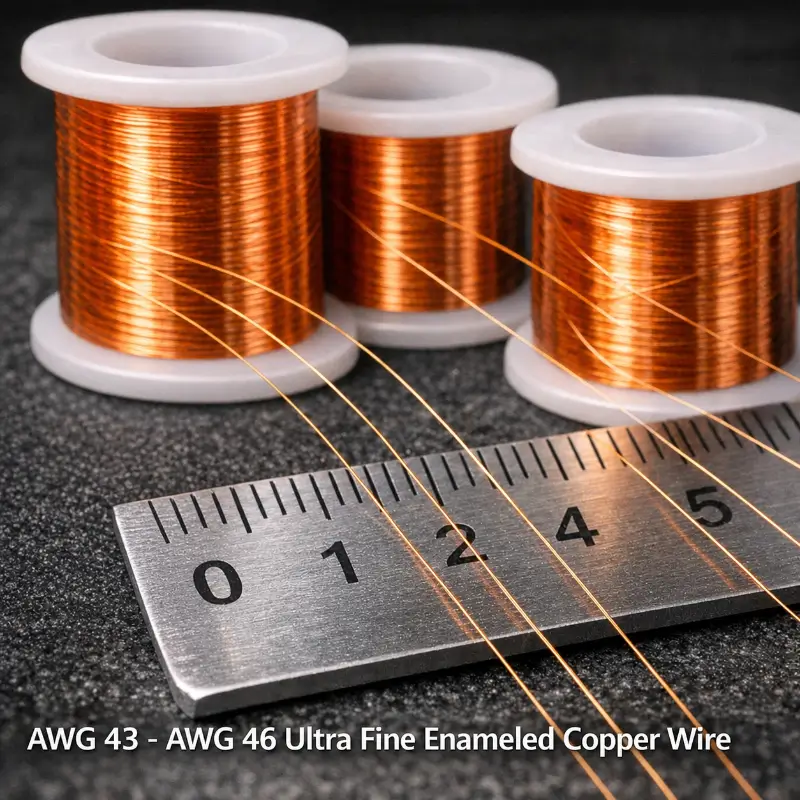
Ultra-fine enameled copper wire (also referred to as micro enameled wire or super-tiny magnet wire) represents the finest-diameter, highest-technical-barrier, and most application-specific specialty category within the enameled wire product portfolio. AWG 43 (diameter: 0.0564 mm), AWG 44 (diameter: 0.0502 mm), AWG 45 (diameter: 0.0447 mm), and AWG 46 (diameter: 0.0398 mm) constitute the ultra-fine end of the AWG wire gauge system, corresponding to conductor diameters in the range of 0.04–0.06 mm and overall outer diameters (after enamel coating) of 0.05–0.08 mm—comparable in thickness to human hair (0.06–0.08 mm).
Owing to its exceptionally small conductor diameter, ultra-low weight, very high resistance, extremely low inductance, excellent flexibility, reliable insulation performance, and stable physical and chemical properties, AWG 43–46 ultra-fine enameled copper wire has become a critical foundational material for applications including miniature motors (mobile phone vibration motors, camera auto-focus motors, watch coils), precision sensors (Hall-effect sensors, inductive displacement sensors, medical sensors), medical electronics (hearing aids, neural stimulators, cardiac pacemaker coils, implantable devices), precision instruments (meter coils, inductors), RFID coils, micro-electromechanical systems (MEMS), high-frequency inductors, miniature relays, premium audio voice coils, and flexible wearable electronics.
This document systematically addresses: an overview of AWG 43–46 ultra-fine wire specifications; physical parameters of AWG 43–46; AWG 43–46 vs. metric (mm) conversion; material systems for ultra-micro-fine enameled wire; enamel types and classifications; enamel thickness application considerations for ultra-fine wire; manufacturing processes for ultra-micro-fine enameled wire; physical performance characteristics (dielectric breakdown, elongation, adhesion, thermal endurance); application domains (miniature motors, sensors, medical devices, coils); winding processes and equipment; quality control and in-line inspection; standards and certifications (NEMA MW 1000, IEC 60317, JIS, GB/T); failure modes; and future trends—providing microelectronics engineers, sensor designers, medical device R&D professionals, and precision coil manufacturers with a comprehensive technical selection and application guide.
AWG 43-46 Ultra-Fine Wire Specification Overview
AWG 43–46 are the finest enameled wire gauges in the American Wire Gauge (AWG) system, primarily used in specialized applications such as microelectronics, medical devices, and precision instrumentation.
AWG Ultra-Fine Wire Range
Definition of AWG Ultra-Fine Wire:
- Diameter range: 0.02–0.10 mm
- Applications: Micro-coils, precision instruments, medical electronics
- Processing difficulty: High (multi-pass drawing, ultra-thin enamel coating)
- Unit cost: 5–50 times higher than standard enamelled wire
AWG Ultra-Fine Wire Gauge Numbers and Corresponding Diameters:
- AWG 40: 0.0799 mm
- AWG 41: 0.0714 mm
- AWG 42: 0.0636 mm
- AWG 43: 0.0564 mm (0.00222 inch)
- AWG 44: 0.0502 mm (0.00198 inch)
- AWG 45: 0.0447 mm (0.00176 inch)
- AWG 46: 0.0398 mm (0.00157 inch)
- AWG 47: 0.0355 mm (theoretical limit)
Position of AWG 43–46 in Wire Gauge Systems:
- AWG 0–30: Standard magnet wire (0.25–8.5 mm)
- AWG 31–40: Fine magnet wire (0.08–0.25 mm)
- AWG 41–44: Ultra-fine magnet wire (0.05–0.08 mm)
- AWG 45–50: Extra-fine magnet wire (0.025–0.05 mm)
- AWG 50+: Theoretical limit (rarely used in practice)
AWG 43–46 Characteristics Comparison:
- AWG 43: Ultra-fine magnet wire limit
- AWG 44: Typical extra-fine wire
- AWG 45: High-difficulty extra-fine wire
- AWG 46: Ultimate ultra-microfine wire
AWG 43–46 vs. Human Perception
Visual Contrast:
- Human hair diameter: 0.06–0.08 mm (fine hair: 0.04–0.06 mm)
- AWG 43: 0.0564 mm (equivalent to fine hair thickness)
- AWG 44: 0.0502 mm (upper limit of fine hair)
- AWG 45: 0.0447 mm (midpoint of fine hair)
- AWG 46: 0.0398 mm (lower limit of fine hair)
- Silk fiber diameter: approx. 0.02–0.05 mm
Weight Comparison:
- 1 km AWG 43 copper conductor: approx. 2.21 g
- 1 km AWG 46 copper conductor: approx. 1.10 g
- One 100 m AWG 46 copper conductor: approx. 0.11 g (extremely lightweight)
Tactile Perception:
- AWG 43: Barely perceptible to finger touch
- AWG 44: Just perceptible to finger touch
- AWG 45: Difficult to perceive by finger touch
- AWG 46: Visible to naked eye upon careful observation
Application Positioning of AWG 43–46
AWG 43–46 falls within the specialty ultra-fine category in the magnet wire product portfolio.
Boundary with Conventional Magnet Wire:
- Standard magnet wire: down to approximately AWG 24 (0.511 mm)
- Fine magnet wire: AWG 24–36 (0.127–0.511 mm)
- Ultra-fine magnet wire: AWG 36–42 (0.064–0.127 mm)
- Extra-fine magnet wire: AWG 43–46 (0.040–0.056 mm)
- Super-fine magnet wire: AWG 47 and finer (<0.040 mm)
Typical Application Scenarios:
- Micro motors (mobile phone vibration, camera autofocus): AWG 36–44
- Hearing aid coils: AWG 41–46
- Cardiac pacemakers: AWG 44–46
- RFID antennas: AWG 38–44
- High-frequency inductors: AWG 38–46
- Micro relays: AWG 40–46
- Micro sensors: AWG 42–46
- Micro coils: AWG 44–46
AWG 43-46 Physical Parameters Detailed
The physical parameters of AWG 43–46 serve as the foundation for product selection and application design.
AWG 43 Physical Parameters
Diameter Parameters:
- Nominal diameter: 0.0564 mm
- Diameter range: 0.0555–0.0573 mm
- Tolerance: ±0.0015 mm (high-grade: ±0.001 mm)
- Diameter in inches: 0.00222 inch
Cross-sectional area parameters:
- Cross-sectional area: 0.00250 mm²
- Diameter in mils: 2.22 mil
- Cross-sectional area in circular mils: 4.93 cmil
Electrical Parameters (Copper Conductor @ 20 °C):
- DC resistance: 13.75 Ω/m (13,750 Ω/km)
- Copper resistivity: 0.01724 Ω·mm²/m
- AC resistance at 50 Hz: approximately 13.78 Ω/m (negligible difference)
Weight Parameters:
- Unit weight: 2.21 g/km
- Length per unit mass: 452 km/kg
- Weight per inch: 0.00127 g/inch
Current-Carrying Capacity (Reference):
- Recommended: <50 mA (fine wire has poor heat dissipation)
- Maximum: 100–150 mA (short-term)
- Recommended current density: ≤10 A/mm² (to prevent overheating)
AWG 44 Physical Parameters
Diameter Parameters:
- Nominal diameter: 0.0502 mm
- Diameter range: 0.0494–0.0510 mm
- Tolerance: ±0.0012 mm (high-grade ±0.0008 mm)
- Diameter in inches: 0.00198 inch
Cross-sectional Area Parameters:
- Cross-sectional area: 0.00198 mm²
- Diameter: 1.98 mil
- Cross-sectional area: 3.92 cmil
Electrical Parameters:
- DC resistance: 17.34 Ω/m (17,339 Ω/km)
Weight Parameters:
- Unit weight: 1.75 g/km
- Length per unit mass: 571 km/kg
Current-Carrying Capacity (Reference):
- Recommended: <40 mA
- Maximum: 80–120 mA (short-term)
AWG 45 Physical Parameters
Diameter Parameters:
- Nominal diameter: 0.0447 mm
- Diameter range: 0.0440–0.0454 mm
- Tolerance: ±0.0010 mm (high-grade ±0.0007 mm)
- Diameter in inches: 0.00176 inch
Cross-sectional area parameters:
- Cross-sectional area: 0.00157 mm²
- Diameter in mils: 1.76 mil
- Cross-sectional area in circular mils: 3.10 cmil
Electrical Parameters:
- DC resistance: 21.88 Ω/m (21876 Ω/km)
Weight Parameters:
- Unit weight: 1.40 g/km
- Length per unit mass: 714 km/kg
Current-Carrying Capacity (Reference):
– Recommended: <30 mA
– Maximum: 60–90 mA (short-term)
AWG 46 Physical Parameters
Diameter Parameters:
- Nominal diameter: 0.0398 mm
- Diameter range: 0.0391–0.0405 mm
- Tolerance: ±0.0008 mm (high-grade: ±0.0006 mm)
- Diameter in inches: 0.00157 inch
Cross-sectional Area Parameters:
- Cross-sectional area: 0.00124 mm²
- Diameter: 1.57 mil
- Cross-sectional area: 2.47 cmil
Electrical Parameters:
- DC resistance: 27.59 Ω/m (27,590 Ω/km)
Weight Parameters:
- Unit weight: 1.10 g/km
- Length per unit mass: 909 km/kg
Current-Carrying Capacity (Reference):
- Recommended: <20 mA
- Maximum: 40–60 mA (short-term)
AWG 43–46 Full Parameter Comparison Table
| Parameter | AWG 43 | AWG 44 | AWG 45 | AWG 46 |
|---|---|---|---|---|
| Diameter (mm) | 0.0564 | 0.0502 | 0.0447 | 0.0398 |
| Diameter (mil) | 2.22 | 1.98 | 1.76 | 1.57 |
| Diameter (inch) | 0.00222 | 0.00198 | 0.00176 | 0.00157 |
| Tolerance (mm) | ±0.0015 | ±0.0012 | ±0.0010 | ±0.0008 |
| Cross-sectional Area (mm²) | 0.00250 | 0.00198 | 0.00157 | 0.00124 |
| Cross-sectional Area (cmil) | 4.93 | 3.92 | 3.10 | 2.47 |
| Resistance (Ω/km) | 13750 | 17339 | 21876 | 27590 |
| Resistance (Ω/m) | 13.75 | 17.34 | 21.88 | 27.59 |
| Weight (g/km) | 2.21 | 1.75 | 1.40 | 1.10 |
| Length (km/kg) | 452 | 571 | 714 | 909 |
| Recommended Current Rating (mA) | <50 | <40 | <30 | <20 |
| Maximum Current Rating (mA) | 100–150 | 80–120 | 60–90 | 40–60 |
| Hair Comparison | Fine hair thickness | Upper limit of fine hair | Mid-range of fine hair | Lower limit of fine hair |
Inductance and Skin Depth for AWG 43–46
Inductance Characteristics (High-Frequency Applications):
- AWG 43: approximately 5–8 nH/m
- AWG 44: approximately 5.5–8.5 nH/m
- AWG 45: approximately 6–9 nH/m
- AWG 46: approximately 6.5–9.5 nH/m
- Note: The inductance of a single enameled wire is very low.
- The inductance of a multi-turn coil depends on the number of turns and the magnetic core.
Skin Depth (10 kHz – 1 MHz):
- Copper at 10 kHz: δ ≈ 0.66 mm (far exceeding AWG 43–46 diameters; no skin effect)
- Copper at 100 kHz: δ ≈ 0.21 mm (still far exceeding)
- Copper at 1 MHz: δ ≈ 0.066 mm (beginning to affect)
- Copper at 10 MHz: δ ≈ 0.021 mm (pronounced skin effect)
- Copper at 100 MHz: δ ≈ 0.0066 mm (severe skin effect)
- AWG 43–46 exhibits virtually no skin effect below 100 kHz
AWG 43-46 vs Metric mm Conversion
Exact conversion between AWG 43–46 and the metric mm system.
AWG to Metric mm Conversion Formula
AWG to mm conversion formula:
- d (mm) = 0.127 × 92^((36−n)/39)
- AWG 43: d = 0.127 × 92^(−7/39) = 0.0564 mm
- AWG 44: d = 0.127 × 92^(−8/39) = 0.0502 mm
- AWG 45: d = 0.127 × 92^(−9/39) = 0.0447 mm
- AWG 46: d = 0.127 × 92^(−10/39) = 0.0398 mm
Metric mm to AWG Conversion Formula:
- n (AWG) = 36 – 39 × log₁₀(d_mm / 0.127) / log₁₀(92)
- 0.04 mm → AWG ≈ 45.85
- 0.05 mm → AWG ≈ 43.94
- 0.06 mm → AWG ≈ 42.27
AWG 43–46 and Corresponding Metric Specifications
Primary Metric Equivalent Specifications:
- 0.040 mm ≈ AWG 46.13
- 0.045 mm ≈ AWG 44.97
- 0.050 mm ≈ AWG 43.94
- 0.056 mm ≈ AWG 43.04 (Standard AWG 43)
- 0.060 mm ≈ AWG 42.27
- 0.063 mm ≈ AWG 41.85
IEC 60317 Standard Correspondence (Partial):
- IEC 60317-7: Fine enameled round copper wire (selected specifications)
- Selected specifications correspond to 0.04–0.060 mm
Minimum additional film thickness (mm) for AWG 43–46
| AWG | Grade 0 | Grade 1 | Grade 2 | Grade 3 |
|---|---|---|---|---|
| 43 | 0.004 | 0.007 | 0.011 | 0.015 |
| 44 | 0.0035 | 0.0065 | 0.010 | 0.014 |
| 45 | 0.003 | 0.006 | 0.009 | 0.013 |
| 46 | 0.003 | 0.0055 | 0.0085 | 0.012 |
AWG 43–46 Overall Diameter (mm):
| AWG | Bare Conductor | Grade 0 | Grade 1 | Grade 2 | Grade 3 |
|---|---|---|---|---|---|
| 43 | 0.0564 | 0.064 | 0.070 | 0.078 | 0.086 |
| 44 | 0.0502 | 0.057 | 0.063 | 0.070 | 0.078 |
| 45 | 0.0447 | 0.051 | 0.057 | 0.063 | 0.071 |
| 46 | 0.0398 | 0.046 | 0.051 | 0.057 | 0.064 |
Outer Diameter Tolerance:
- AWG 43: ±0.002–0.005 mm
- AWG 44: ±0.002–0.004 mm
- AWG 45: ±0.0015–0.004 mm
- AWG 46: ±0.0015–0.003 mm
Ultra-Fine Enameled Wire Material System
The material system of ultra-fine magnet wire comprises conductor materials and insulation enamel materials.
Conductor Materials
Copper Conductor (Standard):
- Purity: ≥99.90% (high-grade: 99.95%)
- Conductivity: ≥100% IACS (high-grade: 101–102%)
- Tensile strength: 220–280 MPa
- Elongation: ≥15% (annealed condition)
- Oxygen content: ≤30 ppm (oxygen-free copper)
Copper Alloy Conductors (Special Applications):
- Copper–silver alloy (Cu–Ag): high strength
- Copper–tin alloy (Cu–Sn): high elasticity
- Copper–nickel alloy (Cu–Ni): corrosion resistance
- Copper–magnesium alloy (Cu–Mg): high-temperature resistance
Aluminum conductors (rarely used):
- Rarely used for AWG 43–46
- Primary application: AWG 30–40 aluminum magnet wire
- Reason: Poor mechanical properties of ultra-fine aluminum wire
Insulation Materials
Basic Requirements for Enamel Coating:
- Coating thickness: 5–15 μm
- Uniformity: High
- Adhesion: Strong
- Dielectric breakdown voltage: ≥100 V (enamel grade)
- Flexibility: No cracking upon bending
- Thermal resistance: Complies with thermal class
Insulation Type
Polyurethane (UEW):
- Thermal class: Class E–B (105–130 °C)
- Characteristics: Solderable (direct soldering at 380 °C)
- Dielectric breakdown voltage: ≥150 V (minimum)
- Color: Transparent to light amber
- Application: Primary enamel for AWG 43–46
- Standards: IEC 60317-20, NEMA MW 79-C
Polyester (PEW):
- Thermal class: Class B (130 °C)
- Characteristics: Good heat resistance; not solderable
- Breakdown voltage: ≥ 200 V
- Color: Transparent to amber
- Application: Conventional ultra-fine enameled wire
- Standards: IEC 60317-3, NEMA MW 26-C
Polyesterimide (EIW):
- Thermal class: Class F (155 °C)
- Characteristics: Excellent heat resistance
- Breakdown voltage: ≥ 250 V
- Color: Dark amber
- Application: High-temperature ultra-fine enameled wire
- Standards: IEC 60317-8, NEMA MW 30-C
Polyamide-imide (AIW):
- Thermal class: Class C (220 °C)
- Characteristics: Extremely heat-resistant and chemical-resistant
- Dielectric breakdown voltage: ≥ 300 V
- Color: Dark brown
- Application: High-end ultra-fine enameled wire
- Standards: IEC 60317-26, NEMA MW 81-C
Polyimide (PI):
- Thermal class: 240 °C
- Characteristics: Highest heat resistance
- Dielectric breakdown voltage: ≥ 350 V
- Color: Dark amber
- Applications: Aerospace, high-end medical
- Standards: IEC 60317-46, NEMA MW 102-C
Polyvinyl Formal (PVF):
- Thermal class: Class A (105 °C)
- Characteristics: Conventional enamel coating
- Dielectric breakdown voltage: ≥ 150 V
- Color: Yellow
- Application: Conventional ultra-fine magnet wire
- Standards: IEC 60317-1, NEMA MW 15-C
Special Coating Characteristics of the Enamel Film (Ultra-Fine Wire)
Enamel Application Method:
- Die coating: mainstream
- Felt coating: traditional
- Mold coating: high-precision
- Electrostatic coating: partial application
Challenges in the Enameling Process:
- Varnish viscosity: extremely low (0.05–0.20 Pa·s)
- Number of coating passes: 5–15 (each layer extremely thin)
- Baking temperature: low-temperature, multiple-stage (250–300 °C)
- Baking time: 5–15 seconds per layer
- In-line tension: extremely low (<5 g)
Insulation Film Surface Requirements:
– Smooth and flawless
– Free of bubbles
– Free of impurities
– Free of mechanical damage
– Intact insulation coating, free of pinholes
Film Thickness and Grade
The film thickness grades of ultra-fine enameled wire are more finely subdivided than those of conventional enameled wire.
Enamel Grade Definition
Grade 0 (Ultra-Thin Film):
- Increased thickness: 3–7 μm
- Breakdown voltage: ≥80 V
- Applications: High-frequency inductors, precision micro-motors
- Advantages: Minimum outer diameter, high slot fill factor
- Limitations: Low voltage resistance, susceptible to damage
Grade 1 (Thin Film):
- Increased thickness: 5.5–9 μm
- Breakdown voltage: ≥120 V
- Application: Conventional ultra-fine magnet wire
- Advantages: Excellent insulation, moderate outer diameter
- Standards: Mainstream for ultra-fine wire
Grade 2 (Medium Coating)
- Thickness increase: 8.5–13 μm
- Breakdown voltage: ≥180 V
- Application: General-purpose ultra-fine enameled wire
- Advantages: Excellent insulation performance, high reliability
- Standards: High-end applications
Grade 3 (Heavy Coating):
- Increased thickness: 12–18 μm
- Breakdown voltage: ≥250 V
- Application: High-voltage ultra-fine wire
- Advantage: High dielectric strength
- Limitation: Larger overall diameter
Selection of Enamel Coating for Ultra-Fine Magnet Wire
Application and Insulation Class Correlation:
- High-frequency inductors: Grade 0 (minimum outer diameter)
- Micro motors: Grade 1 (mainstream)
- Hearing aids: Grade 1
- Medical implants: Grade 2 (reliable)
- Micro relays: Grade 1–2
- Precision sensors: Grade 1
- RFID: Grade 1–2
- Instrument coils: Grade 1–2
- Voice coils: Grade 2
Impact of Insulation Thickness on Performance
Breakdown Voltage vs. Film Thickness:
- Dielectric breakdown voltage (V) = Insulation film thickness (μm) × Dielectric strength (V/μm)
- Dielectric strength: approx. 25–40 V/μm (depending on insulation type)
- Grade 1 (5.5–9 μm): 150–350 V
- Grade 2 (8.5–13 μm): 250–500 V
- Grade 3 (12–18 μm): 400–700 V
Outer Diameter Impact:
– The thicker the insulation film, the larger the overall diameter.
– Overall diameter affects slot fill factor.
– Grade 0 is 0.020–0.030 mm smaller than Grade 3.
Ultra-Fine Enameled Wire Manufacturing Process
The manufacturing process for ultra-fine enameled wire is the most technologically intensive among enameled wire production processes.
Manufacturing Process Overview
Raw copper rod → Bulk drawing → Intermediate drawing → Fine drawing → Micro-drawing → Ultra-micro-drawing → Annealing → Enameling → Multiple enameling and baking cycles → In-line inspection → Spooling → Packaging and warehousing
Step 1: Raw Material—Copper Rod
- Raw material: Φ8 mm electrolytic copper rod
- Copper content: ≥99.90%
- Oxygen content: ≤30 ppm
- Surface quality: smooth, defect-free
Step 2: Drawing (Multi-Pass)
Large-diameter drawing (8 mm → 1.0 mm):
- Multi-pass drawing (10–15 passes)
- Intermediate annealing: 500–600 °C
- Final dimension: 1.0 mm
Intermediate drawing (1.0 mm → 0.25 mm):
- Multi-pass drawing (15–20 passes)
- Intermediate annealing: 450–550 °C
- Drawing speed: 5–30 m/s
- Lubricant: soap-based + oil
Fine drawing (0.25 mm → 0.10 mm):
- Multi-pass drawing (20–25 passes)
- Dies: tungsten carbide (WC)
- Die bore tolerance: ±0.5 μm
- Drawing speed: 3–15 m/s
- Lubricant: low-residue soap-based
Fine-drawing (0.10 mm → 0.06 mm):
- Multi-pass drawing (15–20 passes)
- Dies: natural diamond (single-crystal diamond)
- Die bore tolerance: ±0.3 μm
- Drawing speed: 1–10 m/s
- Lubricant: special low-residue
Ultra-drawing (0.06 mm → 0.04 mm):
- Multi-pass drawing (10–15 passes)
- Dies: natural diamond (highest grade)
- Die bore tolerance: ±0.2 μm
- Drawing speed: 0.5–5 m/s
- Lubricant: nano-scale, low-residue
Step 3: Annealing
Continuous Annealing:
- Annealing temperature: 400–500 °C
- Annealing time: continuous in-line
- Annealing atmosphere: nitrogen protection
- Tensile strength: 220–260 MPa (after annealing)
- Elongation: ≥15% (after annealing)
Step 4: Enameling (Core)
Painting Challenges:
- Extremely fine wire diameter (0.04–0.06 mm)
- Extremely thin enamel coating (5–15 μm)
- Extremely low varnish viscosity
- High precision required for enameling
- Prone to breakage (high breakage rate)
Lacquering Equipment:
- Precision enameling machines: primarily imported
- Die coating: accuracy ±0.5 μm
- Groove coating: accuracy ±1 μm
- Felt coating: accuracy ±2 μm
Lacquering Process Parameters:
- Varnish viscosity: 0.05–0.20 Pa·s (extremely low)
- Varnish solids content: 5–15%
- Enameling speed: 5–50 m/min
- Number of enameling passes: 5–15 (layer-by-layer buildup)
Step 5: Baking and Curing
Baking Oven:
- Multi-zone temperature control (5–15 zones)
- Temperature range: 150–400 °C
- Baking time per zone: 1–5 seconds
- Total baking time: 20–60 seconds
Baking Profile:
- Preheating zone: 80–150 °C (solvent removal)
- Main curing zone: 250–350 °C (enamel film curing)
- Final curing zone: 350–400 °C (complete curing)
- Stepwise temperature ramping: prevents rapid volatilization
Baking atmosphere:
- Natural air (standard)
- Catalytic combustion hot air (energy-saving)
- Partial recirculation (space-saving)
Step 6: Online Precision Inspection
Laser Diameter Measurement:
– Accuracy: ±0.1 μm
– Sampling frequency: one data point per 1 mm
– 100% online measurement
– Feedback-controlled enamel thickness
Pinhole Detection:
- High-voltage electrode (10–100 V)
- Detection of pinhole defects
- Online alarm
Dielectric breakdown voltage sampling inspection:
- Online dielectric breakdown voltage test
- Spot inspection after winding
- Sampling ratio: 1–5%
Film Integrity:
- Surface defect inspection
- CCD visual inspection
- Defect rate statistics
Step 7: Precision Winding
Tension Control:
- Tension: 5–50 g (ultra-low tension)
- Closed-loop control
- Prevents elongation deformation
Reel Specifications:
- Reel diameter: Φ100–200 mm
- Winding length: 1000–10000 m
- Protection against crushing
Take-up speed:
- AWG 43: 20–50 m/min
- AWG 44: 20–50 m/min
- AWG 45: 15–40 m/min
- AWG 46: 10–30 m/min
Step 8: Packaging and Warehousing
Packaging Method:
– Vacuum packaging (moisture-proof and oxidation-resistant)
– Nitrogen filling (partial)
– Shock-absorbing cushioning
– Complete labeling
Storage Environment:
- Temperature: 15–25 °C
- Humidity: 30–60 % RH
- Protect from direct sunlight
- Protect from chemical contamination
Physical Performance Requirements
AWG 43–46 ultra-fine magnet wire has stringent physical property requirements.
Electrical Properties
Dielectric Withstand Voltage (Coating Class):
- Grade 0: ≥80 V
- Grade 1: ≥120 V
- Grade 2: ≥180 V
- Grade 3: ≥250 V
Conductor DC Resistance:
– Strictly compliant with AWG standards
– Tolerance at 20 °C: ±2–5 %
– Temperature coefficient: 0.00393 /°C (copper)
Insulation Resistance:
- 500 V DC test
- ≥100 MΩ·m (standard grade)
- ≥1000 MΩ·m (high-grade)
Dielectric Loss:
- tan δ < 0.01 (standard)
- Tested at 1 kHz
- At ambient temperature
Mechanical Properties
Tensile Strength:
- After annealing: 220–280 MPa
- Half-hard temper: 280–350 MPa
- Test method: Universal testing machine
- Tensile speed: 5 mm/min
Elongation:
– After annealing: ≥15%
– Ultimate elongation: ≥30%
– Test method: Gauge length 100–250 mm
Flexibility:
– Bend test: winding around a round rod with diameter 1–3 mm
– No cracking
– No enamel flaking
Springback:
- Winding spring-back test
- Spring-back angle: <5–10°
- Test condition: Standard tension
Film Adhesion:
- Tensile test: enamel coating remains uncracked
- Rapid elongation test: passed
- Abrasion test: >50 cycles
Chemical Properties
Solvent Resistance:
– Resistant to ethanol and acetone
– Non-dissolving and non-flaking
– Test method: Visual inspection after immersion
Solderability
- Tinning immersion at 380 °C for 2–5 seconds
- Solderable enamel coating (UEW) shall be directly solderable
- Non-solderable enamel coatings are not applicable
Chemical Resistance:
- Acid resistance (weak acid)
- Alkali resistance (weak alkali)
- Oil resistance (mineral oil)
- Refrigerant resistance
Aging Performance
Thermal Aging:
- 130°C aging: ≥5000 hours
- 155°C aging: ≥5000 hours
- 180°C aging: ≥5000 hours
- 220°C aging: ≥5000 hours
- Test method: High-temperature oven + dielectric breakdown voltage test
Thermal Shock:
- 130 °C → room temperature cycling: no cracking
- −40 °C → room temperature cycling: no cracking
- Thermal shock after bending: passed
Damp Heat Aging:
- 95% RH, 40°C: ≥500 hours
- Breakdown voltage retention rate: ≥80%
- Test method: Constant temperature and humidity chamber
Application Fields
AWG 43–46 ultra-fine magnet wire is applied across multiple high-end sectors.
Micro Motors
Mobile Phone Vibration Motors:
- Type: Eccentric rotor motor
- Diameter: Φ6–10 mm
- Wire gauge: AWG 40–44
- Winding method: Flyer winding
- Number of slots: 3 slots (minority: 6 slots)
- Turns per coil: 100–500 turns
- Enamel coating: UEW Grade 1–2
Voice Coil Motor (VCM) for Camera Auto-Focus
- Type: Voice Coil Motor (VCM)
- Diameter: Φ8–12 mm
- Wire Gauge: AWG 38–44
- Winding: Precision air-core coil
- Slot Configuration: Slotless (air-core coil)
- Number of Turns: 50–200 turns
- Enamel Coating: UEW Grade 1–2
Camera zoom motor:
- Type: Stepper motor
- Diameter: Φ6–10 mm
- Wire gauge: AWG 40–44
- Winding type: Flyer winding
- Number of turns: 100–300
Watch motors:
- Type: Stepping motor or LR motor
- Diameter: Φ4–8 mm
- Wire gauge: AWG 42–46
- Winding method: Fly-type winding
- Number of turns: 50–200 turns
- Enamel coating: UEW Grade 1
Miniature Fan Motors:
- Type: BLDC motor
- Diameter: Φ10–20 mm
- Wire gauge: AWG 38–44
- Winding: Three-phase distributed
- Turns: 50–200 turns
Precision Sensors
Hall sensor
- Type: Linear Hall, Switch Hall
- Coil: Excitation coil or magnetic field sensing coil
- Wire gauge: AWG 42–46
- Number of turns: 100–1000 turns
- Enamel coating: UEW Grade 1–2
Inductive Displacement Sensor
- Type: LVDT, RVIT
- Coil: Primary, secondary
- Wire gauge: AWG 40–44
- Number of turns: 100–1000
Inductive Pressure Sensor
- Type: MEMS + Inductor
- Coil: Sensing coil
- Wire gauge: AWG 42–46
Miniature Accelerometer:
- Type: MEMS
- Detection coil
- Wire gauge: AWG 44–46
Miniature Gyroscopes:
- Type: MEMS gyroscope
- Excitation coil, sensing coil
- Wire gauge: AWG 44–46
Medical Electronics
Hearing aids:
- Type: T-coils, induction coils
- Wire gauge: AWG 41–46
- Turns: 500–2000 turns
- Enamel coating: UEW Grade 1–2
- Dimensions: Φ3–8 mm
- Requirements: Biocompatible, high reliability
Pacemakers:
- Type: Bipolar / Unipolar
- Internal coil
- Wire gauge: AWG 44–46
- Enamel coating: PI Grade 1–2 (biocompatible)
- Requirement: Ultra-long service life (10–15 years)
Neurostimulators:
- Type: Deep Brain Stimulation (DBS), Spinal Cord Stimulation (SCS)
- Internal coil
- Wire gauge: AWG 43–46
- Enamel coating: Polyimide (PI), Grade 1–2
Implantable Medical Devices:
- Implantable cardioverter defibrillators (ICDs)
- Cochlear implants (CIs)
- Drug delivery pumps
- Wire gauge: AWG 43–46
- Enamel coating: Polyimide (PI) (biocompatible)
In Vitro Diagnostic (IVD) Equipment:
- PCR instrument
- Hematology analyzer
- Micro-coil
- Wire gauge: AWG 42–46
RFID and Wireless Charging
RFID Coils:
- Type: Inductive coupling
- Wire gauge: AWG 38–44
- Turns: 5–30 turns (antenna)
- Enamel coating: UEW Grade 1–2
NFC Coil:
- Type: 13.56 MHz
- Wire gauge: AWG 40–44
- Number of turns: 3–8
Wireless Charging Receiver Coil
- Type: Qi Standard
- Wire Gauge: AWG 36–44
- Turns: 10–30 turns
Miniature Relays
Signal Relays:
- Type: Reed relay
- Operating coil
- Wire gauge: AWG 42–46
- Number of turns: 500–5,000 turns
- Enamel coating: UEW Grade 1–2
Miniature Electromagnetic Relay:
- Type: Miniature sealed relay
- Coil
- Wire gauge: AWG 40–44
- Number of turns: 200–2,000
High-Frequency Inductors
High-Frequency Power Inductors:
- Type: Air-core coil, core-type coil
- Wire gauge: AWG 38–46
- Number of turns: 5–50 turns
- Enamel coating: UEW Grade 0–1
Chip Inductors:
- Type: Miniature chip inductor
- Wire gauge: AWG 42–46
- Enamel coating: UEW Grade 0–1
Microelectromechanical Systems (MEMS)
MEMS Coils:
- Type: Electromagnetic MEMS
- Wire gauge: AWG 43–46
- Turns: 5–100 turns
- Insulation coating: PI Grade 1
MEMS Sensors:
- Miniature accelerometers
- Miniature gyroscopes
- Miniature pressure sensors
- Wire gauge: AWG 44–46
High-End Audio Voice Coils
Headphone voice coils:
- Type: Moving-coil headphones
- Wire gauge: AWG 36–44
- Enamel coating: UEW/PEW Grade 1–2
Miniature speaker voice coils:
- Type: Mobile phone and laptop speakers
- Wire gauge: AWG 38–46
- Enamel coating: UEW Grade 1
Winding Process and Equipment
Winding of ultra-fine enameled wire requires specialized equipment and advanced processing techniques.
Winding Equipment
Automatic Winding Machines:
- Type: Fly winder
- Rotational speed: 5000–20000 rpm
- Tension control: 0.5–10 g
- Positioning accuracy: ±0.005 mm
Precision Automatic Winding Machines:
- Type: Multi-axis CNC winding machine
- Speed: 1000–10000 rpm
- Tension control: Closed-loop servo
- Automatic loading and unloading
Hollow Coil Winding Machine
- Type: Bobbinless winding
- Tension control: High-precision
- Automatic take-up
- Automatic demolding
Key Points for Winding Process
Tension Control:
- AWG 43: 3–8 g
- AWG 44: 2–6 g
- AWG 45: 1.5–4 g
- AWG 46: 1–3 g
- Tension fluctuation: <5%
Winding speed:
- AWG 43: 3000–8000 rpm
- AWG 44: 3000–8000 rpm
- AWG 45: 2500–6000 rpm
- AWG 46: 2000–5000 rpm
Tensioner:
- Hysteresis tensioner: standard
- Servo tensioner: high precision
- Mechanical tensioner: low cost
- Dancer tensioner: high stability
Winding Sequence:
- Bottom-layer priority (winding uniformity)
- Symmetrical top and bottom layers
- Center-tap position
- Automatic layer separation
Common Winding Issues
Issue 1: Wire Breakage
- Cause: Excessive wire diameter reduction, excessive tension, enamel coating damage
- Prevention: Low-tension winding, clean environment
- Remediation: Locate break point, rewind
Issue 2: Insulation Film Damage
- Cause: Excessive bending, tension fluctuations
- Prevention: Low tension, slow start-up
- Detection: Online dielectric voltage test
Question 3: Turn-to-turn short circuit
- Cause: Insulation film damage, excessive winding density
- Prevention: Tension control, slot fill factor control
- Detection: Turn-to-turn insulation test
Question 4: Winding Deformation
- Cause: Curing stress, thermal expansion
- Prevention: Low-temperature curing, slow cooling
- Detection: Visual inspection, dimensional measurement
Question 5: Starting-end damage
- Cause: High initial tension, initial angle
- Prevention: Low initial tension
- Detection: Initial head test
Quality Control and Online Inspection
Quality control of AWG 43–46 is central to the product.
Raw Material Quality Control
Copper Rod Quality:
- Chemical composition: Cu ≥ 99.90%
- Oxygen content: ≤ 30 ppm
- Resistivity: ≤ 0.01724 Ω·mm²/m
- Surface quality: Defect-free
Varnish Quality:
- Viscosity: Standard value ±5%
- Solid content: Standard value ±2%
- Color: Standard color chart
- Storage stability: ≥6 months
Process Quality Control
Online Conductor Diameter Control:
- Online laser diameter measurement
- Accuracy: ±0.1 μm
- 100% online
- Feedback-controlled drawing
Online Control of Film Thickness:
- Online laser measurement of outer diameter
- Calculation of insulation coating thickness
- Feedback control of coating application volume
- Insulation coating uniformity: ±10%
Pinhole Detection:
- High-voltage electrode testing
- 100% in-line inspection
- Alarm mechanism
- Automatic defect removal
Finished Product Quality Control
Dielectric Withstand Voltage Test:
- In-process sampling inspection
- Post-winding sampling inspection
- Sampling ratio: 1–5%
- Standard method: IEC 60851
Diameter Test:
- Off-line precision diameter measurement
- Sample testing: beginning and end of each coil
- Conformance determination
Film Adhesion:
- Tensile test
- Abrupt pull test
- Abrasion test
Mechanical Properties:
– Tensile strength: universal testing machine
– Elongation: gauge length method
– Flexibility: bend test
Chemical Properties:
- Solderability: 380 °C dip test
- Solvent resistance: immersion test
- Chemical resistance: acid–alkali test
Quality Classification
Class A (Premium):
- Diameter tolerance: ±0.5–0.8 μm
- Dielectric breakdown voltage: 20% higher than standard
- Enamel uniformity: high
- Price: premium
Class B (Standard):
- Diameter tolerance: ±1–1.5 μm
- Dielectric breakdown voltage: Complies with standards
- Enamel uniformity: Complies with standards
- Price: Standard
Class C (Economy):
- Diameter tolerance: ±1.5–2 μm
- Breakdown voltage: Standard lower limit
- Enamel uniformity: Basic
- Price: Economical
Standards and Certifications
AWG 43–46 ultra-fine magnet wire complies with stringent international and national standards.
U.S. Standard (NEMA MW 1000)
MW 79-C:
- Insulation: Polyurethane (UEW)
- Thermal Class: 130 °C (Class B)
- Conductor: Round Copper Wire
- Diameter Range: 0.020–0.100 mm (including AWG 43–46)
- Insulation Grade: Grade 0–3
MW 26-C:
- Insulation: Polyester (PEW)
- Thermal Class: 130°C
- Diameter Range: 0.020–0.100 mm
- Insulation Grade: Grade 0–3
MW 30-C
- Insulation: Polyester-imide (EIW)
- Thermal Class: 155 °C
- Diameter Range: 0.020–0.100 mm
- Insulation Grade: Grade 1–3
MW 81-C:
- Insulation: Polyamide-imide (AIW)
- Thermal Class: 220 °C
- Diameter Range: 0.020–0.100 mm
- Insulation Grade: Grade 1–3
MW 102-C:
- Insulation: Polyimide (PI)
- Temperature Class: 240 °C
- Diameter Range: 0.020–0.100 mm
- Insulation Grade: Grade 1–3
IEC Standards
IEC 60317-1: Polyvinyl acetal enameled round copper wire (Class A)
IEC 60317-3: Polyester Enamelled Round Copper Wire (Class B)
IEC 60317-7: Polyurethane Enamelled Round Copper Wire (130 °C)
IEC 60317-8: Polyester-imide enameled round copper wire (Class F)
IEC 60317-20: Polyurethane Enamelled Round Copper Wire (Solderable, 130 °C)
IEC 60317-26: Polyamide-imide enameled round copper wire (Class C)
IEC 60317-46: Polyimide Enamelled Round Copper Wire (240 °C)
IEC 60317-0-1: General Requirements for Enamelled Round Copper Wire
Japanese Standards
JIS C 3202:
- Enameled round copper wire
- Diameter range: 0.020–0.500 mm
- Multiple enamel coatings
JIS C 3216:
– Ultra-fine enameled round copper wire (0.020–0.100 mm)
Chinese Standards
GB/T 6109.1: Polyvinyl acetal enameled round copper wire
GB/T 6109.2: Polyester Enamelled Round Copper Wire
GB/T 6109.4: Polyurethane Enamelled Round Copper Wire
GB/T 6109.5: Polyester-imide Enamelled Round Copper Wire
GB/T 6109.6: Polyamide-imide Enamelled Round Copper Wire
GB/T 6109.7: Polyimide Enamelled Round Copper Wire
GB/T 6109.10–2008:
– Ultra-fine enameled round copper wire (0.020–0.100 mm)
Industry Certifications
UL Certification:
- UL 1446: Electrical Insulation Systems for Motors
- UL 758: Appliance Wiring Material
- UL Certification: Widely adopted by magnet wire manufacturers
RoHS:
- Restriction of Hazardous Substances
- The enamel coating shall comply with RoHS.
REACH:
- Chemical Restrictions
- The varnish shall comply with REACH.
Biocompatibility (Medical Implant):
- ISO 10993
- USP Class VI
- Enamel coating shall be tested
Failure Modes and Future Trends
Common Failure Modes
Failure 1: Insulation Film Damage:
- Cause: Excessive bending, excessive tension
- Effect: Reduced dielectric breakdown voltage, turn-to-turn short circuit
- Detection: Dielectric breakdown voltage test, turn-to-turn insulation test
- Prevention: Low-tension winding, appropriate bending radius
Failure 2: Conductor Breakage:
- Cause: Scratching, excessive bending, excessive tension
- Phenomenon: Open circuit, infinite resistance
- Detection: Continuity test
- Prevention: Apply appropriate tension; avoid repeated bending
Failure 3: Turn-to-turn short circuit:
- Cause: Insulation film damage, excessive winding density
- Phenomenon: Abnormal current, overheating
- Detection: Turn-to-turn insulation test, impedance test
- Prevention: Low-tension winding, uniform winding
Failure 4: Solderability Failure:
- Cause: Insufficient temperature resistance of the enamel coating
- Phenomenon: Enamel coating damage during soldering
- Test: Solderability test
- Prevention: Use solderable enamel coating (UEW)
Failure 5: Thermal Aging Failure
- Cause: Prolonged high temperature
- Phenomenon: Enamel coating pulverization and dielectric breakdown
- Detection: Aging test
- Prevention: Proper selection of enamel coating thermal class
Failure 6: Chemical Corrosion:
- Cause: Contact with chemical media
- Phenomenon: Insulation coating dissolution
- Detection: Visual inspection, dielectric breakdown voltage
- Prevention: Select insulation coatings resistant to chemicals
Failure 7: Moisture Absorption Failure:
- Cause: Prolonged humidity exposure
- Phenomenon: Decrease in dielectric breakdown voltage
- Test: Damp heat aging
- Prevention: Vacuum packaging, moisture-proof storage
Failure 8: Starting-end Damage:
- Cause: Initial tension, initial winding angle
- Phenomenon: Wire breakage or enamel damage at the start of winding
- Detection: Start-of-wind test
- Prevention: Low initial tension, slow start
Quality Control Recommendations
Raw Material Control:
– Use of high-purity oxygen-free copper
– Varnish solution stability
– Die precision
Process Control:
- Online laser diameter measurement
- Online pinhole detection
- Online dielectric breakdown voltage
Environmental Control:
- Cleanroom (Class 10,000)
- Temperature and humidity control (22 ± 3 °C, 50 ± 10 % RH)
- Electrostatic discharge (ESD) protection
Packaging Control:
- Vacuum packaging
- Nitrogen filling
- Moisture-proof desiccant
Future Development Trends
Trend 1: Finer Ultra-Fine Wires
- AWG 47–50 (< 0.035 mm)
- Applied in MEMS and micro/nano devices
- Extremely high manufacturing difficulty
Trend 2: High-Performance Enamel Coatings
- 240 °C+ polyimide (PI) enamel coating widely adopted
- Solderable + high-temperature-resistant combination
- Nanocomposite enamel coating
- Self-healing enamel coating
Trend 3: Ultra-High-Frequency Applications:
- 5G communication inductors
- Microwave devices operating above 100 GHz
- Microstrip line applications
Trend 4: Growth in Medical Applications:
- Implantable devices (pacemakers, neural stimulators)
- Wearable medical devices
- Microfluidic chips
- Biosensors
Trend 5: Internet of Things (IoT) and Wearables
- Smart watches
- Health-monitoring wristbands
- Miniature sensors
- Low-power Bluetooth
Trend 6: Automated Manufacturing:
- Fully automatic ultra-fine enameled wire production line
- AI-powered online defect detection
- Digital quality management
- Smart factory
Trend 7: Environmentally Friendly Materials:
- Water-based varnish
- Solvent-free varnish
- Low-VOC emissions
- Bio-based enamel coating
Trend 8: Composite Enamel Coatings
- Multi-layer composite enamel coating
- Nano-reinforced
- Gradient dielectric
- High PDIV enamel coating
Conclusion
AWG 43–46 ultra-fine enameled copper wire—the most precise specialty category within enameled wire products—has become a critical foundational material for high-tech applications such as miniature motors, precision sensors, medical electronics, RFID, high-frequency inductors, MEMS, and premium audio systems, owing to its extremely small conductor diameter (0.04–0.06 mm), ultra-light weight (1.10–2.21 g/km), very high resistance (13.75–27.59 Ω/m), solderable enamel coating (UEW), high flexibility, and stringent dimensional tolerances.
Key Application Points for AWG 43–46 Ultra-Fine Magnet Wire
- Understanding AWG 43–46 ultra-fine wire positioning: precision specialty enameled wire with diameter 0.04–0.06 mm
- Mastering AWG 43–46 physical parameters: diameter, cross-sectional area, resistance, weight, and current-carrying capacity
- Familiarizing with AWG-to-metric (mm) conversion: formula 1.122932^(36−n)
- Selecting appropriate insulation film type: UEW (solderable), PEW, PEI, AIW, PI
- Determining insulation film grade: Grade 0–3 selected per application requirements
- Addressing manufacturing process challenges: diamond dies, ultra-thin coating, low-temperature baking
- Emphasizing winding process: low-tension winding, high-precision winding, dedicated winding equipment
- Implementing stringent quality control: in-line laser diameter measurement, pinhole detection, dielectric breakdown voltage testing
- Complying with standard certifications: NEMA MW 1000, IEC 60317, JIS, GB/T
- Monitoring future trends: finer wires, high-performance insulation films, medical applications
Micro-motor engineers, sensor designers, medical device R&D personnel, and precision coil manufacturers should systematically develop application capabilities for AWG 43–46 ultra-fine magnet wire through structured learning (AWG standard system, enamel materials, manufacturing processes), equipment investment (precision winding machines, testing equipment), supplier collaboration (enamel resin suppliers, magnet wire manufacturers), quality control (incoming material inspection, in-process control, finished product testing, performance validation), and technology tracking (new enamel systems, emerging applications, industry standards) to supply this core foundational material to high-tech sectors including micro-motors, medical electronics, precision sensors, and wearable devices.